Blog Details
Home Blog Details

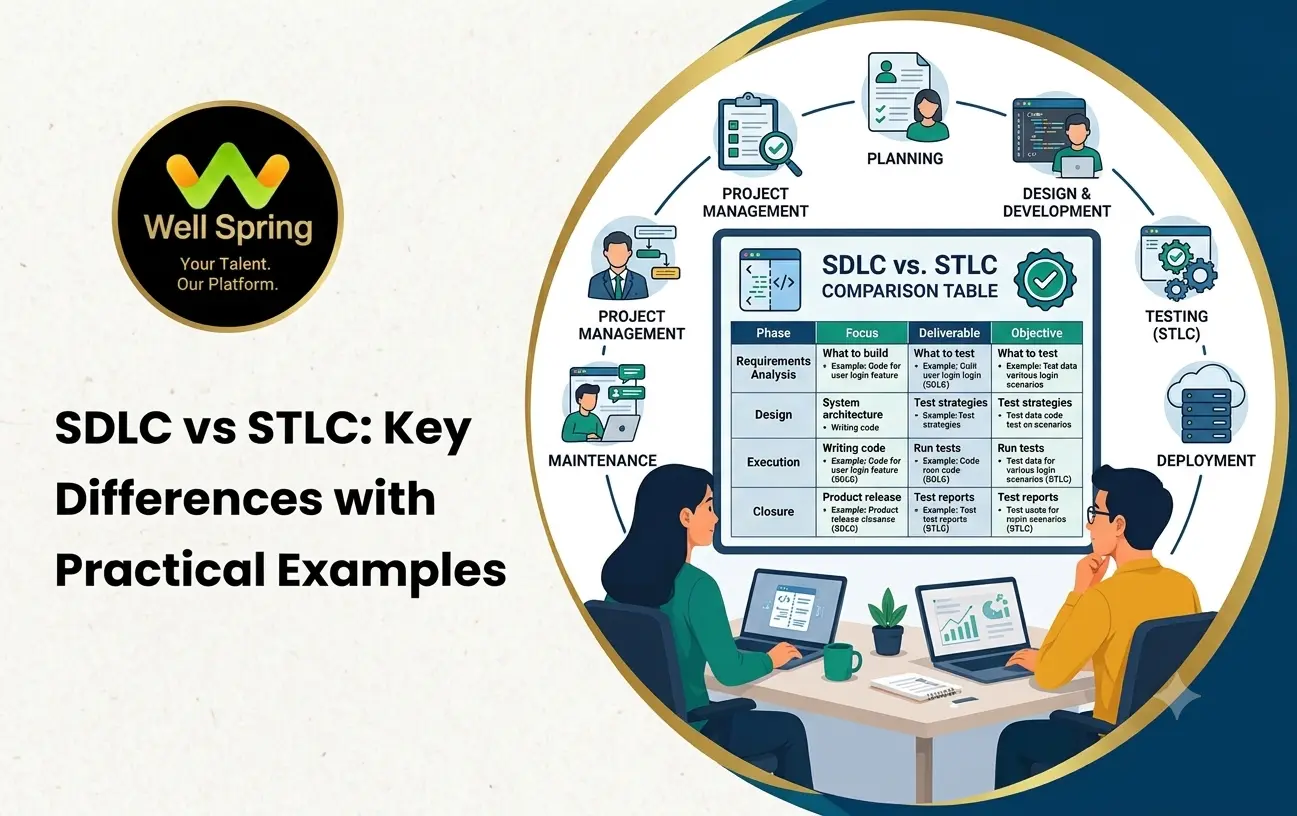
Software development involves several activities, from understanding user requirements to building, testing, and maintaining an application. Two important processes used in software projects are the Software Development Life Cycle (SDLC) and the Software Testing Life Cycle (STLC).
Although SDLC and STLC are closely related, they serve different purposes. SDLC focuses on the complete software development process, while STLC focuses on testing activities that help ensure the software meets its requirements and works as expected.
Understanding SDLC vs STLC helps students, aspiring software developers, and software testers understand how development and testing teams collaborate to deliver reliable applications.
In this guide, we will explore the difference between SDLC and STLC, explain their phases, compare their key activities, and examine practical examples using an online shopping application.
The Software Development Life Cycle (SDLC) is a structured process used to plan, design, develop, test, deploy, and maintain software applications. It helps development teams organise their work, manage project requirements, identify risks, and deliver software that meets user expectations.
SDLC provides a systematic approach to software development. Instead of building an application without a clear plan, teams follow defined stages to understand the problem, select suitable technologies, develop the solution, and maintain it after release.
For example, when a company wants to develop an online shopping application, the development team must understand customer requirements, design the application, write the code, test its functionality, and make it available to users. These activities form part of the Software Development Life Cycle.
SDLC helps software teams manage projects more effectively and maintain consistency throughout development.
Its main benefits include:
Clear project planning: Defines project goals, requirements, timelines, and resources.
Better software quality: Establishes processes for development, reviews, and testing.
Reduced development risks: Helps teams identify technical and project-related problems early.
Improved team collaboration: Clarifies responsibilities among developers, testers, designers, and project managers.
Efficient resource management: Helps teams organise their time, tools, and budget.
Easier maintenance: Provides a structured approach to updating and improving software after release.
The Software Development Life Cycle commonly includes seven phases. The exact stages may vary depending on the development methodology, project requirements, and organisation.
Planning is the initial stage of SDLC. During this phase, the team defines the project's purpose, scope, objectives, estimated cost, timeline, and required resources.
The team also considers whether the project is technically and financially feasible.
Example: A company plans to build an online shopping application. The project team estimates the development budget, identifies the target users, selects the main features, and creates a project schedule.
Key deliverable: Project plan and feasibility assessment.
During requirement analysis, the team gathers and studies the needs of users, customers, and other stakeholders.
Requirements may include functional features, performance expectations, security needs, and usability considerations.
Example: For an online shopping application, requirements may include user registration, login, product search, shopping cart management, online payments, order tracking, and customer notifications.
The team documents these requirements so that developers and testers understand what the application must do.
Key deliverable: Software requirements specification or other documented requirements.
In the design phase, the team determines how the application will be structured and how its different components will work together.
This phase may cover database design, user interface design, system architecture, API specifications, and technology selection.
Example: The team designs the application's login page, product listing pages, shopping cart, database tables, and payment integration.
Key deliverable: System design documents, architecture diagrams, and interface specifications.
During development, software developers write the code required to implement the approved design and requirements.
They use suitable programming languages, frameworks, databases, and development tools to build the application's features.
Example: Developers use Laravel and MySQL to create user authentication, product management, shopping cart functionality, and order processing for an online store.
Developers may also perform code reviews and unit testing to identify issues during implementation.
Key deliverable: Source code and working software components.
Testing helps determine whether the developed software meets its requirements and behaves as expected.
The team checks functionality, usability, performance, security, compatibility, and other relevant quality attributes.
Example: Testers verify whether customers can log in, search for products, add items to the cart, complete payments, and view order details.
Defects are documented and shared with developers for correction.
Key deliverable: Test results, defect reports, and software that has undergone the required testing.
Deployment is the process of releasing the application to its intended environment so that users can access it.
Depending on the project, deployment may happen in stages or through a single release.
Example: After the online shopping application passes the required release checks, the team deploys it to a production server and makes it available to customers.
Key deliverable: A deployed application.
Maintenance begins after deployment and continues throughout the software's useful life.
The team monitors the application, fixes defects, applies security updates, improves performance, and introduces new features when needed.
Example: After launch, the company updates the shopping application to support additional payment methods, improve page loading speed, and fix an issue affecting order tracking.
Key deliverable: Software updates, fixes, and improvements.
The Software Testing Life Cycle (STLC) is a structured process followed by testing teams to plan, prepare, execute, and complete software testing activities.
STLC focuses on evaluating whether an application meets specified requirements and identifying defects before software is released.
While SDLC covers the broader software development process, STLC concentrates on the activities required to assess software quality.
For example, when an online shopping application is developed, testers examine its requirements, prepare test cases, configure the testing environment, execute tests, report defects, and evaluate the results. These activities form part of the Software Testing Life Cycle.
STLC can begin during the requirement analysis phase of SDLC. Testers do not always need to wait until developers finish writing the code. Early involvement helps identify unclear requirements and potential testing challenges before they become expensive problems.
STLC provides a systematic approach to software testing and helps teams evaluate application quality.
Its main benefits include:
Early defect identification: Helps identify problems before they reach production.
Better test coverage: Ensures important requirements and scenarios are considered.
Organised testing activities: Defines testing tasks, responsibilities, and schedules.
Improved reliability: Helps verify that application features work as expected.
Clear defect tracking: Provides a consistent process for reporting, prioritising, and retesting issues.
Better release decisions: Gives stakeholders evidence about test coverage, outstanding defects, and release risks.
STLC commonly consists of six phases. The exact workflow may vary according to the organisation, project, and testing methodology.
During this phase, testers review the available requirements to understand what must be tested.
They identify testable requirements, clarify uncertainties, assess risks, and determine the appropriate testing methods.
Example: For an online shopping application, testers review the login requirements to understand password rules, account lockout behaviour, error messages, and authentication requirements.
They may also identify requirements that need clarification before test cases can be prepared.
Key deliverable: Requirement analysis notes and a requirements traceability matrix, where applicable.
In test planning, the team defines the testing scope, objectives, resources, schedule, tools, responsibilities, and approach.
The team also considers risks, dependencies, testing types, and the criteria for starting or completing testing.
Example: The testing team prepares a plan for testing the online shopping application's login, product search, checkout, and payment features.
The plan identifies who will test each feature, which environments are required, and when testing should take place.
Key deliverable: Test plan and testing estimates.
During this phase, testers create and review test cases based on the documented requirements.
Test cases describe the conditions, inputs, steps, and expected results used to verify application behaviour.
Testers may also prepare test data, review test coverage, and develop automated test scripts where appropriate.
Example: For the login feature, test cases may include:
Logging in with valid credentials.
Logging in with an incorrect password.
Submitting the login form with empty fields.
Entering an invalid email address.
Checking the application's response to repeated failed login attempts.
Verifying that users can log out successfully.
Key deliverable: Test cases, test data, and automation scripts where applicable.
The test environment setup phase involves preparing the hardware, software, configurations, accounts, databases, and other resources needed for testing.
The environment should be suitable for the planned test activities and should resemble the intended production environment where necessary.
Example: The team configures a test version of the shopping application, connects it to a test database, creates sample customer accounts, and configures a payment sandbox.
Using a payment sandbox allows testers to evaluate payment workflows without processing real customer transactions.
Key deliverable: A prepared test environment and environment readiness results.
During test execution, testers run the prepared test cases and compare actual results with expected results.
They record pass or fail outcomes, report defects, retest corrected issues, and perform regression testing when changes could affect existing functionality.
Example: A tester enters valid login credentials and confirms that the application opens the user's account page.
If the application rejects valid credentials, the tester records the issue with the steps to reproduce it, the expected result, the actual result, and supporting evidence.
After the developer fixes the issue, the tester retests the login feature.
Key deliverable: Test execution results, defect reports, and retest records.
Test cycle closure is the final STLC phase. The team evaluates testing outcomes, reviews defects, checks test coverage, and documents lessons learned.
The team determines whether the planned testing activities have been completed and communicates any remaining risks.
Example: Before releasing the shopping application, the testing team reviews the results for login, checkout, and payment functionality. It documents completed tests, unresolved defects, and any limitations that stakeholders should consider.
Test completion does not automatically guarantee that the software is defect-free. Release decisions should consider the test results, severity of outstanding issues, business requirements, and acceptable risk.
Key deliverable: Test summary report, testing metrics, and lessons learned.
The main difference between SDLC and STLC is their scope and purpose.
SDLC manages the complete process of developing and maintaining software, while STLC manages the activities involved in testing software and evaluating its quality.
SDLC includes planning, requirement analysis, design, development, testing, deployment, and maintenance. STLC focuses on requirement analysis for testing, test planning, test case development, environment setup, test execution, and test cycle closure.
Although their activities differ, both processes work together throughout a software project.
| Comparison Factor | SDLC | STLC |
|---|---|---|
| Full Form | Software Development Life Cycle | Software Testing Life Cycle |
| Main Objective | Develop and maintain software | Verify software requirements and evaluate quality |
| Primary Focus | Complete software development process | Software testing activities |
| Scope | Covers development from planning to maintenance | Covers the testing process |
| Starting Point | Usually begins with project planning | Can begin during requirement analysis |
| Main Activities | Planning, analysis, design, coding, testing, deployment, and maintenance | Requirement analysis, test planning, test case development, environment setup, execution, and closure |
| Team Involvement | Project managers, business analysts, designers, developers, testers, and operations teams | Testers, QA engineers, automation engineers, developers, and relevant stakeholders |
| Key Documents | Project plans, requirements, design documents, source code, and release documentation | Test plans, test cases, test data, defect reports, and test summary reports |
| Testing Approach | Includes testing as part of software development | Concentrates on planning and performing testing |
| Defect Handling | Supports defect correction and software improvement | Identifies, reports, retests, and tracks defects |
| Deliverables | Working software and related project deliverables | Test results and evidence about software quality |
| Outcome | Software that meets agreed requirements and is ready for its intended use | Evidence of how well the software meets test requirements and quality expectations |
| Relationship | Provides the broader project lifecycle | Supports quality evaluation within the broader development process |
A practical example makes the difference between SDLC and STLC easier to understand.
Consider a company developing an online shopping application where customers can register, log in, browse products, add items to a cart, make payments, and track orders.
The development team uses SDLC to build and maintain the application. The testing team uses STLC to plan and evaluate its functionality.
Step 1: Planning
The company decides to build an online shopping platform for customers who want to purchase products through a website.
The team estimates the budget, selects the project scope, and defines the delivery schedule.
Step 2: Requirement Analysis
The business analyst gathers requirements for customer registration, product browsing, shopping cart management, payment processing, and order tracking.
Step 3: System Design
The design team creates the page layouts, database structure, application architecture, and integration plans.
Step 4: Development
Developers implement the required features using suitable technologies and connect the application to the database and necessary external services.
Step 5: Testing
Developers and testers evaluate the application to identify defects and verify its behaviour against the requirements.
Step 6: Deployment
After the required release checks are completed, the team deploys the application to the production environment.
Step 7: Maintenance
The team monitors the application, resolves reported problems, applies updates, and introduces improvements based on user needs.
This example demonstrates how SDLC coordinates the overall process of building and maintaining an application.
Now consider the login feature of the same online shopping application.
The testing team follows STLC to verify that customers can access their accounts correctly and that invalid login attempts are handled appropriately.
Step 1: Requirement Analysis
Testers review the login requirements, including valid credentials, invalid passwords, required fields, and authentication rules.
Step 2: Test Planning
The team determines the testing scope, resources, schedule, tools, and test environment required for the login feature.
Step 3: Test Case Development
Testers prepare test cases for valid login, incorrect passwords, empty fields, invalid email formats, and repeated failed attempts.
Step 4: Test Environment Setup
The team prepares the test application, creates sample accounts, and configures the required test data.
Step 5: Test Execution
Testers execute the test cases and compare actual behaviour with the expected results. They report defects, retest fixes, and perform regression testing where necessary.
Step 6: Test Cycle Closure
The team reviews the results, documents outstanding defects, evaluates coverage, and prepares a test summary.
This example demonstrates how STLC organises testing activities for a particular application feature.
The SDLC example explains how the application is planned, designed, developed, released, and maintained.
The STLC example explains how the login feature is evaluated through planned testing activities.
In a real project, SDLC and STLC overlap. Testing activities can begin while requirements and designs are being prepared, rather than waiting until all development work is complete.
SDLC and STLC are complementary processes. SDLC provides the overall structure for software development, while STLC provides a structured approach to testing.
Their collaboration helps teams identify problems earlier, verify requirements, and make better-informed release decisions.
For example, when a business requirement is created for an online shopping application's checkout process, developers use it to design and build the feature. Testers use the same requirement to identify test scenarios, prepare test cases, and determine the expected results.
As development progresses, testers execute tests against the available software and report defects. Developers investigate and correct the problems, and testers verify the fixes.
This process continues until the planned testing activities are completed and stakeholders have sufficient information to make a release decision.
| SDLC Activity | Related STLC Activity |
|---|---|
| Requirement analysis | Review requirements and identify test scenarios |
| System design | Review designs and prepare design-based test scenarios |
| Development | Prepare test cases and test data while features are being built |
| Testing | Execute tests, report defects, and verify corrections |
| Deployment preparation | Evaluate test results and communicate remaining risks |
| Maintenance | Perform regression testing and verify software updates |
The relationship between the two life cycles may vary depending on the development methodology. In Agile projects, for example, development and testing activities often occur repeatedly within each iteration.
Neither SDLC nor STLC is universally more important than the other because they serve different purposes.
SDLC is necessary for organising the complete software development process. It helps teams translate business requirements into a working application and maintain the application after release.
STLC is necessary for organising testing activities. It helps teams verify requirements, identify defects, assess coverage, and provide information about software quality.
A project may follow a well-organised development process but still experience quality problems if testing is inadequate. Similarly, extensive testing cannot compensate for unclear requirements, poor system design, or an incomplete implementation.
The most effective approach is to integrate testing throughout software development. Early tester involvement, regular communication, and appropriate test coverage help teams identify problems before they become more expensive to resolve.
Although SDLC and STLC provide structure, software teams can still encounter challenges when implementing them.
When requirements are incomplete or ambiguous, developers may build features that do not match user expectations, and testers may struggle to define expected results.
Solution: Document requirements clearly, involve stakeholders, and resolve questions before implementation and testing progress too far.
Waiting until development is almost complete to begin all testing activities can delay defect discovery and increase rework.
Solution: Involve testers during requirement analysis and design, and prepare test scenarios as development progresses.
Testing only the most common scenarios may leave important edge cases, integration issues, or security concerns undiscovered.
Solution: Map test cases to requirements, prioritise high-risk functionality, and include negative and boundary-value scenarios where appropriate.
Developers and testers may misunderstand requirements, defect priorities, or changes to application behaviour.
Solution: Maintain shared documentation, conduct regular discussions, and use a common defect-tracking process.
Changing requirements can affect designs, source code, test cases, and release schedules.
Solution: Track changes, assess their impact, update affected test cases, and perform regression testing when necessary.
Addressing these challenges helps teams use SDLC and STLC more effectively.
Understanding SDLC vs STLC helps explain how software development and testing contribute to delivering reliable applications.
SDLC covers the complete software development process, from planning and requirement analysis to design, coding, testing, deployment, and maintenance. STLC focuses on testing activities, including requirement analysis, test planning, test case development, environment setup, execution, and closure.
Although their responsibilities differ, both processes are closely connected. SDLC helps teams build and maintain software, while STLC helps them evaluate whether the software meets its requirements and identify potential defects.
For students and aspiring IT professionals, learning both life cycles provides a useful foundation for understanding real-world software projects. Combining development knowledge with structured testing practices helps teams improve collaboration, manage risks, and deliver software that meets user expectations.
21 Nov 2026
21 Nov 2026
19 Nov 2026
19 Nov 2026
18 Nov 2026
SDLC stands for Software Development Life Cycle and covers the overall process of planning, designing, developing, testing, deploying, and maintaining software. STLC stands for Software Testing Life Cycle and focuses on organising and performing testing activities to evaluate software quality.
The commonly described seven phases of SDLC are planning, requirement analysis, system design, development, testing, deployment, and maintenance. Some methodologies combine or divide these phases differently.
The six commonly described phases of STLC are requirement analysis, test planning, test case development, test environment setup, test execution, and test cycle closure. The exact workflow may vary between organisations.
Yes. Testing is commonly included as a phase or set of activities within SDLC. STLC provides a more detailed structure for planning, executing, and evaluating those testing activities.
Yes. STLC can begin during requirement analysis. Testers can review requirements, identify test scenarios, plan testing, and prepare test cases before the relevant code is completed.
For an online shopping application, SDLC covers planning, design, development, testing, deployment, and maintenance. STLC covers activities such as analysing the application's login requirements, preparing test cases, executing tests, reporting defects, and verifying fixes.
SDLC involves professionals such as project managers, business analysts, software developers, designers, testers, and operations teams. STLC is primarily followed by software testers, QA engineers, and automation engineers, with support from developers and other stakeholders.
STLC is closely associated with SDLC and supports its quality assurance objectives. In many projects, STLC activities take place within the broader SDLC process. However, the two are not identical: SDLC covers the complete development lifecycle, while STLC concentrates on testing.
SDLC includes the activities required to create and maintain software, whereas the testing process focuses on evaluating the software against requirements and identifying defects. STLC provides a structured lifecycle for managing that testing work.
Understanding SDLC helps software testers learn how requirements are defined, how applications are designed and developed, and when testing activities can be introduced. It also improves communication with developers and helps testers plan appropriate testing strategies.
We provide IT training, internships, and online learning for students in Trichy and across India.
We also welcome enquiries from students in these neighbourhoods, towns, and surrounding locations.
Can't attend classes in person? Explore online IT training opportunities with Well Spring Talent Solutions, designed to help learners develop practical technology skills from different locations across India.
Get internship updates, IT training news, placement opportunities, and career tips directly to your inbox.
Join our WhatsApp community for internship updates, IT courses, placement support, and latest job opportunities.
Join Now