Blog Details
Home Blog Details

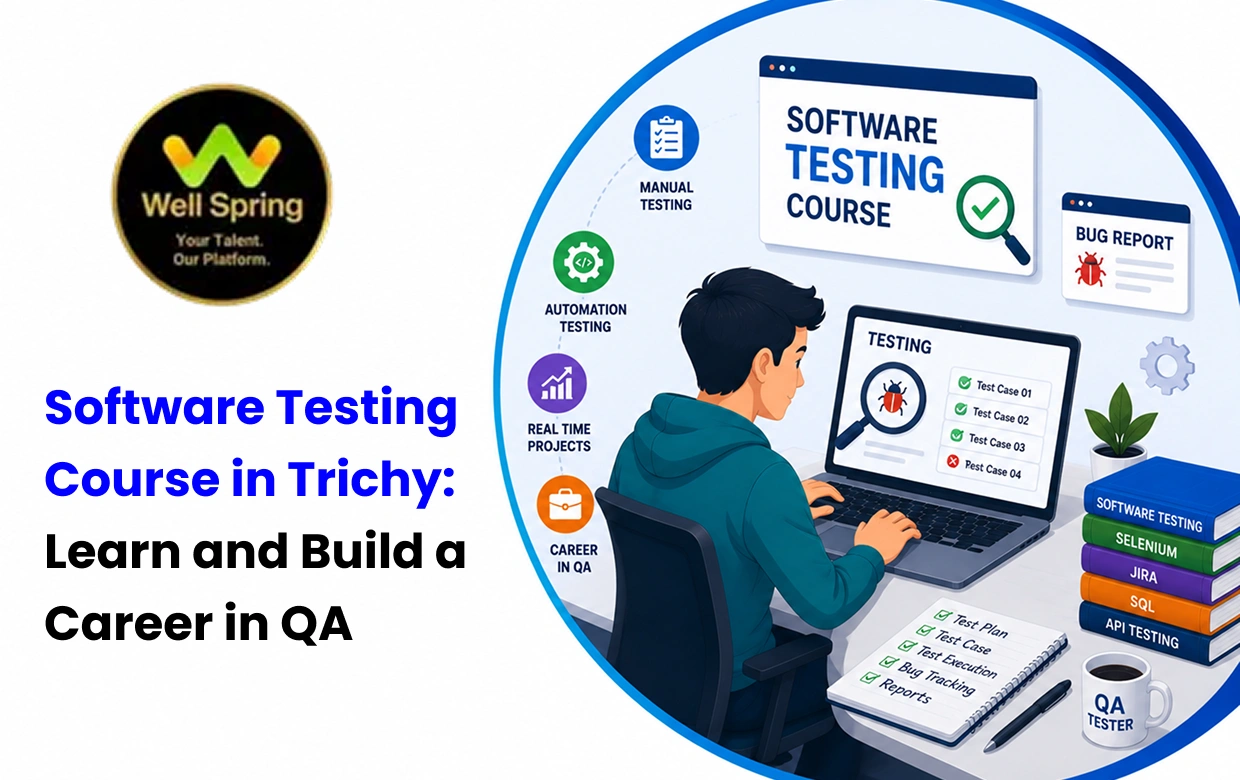
A Software Testing Course in Trichy can help students, freshers, and aspiring IT professionals develop practical skills for checking software quality and identifying issues before applications reach users. Modern software testing involves more than finding bugs. Testers need to understand requirements, create test cases, report defects, test user journeys, and work with automation tools and structured QA workflows.
This guide explains what learners can expect from Software Testing Training in Trichy, including manual testing, automation testing, practical projects, career preparation, current industry trends, internships, and job-ready skills. It also helps learners understand how structured training can support a career in software quality assurance.
A Software Testing Course in Trichy teaches learners how to test software applications through manual and automation testing methods. Students can learn test case design, functional testing, regression testing, defect reporting, test execution, automation concepts, and real-world QA workflows.
A practical Manual and Automation Testing Course can also help learners build problem-solving skills, project experience, and a stronger portfolio for entry-level software testing and quality assurance opportunities.
Many students and fresh graduates want to enter the IT industry but are unsure which technical path to choose. Some are interested in programming, while others enjoy analysing applications, finding problems, checking user experiences, and improving software quality.
Software testing can offer a structured path for learners who want to understand how software products are evaluated before they reach users.
A Software Testing Course in Trichy can help students move from basic testing concepts to practical activities such as analysing requirements, creating test cases, identifying defects, and understanding automation workflows.
For students, freshers, and job seekers, the goal should not be to memorise testing definitions. The goal is to understand how software testing works in real development environments and how different testing activities support software quality.
Software testing is the process of evaluating a software application to identify defects, verify expected behaviour, and check whether the application meets defined requirements.
For example, consider an e-commerce application. A tester may check whether:
Testing is important because software problems can affect users, business operations, data, revenue, and customer trust.
A practical Software Testing Course in Trichy can help learners understand how different testing activities fit into the wider software development process.
Software testing can help teams:
For learners, testing also develops analytical thinking, attention to detail, communication, and problem-solving skills.
Students often know the theory behind software development but may not understand how a real application is checked for quality.
For example, a college project may work successfully during a demonstration. However, a professional testing process may also examine invalid inputs, different user roles, error messages, browser behaviour, data handling, and unexpected user actions.
This is why Software Testing Training in Trichy can be valuable for learners who want practical exposure.
A tester may need to:
These skills are useful because software testing involves both technical understanding and structured problem-solving.
A structured Manual and Automation Testing Course in Trichy can help learners understand the complete testing process, from analysing requirements to testing application features and learning how automation can support repetitive testing activities.
The exact syllabus may vary depending on the current training programme. However, a comprehensive software testing learning path can include topics such as:
Students should review the current course syllabus before enrolling to understand exactly which modules, tools, technologies, projects, and internship opportunities are included in the programme.
A structured learning path can make software testing easier to understand.
1. Understand the Software Development Process
Start by learning how software is planned, developed, tested, released, and maintained. Concepts such as SDLC and STLC provide useful foundations.
2. Learn Manual Testing Fundamentals
Understand testing types, testing levels, functional testing, non-functional testing, smoke testing, sanity testing, regression testing, and retesting.
3. Practise Test Scenario and Test Case Design
Learn how to convert a requirement into clear test scenarios and detailed test cases.
4. Understand Defect Reporting
Practise identifying issues and documenting useful information, including the steps to reproduce a problem, expected results, and actual results.
5. Test Real User Workflows
Work with complete application flows such as registration, login, search, form submission, and checkout.
6. Learn Automation Testing Concepts
After building a strong manual testing foundation, understand how automation tools and scripts can support repetitive testing.
Depending on the actual course syllabus, learners may also work with relevant testing tools, API testing platforms, version control systems, databases, or automation frameworks. Students should always check the current syllabus to understand exactly which tools and technologies are included.
7. Build Practical Testing Experience
Work on realistic projects and test different features. This can help learners understand how concepts connect in a complete application.
A Manual and Automation Testing Course can provide a broader understanding of software quality assurance.
Manual testing helps learners understand requirements, user behaviour, test case design, and defect identification.
Testing requires learners to think about what could go wrong and how an application should behave in different situations.
Automation concepts can help learners understand how selected repetitive tests can be executed using tools and scripts.
Hands-on assignments and projects can help learners demonstrate practical knowledge.
Test cases, bug reports, project documentation, and practical testing work can provide useful examples of your skills.
Learners can develop knowledge related to application testing, regression testing, debugging, documentation, automation, and quality assurance processes.
Memorising terms such as smoke testing or regression testing is not enough.
Solution: Apply each concept to a real application and practise writing test cases.
A vague test case can make execution difficult.
Solution: Write clear steps, expected results, and relevant test data.
Simply writing “Login is not working” may not help a developer reproduce the issue.
Solution: Include steps to reproduce, expected behaviour, actual behaviour, and useful supporting information.
Some learners start automation without understanding testing fundamentals.
Solution: Build a strong understanding of manual testing and application behaviour first.
Real users do not always follow the expected path.
Solution: Test invalid inputs, edge cases, error conditions, and unexpected user actions.
Testers often need to explain problems clearly.
Solution: Practise writing concise bug reports and discussing issues professionally.
In 2026, software testing continues to change as AI-assisted tools, automation, cloud-based applications, and faster development cycles become more common.
AI can support testing teams with tasks such as analysing information, generating ideas for test cases, reviewing patterns, and assisting with documentation. However, AI does not remove the need for human judgment.
Testers still need to understand:
Automation is also an important part of many modern QA workflows. However, automation is not a replacement for all manual testing. Teams may use both approaches based on the application, risk, and testing requirements.
Industry expectations are also changing. Employers increasingly value candidates who can learn continuously, use digital tools responsibly, communicate clearly, and apply their knowledge to practical problems.
Internships can help bridge the gap between learning and workplace expectations. Through practical projects and internship opportunities, learners can gain exposure to workflows, teamwork, feedback, and career-focused skill development.
Choosing the Best Software Testing Course in Trichy involves more than comparing course titles or placement claims. Students should consider the course syllabus, practical learning approach, mentor support, project exposure, internship opportunities, and career preparation.
Well Spring Talent Solutions is a Training Academy and Internship Company in Trichy, Tamil Nadu, focused on helping students and aspiring professionals develop practical, industry-relevant skills through training, hands-on projects, internships, and career guidance.
For software testing learners, the training approach focuses on helping students connect concepts with practical learning through:
The aim is to help learners move beyond theoretical definitions and understand how testing concepts connect with practical software workflows.
Students should review the current course syllabus, training methodology, practical assignments, project opportunities, internship structure, and available career support before enrolling.
Students searching for a Software Testing Course with Placement in Trichy should also understand that placement outcomes depend on individual skills, performance, preparation, available opportunities, and employer requirements.
|
Area |
Traditional Learning |
Industry-Focused Training |
|
Learning approach |
Mainly concept and theory based |
Concepts combined with practical testing |
|
Test cases |
Limited academic examples |
Practice using realistic scenarios |
|
Defect reporting |
Often discussed theoretically |
Applied through hands-on exercises |
|
Projects |
Small or academic projects |
Real-world-style testing practice |
|
Automation |
May receive limited exposure |
Practical introduction to automation workflows |
|
Feedback |
Periodic |
Continuous feedback during practice |
|
Career preparation |
General guidance |
Resume and interview-focused support |
|
Workplace exposure |
Limited |
Can include projects and internship opportunities |
Workforce and technology research continues to highlight the importance of continuous learning as digital technologies and workplace requirements change.
For example, the World Economic Forum's Future of Jobs Report 2025 reported that approximately 39% of workers' existing skill sets are expected to be transformed or become outdated between 2025 and 2030. The report also identifies technology-related skills among the fastest-growing areas.
Research and workforce insights from organisations such as LinkedIn, Deloitte, McKinsey, and IBM have also discussed the changing nature of workplace skills, increasing adoption of AI and digital technologies, and the importance of continuous learning.
These findings are broader workforce and technology insights rather than direct statistics about software testing jobs. However, they reinforce an important lesson for aspiring QA professionals: strong fundamentals, practical experience, adaptability, and continuous learning are increasingly valuable as technology and software development practices evolve.
Publishing note: Verify the latest report versions, wording, and statistics, and link all external claims to the relevant original source pages before publishing.
Is software testing a good career for freshers?
Software testing can be a suitable career path for freshers who enjoy analysing applications, solving problems, checking details, and improving software quality. However, career opportunities depend on your skills, practical experience, communication ability, and current employer requirements.
Freshers can improve their readiness by learning manual testing fundamentals, practising test cases and defect reporting, understanding automation concepts, and building practical project experience.
Should I learn manual testing or automation testing first?
Most beginners benefit from understanding manual testing first because it teaches how to analyse requirements, identify test scenarios, create test cases, and understand application behaviour.
Automation can then build on this foundation by helping learners understand how selected repetitive tests are executed through tools and scripts. A Manual and Automation Testing Course can provide a structured path for learning both approaches step by step.
How long does it take to learn software testing?
Learning time depends on your previous technical knowledge, study schedule, practice, and the depth of skills you want to develop.
Understanding basic manual testing concepts may take less time than becoming comfortable with real testing workflows and automation. Instead of focusing only on a fixed number of months, learners should aim to build practical skills in test case design, defect reporting, application testing, regression testing, and relevant automation concepts.
Does software testing require coding?
Manual testing does not always require advanced programming knowledge, although technical knowledge can be helpful. Automation testing usually involves a greater understanding of programming or scripting concepts because testers may work with automated test scripts and frameworks.
Beginners can start with manual testing fundamentals and gradually build the technical knowledge required for automation.
What skills should a software testing fresher develop?
A software testing fresher can benefit from developing skills in requirement analysis, test scenario creation, test case writing, defect reporting, regression testing, communication, problem-solving, and basic technical concepts. Depending on the career path and course syllabus, automation knowledge and familiarity with relevant testing tools can also be useful.
Trichy is home to many college students, engineering graduates, freshers, and aspiring IT professionals looking for practical ways to build career-ready technology skills.
For students searching for Software Testing Training in Trichy, industry-focused learning can help connect academic knowledge with practical software testing workflows. Instead of learning testing only for examinations or certificates, students can practise analysing applications, writing test cases, reporting defects, and understanding how QA teams work.
Students from Trichy and other parts of Tamil Nadu can also benefit from practical projects and internship opportunities that provide exposure to feedback, teamwork, professional expectations, and structured workflows.
A combination of technical training, real-world-style projects, continuous learning, and practical experience can help learners build stronger foundations for technology careers.
What is a Software Testing Course?
A Software Testing Course teaches learners how to evaluate software applications, identify defects, verify expected behaviour, and understand software quality processes. Training may include manual testing, test cases, defect reporting, regression testing, automation concepts, and practical projects.
Why is software testing important?
Software testing is important because it helps identify problems and verify whether an application works as expected. Effective testing can support better software quality, reliability, functionality, and user experience.
Who should learn software testing?
College students, fresh graduates, job seekers, aspiring QA professionals, manual testers, developers interested in quality assurance, and professionals changing careers can consider learning software testing.
How does practical software testing training help?
Practical training helps learners apply concepts by testing applications, creating test cases, reporting defects, working with realistic scenarios, and understanding how testing activities connect within a software development workflow.
Is software testing worth learning in 2026?
Software testing remains a valuable area because software quality continues to matter as applications become more complex. However, learners should combine testing fundamentals with practical experience, automation knowledge, digital skills, continuous learning, and an understanding of AI-assisted development and testing workflows.
Software testing is not only about finding bugs. It requires analytical thinking, careful observation, structured test design, clear communication, and a strong understanding of how users interact with software.
For students and freshers, a Software Testing Course in Trichy can provide a structured starting point. However, consistent practice, independent learning, real projects, and practical experience are equally important.
Well Spring Talent Solutions, a Training Academy and Internship Company in Trichy, Tamil Nadu, focuses on helping learners develop career-relevant skills through industry-oriented training, hands-on practice, project exposure, internship opportunities, and career preparation.
For aspiring QA professionals, developing practical manual and automation testing skills can be an important step towards building confidence and preparing for opportunities in the software industry.
If you are planning to start a career in software testing, review the current Software Testing Course syllabus at Well Spring Talent Solutions, understand the practical training, project and internship opportunities available, and choose a learning path that matches your career goals.
15 Oct 2026
15 Oct 2026

14 Oct 2026

14 Oct 2026
13 Oct 2026
A comprehensive course can cover software testing fundamentals, SDLC and STLC concepts, testing types, test scenarios, test cases, functional testing, regression testing, defect life cycle, bug reporting, test documentation, and automation testing concepts. The exact syllabus and tools may vary. The most useful training also includes practical exercises and projects that help learners apply testing concepts to realistic applications and workflows.
Yes, beginners can start learning manual testing without advanced programming knowledge. Manual testing focuses heavily on understanding requirements, analysing applications, designing test cases, executing tests, and reporting defects. However, basic technical knowledge can be useful. Learners who later want to move into automation testing may need to develop programming or scripting skills. A step-by-step learning approach can make this transition easier.
Manual testing involves a tester performing test activities directly, such as executing test cases and checking application behaviour. Automation testing uses tools and scripts to execute selected tests automatically, especially where repeated execution is useful. Manual testing is important for exploratory testing, user-focused checks, and understanding application behaviour. Automation can help support repetitive and regression testing. Modern QA workflows often use both approaches based on project needs.
Internships can provide practical exposure that goes beyond classroom learning. Depending on the internship structure, learners may test real or simulated applications, work with project requirements, receive feedback, follow deadlines, and understand team workflows. This experience can help students apply their testing knowledge and develop professional habits. Internship projects can also provide useful experience to discuss in a portfolio, resume, or interview.
Well Spring Talent Solutions supports learners through industry-oriented training, practical software testing exercises, project-based learning, mentor guidance, internship opportunities, resume-building support, interview preparation, career guidance, and placement assistance. The aim is to help learners move beyond theoretical knowledge and develop practical, career-relevant skills. Individual results can vary, so learners should also practise consistently and continue building their own testing knowledge and project experience.
Get internship updates, IT training news, placement opportunities, and career tips directly to your inbox.
Join our WhatsApp community for internship updates, IT courses, placement support, and latest job opportunities.
Join Now