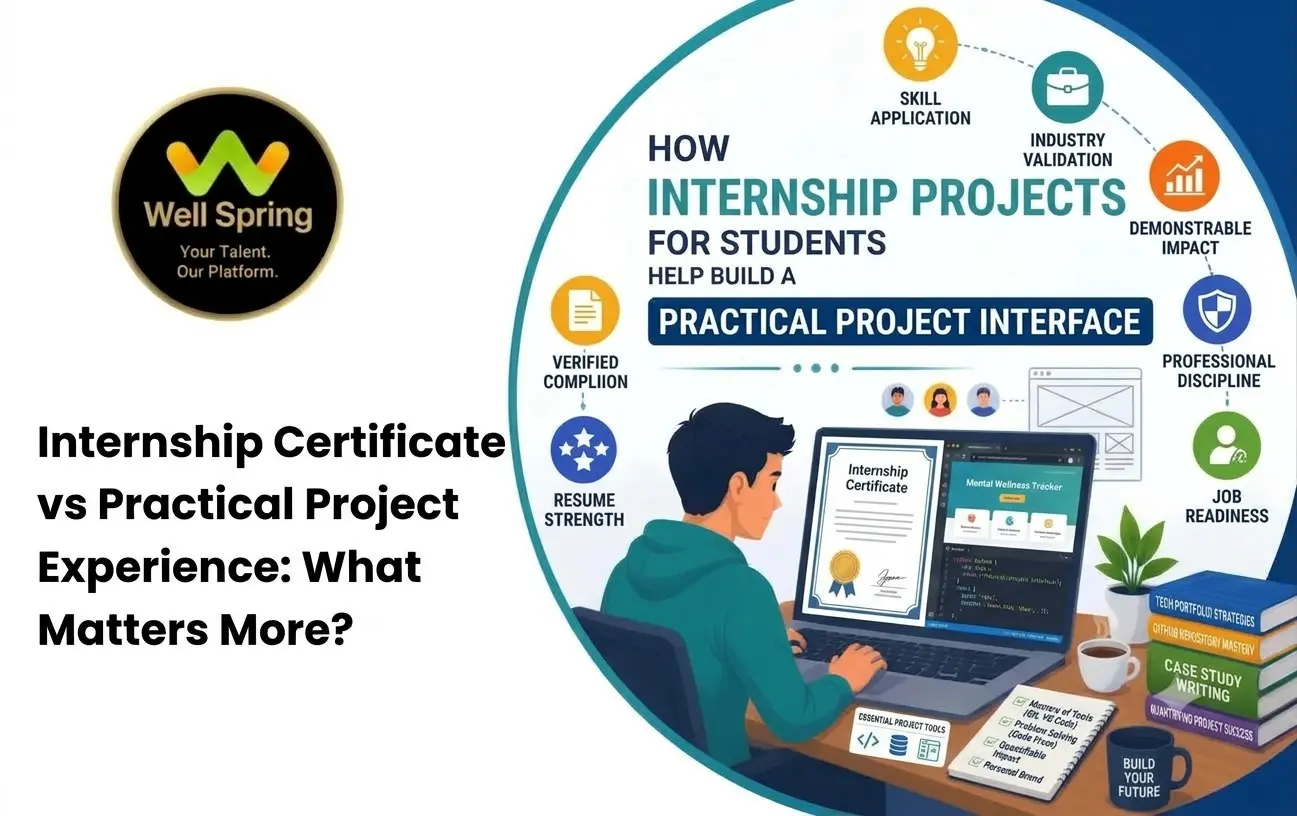

Students often compare internship opportunities by looking at the certificate they receive at the end of the program. However, a certificate is only one part of the learning experience. The practical skills gained, tasks completed, and ability to explain what was learned can also be important when preparing for a job.
An internship certificate and practical project experience serve different purposes. A certificate can document participation or completion, depending on its terms, while project experience can help students demonstrate how they apply their knowledge to specific tasks.
For students exploring internships through Well Spring Talent Solutions, understanding this difference can help them evaluate available opportunities and choose a program that matches their learning goals.
What Is an Internship Certificate?
An internship certificate is a document issued by an organization to confirm that a student participated in or completed an internship, according to the organization's stated requirements.
The information included can vary between organizations. A certificate may mention the student's name, internship duration, area of work, and completion status.
Benefits of an Internship Certificate
- Documents participation: It provides evidence that the student completed or participated in a specified internship.
- Supports a resume: Students may list the internship under relevant experience or training, accurately describing its nature.
- Provides a reference point: Recruiters can review the certificate alongside the student's resume and other supporting evidence.
- Records completion: It may help students maintain documentation of their learning activities.
What an Internship Certificate Cannot Prove on Its Own
A certificate does not automatically establish that a student has mastered a technology, independently completed a project, or is ready for a particular job.
Employers may also consider practical knowledge, communication skills, problem-solving ability, and the student's ability to explain their work.
Students should therefore understand what the certificate represents and what requirements must be met to receive it.
What Is Practical Project Experience?
Practical project experience involves applying knowledge to a task or project rather than learning only through explanations or demonstrations.
Depending on the internship, students may work on guided exercises, simulated tasks, small projects, or projects connected to an actual business requirement. The level of responsibility can vary, so students should confirm what the program involves before enrolling.
For example, a software development intern might build a feature for a web application, while a software testing intern might prepare test cases, identify defects, and document test results.
Benefits of Practical Project Experience
- Applies theoretical knowledge: Students practise using concepts and tools in a task-based environment.
- Develops problem-solving skills: Projects can require learners to investigate errors and find suitable solutions.
- Creates evidence of learning: Students may be able to demonstrate their work through permitted project samples, documentation, or a portfolio.
- Improves technical communication: Explaining project decisions can help students practise discussing their work clearly.
- Builds confidence: Completing tasks can help students understand their strengths and identify areas for improvement.
Practical experience is most useful when students understand the objectives, participate meaningfully, receive appropriate guidance, and can explain their contributions.
Internship Certificate vs Practical Project Experience: Key Differences
| Comparison factor | Internship certificate | Practical project experience |
|---|---|---|
| Main purpose | Documents participation or completion | Demonstrates applied learning |
| Evidence provided | Certificate or completion document | Project work, documentation, demonstrations, or portfolio evidence |
| Skills demonstrated | Depends on the certificate and its requirements | Depends on the tasks completed and the student's contribution |
| Resume value | Can support an internship entry | Can provide specific examples of work and skills |
| Interview preparation | Helps describe the internship completed | Helps explain technical decisions, challenges, and solutions |
| Assessment | Depends on the issuing organization | May involve project reviews, feedback, testing, or demonstrations |
| Limitations | Does not independently prove technical competence | A project alone does not establish every aspect of professional readiness |
Neither option should be evaluated in isolation. The value of an internship depends on its structure, learning outcomes, supervision, and the evidence a student can provide.
Which Matters More to Employers?
There is no universal answer because employers assess candidates according to the role, experience level, and job requirements.
For many technical entry-level roles, the ability to explain concepts and demonstrate relevant skills can be valuable. A certificate may help document participation, while practical project work can give a candidate concrete examples to discuss.
Consider two hypothetical candidates.
Candidate A has an internship certificate but has limited experience explaining the tasks completed during the internship.
Candidate B has an internship certificate and can describe a project, explain their individual contribution, discuss challenges, and demonstrate relevant work where permitted.
Candidate B has more specific evidence of applied learning to discuss. However, the final hiring decision still depends on the employer's requirements, interview performance, and other qualifications.
The important distinction is not simply certificate versus project. It is whether the internship provides meaningful learning and whether the student can accurately demonstrate what they gained from it.
What Is the Difference Between a Certificate Internship and a Live Project Internship?
The terms can describe different types of internship experiences, but they are not mutually exclusive.
A certificate-focused internship may emphasize structured learning and the completion of defined activities required to receive a certificate. A live project internship may emphasize participation in a project with real requirements, users, or business objectives.
A live project does not automatically mean the student works independently on a production system. Some projects are supervised, restricted to a small feature, or conducted in a controlled environment. Students should ask what “live project” means in the specific program.
| Feature | Certificate-focused internship | Live project internship |
|---|---|---|
| Primary emphasis | Completing defined learning or internship requirements | Contributing to a project with defined requirements |
| Typical activities | Training sessions, exercises, assignments, and assessments | Project tasks, testing, implementation, documentation, and reviews |
| Learning evidence | Completion document and any required assessments | Project artefacts and explanations of individual contributions |
| Guidance | Depends on the program | Depends on the project and supervision arrangements |
| Certificate availability | Must be confirmed | Must be confirmed separately |
| Practical exposure | Can include practical activities | Depends on the student's actual tasks and project scope |
An internship can include both a certificate and project work. Students should evaluate the actual learning experience rather than relying on the program label alone.
How to Choose the Right Internship
Before selecting an internship, review the program details carefully.
1. Check the Internship Structure
Ask for a clear explanation of the training schedule, internship duration, expected tasks, and completion requirements.
2. Understand the Project Work
Find out whether the internship includes exercises, guided projects, simulated assignments, or work connected to actual business requirements.
3. Ask About Your Individual Contribution
Confirm what students are expected to do themselves. A project demonstration is not the same as independently completing the work.
4. Check Mentorship and Feedback
Ask whether a trainer or mentor reviews tasks, answers questions, and provides feedback on errors or incomplete work.
5. Verify Certificate Conditions
Confirm the certificate's issuing organization, eligibility requirements, completion criteria, and the information it records.
6. Review the Final Deliverables
Find out whether students receive project documentation, assessment feedback, or permission to include suitable work samples in a portfolio.
7. Compare the Total Cost
Consider the program fee, duration, learning resources, schedule, and any additional charges before enrolling.
How Well Spring Talent Solutions Fits Into Your Internship Search
Well Spring Talent Solutions offers internship-related learning opportunities across technology areas. Students considering its programs should review the specific internship page to understand the advertised activities, eligibility requirements, learning format, and completion conditions.
When evaluating an internship at Well Spring or another provider, ask these questions:
- What tasks will I complete during the internship?
- Will I receive guided practical exercises or project assignments?
- How will my work be reviewed?
- What support is available when I encounter technical problems?
- What are the requirements for receiving the certificate?
- What project evidence, if any, can I retain or show in a portfolio?
The answers can help you determine whether the opportunity matches your goals. Verify the details of the particular program before making a decision.
How to Present Internship Experience on Your Resume
Students should describe their internship accurately and focus on what they actually completed.
For example, instead of writing only “Completed a software development internship,” a student could describe a specific contribution:
- Developed a responsive interface for an assigned application feature.
- Wrote and executed test cases for a sample application.
- Created a dashboard using the tools covered in the internship.
- Documented project requirements and testing observations.
Use only statements that accurately reflect your work. Do not describe a guided exercise as professional client work or claim ownership of a project completed by a team.
If you have an internship certificate, list the organization and duration accurately. Where appropriate, include a brief description of your responsibilities and the skills you practised.
Conclusion
An internship certificate and practical project experience serve different purposes. A certificate can document participation or completion, while project experience can provide examples of how a student applied knowledge to a task.
For students preparing for technical careers, an internship that combines structured learning, appropriate guidance, meaningful practical activities, and clear completion requirements can be worth considering.
Before enrolling with Well Spring Talent Solutions or another provider, review the specific internship details, understand what you will be expected to complete, and confirm what evidence of learning you will receive. Choose an opportunity based on its actual learning value rather than its title alone.