Blog Details
Home Blog Details

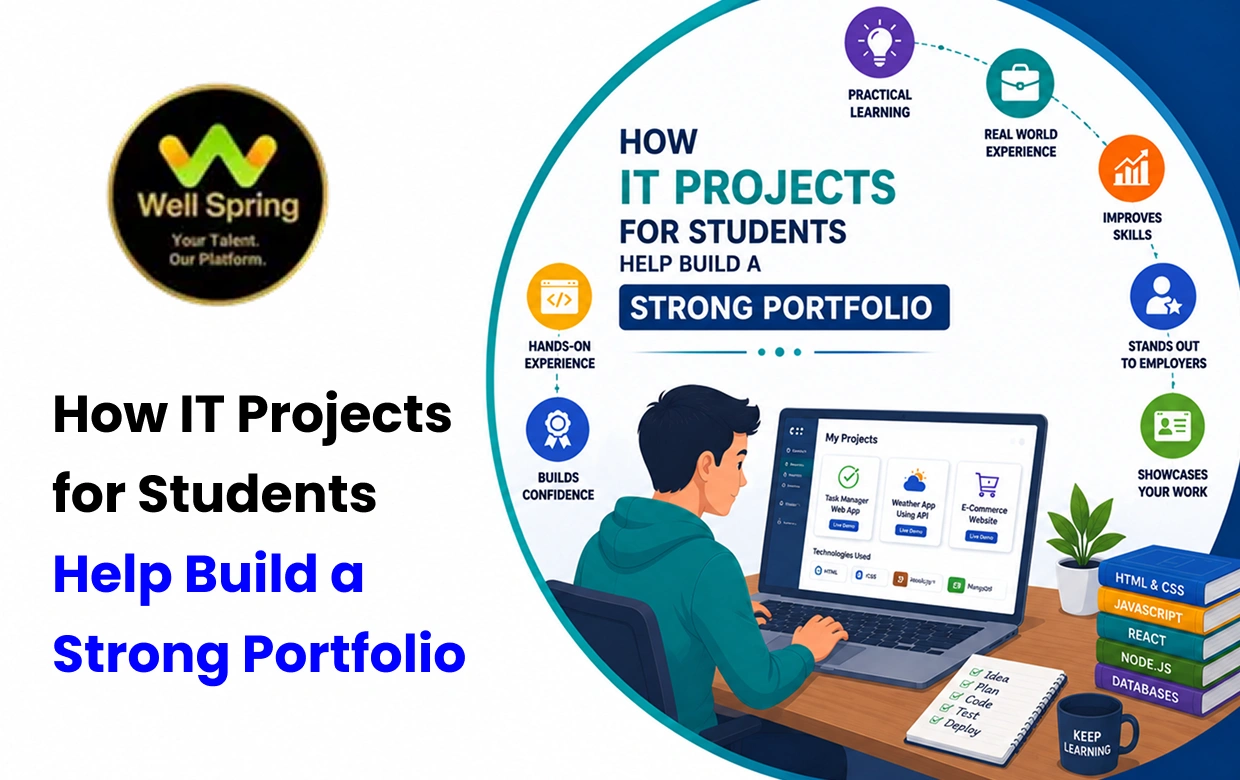
A strong IT portfolio can help students demonstrate practical skills beyond academic grades and certificates. IT Projects for Students give learners an opportunity to show how they apply programming, web development, databases, software tools, and problem-solving techniques to practical challenges. Software Projects for Students can also provide valuable examples for resumes, internships, and entry-level job interviews. This guide explains how student projects contribute to an IT Portfolio for Students, what types of projects are worth building, how to present them professionally, and how students can use project experience to become more confident and career-ready.
IT Projects for Students help build a strong portfolio by providing practical evidence of technical skills. Instead of simply listing technologies such as Java, Python, JavaScript, SQL, or HTML, students can demonstrate how they used those skills to create working solutions. A good project can showcase coding ability, problem-solving, database knowledge, UI development, testing, teamwork, and technical decision-making. For students preparing for internships and entry-level IT roles, relevant projects can make their portfolio more informative and easier for recruiters to evaluate.
Getting the first IT job or internship can be challenging for students.
Many students have completed courses, earned certifications, and learned programming languages, but recruiters may still ask an important question:
“What have you actually built?”
This is where IT Projects for Students become valuable.
A project gives students an opportunity to move beyond theoretical learning and demonstrate how they use their knowledge to solve practical problems. A well-developed project can show coding ability, logical thinking, database skills, interface design, debugging, testing, and even teamwork.
For students in Trichy, Tamil Nadu, building practical projects can be particularly useful when preparing for internships, campus opportunities, and entry-level technology roles.
At Well Spring Talent Solutions, project-based learning can complement technical training by giving students opportunities to apply what they learn in practical development environments.
IT Projects for Students are practical applications or technology-based solutions created as part of academic learning, training, internships, or independent skill development.
Projects can range from simple beginner applications to complete software systems.
Examples include:
The right project depends on the student's skill level, career goal, and technology stack.
A beginner may start with a simple calculator or task manager, while an advanced learner may develop a full-stack application with authentication, APIs, databases, dashboards, and deployment.
A resume can say that a student knows Python.
A project can show how the student used Python.
For example, instead of writing:
Python – Intermediate
a student could describe a Python-based application and explain the features they developed, the database they used, and the problems they solved.
This provides practical context to the skill.
Courses and certificates indicate that a learner studied a particular subject.
Projects provide evidence that the learner attempted to apply it.
This distinction is important for freshers because they may not yet have extensive professional experience.
Building an application rarely goes perfectly.
Students may encounter:
Solving these challenges helps students develop analytical thinking.
Students often understand concepts but feel nervous when asked to build something independently.
Completing projects provides repeated opportunities to practise.
Over time, students become more comfortable with coding, debugging, testing, documentation, and explaining technical decisions.
An IT Portfolio for Students should do more than display screenshots.
It should communicate three things:
What did you build?
Why did you build it?
What did you contribute?
A strong project presentation can include:
This structure helps recruiters quickly understand the project's value.
Students starting their programming journey can build:
These projects help develop fundamental programming and interface skills.
Once students understand programming fundamentals, they can move to:
These projects introduce databases, authentication, CRUD operations, APIs, and application architecture.
Students preparing for software development roles can consider:
The objective should not be to make a project unnecessarily complicated. It should demonstrate meaningful technical skills.
Decide whether you are targeting:
Your projects should support the role you want.
Choose projects that demonstrate skills employers may expect for your target role.
For example, a full-stack developer portfolio could include a web application with front-end, back-end, database, authentication, and API integration.
Use tutorials for learning, but avoid simply copying an existing project.
Make your own decisions and add features that demonstrate your understanding.
Test different scenarios.
Ask:
Write a simple project description explaining the purpose, technology stack, features, and challenges.
Where appropriate, use GitHub or a personal portfolio website to showcase your projects.
Be specific about what you personally developed.
This becomes particularly important when the project was completed as part of a team.
Projects provide opportunities to apply programming concepts in realistic situations.
Relevant projects can give freshers useful technical experience to include on their resumes.
Interviewers may ask questions about projects listed on a candidate's resume. Genuine project experience makes it easier to discuss technical decisions.
Projects create content for an IT Portfolio for Students.
Students learn how to investigate errors and develop solutions.
Using a technology repeatedly in different situations can deepen understanding.
Projects can help students discover which areas of technology they enjoy.
Having 15 incomplete projects is not necessarily better than having three strong projects.
Better approach: Build fewer projects with greater depth.
Copied projects may look impressive but become difficult to explain during interviews.
Better approach: Understand the project and add your own features.
A student applying for a Python developer role may gain limited value from a portfolio containing only graphic design projects.
Better approach: Align projects with the target job.
A visually attractive website is useful, but technical functionality also matters.
Better approach: Demonstrate both usability and technical implementation.
Students sometimes describe only what worked.
Better approach: Explain at least one meaningful technical problem and how you solved it.
A recruiter should not have to guess what your project does.
Better approach: Add a clear README or project description.
The technology industry continues to evolve rapidly, particularly because of AI, automation, cloud platforms, cybersecurity, and data-driven applications.
The World Economic Forum's Future of Jobs Report 2025 identifies AI and big data, networks and cybersecurity, and technological literacy among the fastest-growing skill areas through 2030. It also highlights analytical thinking, creative thinking, resilience, flexibility, and agility as important workforce skills.
For students, this means portfolios should increasingly demonstrate both technical capability and adaptability.
For example, students can strengthen projects by learning:
However, students should not add AI simply because it is trending. The technology should have a genuine purpose within the project.
Keep Projects Relevant
Build projects related to the role you want.
Focus on Quality
A well-tested project is better than an unfinished collection of applications.
Show Your Development Process
Explain how you moved from the problem to the final solution.
Use Clear Project Descriptions
Avoid vague statements such as “Developed a website.”
Instead, explain the project's objective, features, technologies, and your contribution.
Keep Improving
Return to older projects and improve their interface, security, performance, testing, or functionality as your skills grow.
Students often need more than classroom instruction to understand how technical skills are applied in practical situations.
Well Spring Talent Solutions in Trichy focuses on career-oriented IT learning that can include:
The goal is to help students connect learning → projects → internships → career preparation.
For learners building their first IT Portfolio for Students, structured project guidance can help them choose appropriate technologies, understand development workflows, document their work, and prepare to explain their projects professionally.
|
Traditional Learning |
Project-Based Learning |
|
Focuses mainly on concepts |
Combines concepts with application |
|
Exercises may be predefined |
Students solve practical problems |
|
Limited project exposure |
Regular project development |
|
Less debugging practice |
Frequent troubleshooting |
|
Skills may remain theoretical |
Skills are demonstrated through applications |
|
Limited portfolio material |
Projects can become portfolio assets |
|
Interview examples may be limited |
Projects provide technical discussion topics |
The best approach combines both. Students need strong fundamentals before applying them effectively.
How many IT projects should a student have in a portfolio?
There is no universal number. For most students, two to four well-developed and relevant projects can provide a strong starting point. Quality matters more than quantity. Each project should demonstrate a different aspect of your target skill set and should be something you can explain confidently. A portfolio containing a few complete, tested, documented projects is generally more useful than a long list of unfinished applications.
What are the best IT projects for students?
The best project depends on the student's career goal and skill level. Web development students can build responsive websites or full-stack applications. Java learners can develop management systems or enterprise-style applications. Python students can explore automation, data analysis, or web applications. AI/ML learners can build prediction or classification projects. The strongest project is one that solves a clear problem and allows the student to demonstrate relevant technical skills.
How do I build an IT portfolio as a fresher?
Start by selecting two or three projects that match your target job. Build them carefully, test the main features, document the technologies and your contribution, and add screenshots or demonstrations where appropriate. You can present the projects through a personal portfolio website and relevant code repositories. Also prepare a short explanation of each project so you can confidently discuss its purpose, architecture, challenges, and results during interviews.
Are software projects important for IT placements?
Yes, software projects can be valuable for IT placements because they provide practical examples of technical ability. Academic qualifications explain what a student has studied, while projects can demonstrate how that knowledge was applied. Projects may also give recruiters useful topics for technical discussions. However, projects work best when students genuinely understand them. Simply listing a project without being able to explain its functionality or implementation provides limited value.
Should students include academic projects in their portfolio?
Yes. Academic projects can be included, particularly when students have limited professional experience. However, they should present them professionally by explaining the project's objective, technologies, features, individual contribution, challenges, and outcomes. Students can strengthen academic projects by improving functionality, testing the application, adding documentation, and making the project accessible through a suitable portfolio or code repository.
For students in Trichy and Tamil Nadu, practical project development can be a useful part of preparing for internships and entry-level IT opportunities.
Students can use local training and internship programs to gain exposure to technologies such as Java, Python, web development, full-stack development, mobile applications, data analytics, AI/ML, and software development.
The broader South India technology ecosystem also creates opportunities for learners who build relevant skills and maintain professional portfolios.
For students searching for IT training in Trichy, project-focused learning can provide an additional advantage by helping them develop work they can demonstrate during applications and interviews.
What are IT Projects for Students?
They are practical technology projects created by students to apply programming, software development, database, data, or other IT skills.
Why are IT projects important for students?
They provide practical evidence of technical ability and help students develop problem-solving and project experience.
How do student projects help build a strong IT portfolio?
They give students concrete work to showcase, explain, and discuss with recruiters.
What should an IT student portfolio contain?
It should include relevant projects, technical skills, project descriptions, technologies used, individual contributions, and links to demonstrations or code where appropriate.
Are Software Projects for Students useful for placements?
Yes. Relevant software projects can help freshers demonstrate practical knowledge and provide meaningful examples for technical interviews.
Building an IT career is about more than completing courses and collecting certificates. Students need opportunities to demonstrate what they can actually create.
IT Projects for Students provide that opportunity.
A carefully developed project can show programming knowledge, problem-solving ability, database skills, testing experience, technical decision-making, and creativity. When these projects are presented clearly, they become valuable assets for an IT Portfolio for Students.
Students should focus on building relevant, practical, well-documented applications rather than trying to fill their portfolios with as many projects as possible. Each project should tell a clear story: what problem did you solve, what technologies did you use, what did you contribute, and what did you learn?
For students in Trichy, Well Spring Talent Solutions can support this journey through industry-oriented training, hands-on learning, project development, internships, expert mentoring, career guidance, resume building, interview preparation, and placement assistance.
The goal is simple: learn the skill, build the project, document the work, and be ready to demonstrate it.
15 Oct 2026
15 Oct 2026
14 Oct 2026
14 Oct 2026
13 Oct 2026
Absolutely. Students do not need years of professional experience to start an IT portfolio. Academic projects, internship projects, personal applications, open-source contributions, and well-designed practice projects can all demonstrate practical ability. The key is to present the work honestly and clearly. Students should explain their personal contribution, technologies used, challenges, and learning outcomes. A strong beginner portfolio can therefore serve as a starting point for internships and entry-level opportunities.
No. A project does not become valuable simply because it uses many frameworks or advanced technologies. A well-designed application using a smaller technology stack can demonstrate stronger understanding than a complicated project that the student cannot explain. Choose technologies appropriate to the problem and your current skill level. As you become more experienced, you can gradually introduce APIs, cloud services, AI, automation, security, testing, or other advanced capabilities.
Start with a clear project objective and intuitive user experience. Test important features, handle common errors, organise the code properly, and create useful documentation. Add screenshots or a demonstration when appropriate. Your project description should explain the problem, solution, technologies, major features, and your contribution. Most importantly, make sure you understand the implementation. Professional presentation is valuable, but genuine technical understanding should remain the foundation.
Be prepared to explain the problem your project solves, who would use it, the technologies you selected, the application's main features, and your specific contribution. You should also be ready to discuss at least one technical challenge and how you solved it. Interviewers may ask about database design, APIs, authentication, testing, performance, or future improvements depending on the project. Practising a two- to three-minute project explanation can improve confidence.
Yes. Live or realistic projects can make a portfolio more practical because they may expose students to requirements, development workflows, debugging, testing, feedback, and changing needs. However, the value depends on the student's actual involvement. Students should understand the code, contribute to implementation, document their work, and be able to explain their decisions. A genuine project experience can therefore strengthen both the portfolio and the student's practical understanding of software development.
Get internship updates, IT training news, placement opportunities, and career tips directly to your inbox.
Join our WhatsApp community for internship updates, IT courses, placement support, and latest job opportunities.
Join Now