Blog Details
Home Blog Details

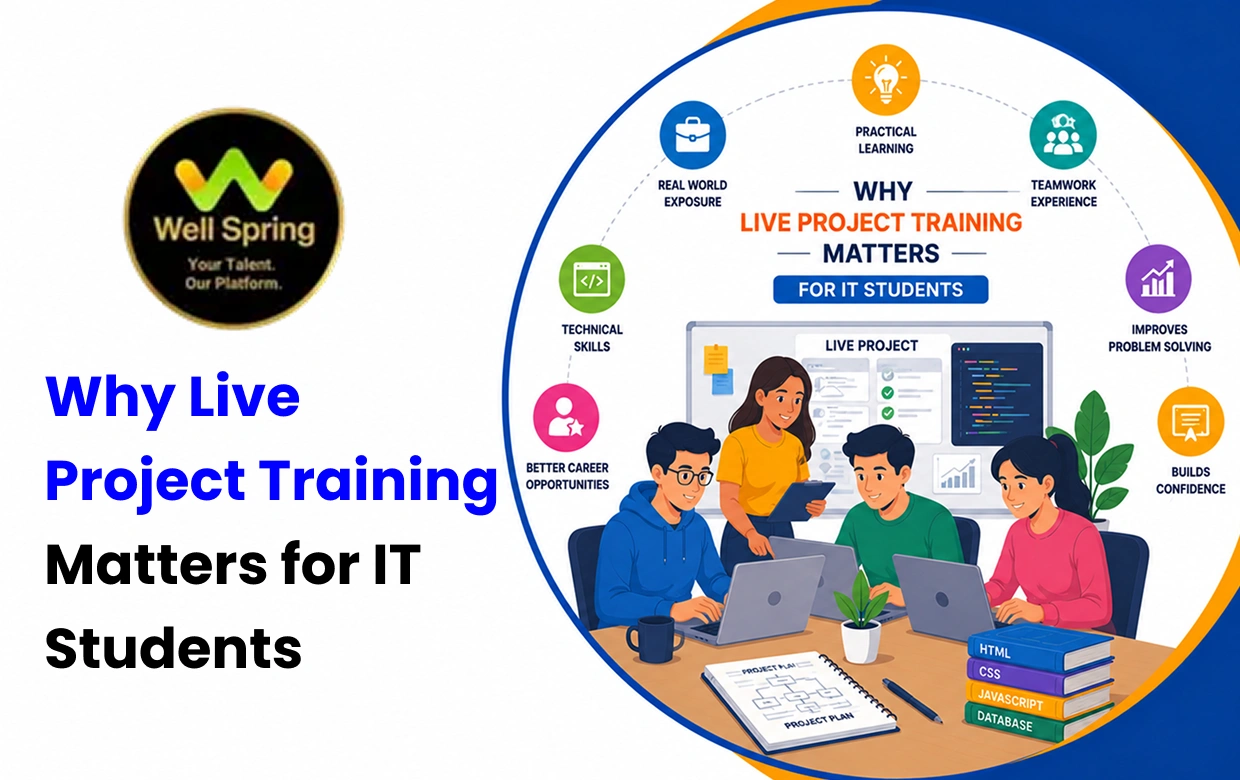
Learning programming languages and completing classroom exercises can build a technical foundation, but IT careers also require students to know how to apply those skills. Live Project Training gives students practical exposure to realistic development tasks, problem-solving, debugging, teamwork, and project delivery. Through Hands-On IT Training, learners can connect theory with implementation and build evidence of what they can actually do. This article explains why Practical IT Training, Real-World Projects in IT Training, and Project-Based IT Learning are valuable for students, fresh graduates, and aspiring software developers preparing for careers in Trichy, Tamil Nadu, and the wider technology industry.
Live Project Training matters for IT students because it turns theoretical knowledge into practical experience. Students learn to understand requirements, write and test code, work with databases and APIs, debug errors, use development tools, and complete project features. This experience can improve technical confidence, problem-solving ability, teamwork, portfolio quality, and interview readiness. For students entering a competitive technology market, combining academic knowledge with practical projects can provide a stronger foundation for career development.
For many IT students, the learning journey begins with programming languages, frameworks, databases, and theoretical concepts. These fundamentals are essential. However, knowing a concept and being able to use it to solve a practical problem are two different skills.
A student may understand Java syntax but struggle to develop a complete application. Another student may know SQL commands but find database integration challenging when building a real system.
This is where Live Project Training becomes valuable.
Instead of learning only through lectures and predefined exercises, students work through realistic development tasks. They learn how requirements become features, how different technologies connect, how bugs are investigated, and how a project evolves into a usable application.
For students and fresh graduates in Trichy, Well Spring Talent Solutions focuses on practical, career-oriented learning that can help bridge the gap between academic knowledge and workplace expectations.
Live Project Training is a practical learning approach in which students develop projects based on realistic requirements, business scenarios, or real-world use cases.
A typical project may involve:
For example, instead of learning database operations only through isolated exercises, a student could use SQL while developing a student management system. This creates a practical reason to understand tables, relationships, queries, validation, and data handling.
The learning becomes more connected because each technical concept contributes to a larger solution.
Theoretical learning explains what a technology does. Projects help students understand how and when to use it.
A learner studying Python, for example, can apply functions, classes, file handling, databases, APIs, and error handling within one application. This makes individual concepts easier to understand in context.
Hands-On IT Training requires students to actively participate.
Instead of only watching an instructor demonstrate a feature, learners write code, test it, make mistakes, investigate errors, and improve their implementation.
Repeated practice can make development tools and workflows more familiar.
Professional development rarely involves perfect code on the first attempt.
Students may encounter:
Learning to investigate these problems helps students develop structured problem-solving skills.
Practical IT Training can help students understand the broader development process:
Requirement → Planning → Development → Testing → Debugging → Deployment → Maintenance
This perspective is important because professional developers work on complete solutions rather than isolated programming questions.
How Project-Based IT Learning Builds Career Readiness
Project-Based IT Learning allows students to combine several skills within one application.
Depending on the course, a project may involve:
For example, a full-stack student might build an e-commerce application containing user registration, product management, shopping-cart functionality, database integration, payment-related workflows, and an administrative dashboard.
The value is not simply completing the application. Students learn how different technical components work together.
1. Understand the Problem
Before writing code, identify the users, business objective, required features, and expected outcome.
2. Break the Project into Modules
Divide the application into manageable components such as authentication, dashboard, database, reports, and notifications.
3. Choose Appropriate Technologies
Use technologies that match the project's requirements rather than selecting tools simply because they are popular.
4. Build Incrementally
Develop one feature at a time. Test each component before moving to the next.
5. Debug Systematically
When something fails, identify the error, reproduce it, investigate the cause, test a solution, and verify the result.
6. Document Your Work
Record important technologies, architecture decisions, features, challenges, and solutions.
7. Present the Project
Students should be able to explain what they built, why they built it, and what they learned.
Watching tutorials continuously without creating projects can limit practical understanding.
Solution: Build small applications after learning each major concept.
Copied code may produce the desired output but does not develop independent problem-solving ability.
Solution: Understand every important section and modify features yourself.
Some students see bugs as failures rather than learning opportunities.
Solution: Treat debugging as an essential development skill.
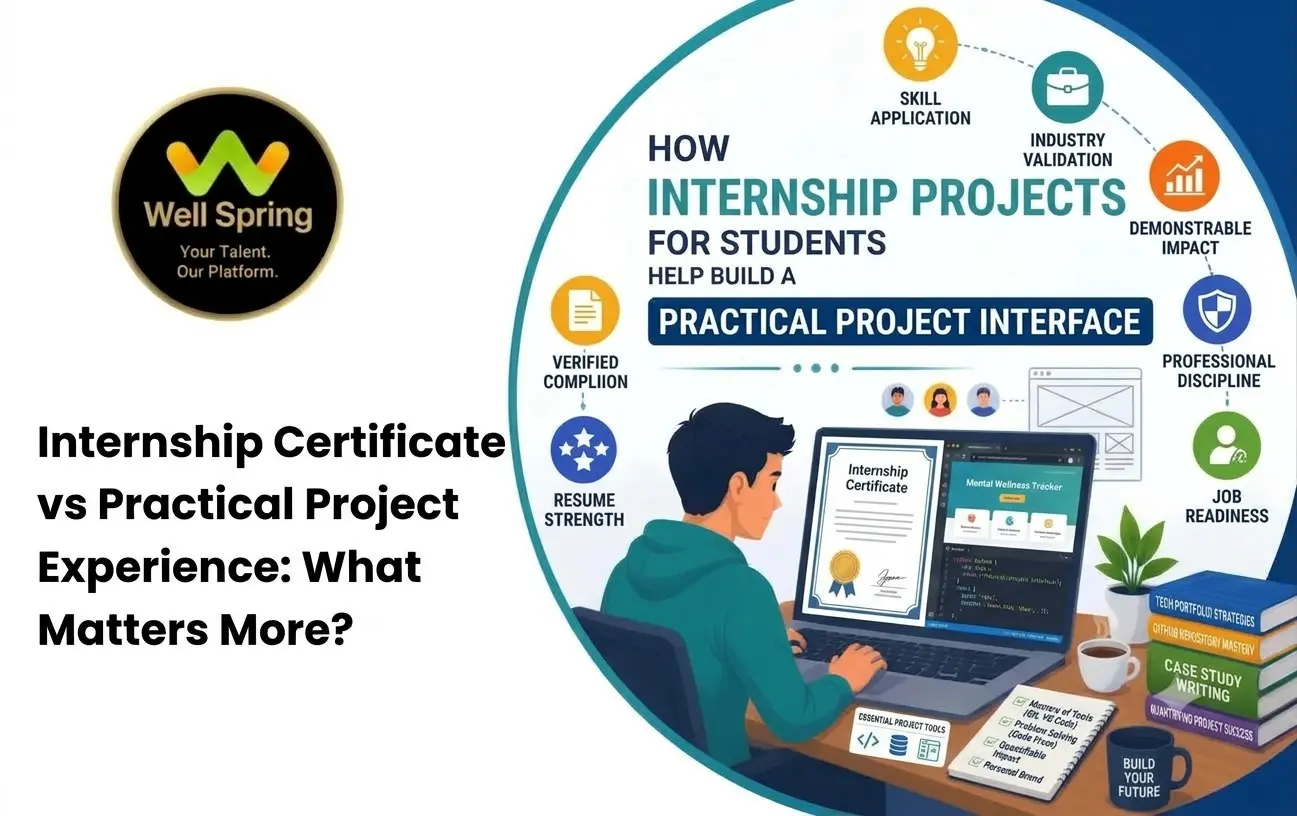
A certificate can show course completion, but it cannot replace genuine understanding.
Solution: Focus on what you can build, explain, test, and improve.
Using every popular framework in one project can make the application unnecessarily complex.
Solution: Start with a suitable technology stack and expand only when there is a clear requirement.
Technology is changing rapidly, making practical learning even more important.
The World Economic Forum Future of Jobs Report 2025 found that employers expect 39% of workers' core skills to change by 2030. It also identifies AI and big data, networks and cybersecurity, and technological literacy among the fastest-growing skill areas.
The report also projects 170 million jobs created and 92 million displaced globally by 2030, resulting in a net increase of 78 million jobs.
LinkedIn's 2025 Skills on the Rise analysis highlights changing skill requirements and identifies problem-solving, code review, strategic thinking, and innovative thinking among notable skills in India.
AI is also becoming part of practical education. In December 2025, IBM announced a commitment to skill 5 million learners in India in AI, cybersecurity, and quantum computing by 2030, including collaboration with AICTE around hands-on learning, hackathons, and internships.
These developments point toward an important lesson: students need more than static knowledge. They need the ability to apply technology, adapt to new tools, solve problems, and continue learning.
Well Spring Talent Solutions can help address this gap through industry-oriented learning, practical assignments, projects, internships, mentoring, and career preparation.
To get maximum value from Live Project Training:
For students in Trichy, choosing training based only on course duration or certification may not provide enough career value. A stronger approach is to look at how much practical exposure the program provides.
Well Spring Talent Solutions emphasizes an industry-oriented learning approach that can include:
The objective is not simply to help students complete a course. It is to help them understand how their skills can be applied in practical development environments.
|
Traditional Learning |
Industry-Oriented Training |
|
Focuses strongly on concepts |
Combines concepts with implementation |
|
Often uses predefined exercises |
Uses practical project requirements |
|
Limited debugging exposure |
Regular troubleshooting |
|
Individual topics may be studied separately |
Multiple technologies are integrated |
|
Less project evidence |
Builds demonstrable project experience |
|
Interview preparation may be theoretical |
Project discussions can support interview preparation |
|
Limited exposure to workflows |
Introduces development and testing workflows |
Both approaches have value. Strong IT education should combine technical fundamentals with practical application.
Statistics: Why Skills and Practical Learning Matter
Current data reinforces the need for continuous skill development:
These statistics do not mean every student needs to master every emerging technology. They show why building adaptable, practical skills is increasingly important.
What is Live Project Training for IT students?
Live Project Training is practical learning in which students work on realistic software requirements and build functional solutions. Instead of studying programming concepts independently, learners apply them through development tasks such as database integration, API usage, testing, debugging, and feature implementation. The approach can help students understand the software development lifecycle and develop project experience before applying for internships or entry-level IT positions.
Is Live Project Training useful for freshers?
Yes. Live Project Training can be particularly useful for freshers because they may have limited professional experience. A completed project gives them something concrete to demonstrate during interviews. Students can explain the project's objective, technologies, features, challenges, and solutions. This can make their technical knowledge easier for recruiters to evaluate while also helping the student become more confident when discussing development work.
Why do real-world projects matter in IT training?
Real-World Projects in IT Training matter because professional software development involves more than writing isolated programs. Developers must understand requirements, integrate technologies, test applications, troubleshoot problems, communicate with others, and improve solutions. Project-based learning introduces students to these activities in a structured environment and helps connect theoretical knowledge with practical implementation.
Can projects improve IT interview preparation?
Projects can provide useful material for technical interviews. Candidates may be asked how their application works, why they selected a technology, how their database was designed, what bugs they encountered, and how they solved them. Students who genuinely developed their projects are generally better positioned to explain these decisions than students who only list technologies without practical experience.
Should students learn theory before doing projects?
Students need both theory and practice. Fundamental concepts provide the foundation needed to understand why a solution works, while projects provide opportunities to apply those concepts. A good learning cycle is learn → build → test → debug → improve. Students should avoid waiting until they know everything before starting projects because practical development itself reveals which concepts require deeper study.
Students in Trichy, Tamil Nadu, and other parts of South India have access to a growing range of technology-learning opportunities. However, selecting training based on practical exposure is important.
For local students, industry-focused training can provide a structured environment to learn programming, software development, full-stack technologies, Java, Python, databases, testing, and other digital skills.
Internships and project work can also help students become familiar with professional expectations before they enter the job market.
For learners looking for practical IT training in Trichy, Well Spring Talent Solutions combines technical learning with projects, internships, mentoring, career guidance, and placement-oriented preparation.
What is Live Project Training?
It is practical training where learners apply technical concepts to realistic projects and development tasks.
Why is Live Project Training important?
It helps students connect theory with implementation, develop problem-solving skills, and gain project experience.
Who should join Live Project Training?
College students, fresh graduates, beginners, interns, and aspiring IT professionals can benefit.
How does project-based learning help careers?
It can improve practical skills, confidence, portfolio quality, technical communication, and interview readiness.
Is Live Project Training worth it?
It can be worthwhile when the training provides genuine hands-on development, mentoring, debugging practice, and meaningful project work rather than only demonstrations or certificates.
Learning an IT technology is only the first step toward becoming job-ready. Students also need opportunities to apply what they learn, make mistakes, solve problems, and understand how complete applications are developed.
That is why Live Project Training matters for IT students.
Through Hands-On IT Training, Practical IT Training, and Project-Based IT Learning, students can move beyond memorising concepts and start developing practical technical capability. Real-world projects can also provide valuable material for portfolios, resumes, and technical interviews.
For students in Trichy and across Tamil Nadu, Well Spring Talent Solutions provides an industry-oriented learning environment focused on practical skills, projects, internships, expert mentoring, career guidance, and placement preparation.
The strongest IT career foundation is not simply knowing a technology. It is being able to use that technology to understand problems, build solutions, explain your work, and continue learning as the industry evolves.
15 Oct 2026
15 Oct 2026
14 Oct 2026
14 Oct 2026

13 Oct 2026
Students should look for training that includes genuine coding practice, realistic requirements, project planning, database or API integration, testing, debugging, mentor feedback, and project presentation. It is also useful when training includes resume and interview preparation. A certificate can be an additional benefit, but students should prioritise the quality of practical learning and whether they can independently explain and demonstrate the project they completed.
There is no fixed number that applies to every candidate. One or two well-developed, relevant projects can be more valuable than many incomplete or copied applications. A fresher should ideally select projects that demonstrate the skills required for the target role. Each project should clearly explain its objective, technologies, important features, responsibilities, and challenges. Students should also be prepared to demonstrate or explain their work during interviews.
Yes. Beginners can benefit from project-based learning when the program is structured progressively. They should first learn the fundamentals required for the technology and then apply those concepts through increasingly practical tasks. Good mentoring is important because beginners may encounter unfamiliar errors or development concepts. Starting with smaller applications before progressing to complete projects can make the learning experience more manageable.
They are related but not identical. An internship is a broader professional learning experience that may include project work, team activities, meetings, documentation, testing, and workplace processes. Live Project Training focuses more specifically on applying technical skills through practical project development. A strong internship program may incorporate live projects so students can gain both technical experience and exposure to professional workflows.
Project training helps students practise skills that remain useful across changing technologies: understanding requirements, coding, debugging, testing, documentation, communication, collaboration, and problem-solving. It can also encourage learners to adapt to new tools such as AI-assisted development platforms. Because technology changes quickly, students benefit from learning how to learn, experiment, evaluate solutions, and continuously improve their technical skills—not simply memorising one technology stack.
Get internship updates, IT training news, placement opportunities, and career tips directly to your inbox.
Join our WhatsApp community for internship updates, IT courses, placement support, and latest job opportunities.
Join Now