Blog Details
Home Blog Details

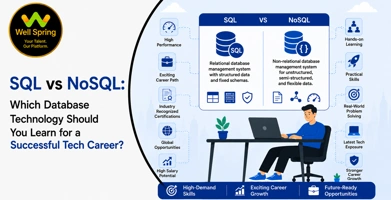
Choosing between SQL vs NoSQL is one of the most important decisions for students, aspiring software developers, database administrators, data analysts, and backend engineers. Databases are the backbone of modern applications, powering everything from banking systems and e-commerce websites to social media platforms and cloud applications. While SQL databases have been the industry standard for decades because of their structured design and reliability, NoSQL databases have gained immense popularity due to their flexibility, scalability, and ability to manage massive volumes of unstructured data.
This comprehensive guide compares SQL vs NoSQL, covering their architecture, career opportunities, salaries, industry demand, required skills, latest 2026 trends, and future scope. Whether you're planning to enroll in a SQL Course in Trichy, explore a NoSQL Database Tutorial, or join a Database Management Course, this guide will help you choose the right database technology for your career.
If you want to build a strong foundation in databases, software development, and data analytics, SQL is the best technology to learn first. If you're interested in big data, cloud applications, high-performance web platforms, and distributed systems, learning NoSQL will significantly expand your career opportunities.
Both technologies are essential in 2026. SQL remains the preferred choice for structured business applications and financial systems, while NoSQL powers modern cloud-native applications, social media platforms, IoT, and large-scale web services.
SQL vs NoSQL compares relational and non-relational database technologies.
SQL databases organize data into structured tables with predefined schemas.
NoSQL databases store structured, semi-structured, and unstructured data with flexible schemas.
SQL remains the foundation of software development and data analytics.
NoSQL excels in handling massive datasets and scalable cloud applications.
Practical database projects are highly valued by employers.
Cloud computing has accelerated the adoption of NoSQL databases.
Learning both SQL and NoSQL provides excellent long-term career flexibility.
Every modern application depends on databases to store, manage, retrieve, and process information. Whether you're ordering food online, transferring money through a banking application, booking flight tickets, streaming movies, or shopping on an e-commerce website, databases work silently behind the scenes to ensure everything functions efficiently.
As organizations generate enormous volumes of structured and unstructured data, choosing the right database technology has become a critical business decision.
According to Statista, the global volume of data created, captured, copied, and consumed is expected to exceed 180 zettabytes by 2025, reflecting the rapid growth of digital information. Additionally, Grand View Research estimates that the global database management system market will continue expanding significantly throughout the decade, driven by cloud computing, artificial intelligence, and digital transformation initiatives.
These trends have dramatically increased the demand for database professionals who understand both SQL and NoSQL technologies.
This growing demand has made SQL vs NoSQL one of the most searched comparisons among students and IT professionals.
Many aspiring developers ask:
The answer depends on your career goals and the types of applications you want to build.
If you enjoy structured data, financial applications, business systems, and analytics, SQL is the ideal starting point.
If you're interested in scalable web applications, cloud platforms, IoT, artificial intelligence, and big data, NoSQL provides outstanding opportunities.
At Well Spring Talent Solutions, students receive practical, industry-oriented training through live database projects, backend application development, expert mentorship, interview preparation, internships, and placement assistance. Whether enrolling in a SQL Course in Trichy or a Database Management Course, learners gain hands-on experience aligned with today's software industry.
Every organization today depends on data to operate efficiently. Databases support business operations, customer management, financial transactions, cloud applications, analytics, and enterprise software.
Industries actively hiring database professionals include:
Database professionals help organizations:
As organizations continue generating and analyzing large volumes of data, database professionals remain among the most valuable technology specialists.
Many students believe database technologies are only useful for Database Administrators.
In reality, SQL and NoSQL skills are required across numerous technology roles.
Employers commonly seek database expertise in:
Candidates who demonstrate practical database design, query optimization, API integration, and real-world projects often stand out during technical interviews.
This is why practical database projects are as valuable as certifications.
SQL (Structured Query Language) is the standard language used to create, manage, retrieve, and manipulate data stored in relational databases.
SQL databases organize information into structured tables containing rows and columns, ensuring data consistency through predefined schemas and relationships.
Popular SQL database management systems include:
SQL databases are widely used for:
Because of their reliability, consistency, and support for ACID transactions, SQL databases remain the preferred choice for mission-critical business applications.
A professional SQL Course in Trichy prepares students with practical database management skills required across multiple IT careers.
Students typically learn:
Students also build real-world database applications and perform complex query development using business datasets.
SQL professionals are employed across almost every technology-driven organization because structured databases remain essential for business operations.
Common employers include:
SQL remains one of the most universally required technical skills in the IT industry.
Despite the rapid growth of NoSQL databases, SQL continues to dominate enterprise software because structured data remains critical for business operations.
Organizations use SQL to:
Because nearly every organization depends on relational databases, SQL professionals continue to enjoy excellent long-term career opportunities.
NoSQL (Not Only SQL) is a non-relational database technology designed to store, manage, and process large volumes of structured, semi-structured, and unstructured data. Unlike SQL databases, NoSQL databases do not require a fixed schema, making them highly flexible and scalable for modern cloud-based applications.
As businesses generate massive amounts of data from mobile apps, IoT devices, social media platforms, streaming services, and AI systems, NoSQL databases have become essential for handling rapidly changing and high-volume datasets.
Popular NoSQL databases include:
NoSQL databases are commonly used in:
Their ability to scale horizontally makes them ideal for modern distributed systems.
A practical NoSQL Database Tutorial introduces students to modern database concepts used in cloud-native and large-scale applications.
Students typically learn:
NoSQL Fundamentals
Document Databases
Key-Value Databases
Column-family Databases
Graph Databases
MongoDB
CRUD Operations
Collections & Documents
Indexing
Aggregation Framework
Data Modeling
Replication
Sharding
Performance Optimization
Cloud Database Integration
Students also work on practical projects involving modern web applications, APIs, and cloud databases.
NoSQL professionals are highly valued in organizations managing large-scale distributed systems and cloud applications.
Common employers include:
Cloud Computing Companies
SaaS Companies
Social Media Platforms
E-commerce Organizations
AI Startups
FinTech Companies
Gaming Companies
Streaming Services
Mobile App Development Firms
Big Data Organizations
Digital Marketing Platforms
Global Technology Companies
With cloud-native development becoming the industry standard, NoSQL expertise continues to grow in demand.
Modern applications require databases capable of handling millions of concurrent users and massive amounts of rapidly changing data.
Organizations use NoSQL to:
Scale cloud applications
Manage big data
Store user activity
Support AI applications
Handle IoT devices
Improve application performance
Enable real-time analytics
Reduce infrastructure bottlenecks
As businesses continue adopting cloud computing and microservices architecture, NoSQL databases play a crucial role in modern software development.
Although both technologies manage data, they are designed for different types of applications and workloads.
|
Feature |
SQL |
NoSQL |
|
Database Type |
Relational |
Non-relational |
|
Schema |
Fixed |
Flexible |
|
Data Structure |
Tables & Rows |
Documents, Key-Value, Graphs, Columns |
|
Scalability |
Vertical Scaling |
Horizontal Scaling |
|
Transactions |
ACID |
BASE (varies by database) |
|
Best For |
Structured Business Data |
Large-scale Distributed Data |
|
Query Language |
SQL |
Database-specific APIs & Queries |
|
Cloud Applications |
Supported |
Excellent |
|
Performance |
Excellent for structured queries |
Excellent for high-volume workloads |
Both technologies remain essential because different business applications require different database architectures.
Many students search specifically for SQL vs NoSQL Differences before choosing a database technology.
Rather than replacing SQL, NoSQL complements it by solving scalability challenges that traditional relational databases were not originally designed to address.
Many beginners ask Which is Better SQL or NoSQL?
There isn't a universal answer because both technologies solve different business problems.
Choose SQL if you enjoy:
Choose NoSQL if you enjoy:
Learning SQL first provides a strong database foundation before progressing to NoSQL technologies.
Database professionals continue to enjoy excellent salary growth worldwide.
|
Job Role |
Salary Growth Potential |
|
SQL Developer |
High |
|
Database Administrator |
Very High |
|
Backend Developer |
Very High |
|
NoSQL Database Engineer |
Very High |
|
Database Architect |
Excellent |
|
Cloud Database Engineer |
Excellent |
|
Data Engineer |
Outstanding |
Salary depends on:
Professionals with expertise in SQL, NoSQL, cloud databases, and backend development often command the highest salaries.
Skills Required for SQL Professionals
Successful SQL professionals typically master:
SQL Queries
MySQL
PostgreSQL
SQL Server
Oracle Database
Database Design
Normalization
Indexing
Stored Procedures
Transactions
Query Optimization
Database Security
Backup & Recovery
Data Analytics
Professional NoSQL developers generally master:
MongoDB
Cassandra
Redis
Firebase
Document Databases
Data Modeling
Replication
Sharding
API Integration
Cloud Databases
JSON
Backend Development
Distributed Systems
Performance Optimization
Many students directly learn MongoDB or Firebase without understanding relational database concepts.
SQL fundamentals remain valuable regardless of specialization.
Poor database design leads to inefficient applications.
Students should understand relationships, indexing, normalization, and schema planning.
Database professionals should also understand:
Employers prefer candidates who have developed:
Modern applications increasingly use cloud-managed databases such as Amazon RDS, Azure SQL Database, MongoDB Atlas, and Firebase.
Understanding cloud databases significantly improves career opportunities.
Database technologies continue evolving rapidly.
Major trends include:
Cloud-native Databases
AI-assisted Database Optimization
Vector Databases for Generative AI
Serverless Databases
Multi-model Databases
Real-time Analytics
Distributed SQL
Edge Databases
Database Automation
Data Lakehouses
Database Security Automation
Hybrid Database Architectures
Database Observability
Professionals who combine database expertise with cloud computing and AI technologies will remain highly competitive.
Students looking for an industry-oriented SQL Course in Trichy or Database Management Course receive practical training aligned with today's software industry.
Training includes:
SQL
MySQL
PostgreSQL
MongoDB
Database Design
Query Optimization
Data Modeling
Backend Integration
Cloud Database Fundamentals
Live Database Projects
Portfolio Development
Internship Opportunities
Mock Interviews
Placement Assistance
Expert Mentorship
Students graduate with practical database development experience that prepares them for modern IT careers.
1. Learn SQL Before NoSQL
SQL provides the foundation for understanding database concepts and query optimization.
2. Practice Real Database Projects
Build applications involving customer management, e-commerce, healthcare, and inventory systems.
3. Learn Backend Integration
Databases become more valuable when integrated with backend technologies such as Node.js, Java, Python, or .NET.
4. Understand Cloud Databases
Learn services such as Amazon RDS, Azure SQL Database, MongoDB Atlas, and Firebase to prepare for cloud-based development.
5. Never Stop Learning
Explore emerging technologies such as vector databases, AI-powered data management, graph databases, and distributed SQL systems to stay ahead in the industry.
Which is better: SQL or NoSQL?
Both technologies are essential. SQL is ideal for structured business applications and transactional systems, while NoSQL is better suited for cloud-native applications, big data, and distributed systems.
Is SQL easier than NoSQL?
For beginners, SQL is generally easier to learn because it follows a standardized query language and structured database model.
Can I learn SQL and NoSQL together?
Yes. Many organizations use both relational and non-relational databases. Learning SQL first and then NoSQL provides a comprehensive database skill set.
Is SQL still in demand in 2026?
Absolutely. SQL remains one of the most widely used technologies in software development, data analytics, business intelligence, and enterprise applications.
Do backend developers need SQL?
Yes. Most backend developers work with relational databases, NoSQL databases, or both, making database knowledge a fundamental skill.
The demand for database professionals continues to grow across Trichy, Madurai, Thanjavur, Karur, Dindigul, Pudukkottai, Ariyalur, Perambalur, and other regions of Tamil Nadu. Software companies, fintech organizations, healthcare providers, e-commerce businesses, and cloud service providers are actively hiring professionals with expertise in SQL, NoSQL, database design, and backend development.
At Well Spring Talent Solutions, students receive practical training through a SQL Course in Trichy, Database Management Course, and hands-on NoSQL Database Tutorial sessions featuring live database projects, expert mentorship, internships, interview preparation, and placement assistance.
What is the difference between SQL and NoSQL?
SQL databases store structured data in relational tables using predefined schemas, while NoSQL databases store structured, semi-structured, and unstructured data using flexible schemas designed for scalability.
Which database technology has better job opportunities?
Both SQL and NoSQL offer excellent career opportunities. SQL remains essential for enterprise software, finance, and analytics, while NoSQL is increasingly used in cloud computing, AI, and large-scale web applications.
Which database should beginners learn first?
SQL is generally recommended as the first database technology because it provides a strong understanding of database design, querying, and data relationships before moving to NoSQL.
Is NoSQL replacing SQL?
No. SQL and NoSQL serve different purposes. Many modern applications use both technologies together depending on business requirements and data architecture.
Is database management a good career in 2026?
Yes. Database management continues to be a highly rewarding career as organizations increasingly rely on cloud computing, AI, analytics, and digital transformation, all of which depend on efficient data management.
SQL vs NoSQL compares relational and non-relational database technologies designed for different use cases.
SQL remains the foundation of software development, analytics, and enterprise business applications.
NoSQL excels in cloud-native development, big data, and highly scalable applications.
Learning SQL first builds a strong database foundation before progressing to NoSQL.
Practical database projects and cloud database experience significantly improve employability.
Professionals skilled in SQL, NoSQL, and cloud databases enjoy outstanding long-term career opportunities.
Choosing between SQL vs NoSQL isn't about selecting one technology over the other—it's about understanding where each database excels. SQL remains the backbone of structured business applications, financial systems, and analytics, while NoSQL powers modern cloud-native applications, social media platforms, IoT, and AI-driven systems.
At Well Spring Talent Solutions, students receive industry-oriented training through live database projects, backend development, internships, expert mentorship, interview preparation, and placement assistance. Whether you choose a SQL Course in Trichy, explore a NoSQL Database Tutorial, or enroll in a Database Management Course, you'll gain the practical skills needed to build a successful career in modern software development.
Start learning today and build a strong foundation in one of the most essential technologies powering the digital world.
15 Oct 2026
15 Oct 2026

14 Oct 2026
14 Oct 2026
13 Oct 2026
Both technologies offer excellent career opportunities. SQL is widely used in enterprise software, banking, healthcare, and analytics, while NoSQL is increasingly adopted in cloud computing, AI, IoT, and high-scale web applications.
Yes. Learning both technologies is highly recommended because many organizations use relational databases alongside NoSQL databases to meet different business and technical requirements.
Yes. Understanding SQL helps build a strong foundation in database concepts, relationships, indexing, and query optimization, making it easier to understand NoSQL architectures later.
Yes. Employers often prioritize candidates who can demonstrate practical database projects, backend integrations, query optimization, and real-world application development. Certifications enhance credibility, but hands-on experience showcases your technical skills.
Begin by learning SQL fundamentals, database design, and query optimization. Then explore NoSQL technologies such as MongoDB, work on real-world database projects, integrate databases with backend applications, learn cloud database services, and enroll in an industry-oriented training program that provides live projects, internships, mentorship, and placement assistance.
Get internship updates, IT training news, placement opportunities, and career tips directly to your inbox.
Join our WhatsApp community for internship updates, IT courses, placement support, and latest job opportunities.
Join Now