Blog Details
Home Blog Details
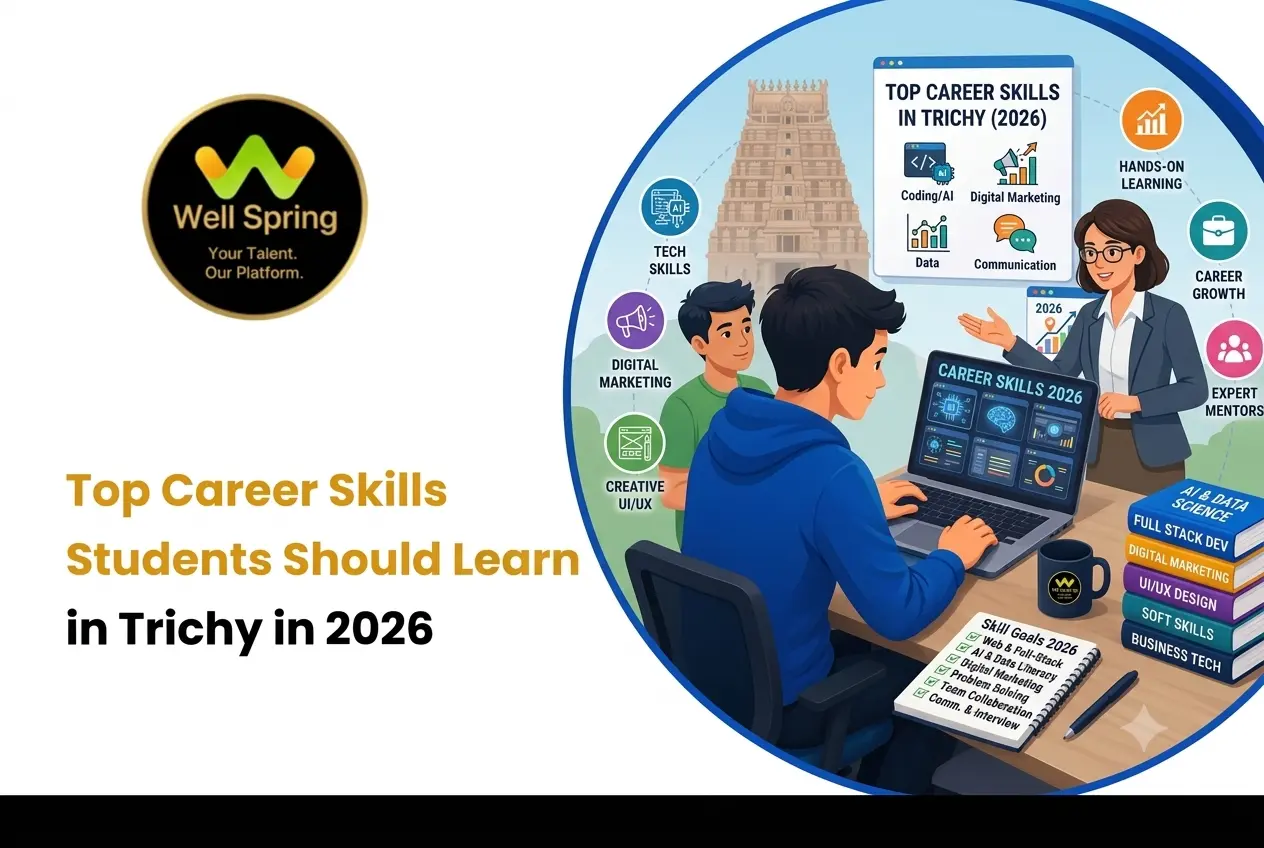
The future workplace is changing rapidly due to Artificial Intelligence, automation, digital transformation, and evolving employer expectations. Academic qualifications alone are no longer enough; students need practical abilities that help them adapt and succeed.
Student Skill Development plays an important role in preparing learners for modern careers by improving technical knowledge, communication abilities, creativity, and problem-solving skills. This guide explains the most important Future Skills for Students, including Career Skills 2026, Emerging Skills, and Skills for Future Jobs that can improve employability.
Learn how Well Spring Talent Solutions in Trichy helps students develop industry-ready skills through practical training, internships, mentorship, and career-focused programmes.
Future skills are the abilities students need to succeed in changing industries and future workplaces. They include technical skills, Artificial Intelligence knowledge, communication, adaptability, creativity, leadership, and problem-solving.
Effective Student Skill Development helps learners become career-ready by improving confidence, employability, and workplace performance. The most valuable Career Skills 2026 combine digital knowledge with human skills such as teamwork, emotional intelligence, and continuous learning.
Student Skill Development helps students prepare for future career opportunities.
Technology skills are becoming essential across almost every industry.
Communication and teamwork remain critical workplace abilities.
Future Skills for Students improve confidence and employability.
Emerging Skills help learners stay competitive in changing job markets.
Employers value practical abilities along with academic qualifications.
Skills for Future Jobs require a combination of technical and soft skills.
The career landscape is changing faster than ever before. New technologies, Artificial Intelligence, automation, and digital platforms are transforming the way companies operate and the skills they expect from employees.
Many students focus mainly on academic marks and qualifications. While education provides a strong foundation, modern employers increasingly look for candidates who can solve problems, communicate effectively, work with technology, and adapt to new situations.
This makes Student Skill Development essential for career success.
Students who develop the right skills early gain a competitive advantage during internships, interviews, and job opportunities. They become more confident and better prepared for professional environments.
At Well Spring Talent Solutions in Trichy, Tamil Nadu, students receive industry-focused training, practical learning opportunities, career guidance, and professional development programmes designed to build future-ready professionals.
Student Skill Development is the process of improving technical, professional, and personal abilities that help students succeed in education and careers.
It focuses on transforming theoretical knowledge into practical capability.
Student skill development includes:
Technical skill improvement
Communication development
Problem-solving ability
Digital literacy
Leadership qualities
Teamwork skills
Workplace behaviour
Career planning
In today's competitive job market, students need more than degrees. They need skills that demonstrate their ability to contribute effectively in professional environments.
Industries are evolving because of:
Job roles are continuously changing, and students need updated knowledge to remain relevant.
For example, a marketing student today may need knowledge of digital marketing tools, analytics platforms, and AI-based solutions along with traditional marketing concepts.
Students with strong professional skills often have better career opportunities because they can demonstrate practical abilities.
Future skills help students:
Many fresh graduates experience uncertainty when entering professional environments.
Skill development improves:
Students who gain practical exposure feel more prepared for workplace challenges.
Technology and industries continue to change. A skill that is valuable today may become outdated tomorrow.
Continuous learning helps students:
Artificial Intelligence is becoming one of the most important Emerging Skills across industries.
Students do not need to become AI specialists in every field, but understanding AI applications can provide a major advantage.
Students should learn:
AI knowledge helps students work smarter and adapt to technology-driven workplaces.
Communication remains one of the most valuable Career Skills 2026.
Employers need professionals who can explain ideas clearly and collaborate effectively.
Students should improve:
Strong communication helps students perform better in interviews, meetings, and workplace discussions.
Companies need employees who can analyse situations and find practical solutions.
Problem-solving is one of the most important Skills for Future Jobs.
Students can develop critical thinking through:
A problem-solving mindset helps professionals handle challenges effectively.
Future workplaces will continue changing because of technology and business transformation.
Adaptability helps students:
Flexible professionals often have stronger career growth opportunities.
Data plays an important role in modern businesses.
Students across different fields can benefit from understanding data.
Important skills include:
Data skills are valuable in technology, business, finance, healthcare, and marketing careers.
Leadership skills are not limited to managers. Students can develop leadership abilities from the beginning of their careers.
Important leadership qualities include:
Leadership development improves confidence and professional growth.
Emotional intelligence helps students understand themselves and interact better with others.
It includes:
Companies value employees who can maintain positive professional relationships.
Creativity helps professionals develop new ideas and solutions.
Students can improve creativity through:
Creative thinking helps students stand out in competitive industries.
Modern organisations depend on teamwork.
Students should learn:
Teamwork is essential for workplace success.
The ability to keep learning is one of the most important future skills.
Students should develop habits such as:
Continuous learning creates long-term career advantages.
College Learning:
Future Skill Development:
College Learning:
Future Skill Development:
College Learning:
Future Skill Development:
Students should first understand:
Career clarity helps create an effective learning plan.
Students should focus on skills connected to their career goals.
Examples:
Technical knowledge alone is not enough.
Students should develop:
Practical exposure strengthens learning.
Students should participate in:
A portfolio helps students demonstrate their abilities.
Include:
Students become more attractive to employers because they demonstrate practical abilities.
Skills help students communicate and perform better professionally.
Students understand workplace expectations before entering jobs.
Future-ready professionals handle industry changes more effectively.
Continuous learning supports long-term professional success.
|
Common Mistake |
Solution |
|
Focusing only on academics |
Develop practical skills |
|
Ignoring communication |
Practice professional conversations |
|
Learning outdated skills |
Follow industry trends |
|
Avoiding technology |
Improve digital knowledge |
|
Not practising skills |
Build projects regularly |
|
No career planning |
Create a skill roadmap |
Artificial Intelligence and automation are influencing almost every industry.
Students are increasingly expected to understand:
Many employers are moving beyond only academic qualifications.
Recruiters increasingly evaluate:
Businesses require professionals who can work with modern digital tools.
Digital skills are becoming valuable across:
Internships and practical projects are becoming important career preparation methods.
Students gain:
Although technology is growing, human skills remain essential.
Employers continue to value:
Developing future skills requires consistent effort and practical action. Students can improve their career readiness by following these strategies:
Students should understand the skills required for their target career and focus on learning tools, technologies, and professional practices used by industries.
Examples:
Internships provide valuable workplace exposure before graduation.
Students can gain:
Workplace confidence
Internships help students connect classroom learning with real professional situations.
Projects allow students to demonstrate their abilities.
Students should create:
Practical work helps employers understand a student's capabilities beyond academic marks.
Professional success depends heavily on communication.
Students should practise:
Workplace conversations
Strong communication improves interview performance and career growth.
Students should stay updated with changes in their fields.
Useful methods include:
Continuous awareness helps students develop relevant Career Skills 2026.
Well Spring Talent Solutions in Trichy, Tamil Nadu, helps students prepare for modern career opportunities through industry-focused learning and professional development.
The academy focuses on reducing the gap between academic education and workplace requirements by providing practical and career-oriented programmes.
Students benefit from:
Students learn skills aligned with current industry expectations. Training focuses on practical understanding rather than only theoretical concepts.
Students gain experience through:
This improves confidence and workplace readiness.
Internships help students understand professional environments and gain valuable industry exposure before graduation.
Experienced mentors guide students in:
Skill development
Career planning
Industry expectations
Professional growth
Students receive support in identifying suitable career paths based on their interests, abilities, and industry opportunities.
Career support helps students improve:
Resume quality
Professional presentation
Communication skills
|
Traditional Learning |
Future Skill Development |
|
Focuses mainly on theory |
Focuses on practical abilities |
|
Academic knowledge-based |
Career skill-based |
|
Exam-oriented evaluation |
Skill demonstration-based evaluation |
|
Limited industry exposure |
Real-world experience |
|
Fixed curriculum |
Continuous learning |
|
Degree-focused approach |
Employment-focused approach |
|
Source |
Key Insight |
|
World Economic Forum – Future of Jobs Report |
Analytical thinking, resilience, technology skills, and lifelong learning remain important workplace capabilities. |
|
LinkedIn Learning Reports |
Continuous learning and skill development are increasingly important for career growth. |
|
NASSCOM |
India’s technology sector continues to require professionals with digital and industry-relevant skills. |
|
National Skill Development Corporation (NSDC) |
Skill development initiatives support workforce readiness and employability. |
|
Deloitte Workforce Research |
Organisations increasingly value adaptable employees with strong professional skills. |
Several trusted organisations highlight the growing importance of skill development, digital knowledge, and adaptability in modern careers.
Do not wait until graduation to develop professional skills. Early preparation creates better career opportunities.
Technical abilities help students perform tasks, while communication and teamwork help them succeed professionally.
Internships, projects, and practical training provide valuable exposure that improves employability.
Set regular goals for learning new technologies, tools, and professional skills.
Maintain a portfolio that highlights:
What are the most important future skills for students in 2026?
The most important future skills for students in 2026 include Artificial Intelligence knowledge, digital literacy, communication skills, problem-solving ability, adaptability, teamwork, creativity, and leadership. These skills help students handle changing workplace expectations and improve their career opportunities. Developing both technical and human-centred skills allows students to become more prepared for future jobs across different industries.
Why is Student Skill Development important for career success?
Student Skill Development is important because employers increasingly look for candidates who can apply knowledge practically. Skill development improves confidence, workplace readiness, communication ability, and problem-solving skills. Students who develop professional skills along with academic qualifications can perform better during internships, interviews, and employment opportunities.
How can students learn Emerging Skills?
Students can learn Emerging Skills through industry training programmes, internships, online courses, workshops, practical projects, and mentorship. They should identify skills relevant to their career goals and continuously improve them. Learning technologies such as AI tools, digital platforms, and analytical methods can help students stay competitive in changing industries.
Which Skills for Future Jobs should students focus on?
Students should focus on a combination of technical and professional skills. Important Skills for Future Jobs include Artificial Intelligence awareness, digital skills, communication, critical thinking, creativity, teamwork, adaptability, and leadership. These abilities help professionals manage workplace challenges and contribute effectively to organisations.
Are future skills necessary before graduation?
Yes. Developing future skills before graduation gives students an advantage during internships, campus placements, and job searches. Early skill development helps students understand workplace expectations, gain confidence, build portfolios, and demonstrate practical abilities to employers.
Students in Trichy and across Tamil Nadu are increasingly focusing on skill development programmes that prepare them for competitive job markets.
Well Spring Talent Solutions helps students develop career-ready abilities through:
Students from engineering, arts, commerce, management, and other backgrounds can benefit from learning Future Skills for Students that match modern industry expectations.
By combining practical knowledge with professional skills, students in Trichy and South India can improve their employability and career confidence.
What is Student Skill Development?
Student Skill Development is the process of improving technical, professional, and personal abilities that help students succeed in education and careers. It includes communication skills, digital knowledge, problem-solving, leadership, and workplace skills.
Why are future skills important for students?
Future skills help students adapt to changing industries, improve employability, and prepare for modern workplace challenges. They allow learners to combine academic knowledge with practical abilities required by employers.
Who should learn Emerging Skills?
College students, fresh graduates, job seekers, and professionals who want to improve their career opportunities should learn Emerging Skills. These skills help individuals remain competitive in technology-driven industries.
How do future skills improve career growth?
Future skills improve career growth by increasing confidence, improving workplace performance, and helping professionals adapt to new opportunities. Students with strong skills can demonstrate greater value to employers.
Is learning future skills worth it?
Yes. Learning future skills is valuable because industries continue to change. Students who continuously upgrade their abilities can access better career opportunities and remain prepared for future workplace demands.
Student Skill Development is essential for career success in changing industries.
Future workplaces require both technical and human skills.
Career Skills 2026 include AI knowledge, communication, adaptability, and problem-solving.
Emerging Skills help students remain competitive.
Practical experience improves confidence and employability.
Internships and projects strengthen professional readiness.
Continuous learning creates long-term career growth.
Skills for Future Jobs combine technology knowledge with professional abilities.
The future job market will reward students who can combine academic knowledge with practical skills. Degrees provide valuable foundations, but developing relevant abilities helps students become more confident, adaptable, and career-ready.
By focusing on Student Skill Development, learning important Career Skills 2026, and building Future Skills for Students, learners can improve their employability and prepare for changing industry expectations.
Well Spring Talent Solutions in Trichy helps students bridge the gap between education and employment through industry-focused training, internships, practical learning, mentorship, and career development programmes.
Developing the right skills today creates stronger career opportunities tomorrow.
24 Sep 2026
23 Sep 2026
23 Sep 2026
23 Sep 2026
22 Sep 2026
Every student should develop a combination of technical and professional skills. Important areas include AI awareness, digital literacy, communication, teamwork, problem-solving, creativity, leadership, and adaptability. These skills help students handle workplace challenges, improve confidence, and become more attractive to employers across different industries.
Skill development improves job opportunities by helping students demonstrate practical abilities beyond academic qualifications. Employers prefer candidates who can apply knowledge, solve problems, communicate effectively, and adapt to professional environments. Training, internships, and projects provide evidence of these abilities and improve interview performance.
Yes. AI skills are becoming valuable across many industries. Students do not always need advanced programming knowledge, but understanding AI tools, automation concepts, and digital applications can improve productivity and career opportunities. AI awareness is becoming an important part of modern professional development.
Academic learning focuses on concepts, theories, and qualifications, while future skill development focuses on applying knowledge practically. Skill development includes technical abilities, communication, teamwork, and workplace readiness. Combining both creates a stronger foundation for career success.
Students in Trichy can benefit from skill development programmes because they provide practical exposure, industry knowledge, internship opportunities, and career guidance. Programmes offered by training academies like Well Spring Talent Solutions help students develop the abilities required for modern industries and improve their employment readiness.
Get internship updates, IT training news, placement opportunities, and career tips directly to your inbox.
Join our WhatsApp community for internship updates, IT courses, placement support, and latest job opportunities.
Join Now