Blog Details
Home Blog Details

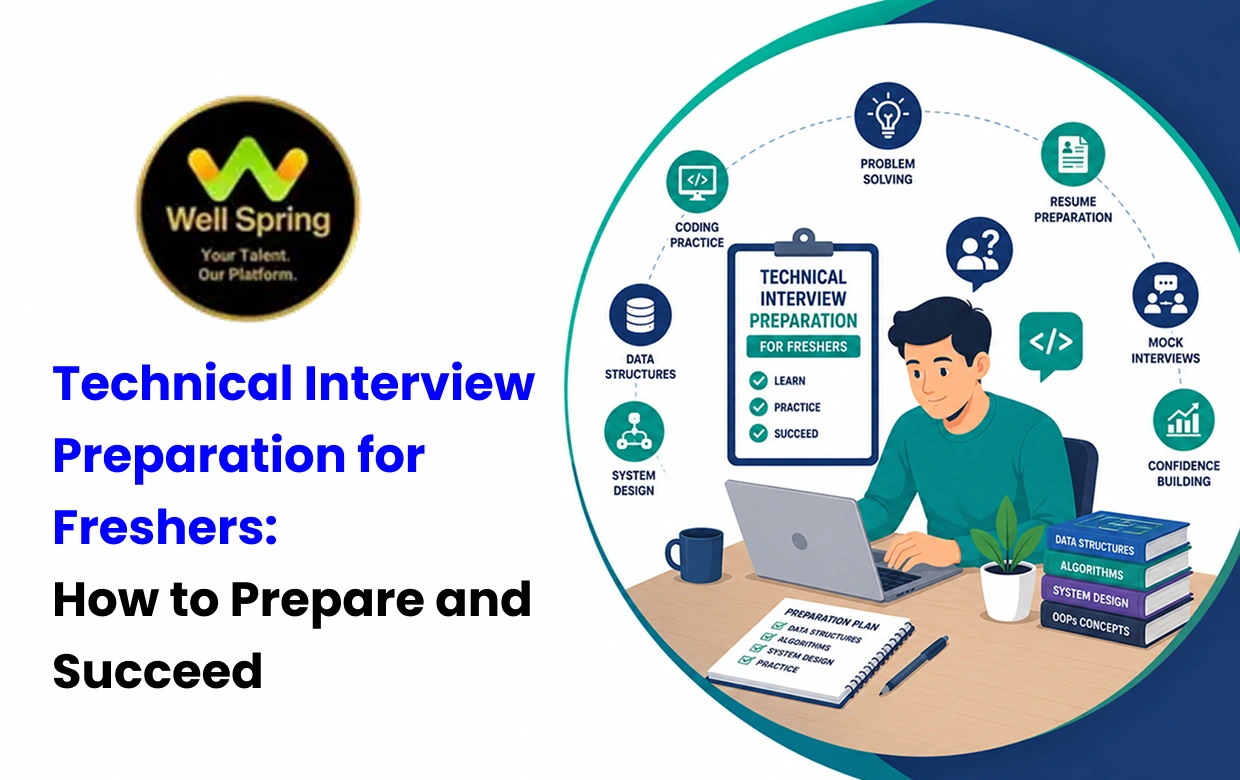
Technical interviews can feel challenging for fresh graduates because they test more than theoretical knowledge. Effective Technical Interview Preparation for Freshers requires a strong understanding of programming fundamentals, problem-solving, projects, role-specific technologies, and communication.
This guide explains How to Prepare for a Technical Interview, the types of Technical Interview Questions for Freshers you may face, how to approach coding rounds, how to prepare your projects and resume, and how industry trends can influence the skills you prioritise.
Whether you are applying for a software development, web development, data, cybersecurity, testing, or another IT role, a structured preparation strategy can help you demonstrate your skills clearly and approach the interview with greater confidence.
To prepare for a technical interview as a fresher, begin by studying the job description and identifying the skills required for the role. Revise programming fundamentals, data structures, databases, and role-specific technologies. Practise relevant coding problems, prepare to explain every project and technical skill on your resume, and take mock interviews.
Remember that a technical interview is broader than a coding interview. A technical round may assess programming concepts, databases, projects, role-specific technologies, and problem-solving, while a coding interview focuses more heavily on solving programming problems and explaining your approach.
The goal is not to memorise hundreds of answers. Instead, focus on understanding concepts, applying them to problems, and explaining your reasoning clearly.
For many fresh graduates, the technical interview is one of the most challenging stages of the hiring process. You may understand programming concepts and know how to write code, but explaining your thinking under pressure can be difficult.
This is why Technical Interview Preparation for Freshers should not begin with randomly searching for hundreds of questions. A more effective approach is to understand the role, identify the skills employers expect, strengthen your fundamentals, and practise applying your knowledge.
Technology roles also continue to evolve. The World Economic Forum's Future of Jobs Report 2025 identifies areas such as AI and big data, networks and cybersecurity, and technological literacy among the fastest-growing skills, while analytical thinking remains an important core skill.
For interview preparation, the practical takeaway is not to learn every emerging technology. Instead, build a strong foundation and develop the technical skills most relevant to your chosen role.
Technical interview preparation is the process of developing the knowledge and practical ability needed to answer technical questions, solve problems, explain projects, and demonstrate your suitability for a specific role.
It usually includes:
The exact preparation should depend on the role you are applying for.
A Java developer interview, for example, may focus on Java, object-oriented programming, collections, databases, and problem-solving. A front-end role may focus more on HTML, CSS, JavaScript, frameworks, APIs, and browser concepts.
The most important principle is simple: prepare for the role instead of studying unrelated topics.
Freshers may not have years of professional experience, so interviewers often evaluate their potential through technical knowledge, problem-solving ability, projects, communication, and willingness to learn.
Depending on the role, an interviewer may evaluate:
A useful rule for freshers is:
If a technology appears on your resume, assume the interviewer can ask you follow-up questions about it.
Therefore, avoid listing technologies simply because you have watched a tutorial or used them briefly. Be prepared to explain where and why you used each important skill.
Freshers often have limited professional experience, so their technical preparation becomes an important way to demonstrate potential.
For example, an interviewer may ask you to:
A candidate who memorises definitions may struggle when asked follow-up questions. However, a candidate who understands a concept can explain it in simple language and support the answer with an example.
This is why preparation should focus on understanding, application, and explanation, rather than memorisation alone.
Before preparing, carefully review the job description.
Look for:
Then divide the required skills into three groups:
This helps you create a focused preparation plan instead of studying everything at once.
Programming fundamentals are the foundation of Coding Interview Preparation for Freshers.
Revise:
Also prepare common comparisons such as:
Do not memorise definitions alone. Understand when a concept is used, why it is useful, and how you can explain it with a simple example.
A basic understanding of data structures and algorithms is useful for many technical roles because it develops structured problem-solving.
Start with:
For roles that place greater emphasis on algorithms, gradually move into:
You do not need to master every advanced algorithm for every fresher position. Prioritise the topics mentioned in the job description and those commonly expected for your target role.
Prepare questions from the core areas related to your target role.
Programming questions:
Database questions:
Web development questions:
Practise answering questions aloud. This helps you improve both your understanding and your ability to communicate technical information clearly.
Projects can be a major advantage for freshers because they provide evidence of practical knowledge.
For every project, prepare answers for:
Use this structure:
Problem → Solution → Technology → Your Contribution → Challenge → Result
For example, instead of simply saying:
"I developed a web application using React."
be prepared to explain what the application does, why React was selected, which components you developed, how data was handled, what problems you encountered, and how you solved them.
Never exaggerate your contribution. If you worked as part of a team, clearly explain what you personally built or handled. Interviewers may ask detailed follow-up questions to verify your understanding.
Your resume can effectively become an interview question paper.
Interviewers may ask about:
Before the interview, review every technical item on your resume.
Ask yourself:
Only include technologies you can genuinely discuss.
Technical knowledge is only part of the interview.
Practise explaining:
When you do not understand a question, ask for clarification instead of immediately guessing.
A clear explanation of a simple solution is often more effective than a complicated answer that you cannot confidently defend.
Mock interviews can help you identify problems that may not appear during individual study.
Practise:
After each mock interview, identify:
Then use those observations to improve your next practice session.
Technical interview questions vary by role, but freshers should prepare across several core areas.
Common topics include:
Be prepared to explain:
Depending on the role, interviewers may ask about:
Important topics include:
Project questions are especially important for freshers because they allow interviewers to understand how you apply your knowledge.
Expect questions such as:
A coding interview is not only about writing the correct solution. Your problem-solving process also matters.
Do not immediately start typing code. Read the problem carefully and identify:
If the requirements are unclear, ask a relevant question before beginning.
Before coding, explain how you plan to solve the problem.
If there are multiple approaches, briefly compare them and explain why you prefer one.
Start with a straightforward solution if necessary, then discuss how it could be improved.
Use meaningful variable names and keep your logic organised.
Avoid unnecessarily complicated code when a simpler approach is easier to understand and maintain.
Do not test only the normal example.
Consider:
For roles that focus heavily on algorithms and data structures, be prepared to explain:
The objective is not always to produce the most advanced solution immediately. It is to demonstrate that you can reason about the problem and improve your approach when appropriate.
The skills you prioritise should depend on the position you are targeting.
|
Target Role |
Priority Preparation Areas |
|
Software Developer |
Programming, OOP, data structures, databases, Git, projects |
|
Java Developer |
Java, OOP, collections, exceptions, SQL, framework basics |
|
Web Developer |
HTML, CSS, JavaScript, APIs, frameworks, browser concepts |
|
Data Analyst |
SQL, Excel, statistics, Python, data visualisation |
|
Cybersecurity Fresher |
Networking, operating systems, security fundamentals, vulnerabilities, relevant tools |
|
QA / Testing |
Testing concepts, SQL, debugging, automation basics, testing tools |
You do not need to learn every technology listed in the table. Use the job description to determine which areas deserve the most preparation time.
For example, if a job description specifically mentions Java and Spring, prioritise those technologies instead of spending most of your preparation time on unrelated programming languages.
If you are unsure where to start, use this seven-day plan as a structured foundation. Adjust the time spent on each topic based on the job role and your current skill level.
Review the job description and identify:
Create a list of strong skills, skills that need improvement, and new topics you need to learn.
Focus on your primary programming language and revise:
Practise explaining each concept with a simple example.
Solve problems involving:
Focus on understanding the logic instead of trying to memorise solutions.
Review database concepts such as:
Then spend time on technologies specifically mentioned in your target job description, such as a framework, API, testing tool, or cloud platform.
Review every technical item listed on your resume.
For each project, prepare to explain:
Problem → Solution → Technology → Your Contribution → Challenge → Result
Remove or revise any skill that you cannot confidently discuss.
Practise answering technical questions aloud.
Include:
Write down the areas where you struggled and use them for your final revision.
Review the topics where you struggled during the previous six days.
Focus on:
Avoid trying to learn too many completely new topics at the last minute. Focus on strengthening your existing preparation.
Understanding industry trends can help freshers decide what to prioritise during technical interview preparation. You do not need to master every emerging technology, but awareness of changing skill requirements can help you make better learning decisions.
AI is increasingly influencing software development and technical workflows. Freshers should understand how AI tools can support programming, debugging, research, testing, and productivity.
However, using AI during preparation does not replace technical understanding.
During an interview, you should still be able to:
If AI helped you build a project, review the generated code carefully and make sure you understand how it works. Interviewers may ask follow-up questions about any technical decision mentioned on your resume.
What to prepare: Continue strengthening programming fundamentals and problem-solving while learning how AI-assisted development fits into modern workflows.
Many software applications now rely on cloud infrastructure and online services.
Freshers applying for software, web, DevOps, or cloud-related positions can benefit from understanding basic concepts such as:
You do not need to memorise every cloud service.
What to prepare: Learn the fundamental purpose of cloud technologies and practise deploying or working with a simple application if the target role requires it.
Security awareness is becoming increasingly important across technology roles, not only dedicated cybersecurity positions.
The World Economic Forum's Future of Jobs Report 2025 identifies networks and cybersecurity among the fastest-growing skill areas.
For cybersecurity roles, candidates should prioritise:
What to prepare: Build strong networking and security fundamentals before moving into specialised tools.
Data-related skills are increasingly relevant across software, business, analytics, and technology roles.
Depending on the position, useful areas include:
What to prepare: Focus on the data skills directly connected to the target role rather than attempting to learn every analytics platform.
Technology changes quickly, so the ability to learn and adapt is important during both interviews and early career development.
LinkedIn's 2025 Work Change Report estimated that 70% of the skills used in most jobs could change by 2030, with AI acting as a major catalyst.
For technical interviews, adaptability can be demonstrated when you:
What to prepare: Practise solving unfamiliar problems instead of limiting your preparation to questions you have already seen.
Projects, internships, debugging practice, code reviews, and practical exercises help fresh graduates connect theoretical concepts with real-world application.
This experience can also strengthen interview answers. Instead of simply saying that you know a technology, you can explain:
Practical experience therefore supports both technical knowledge and communication during interviews.
Both theoretical and practical learning have value. Strong fundamentals help you understand why technologies work, while practical experience helps you apply those concepts to real problems.
|
Area |
Theory-Based Learning |
Practical Industry-Focused Learning |
|
Learning style |
Primarily concept and theory focused |
Combines concepts with practical application |
|
Coding practice |
May be limited depending on the learning environment |
Regular hands-on coding and problem-solving |
|
Projects |
Often academic or assignment based |
More focused on practical problems and application |
|
Interview preparation |
Often self-directed |
Can include structured practice and mock interviews |
|
Industry exposure |
May be limited |
Greater exposure through practical activities |
|
Skill application |
Focuses on understanding concepts |
Focuses on applying concepts to realistic scenarios |
For technical interviews, combining both approaches can help you explain not only what you know but also how you have applied it.
Mistake 1: Memorising Answers
Solution: Understand the concept and prepare a simple example instead of memorising a fixed definition.
Mistake 2: Ignoring the Job Description
Solution: Prioritise the technologies and skills required for the specific role.
Mistake 3: Listing Too Many Skills
Solution: Only include technologies you can genuinely explain and discuss.
Mistake 4: Starting to Code Immediately
Solution: Understand the problem, identify constraints, and explain your approach before writing the solution.
Mistake 5: Ignoring Projects
Solution: Prepare a structured explanation for every project on your resume.
Mistake 6: Exaggerating Your Contribution
Solution: Clearly explain what you personally worked on in team projects.
Mistake 7: Giving Up When You Do Not Know an Answer
Solution: Stay calm, explain what you understand, ask for clarification when appropriate, and describe how you would approach the problem.
Mistake 8: Relying Completely on AI Tools
Solution: Use AI as a learning aid, but make sure you understand the code, concepts, and decisions involved.
Mistake 9: Not Practising Communication
Solution: Practise explaining technical concepts and problem-solving steps aloud.
The final day should be used for focused revision rather than trying to learn an entirely new technology.
Review:
Also:
The goal of the final 24 hours is to improve recall and confidence, not to completely rebuild your preparation.
Students and fresh graduates in Trichy, Tamil Nadu, can improve their career readiness by combining academic learning with practical skill development.
Coding practice, real-world projects, internships, mock interviews, resume preparation, and career guidance can help students build stronger technical and communication skills before entering the job market.
For learners who want structured practical training, Well Spring Talent Solutions offers training and career-focused learning opportunities that can help students strengthen technical skills and prepare for employment.
Students can explore relevant IT Courses in Trichy to build their technical foundation and consider Internship Programs in Trichy to gain practical exposure. Learners preparing for recruitment can also explore placement-oriented support and interview preparation resources.
For additional career guidance, students can also explore resources covering interview tips for freshers and common interview mistakes made by fresh graduates.
The most important goal is to combine learning with practical application so that you can confidently explain not only what you have studied, but also how you have used your skills.
Technical Interview Preparation for Freshers is not about knowing every programming language or memorising hundreds of answers. It is about building a strong foundation, developing problem-solving ability, understanding your projects, and communicating your knowledge clearly.
Start with the skills required for your target role. Strengthen weak areas, practise Technical Interview Questions for Freshers, improve your coding skills, and prepare every project and technical skill on your resume.
Remember that technical interviews evaluate more than correct answers. Interviewers may also assess how you approach unfamiliar problems, explain your reasoning, respond to feedback, and demonstrate your ability to learn.
Industry trends can also help you decide where to invest your learning time. Rather than chasing every new technology, build strong fundamentals and then develop role-specific skills in areas such as AI, cloud, cybersecurity, data, or modern development tools when relevant.
For students and fresh graduates, combining theory with practical projects, internships, coding practice, and mock interviews can create a stronger foundation for technical opportunities and long-term career growth.
15 Oct 2026
15 Oct 2026
14 Oct 2026
14 Oct 2026
13 Oct 2026
Start by analysing the job description and identifying the required skills. Revise programming fundamentals, data structures, databases, and role-specific technologies. Practise coding problems, prepare your projects and resume, and complete mock interviews. Focus on understanding concepts and explaining your reasoning rather than memorising answers.
Common questions cover programming fundamentals, object-oriented programming, data structures, databases, web development, and basic problem-solving. Interviewers may also ask questions based on your projects, internships, and technical skills. The exact questions depend on the role, so use the job description to prioritise your preparation.
Begin with basic problems involving arrays, strings, loops, searching, sorting, and functions. Gradually move into data structures and algorithms based on the requirements of your target role. Practise understanding the problem, explaining your approach, writing readable code, testing edge cases, and discussing time and space complexity when relevant.
Yes. Projects can demonstrate how you apply technical knowledge. Be prepared to explain the problem, technologies, your individual contribution, challenges, technical decisions, and results. If you worked in a team, clearly explain your own responsibilities rather than claiming the entire project as your individual work.
The preparation period depends on your existing knowledge and the role you are targeting. A fresher with strong fundamentals may need a few focused weeks, while someone learning new technologies may need longer. Instead of focusing only on the number of days, create a structured plan covering programming, coding practice, projects, role-specific skills, and mock interviews.
Stay calm and avoid confidently guessing. Explain what you understand, ask for clarification when appropriate, and describe how you would approach the problem. Demonstrating logical thinking, honesty, and a willingness to learn is better than providing an incorrect answer with confidence.
Get internship updates, IT training news, placement opportunities, and career tips directly to your inbox.
Join our WhatsApp community for internship updates, IT courses, placement support, and latest job opportunities.
Join Now