
Introduction
Students often spend years learning academic concepts, completing assignments, and preparing for examinations. However, career growth requires more than knowing what a concept means. Students also need opportunities to apply knowledge, solve practical problems, communicate their ideas, build projects, receive feedback, and understand how their skills are used in professional environments.
This is where the learning environment becomes an important part of career development for students. A supportive environment can connect classroom knowledge with practical application and help students gradually develop the confidence and skills needed for employment, internships, higher education, or entrepreneurship.
The right learning environment does not simply provide more information. It helps students understand what to learn, why it matters, how to apply it, and how to improve.
Quick Answer
Career development for students improves when learning goes beyond theoretical knowledge and includes practical projects, guidance, feedback, communication, industry-relevant skills, and career preparation. A career-focused learning environment helps students turn academic concepts into demonstrable skills and build evidence of their capabilities.
What Is Career Development for Students?
Career development for students is the process of building the knowledge, technical abilities, practical experience, professional skills, and career awareness required to move toward future career opportunities.
It is not limited to choosing a job title or deciding which company to join.
Student career development can involve:
- Understanding personal interests and possible career directions.
- Developing technical and domain-specific skills.
- Applying concepts through practical assignments and projects.
- Building communication, teamwork, and problem-solving abilities.
- Creating a portfolio or other evidence of practical capability.
- Understanding workplace expectations.
- Gaining internship or project experience where appropriate.
- Preparing for interviews and professional communication.
- Continuously identifying skill gaps and improving them.
For example, a student interested in web development may learn HTML, CSS, JavaScript, and a backend technology. Career development happens when that student also uses those skills to build websites, debug problems, work with version control, document the project, explain technical decisions, and prepare a portfolio.
The difference is important: learning a technology gives a student knowledge, while applying that technology gives the student evidence of capability.
Why Does the Learning Environment Matter?
Two students can study the same subject and still develop very different levels of practical readiness.
The difference can come from how they learn.
A learning environment influences whether students get opportunities to:
- Ask questions when they are confused.
- Practise concepts instead of only reading about them.
- Receive feedback on their work.
- Learn from mistakes without treating mistakes as failure.
- Work on increasingly complex problems.
- Collaborate with other learners.
- Understand professional expectations.
- Connect technical concepts with realistic applications.
A student who only memorises information may perform well in an examination but struggle when asked to use that knowledge independently.
A student who regularly moves from explanation to practice, feedback, revision, and project work gets repeated opportunities to convert knowledge into usable skills.
This is why the learning environment should be considered part of the learning experience itself.
Career Focused Education vs Traditional Learning
Traditional education and career-focused education do not necessarily represent opposing approaches. Academic foundations remain important because they provide the concepts students need to understand their field.
The difference is often in what happens after the concept is introduced.
| Traditional Academic Emphasis | Career-Focused Learning Emphasis |
|---|---|
| Understanding concepts | Understanding and applying concepts |
| Examination preparation | Skill and career preparation |
| Structured assignments | Practical tasks and projects |
| Individual academic performance | Application, collaboration, and communication |
| Knowledge acquisition | Knowledge plus demonstrable capability |
| Subject completion | Progressive skill development |
| Theoretical understanding | Theory connected to realistic problems |
For instance, learning database normalization as a concept is useful. Building a small database, identifying relationships, writing queries, testing data, and explaining why the database was structured in a particular way creates a more application-oriented learning experience.
The objective should not be to remove theory. Instead, career focused education connects theory with meaningful application.
What Is Career Focused Learning?
Career focused learning is an approach in which students develop knowledge and practical abilities with future professional application in mind.
It asks questions such as:
- Where is this concept used?
- What type of problem does this skill solve?
- How would a professional apply it?
- What mistakes might occur during implementation?
- What tools or workflows are commonly associated with the skill?
- How can the student demonstrate this ability to another person?
A strong career focused learning program therefore does more than list subjects in a syllabus.
It should provide a progression from learning to application.
A simple progression is:
Learn → Practise → Build → Receive Feedback → Improve → Demonstrate
This approach allows students to gradually move from understanding a concept to showing what they can actually do with it.
Key Elements of a Career-Focused Learning Environment
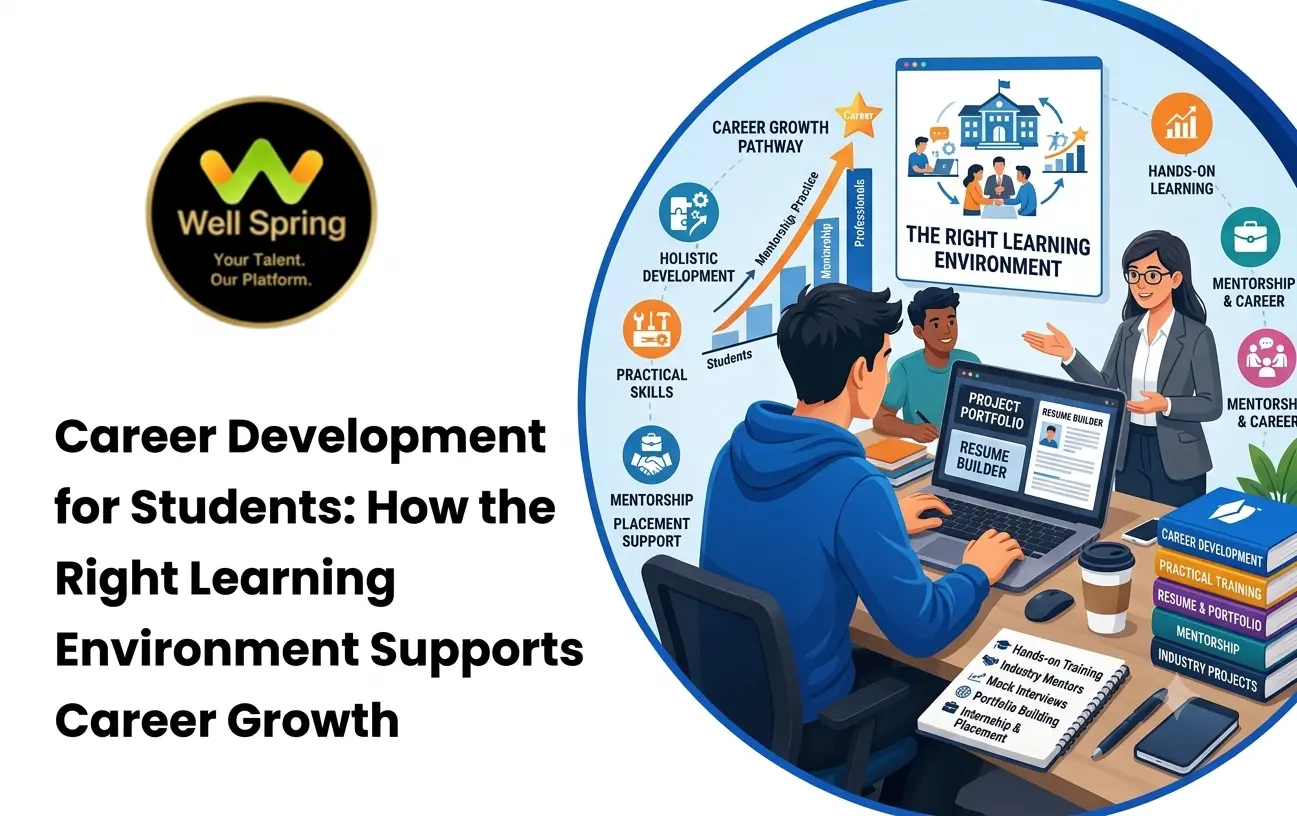
A career-oriented environment does not need to look exactly like a workplace. However, it should expose students to several behaviours and activities that are relevant to professional work.
1. Structured Learning
Students need a logical sequence rather than a collection of unrelated topics.
A structured program should explain what students are learning, what prerequisite knowledge is required, and how each stage connects to the next.
2. Regular Practical Work
Practical activities help students discover whether they can apply what they have learned.
A programming student might write code after learning a concept. A graphic design student might create a campaign after learning visual hierarchy. A testing student might write and execute test cases after learning testing principles.
3. Feedback and Correction
Feedback turns practice into improvement.
Students should understand not only that something is incorrect but also why it is incorrect and how it can be improved.
4. Project-Based Learning
Projects provide a larger context in which multiple skills need to work together.
A project can also expose gaps that are difficult to identify through isolated exercises.
5. Mentorship
A trainer or mentor can help students understand alternative approaches, identify weaknesses, ask better questions, and make informed improvements.
6. Professional Workflows
Students benefit from becoming familiar with practices such as documentation, version control, file organisation, deadlines, presentations, review cycles, collaboration, and structured problem-solving when those practices are relevant to their field.
7. Career Preparation
A career-focused environment should eventually help students understand how to communicate their skills through resumes, portfolios, interviews, professional profiles, and project discussions.
How Practical Learning Supports Career Growth
Practical learning is important because professional work rarely presents problems in the exact format in which they appear in a textbook.
Consider a beginner learning Python.
The student may understand:
- variables
- loops
- functions
- conditions
But a real project might require the student to combine these concepts to process data, validate inputs, handle errors, structure files, and troubleshoot unexpected behaviour.
The gap between these two situations is where practical learning becomes valuable.
Practical Work Develops Problem-Solving
When students work on projects, they encounter questions that do not always have an immediately visible answer.
They may need to:
- Identify what is causing an error.
- Search documentation.
- Break a large problem into smaller tasks.
- Test different approaches.
- Decide between alternative solutions.
- Explain why a particular approach was selected.
These activities develop problem-solving habits that are difficult to build through passive learning alone.
Practical Work Builds Confidence Through Evidence
Confidence is more useful when it comes from repeated practice.
A student who has successfully created several projects can discuss specific experiences rather than simply saying, “I know this technology.”
For example:
“I built a student management application and implemented authentication, database operations, and input validation.”
is more demonstrable than:
“I know web development.”
The project gives the student something concrete to explain.
Why Industry Focused Learning Matters
Industry focused learning connects educational activities with the kinds of skills, tools, workflows, and problem-solving situations students may encounter in professional environments.
This does not mean that students should be expected to perform like experienced professionals.
Instead, learning can introduce professional expectations progressively.
For example, a beginner might first learn to create a simple website. Later, the student may learn responsive design, accessibility considerations, version control, deployment, performance optimisation, and project documentation.
The complexity increases as the student's ability develops.
This gradual exposure helps students understand that professional skill is not simply about knowing more commands or tools. It also involves:
- Choosing appropriate approaches.
- Understanding requirements.
- Testing results.
- Handling constraints.
- Communicating decisions.
- Revising work after feedback.
- Maintaining quality over time.
Role of Mentors and Trainers in Career Development
A good learning environment is not defined only by classrooms, software, or course materials.
The quality of guidance also matters.
A mentor can help a student move through three stages:
“I don't understand this.” → “I can do this with guidance.” → “I can solve this independently.”
Effective guidance can include demonstrations, questions, code or design reviews, project discussions, troubleshooting support, and suggestions for improvement.
Feedback is especially valuable when students are working on projects.
Instead of simply correcting the final result, a mentor can ask:
- What problem were you trying to solve?
- Why did you choose this approach?
- What alternatives did you consider?
- What happened when your first approach failed?
- How would you improve the solution?
These questions encourage students to think about the reasoning behind their work.
Projects and Portfolios as Career Evidence
One of the clearest ways for students to demonstrate practical ability is through completed work.
A portfolio does not have to contain dozens of projects.
A smaller collection of well-developed projects can demonstrate:
- Technical ability.
- Design thinking.
- Problem-solving.
- Attention to detail.
- Communication.
- Ability to complete a task from beginning to end.
For example, a digital marketing student could create a sample campaign that includes audience research, content planning, creatives, keyword research, performance metrics, and an explanation of optimisation decisions.
A UI/UX student could document a design project from user problem to wireframe, prototype, usability feedback, and final interface.
A software student could explain the problem, architecture, implementation, testing, and lessons learned.
The strongest portfolio projects answer three questions:
What did you build?
Why did you build it that way?
What did you learn or improve during the process?
Developing Soft Skills Alongside Technical Skills
Career development is not only about technical knowledge.
Students may also need to communicate with teammates, understand requirements, present their work, respond to feedback, manage deadlines, and explain problems clearly.
Important professional skills include:
Communication
Students should be able to explain technical or creative ideas in language appropriate to their audience.
Teamwork
Collaborative projects can introduce students to task allocation, communication, shared responsibilities, and resolving differences in approach.
Time Management
Completing a project within a defined period teaches students to prioritise tasks rather than waiting until the final stage.
Problem-Solving
Students should learn to investigate problems systematically instead of immediately looking for someone else to provide the answer.
Adaptability
Tools and technologies change. Learning how to learn and update skills is therefore valuable beyond any single course.
How Students Can Choose the Right Learning Environment
Students should evaluate a learning environment based on how well it supports their intended learning goals. Learn more about our learning environment and career-focused approach.
Before joining a program, ask:
Does the program include practical work?
Look for assignments, exercises, projects, simulations, or other activities that require students to apply concepts.
Is feedback available?
Find out how students receive corrections, project reviews, or guidance.
Does the curriculum connect concepts with applications?
A course should make it clear why a topic matters rather than simply presenting a list of subjects.
Are projects part of the learning process?
Check whether students build meaningful work instead of completing only small isolated exercises.
Is there career preparation?
Depending on the program, this may include portfolio development, resume guidance, interview preparation, professional communication, or internship exposure.
Can students progressively increase difficulty?
A useful program should allow students to move from fundamentals toward more complex applications without assuming that beginners already have professional-level skills.
Common Mistakes Students Should Avoid
Choosing a Course Only Because It Is Popular
A popular course may not match a student's interests, current skill level, or career objective.
Collecting Certificates Without Building Skills
Certificates can document participation or achievement, but they do not automatically demonstrate that a student can apply the underlying skill.
Learning Too Many Tools at Once
Trying to learn every popular technology simultaneously can create shallow knowledge and make it difficult to complete meaningful projects.
Avoiding Difficult Projects
If every task is easy, students may not develop the problem-solving ability required to handle unfamiliar situations.
Ignoring Feedback
Repeating the same approach without reviewing mistakes slows improvement.
Waiting Until Graduation to Think About Careers
Career exploration does not need to begin with a job search. Students can start earlier by exploring roles, skills, projects, internships, and areas of interest.
A Practical Learning and Career Development Path
Students do not need to become job-ready immediately.
A gradual approach can make career preparation more manageable.
Stage 1: Explore
Identify subjects, technologies, industries, and roles that interest you.
Stage 2: Build Foundations
Learn the fundamental concepts required for the selected area.
Stage 3: Practise
Complete small exercises that require you to use those concepts.
Stage 4: Create Projects
Combine multiple skills to solve realistic problems.
Stage 5: Review and Improve
Ask for feedback and revise your work instead of treating the first version as final.
Stage 6: Build Evidence
Organise relevant projects, achievements, assignments, certifications, and experiences into a professional portfolio or resume.
Stage 7: Gain Exposure
Where appropriate, pursue internships, industry projects, workshops, competitions, freelance assignments, or other practical experiences.
Stage 8: Prepare for Opportunities
Practise explaining your projects, answering role-specific questions, communicating professionally, and identifying the skills expected for your target opportunities.
This is the practical connection between learning and career development: each learning stage should gradually increase the student's ability to demonstrate useful skills.
What Does Career-Oriented Learning Look Like in Different Fields?
The learning environment should reflect the nature of the field.
| Field | Example of Career-Oriented Practice |
|---|---|
| Web Development | Building responsive websites and deploying projects |
| Software Development | Developing applications, debugging code, and using version control |
| Software Testing | Creating test cases, reporting defects, and practising regression testing |
| UI/UX Design | Creating wireframes, prototypes, user flows, and usability improvements |
| Graphic Design | Developing branding, campaign creatives, and portfolio projects |
| Digital Marketing | Planning campaigns, researching keywords, creating content, and analysing performance |
| Data and AI | Working with datasets, building models, evaluating results, and documenting findings |
| Video Editing | Editing structured video projects with pacing, sound, transitions, and storytelling |
The specific activities will vary, but the principle remains consistent: students should repeatedly connect what they learn with what they can create or solve.
Key Takeaways
Career development for students is a gradual process, not a final-year activity.
- A strong learning environment connects theoretical knowledge with practical application.
- Career focused education should develop both technical capabilities and professional skills.
- Projects help students turn learning into demonstrable evidence.
- Industry focused learning can introduce workplace-relevant practices progressively.
- Mentorship and feedback help students identify gaps and improve their work.
- Certificates can complement learning, but practical ability needs to be developed through application.
- Students can begin career preparation by exploring interests and building relevant skills well before graduation.
- The most useful learning environments help students move from understanding concepts to applying, improving, and explaining them.
Conclusion
Career development for students becomes more meaningful when learning is connected to real application. A strong educational environment can help students move beyond memorising concepts and gradually develop practical skills, problem-solving ability, communication, project experience, and career awareness.
The goal of career-oriented learning is not to turn a student into an experienced professional overnight. It is to create a steady path from learning → practice → projects → feedback → improvement → career preparation.
For students, choosing an environment that supports this progression can make technical and professional learning more purposeful and easier to translate into future opportunities.