
Cantonment Branch
77, C4, St. Pauls Complex,
Pudukottai Main Road, Bharathiyar Salai,
Cantonment, Tiruchirappalli,
Tamil Nadu 620001
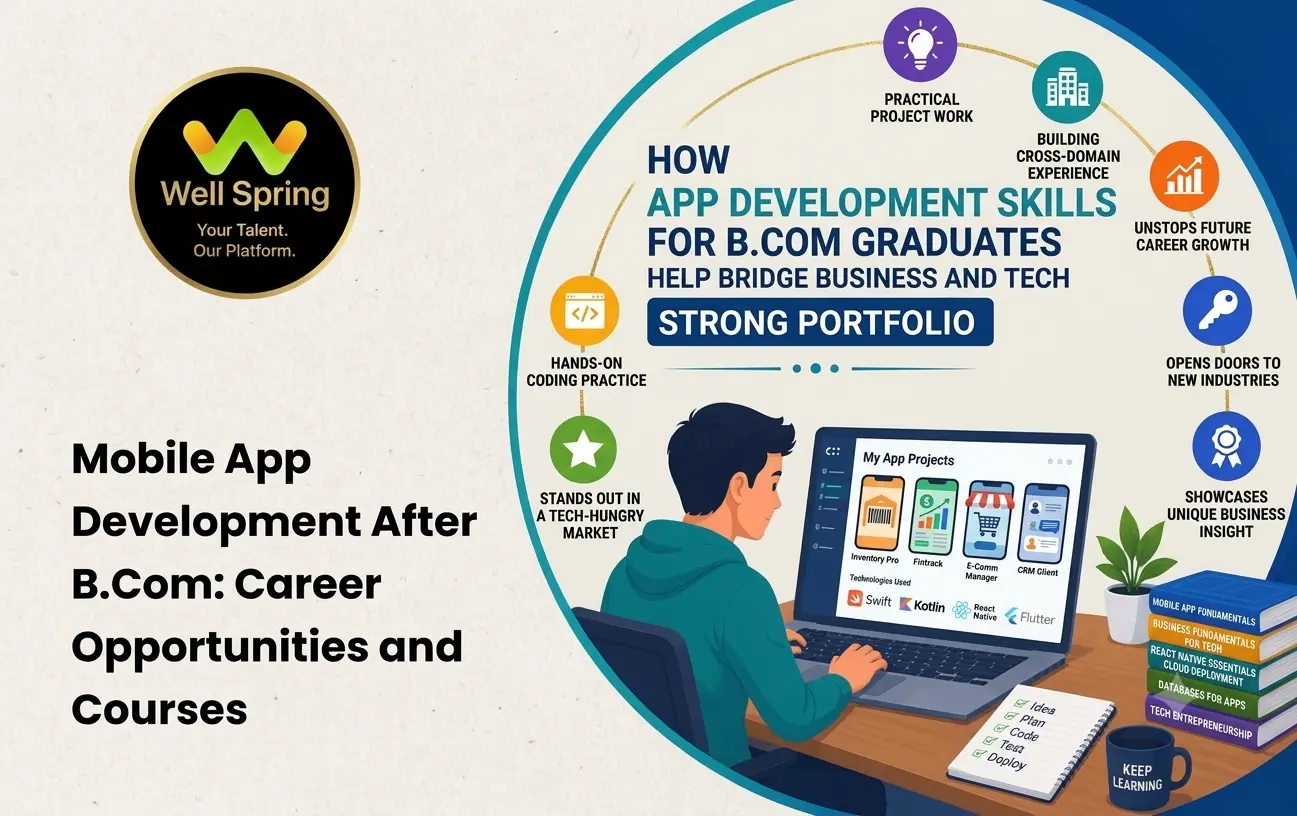
Have you completed your B.Com degree and are wondering what to study next? If you are interested in technology and want to explore career opportunities beyond accounting, finance, and commerce, mobile app development could be an option for you.
Today, mobile applications are used in banking, education, shopping, healthcare, travel, and many other industries. Businesses use applications to manage their services, connect with customers, and simplify everyday activities. This creates opportunities for people with the right technical knowledge and practical skills.
Even if you studied commerce instead of computer science, you can start learning software development with the right guidance and consistent practice.
At Well Spring Talent Solutions in Trichy, you can explore IT training options, develop practical skills, and enquire about career guidance, internship opportunities, and placement support. If you have completed B.Com and want to move into the IT industry, learning mobile app development can be a starting point for your career journey.
Yes, B.Com graduates can learn mobile app development. You do not necessarily need a computer science degree to begin learning programming. However, you should be willing to understand technical concepts, practise coding, and work on projects.
Your B.Com degree gives you knowledge of business operations, accounting, finance, and management. When you combine this knowledge with technical skills, you can explore opportunities involving business applications and software solutions.
For example, businesses use mobile applications for billing, expense tracking, inventory management, customer communication, and online transactions. Understanding business requirements can be useful when learning how these applications work.
If you are a beginner, start with programming fundamentals and gradually progress to mobile application development. Choosing a suitable course and receiving guidance during your learning journey can help you understand the concepts more clearly.
After completing B.Com, many students consider jobs in accounting, banking, finance, taxation, and administration. These are valid career options, but they are not the only choices available.
If you enjoy learning new skills and working with technology, you can also explore IT-related careers.
Learning a technical skill can help you understand a different industry, develop practical knowledge, and prepare for opportunities that match your interests.
Here are some reasons to consider learning mobile app development after B.Com.
You can explore opportunities in software and application development instead of limiting your options to traditional commerce-related roles.
Mobile app development involves understanding user requirements, writing code, designing application features, testing functionality, and improving the user experience.
Learning mobile app development introduces you to programming, application interfaces, data management, and software development concepts.
These skills take time to develop, so regular practice and project work are important.
Your commerce background can be useful when understanding business-related applications.
For example, you could learn how to develop an expense tracker, invoice management application, billing system, or inventory management tool. These projects can help you connect your existing knowledge with software development.
After gaining the necessary skills, you can explore suitable internships and entry-level roles based on your technical knowledge and project experience.
Your opportunities will depend on the technologies you learn, your practical skills, and the requirements of individual employers.
Choosing a suitable training institute is an important step when you want to enter the IT industry after completing B.Com.
Well Spring Talent Solutions in Trichy provides IT training opportunities for students and graduates who want to develop their technical knowledge and prepare for technology-related careers.
If you are interested in mobile app development, you can enquire about the available course, its syllabus, eligibility requirements, training approach, and practical learning opportunities.
Before joining, make sure the course covers the technologies you want to learn and offers sufficient opportunities to practise what you study.
A structured learning approach can help beginners progress through the following stages:
Understanding basic programming concepts.
Learning how application interfaces work.
Exploring mobile application development technologies.
Practising coding through exercises.
Developing small applications.
Working on practical projects.
Preparing to demonstrate your skills to potential employers.
Instead of focusing only on theoretical knowledge, try to understand how each concept is used in a real application.
The goal is to develop the knowledge and confidence needed to continue learning and work towards your chosen career path.
The technologies and subjects covered will depend on the course you choose. Before enrolling at Well Spring, ask for the current syllabus to understand exactly what is included.
A mobile app development learning path may cover the following areas.
Programming is the foundation of application development. Beginners should first understand how to write instructions that a computer can execute.
You may learn concepts such as variables, data types, operators, conditions, loops, functions, and basic problem-solving.
These fundamentals help you understand how applications process information and respond to user actions.
A mobile application needs a clear and easy-to-use interface.
Learning about application interfaces can help you understand how screens, buttons, forms, menus, and navigation work together.
You can practise creating simple screens and arranging interface elements to make applications easier to use.
Android development is one area you can explore when learning to build mobile applications.
Depending on the syllabus, you may study application structure, screen navigation, user interactions, data handling, and testing.
Practising these concepts can help you understand how Android applications are created and improved.
Flutter is a framework used to develop applications for multiple platforms from a shared codebase.
Learning a cross-platform development framework may be useful if you want to understand how developers build applications for different devices.
Check whether Flutter or another cross-platform technology is included in the course before enrolling.
Many applications need to store and retrieve information.
For example, a billing application may store customer details, while an expense tracker may record transactions.
Understanding database fundamentals can help you learn how applications manage information and retrieve it when required.
Applications often communicate with online services to retrieve information or perform tasks.
Learning API fundamentals can help you understand how an application exchanges data with a server.
This knowledge becomes useful as you progress from simple applications to more advanced projects.
Developers need to identify errors and ensure that applications work as expected.
Learning basic testing and debugging techniques helps you find problems, understand why they occur, and improve the quality of your work.
These skills are important when preparing applications for practical use.
Understanding programming concepts is important, but applying them is equally valuable.
When you work on projects, you learn how different parts of an application work together. You also gain experience solving problems that may not appear in simple classroom exercises.
As a beginner, you can start with small projects and gradually increase their complexity.
For example, you could explore projects such as:
Expense Tracker Application: Create an application that records income and expenses and displays basic spending information.
Student Information Application: Develop a simple application for recording and viewing student details.
Billing Application: Explore how an application can organise product information, quantities, and totals.
Inventory Management Application: Learn how an application can maintain product records and track stock information.
Task Management Application: Build a simple application that allows users to create, view, and manage tasks.
These examples are especially relevant to commerce graduates because they connect familiar business activities with software development.
At Well Spring Talent Solutions, enquire about the practical projects included in the mobile app development course and how students receive guidance while completing them.
Building and documenting projects can help you demonstrate your learning when applying for internships or entry-level positions.
Choosing an IT course after B.Com can be confusing, particularly if you have never studied programming before.
You may wonder which technology to learn, which jobs to target, and how to prepare for interviews.
Career guidance can help you understand your options and plan your next steps.
At Well Spring Talent Solutions, you can enquire about available career guidance to help you explore suitable training options and understand the skills needed for your preferred career path.
Career guidance may help you consider the following areas.
Mobile app development is one option, but it may not suit everyone.
If you enjoy creating applications, mobile app development may be worth exploring. If you prefer building websites, full stack or web development may be more suitable. If you enjoy visual design, you could explore UI/UX design.
Understanding the differences between these fields can help you make a more informed decision.
Employers look for different skills depending on the role.
A mobile app development position may require programming knowledge, familiarity with a particular framework, debugging skills, and an understanding of application development.
Career guidance can help you identify the skills relevant to your chosen role and focus your learning accordingly.
A resume should clearly present your education, technical skills, projects, internship experience, and other relevant achievements.
As a B.Com graduate entering IT, you can highlight your commerce qualification alongside the technical skills you develop.
If you have built applications during your training, describe what each project does, the technologies you used, and your contribution.
Technical interviews may include programming fundamentals, questions about the technologies you have studied, and discussions about your projects.
Practising these areas can help you explain your knowledge more clearly and identify topics that require additional preparation.
An internship can help learners understand how technical knowledge is applied in a working environment.
For someone moving from B.Com into IT, an internship may provide an opportunity to gain experience with development tasks, learn from other professionals, and understand workplace expectations.
Depending on the opportunities available and your eligibility, you can enquire at Well Spring Talent Solutions about internship options related to your training.
During an internship, relevant activities may include:
Practising programming concepts.
Assisting with application development tasks.
Understanding project requirements.
Testing application features.
Identifying and correcting errors.
Learning to work with project documentation.
Improving communication and teamwork.
Internship availability, selection, duration, and responsibilities vary. Ask the training team about the current opportunities and requirements before enrolling.
Even when an internship is not immediately available, developing your own projects can help you continue practising and building a portfolio.
After completing your training, you may want to apply for jobs in the IT industry.
Finding your first role can require more than completing a course. Employers may evaluate your technical knowledge, practical skills, communication, problem-solving ability, and suitability for the position.
Placement support can help you understand the recruitment process and prepare for relevant opportunities.
At Well Spring Talent Solutions, enquire about the placement support currently offered to eligible students, including the application process, interview preparation, and access to relevant job openings.
Resume Preparation: Learn how to present your education, technical skills, and projects clearly.
Technical Interview Practice: Revise programming fundamentals and practise answering questions related to the technologies you have learned.
Project Explanation: Learn how to describe the purpose, features, and development process of your applications.
Communication Skills: Practise explaining technical concepts clearly and answering interview questions confidently.
Job Opportunity Awareness: Understand how to identify openings that match your skills, experience, and eligibility.
Placement support can help you prepare, but it does not guarantee a job. Your results will depend on your preparation, performance, available vacancies, and employer requirements.
Once you have developed relevant technical skills and practical experience, you can explore several career options.
A junior mobile app developer assists with creating, maintaining, and improving mobile applications. The required skills depend on the platform and technologies used by the employer.
An Android developer works on applications designed for Android devices. Employers may expect knowledge of Android development tools, programming, application interfaces, and debugging.
A Flutter developer uses the Flutter framework to build applications for supported platforms. You would need to learn the framework and demonstrate your ability to develop working applications.
An internship can provide an opportunity to learn about development tasks and gain practical experience. Requirements vary depending on the organisation and internship programme.
Depending on your technical skills, you may also explore junior software development roles that match your knowledge of programming and application development.
Remember that these are potential career paths, not guaranteed outcomes. Your first role may differ depending on the technologies you learn and the opportunities available when you apply.
The right course depends on your interests, strengths, and career goals.
If you enjoy creating applications and solving logical problems, mobile app development may be a suitable choice to explore.
If you prefer building websites, web development or full stack development may be a better fit. If you are interested in visual layouts and user experiences, UI/UX design may be worth considering.
You can compare the following options before making a decision:
| Course | What You Learn | Suitable Interest |
|---|---|---|
| Mobile App Development | Building applications for mobile devices | Creating mobile applications |
| Web Development | Creating websites and web applications | Developing websites |
| Full Stack Development | Front-end and back-end web technologies | Building complete web applications |
| Python Programming | Programming fundamentals and Python-based development | Coding and problem-solving |
| UI/UX Design | User interfaces and digital product experiences | Design and usability |
| Software Testing | Testing software and identifying defects | Quality checking and problem-solving |
Before choosing a course at Well Spring Talent Solutions, discuss your interests and career goals with the training team and confirm the current course details.
If you have completed B.Com and want to explore mobile app development, you can take the following steps.
Step 1: Identify Your Interest
Think about whether you enjoy coding, creating applications, solving problems, or working with technology.
Step 2: Enquire About the Course
Contact Well Spring Talent Solutions in Trichy to ask about mobile app development training, eligibility, course duration, fees, and the current syllabus.
Step 3: Understand the Training Approach
Ask about practical sessions, project work, technologies covered, and how learners receive help when they face difficulties.
Step 4: Develop Your Skills
Attend your training sessions, practise regularly, revise programming concepts, and work on projects that match your skill level.
Step 5: Build Your Portfolio
Organise your completed projects and prepare to explain how they work, which technologies you used, and what you learned.
Step 6: Explore Career Guidance and Placement Support
Ask about the career guidance, internship opportunities, and placement support available to eligible learners.
Step 7: Apply for Suitable Opportunities
Once you have developed the required skills, prepare your resume and apply for internships or entry-level roles that match your qualifications.
Following these steps can help you approach your transition from commerce to IT with a clearer learning plan.
Completing B.Com does not mean you have to follow only a traditional commerce career path. If you are interested in technology, you can explore IT training and develop new skills that align with your interests.
Mobile app development is one option for graduates who want to learn programming and understand how applications are built. With consistent practice, practical projects, and appropriate career preparation, you can work towards suitable entry-level opportunities.
Well Spring Talent Solutions in Trichy is a place to explore your IT training options and enquire about mobile app development, practical learning, career guidance, internship opportunities, and placement support.
Before joining, discuss your goals with the training team and confirm which services are available for your chosen course.
Completed B.Com and looking for an IT course in Trichy? Contact Well Spring Talent Solutions to explore suitable training options and take your next step towards a career in technology.
31 Oct 2026
31 Oct 2026
30 Oct 2026
30 Oct 2026
29 Oct 2026
Yes. B.Com graduates can learn mobile app development by starting with programming fundamentals and progressing to application development. Check the eligibility requirements of the course you choose.
Beginners may need time to understand programming concepts, but regular practice can help. Start with the basics and gradually work on more complex applications.
You can consider mobile app development, web development, full stack development, Python programming, UI/UX design, or software testing. Choose according to your interests and career goals.
Contact Well Spring Talent Solutions to confirm the career guidance services currently available for your chosen course and eligibility.
Some internships may accept graduates from different educational backgrounds, while others require specific qualifications or skills. Check the eligibility requirements for each opportunity.
Enquire with Well Spring Talent Solutions about the current placement support process, eligibility criteria, interview preparation, and relevant job opportunities.
You can begin with simple projects such as expense trackers, task managers, billing applications, student information systems, and inventory tools. Choose projects that match your current skills.
A course can help you develop technical skills, but employment is not guaranteed. Job opportunities depend on your knowledge, project experience, interview performance, and employer requirements.
We provide IT training, internships, and online learning for students in Trichy and across India.
Can't attend classes in person? Explore online IT training opportunities with Well Spring Talent Solutions, designed to help learners develop practical technology skills from different locations across India.
Get internship updates, IT training news, placement opportunities, and career tips directly to your inbox.
Join our WhatsApp community for internship updates, IT courses, placement support, and latest job opportunities.
Join NowVisit our branches in Tiruchirappalli for IT training and career guidance.
77, C4, St. Pauls Complex,
Pudukottai Main Road, Bharathiyar Salai,
Cantonment, Tiruchirappalli,
Tamil Nadu 620001
2nd Floor, C56, 4th Cross Rd W, opp. Poorvika Mobiles, Thillai Nagar, Tiruchirappalli,
Tamil Nadu 620018
YVD Complex, chatram bus stand, No. 15, Tiruchirappalli,
Tamil Nadu 620002, India
16, 1st Cross Road, Anna Nagar, Tiruchirappalli,
Tamil Nadu 620007