
Introduction
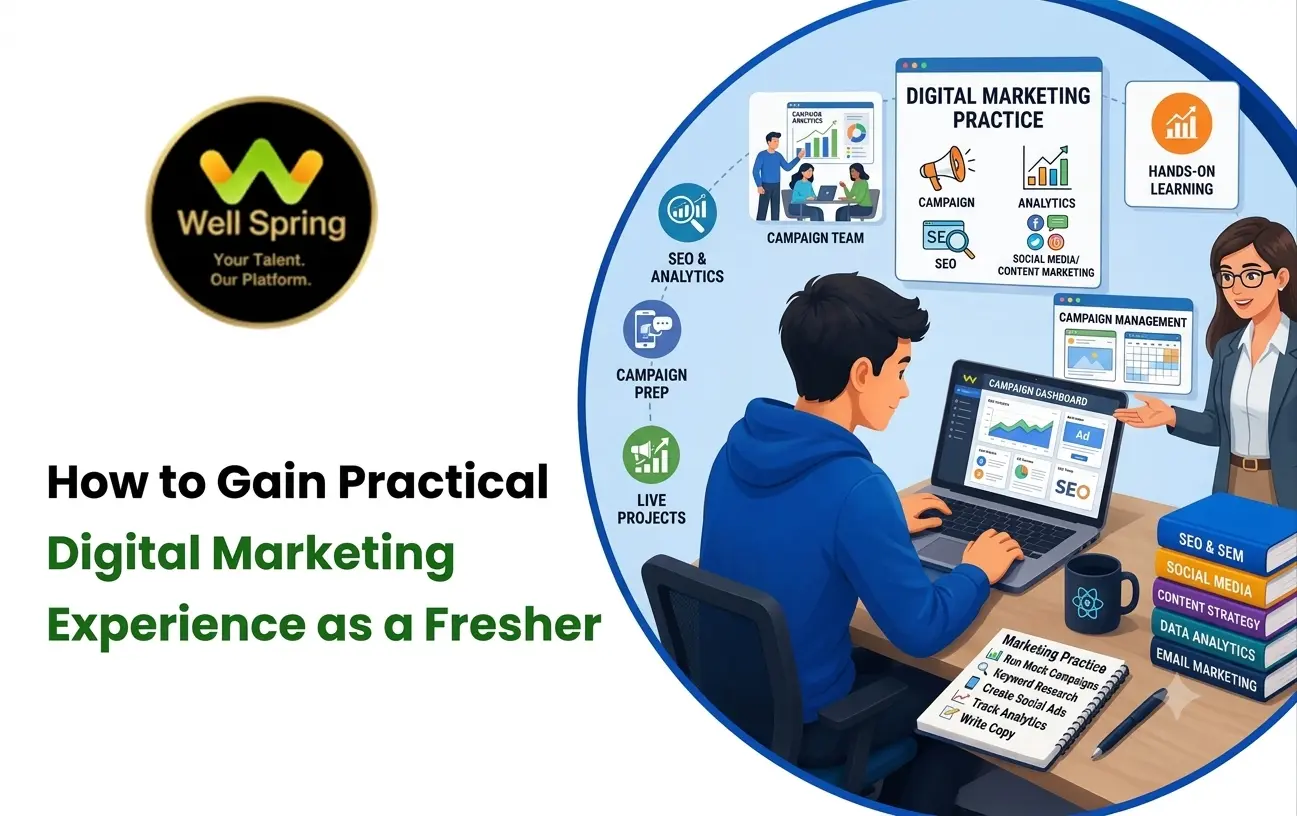
Learning digital marketing through courses, tutorials, articles, and online resources can help beginners understand important concepts. However, understanding a concept is different from being able to apply it to a real task.
Employers and clients may want to see whether a fresher can research an audience, identify relevant keywords, create useful content, optimise a webpage, manage social media activities, analyse campaign data, use marketing tools, and make decisions based on results.
This is why gaining practical digital marketing experience can be an important step for anyone starting a career in digital marketing.
The good news is that you do not always need a full-time job before you can start building evidence of your skills. Personal projects, volunteer work, practice campaigns, websites, blogs, internships, and portfolio projects can all provide opportunities to apply what you have learned.
The key is to move from learning → practising → documenting → improving → demonstrating.
Quick Answer: How Can a Fresher Gain Digital Marketing Experience?
A fresher can gain digital marketing experience by working on practical projects instead of relying only on theoretical learning.
Some effective ways include:
- Creating and optimising a personal website
- Starting a niche blog
- Practising keyword research and SEO
- Managing a practice social media account
- Creating content marketing projects
- Volunteering for a small business or organisation
- Running mock paid advertising campaigns
- Analysing website or campaign data
- Participating in internships
- Building a portfolio of documented projects
A useful approach is to choose a project, define a specific objective, complete the required marketing activities, measure relevant results, document the process, and explain what you learned.
What Does Digital Marketing Experience Mean?
Digital marketing experience is not limited to working for a company.
For a fresher, it can include different levels of practical exposure:
Learning activity:
Watching an SEO tutorial or reading about keyword research.
Practice activity:
Using keyword research concepts to analyse topics for your own website.
Project experience:
Planning and completing an SEO project and documenting the work.
Professional experience:
Performing marketing work for an employer, client, business, organisation, or internship.
This distinction is important because completing a tutorial does not automatically demonstrate practical experience.
For example, saying:
"I learned SEO."
is different from saying:
"I researched keywords for a website, mapped them to search intent, improved page content, monitored performance, and documented what I learned."
The second example provides evidence of application rather than only knowledge.
Why Practical Experience Matters for Freshers
Connects Theory With Application
Digital marketing involves applying concepts to real situations.
A beginner may understand what keyword research is, but conducting research for an actual website requires decisions about search intent, relevance, competition, content type, and page structure.
Practical projects help connect what you learn with what you actually need to do.
Develops Problem-Solving Ability
Digital marketing rarely follows a fixed formula.
A webpage may not receive the expected traffic. A social media post may receive limited engagement. A campaign may spend money without producing the intended action.
Working through these situations teaches beginners to investigate problems, consider possible causes, test changes, and evaluate the outcome.
Creates Evidence of Skills
A portfolio project can show what you actually worked on.
Instead of simply listing:
- SEO
- Content marketing
- Social media
- Analytics
you can demonstrate how you applied those skills through specific projects.
Improves Confidence
Practical work also helps beginners become more comfortable discussing digital marketing during interviews.
When you have completed your own project, you can explain:
- What you were trying to achieve
- What research you completed
- Which decisions you made
- Which tools you used
- What problems you encountered
- What you changed
- What you learned
That creates a more useful foundation for discussing your skills.
How to Gain Digital Marketing Experience Without a Job
You can begin building practical experience before getting your first marketing job.
The important thing is to treat each activity as a structured project rather than simply completing random tasks.
A useful framework is:
Choose an activity → Set an objective → Complete the work → Measure relevant indicators → Document the process → Identify lessons
Create Your Own Website
Building your own website is one way to practise several areas of digital marketing in one project.
You can work on:
- Keyword research
- Search intent
- Page titles and descriptions
- Headings
- Content optimisation
- Internal linking
- Basic technical SEO
- User experience
- Conversion-focused content
- Analytics
For example, you could create a website around a topic you understand and publish useful content for a clearly defined audience.
What to document
Keep records of:
- Initial website structure
- Keyword research
- Content planning
- Pages created
- Optimisation changes
- Internal linking decisions
- Performance observations
- Lessons learned
The purpose is not simply to create a website. It is to demonstrate how you used marketing principles to improve it.
Start a Niche Blog
A niche blog can provide practical experience with content marketing and SEO.
Choose a subject with a clearly defined audience and create content based on genuine questions that audience members may search for.
You can practise:
- Topic research
- Keyword research
- Search intent analysis
- Content planning
- Article writing
- On-page optimisation
- Internal linking
- Content updates
- Performance monitoring
Instead of publishing articles randomly, create a basic content plan.
For example:
Audience: Beginners interested in photography
Content categories:
- Camera basics
- Photography techniques
- Editing tips
- Equipment guides
- Beginner questions
This gives you experience in organising content around audience needs.
Manage a Practice Social Media Account
You can create a practice social media project around a fictional or personal brand.
For example, imagine a local fitness studio wants to increase awareness among young adults.
You could create:
- Audience profiles
- Content themes
- A monthly content calendar
- Educational posts
- Short-form video ideas
- Engagement prompts
- Promotional content
- Performance tracking
The objective is not to pretend that a fictional campaign produced real business results.
Instead, document the strategy and explain why you selected particular content formats, topics, and audiences.
This demonstrates your ability to think through a social media campaign.
Volunteer for a Small Business or Organisation
If possible, volunteering can provide exposure to real business requirements.
A small business may need help with:
- Website content
- Social media posts
- Local SEO
- Blog writing
- Basic keyword research
- Content calendars
- Competitor research
- Performance reporting
Before starting, clearly agree on what you will work on and what the organisation expects.
After completing the work, document:
- The initial situation
- Your responsibilities
- The tasks completed
- The tools used
- The changes made
- The results that can legitimately be measured
- What you learned
Always obtain permission before using a business's data, screenshots, or materials in a public portfolio.
Start With a Personal Digital Marketing Project
A personal project can bring several digital marketing skills together.
For example, imagine you want to promote a fictional local bakery.
You could:
- Define the target audience.
- Research relevant search topics.
- Create a simple website structure.
- Develop a content plan.
- Write and optimise pages.
- Create social media content ideas.
- Develop a basic local marketing strategy.
- Set up suitable analytics.
- Monitor available data.
- Document the decisions and lessons.
This gives you a project that can demonstrate more than one skill.
The important part is to document why you made each decision rather than simply listing the tasks you completed.
Build Practical SEO Experience
SEO provides many opportunities for beginners to practise through their own projects.
Practise Keyword Research
Start with a specific topic and identify the questions and phrases that your target audience may use.
Consider:
- Search intent
- Relevance
- Topic coverage
- Related questions
- Content type
- Competition
Do not choose keywords only because they have high search volume.
A useful keyword should also make sense for the audience and the purpose of the page.
Practise On-Page Optimisation
Take an existing page and review elements such as:
- Page title
- Meta description
- Main heading
- Subheadings
- Content structure
- Internal links
- Image alt text
- URL structure
Then document what you changed and why.
This creates a simple before-and-after SEO exercise that can become part of your portfolio.
Practise Content Optimisation
Choose an existing article and evaluate whether it clearly satisfies the reader's search intent.
Ask:
- Does the introduction answer the main question?
- Are the headings logically organised?
- Does each section provide useful information?
- Are important concepts explained clearly?
- Are there unnecessary repetitions?
- Are supporting questions answered?
- Does the content provide a useful next step?
Then make improvements and record your reasoning.
Learn Basic Technical SEO
Beginners do not need to become technical SEO specialists immediately.
Start by understanding concepts such as:
- Crawlability
- Indexing
- Canonical URLs
- XML sitemaps
- Robots.txt
- Page speed
- Mobile usability
- Broken links
- Structured data
Practise identifying basic issues on a website and explaining what they mean.
Practise Local SEO
If you are working with a local business project, explore areas such as:
- Business information consistency
- Location-focused content
- Local search intent
- Business profiles
- Reviews
- Local landing pages
- Relevant local references
The goal is to understand how digital marketing can support visibility for a specific geographic audience.
Practise Social Media Marketing
Social media experience should involve more than creating attractive posts.
Start with a defined audience and objective.
For example, for a fictional fitness studio, you could define:
Audience: Young adults interested in improving fitness
Objective: Increase awareness and encourage enquiries
Content categories:
- Educational tips
- Exercise demonstrations
- Frequently asked questions
- Customer-focused content
- Promotional content
Then create a content calendar and explain why each content type was selected.
You can also track practice metrics such as:
- Reach
- Engagement
- Clicks
- Profile visits
- Video views
Do not treat individual metrics as proof of business success without appropriate context. The purpose of a beginner project is to learn how to interpret data and make informed adjustments.
Learn Through Content Marketing
Content marketing can help you develop research, writing, SEO, communication, and audience-analysis skills.
Choose a specific audience and create useful content around their questions.
A basic content workflow can be:
Audience research → Topic selection → Search intent → Content outline → Content creation → Optimisation → Publishing → Measurement → Improvement
For each article or content asset, ask:
- Who is this for?
- What problem does it solve?
- What action should the reader take?
- How is the content different from existing information?
- How will I evaluate its performance?
This makes content creation more strategic.
Gain Experience With Google Ads and Paid Campaigns
Beginners can learn paid advertising concepts through structured practice without immediately spending large amounts of money.
You can create a mock campaign for a fictional business.
For example:
Business: Local fitness studio
Goal: Generate enquiries
Audience: Adults within a defined local area
Campaign elements:
- Campaign objective
- Audience
- Ad groups or targeting structure
- Keywords where relevant
- Ad copy
- Landing page concept
- Budget assumptions
- Conversion action
You can then explain why you selected each element.
If you run an actual campaign, record the budget, dates, objectives, targeting, results, and changes made. Do not present hypothetical results as actual campaign performance.
Practise Analytics and Reporting
Digital marketing experience becomes more valuable when you can interpret data rather than simply collect numbers.
Practise working with metrics relevant to the activity.
For example:
Website project
- Users
- Traffic sources
- Engagement
- Conversions
SEO project
- Search impressions
- Clicks
- Click-through rate
- Search visibility
- Landing-page performance
Social media project
- Reach
- Engagement
- Clicks
- Video views
Paid campaign
- Impressions
- Clicks
- Cost
- Click-through rate
- Conversions
The important skill is understanding what the data means.
For example, if traffic increases but meaningful actions do not, you should investigate whether the traffic is relevant, whether the page satisfies user intent, and whether the conversion path is clear.
This develops analytical thinking instead of simple metric reporting.
Develop Essential Digital Marketing Skills Through Projects
Rather than learning every skill separately, connect each skill with a practical activity.
| Skill | Practical activity |
|---|---|
| SEO | Optimise a website page |
| Keyword research | Build a keyword map |
| Content marketing | Create a content cluster |
| Social media | Build a content calendar |
| Paid advertising | Create a mock campaign |
| Analytics | Analyse website or campaign data |
| Copywriting | Write and improve marketing copy |
| Research | Analyse audience needs and competitors |
| Communication | Present project findings |
| Creative thinking | Develop alternative campaign ideas |
This approach helps turn a list of skills into evidence of application.
Get Experience Through Internships
Internships can provide exposure to real workflows, deadlines, collaboration, feedback, and business requirements.
Before joining an internship, understand what kind of work you are likely to perform.
Useful questions include:
- What responsibilities will I have?
- Will I work on real projects?
- Will I receive feedback?
- Which tools will I use?
- Will I be able to document my work?
- Who will supervise the work?
- What skills can I expect to practise?
The goal should be to finish the internship with a clearer understanding of how digital marketing work is performed, not simply to add an internship title to a resume.
Where permitted, keep examples of your work, feedback, reports, and learning outcomes for future reference.
Create a Digital Marketing Portfolio
A portfolio can help transform your practical work into evidence that others can understand.
You do not need dozens of projects.
A few well-documented projects can be more useful than a large collection of incomplete exercises.
For each project, include:
- Project
- Objective
- Target Audience
- Initial Situation
- Strategy
- Tasks Completed
- Tools Used
- Changes Made
- Results or Observations
- Lessons Learned
- Next Steps
This structure shows not only what you did but also how you approached the problem.
How to Turn Practice Into a Portfolio Case Study
A strong case study can follow a simple:
Before → Actions → After
Before
Explain the original situation.
For example:
The webpage had unclear topic targeting and limited internal linking.
Actions
Explain what you did.
For example:
Conducted keyword research, reviewed search intent, improved the content structure, and added relevant internal links.
After
Explain what happened based on measurable evidence.
If you have genuine performance data, present it clearly.
If you do not have enough data to establish an outcome, say so.
For example:
The changes were implemented and performance was monitored to identify further optimisation opportunities.
This is more credible than inventing impressive results.
What Employers Can Learn From a Fresher's Project
A practical project can demonstrate several qualities beyond technical knowledge.
It can show whether you can:
- Understand an audience
- Research a problem
- Plan marketing activities
- Use relevant tools
- Make decisions
- Complete tasks independently
- Interpret information
- Communicate your reasoning
- Learn from mistakes
- Improve your work
During an interview, be prepared to explain not only what you did, but also why you did it.
Questions you should be able to answer include:
- Why did you choose this audience?
- Why did you select these keywords?
- Why did you structure the content this way?
- Which tools did you use?
- What problem did you encounter?
- What would you change if you repeated the project?
- What did the data tell you?
These questions help demonstrate your understanding of the work.
Common Mistakes Freshers Should Avoid
Only Watching Tutorials
Tutorials can provide knowledge, but passive learning does not create much evidence of practical ability.
Better approach: Learn a concept and immediately apply it to a small project.
Creating Projects Without Objectives
Completing random tasks makes it difficult to explain the purpose of the work.
Better approach: Define an objective before starting.
Focusing Only on Tools
Knowing how to use a tool is not the same as knowing how to make marketing decisions.
Better approach: Explain the problem, decision, action, and outcome.
Claiming Results You Cannot Prove
Avoid adding impressive numbers simply to make a portfolio look stronger.
Better approach: Use genuine data and clearly distinguish between actual results, observations, and assumptions.
Building Too Many Incomplete Projects
Ten unfinished projects may provide less useful evidence than two well-documented projects.
Better approach: Complete a small number of projects properly.
Ignoring Documentation
If you do not record what you did, it can be difficult to recreate or explain the project later.
Better approach: Save screenshots, notes, reports, content samples, and project decisions as you work.
A 90-Day Digital Marketing Experience Plan
A structured plan can help turn learning into practical evidence.
Month 1: Learn and Practise
Focus on understanding core concepts and applying them to small exercises.
Suggested activities
- Complete keyword research exercises
- Perform a basic website audit
- Write and optimise sample content
- Create a social media content calendar
- Study basic analytics
- Build a simple personal website or project space
Month 1 deliverables
By the end of the month, aim to have:
- 1 keyword research exercise
- 1 website audit
- 5–10 content ideas
- 1 content calendar
- 1 basic analytics exercise
Month 2: Build a Practical Project
Choose one project and work on it consistently.
For example:
Project: Improve the digital presence of a fictional local business.
You could work on:
- Audience research
- Keyword research
- Website structure
- Content creation
- SEO optimisation
- Social media planning
- Analytics setup
- Performance monitoring
Month 2 deliverables
Aim to complete:
- 1 practical project
- Several content assets
- A documented strategy
- A record of optimisation work
- A basic performance report
Month 3: Measure, Improve and Demonstrate
Use the final month to turn your work into something you can present.
Focus on:
- Reviewing project data
- Identifying improvements
- Updating the project
- Creating a case study
- Building your portfolio
- Updating your resume
- Preparing interview explanations
- Applying for suitable internships or entry-level opportunities
Month 3 deliverables
Aim to have:
- 1 completed case study
- 1 project presentation
- 1 portfolio section
- 1 updated resume
- Clear explanations of the projects you completed
By the end of 90 days, you should have more than notes about digital marketing. You should have practical work that demonstrates how you applied what you learned.
Key Takeaways
Gaining digital marketing experience as a fresher does not have to begin with a full-time job.
You can start by:
- Applying what you learn to practical projects
- Building your own website or blog
- Practising SEO and content marketing
- Creating social media campaigns
- Working on volunteer projects
- Practising analytics and reporting
- Building mock paid advertising campaigns
- Participating in internships
- Documenting your work
- Creating portfolio case studies
The most important transition is from learning about digital marketing to actually applying digital marketing concepts.
A useful project should show:
Problem → Objective → Research → Strategy → Action → Measurement → Learning
That process gives you something concrete to discuss and improve.
Conclusion
Digital marketing experience is built through application, not just information.
For a fresher, the first step does not necessarily have to be a full-time marketing position. A well-planned personal project, volunteer assignment, website, blog, practice campaign, or internship can provide opportunities to apply digital marketing skills.
The strongest approach is to treat each project seriously: define an objective, research the audience, complete the work, measure what you can, document the process, and identify what you learned.
Over time, these individual projects can become a portfolio that demonstrates your ability to think, execute, analyse, and improve.
The goal is not simply to say that you have learned digital marketing. The goal is to be able to show how you applied it.