Blog Details
Home Blog Details

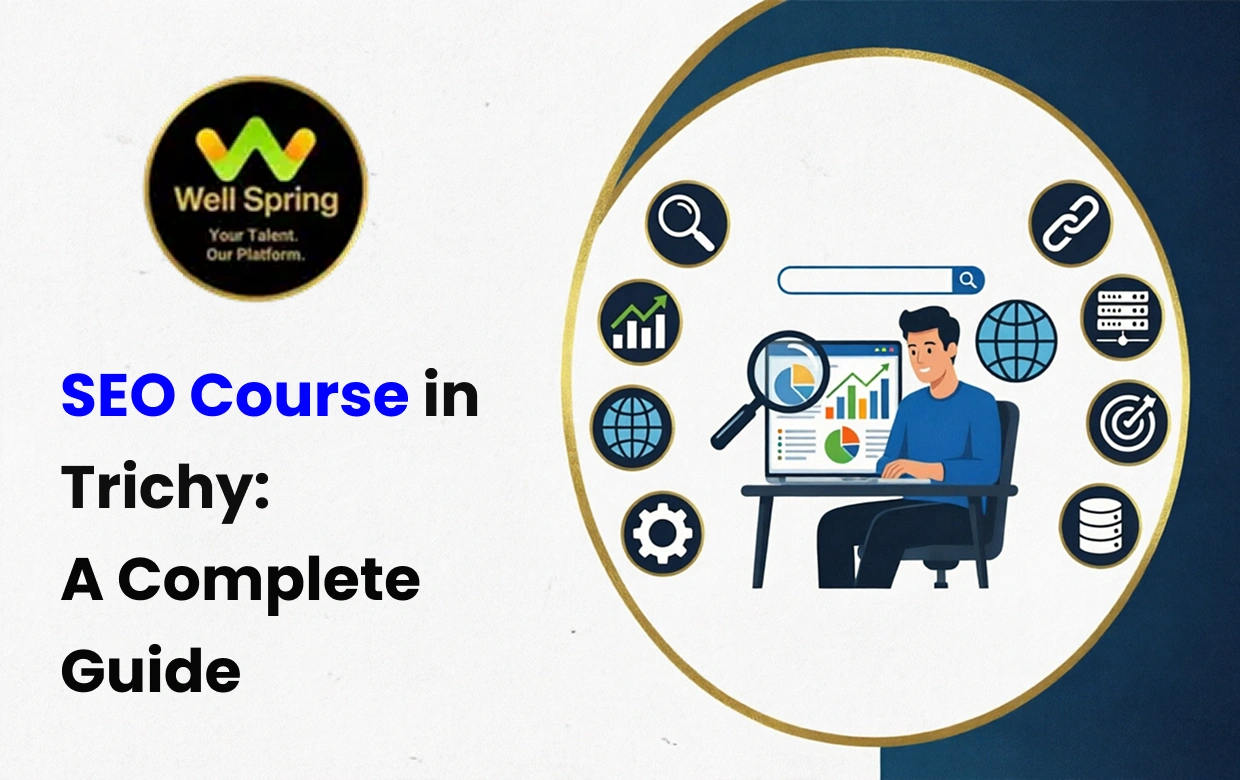
If you are completing college or have recently graduated, you may be wondering what practical skill you should learn next. SEO is one digital skill that can help you understand how websites appear in search engines, how people search online, and how businesses attract visitors through organic search. This guide explains SEO from a beginner's perspective, including on-page SEO, off-page SEO, technical SEO, local SEO, keyword research, SEO tools, practical projects, career opportunities, and what to look for when choosing an SEO course in Trichy.
Completing a degree is an important achievement, but for many students, it also brings a new question:
“What should I learn now to prepare for my career?”
You may already have a degree in commerce, computer science, business, arts, science, or another field from institutions like Bharathidasan University, NIT Trichy, Jamal Mohamed College, or SRM. But academic knowledge and practical workplace skills are not always the same thing.
If you are interested in websites, Google search, content, online businesses, or digital marketing, Search Engine Optimisation (SEO) is one area you can explore.
SEO is used by businesses of all sizes to improve their visibility in organic search results. A local business may want customers to find its services in Tiruchirappalli, while an online business may want to reach customers across India or other countries.
Learning SEO gives you an opportunity to work with:
However, learning SEO properly is more than learning where to place a keyword. You need to understand why people search, what they expect to find, how websites are structured, and how to measure whether your work is helping.
If you are considering SEO training in Trichy, understanding these areas can help you decide what type of programme is actually useful for you.
SEO stands for Search Engine Optimisation.
In simple terms, SEO is the process of improving a website and its content so that search engines can understand it and users can discover relevant information through organic search.
Imagine someone searches Google for:
SEO classes in Trichy
Google may find many pages related to that search. It needs to understand which pages are relevant and useful to the person searching.
SEO helps a website communicate its topic and value more clearly through areas such as:
Relevant content
Keyword research
Page titles
Headings
Website structure
Internal links
Technical accessibility
Mobile usability
Page performance
Local search signals
Relevant external links
The goal of SEO should not simply be to put a website at position one.
The more useful question is:
Can this page provide the information the person is actually looking for?
That mindset is important for anyone beginning a career in search engine optimisation.
Understanding the basic search process makes SEO easier to learn.
Search engines use automated systems to discover webpages. They can follow links and discover new pages or pages that have been updated.
After discovering a page, a search engine analyses its content and information. If appropriate, the page can be stored in its search index.
When a person performs a search, the search engine determines which pages are relevant and useful for that query and orders the results.
This means simply publishing a webpage does not guarantee that it will appear at the top of Google.
SEO therefore involves making sure that:
Search engines can discover the page → understand the page → associate it with relevant searches → provide a useful experience to visitors.
SEO includes several areas of work. Beginners should understand how these areas connect rather than treating them as completely separate activities.
On-page SEO focuses on the elements you can improve within a webpage.
Common areas include:
Keyword research
Search intent
SEO titles
Meta descriptions
Headings
Content
URLs
Internal linking
Image optimisation
Content structure
Keyword research helps you understand what people search for.
For example:
The second search tells you more about the person's needs and location.
Keyword research is not only about finding words with search volume. You also need to understand why the person searched for that phrase.
Understanding this difference helps you create the right page for the right audience.
The SEO title should clearly describe the page. For example:
SEO Course in Trichy: A Complete Guide for Students & Beginners
is more useful than a vague title that doesn't tell the user what they will find.
A meta description gives users a short summary of a webpage. It should explain what the page offers and encourage a relevant click without making unrealistic claims.
A good heading structure makes content easier to read. For example:
H1: SEO Course in Trichy: A Complete Guide for Students & Beginners
H2: What Is SEO?
H2: What Are the Main Types of SEO?
H3: On-Page SEO
H3: Off-Page SEO
H3: Technical SEO
The headings should describe the content naturally instead of being created only to insert keywords.
Off-page SEO focuses on signals and activities outside your own website.
One of the best-known areas is link building. A backlink is a link from another website to your website.
But beginners should understand an important point: SEO is not about collecting as many backlinks as possible. A relevant link from a trustworthy and contextually appropriate website can be more valuable than a large number of unrelated links.
Off-page activities can include:
The focus should be on relevance, quality, and natural connections. Avoid approaches that promise hundreds or thousands of low-quality backlinks simply because the number looks impressive.
Technical SEO focuses on the technical aspects of a website that can affect crawling, indexing, website structure, and user experience.
Important areas include:
For example, imagine you have written a detailed article that answers a user's question perfectly. If there is a technical problem preventing search engines from properly accessing or indexing the page, the quality of the writing alone cannot solve the issue.
This is why a good SEO training programme in Trichy should cover technical fundamentals along with content and keyword optimisation.
Local SEO focuses on improving visibility for searches connected to a specific location.
For example, SEO classes in Trichy has a clear local intent. With Trichy’s growing tech ecosystem and local retail sector, businesses actively need professionals who understand local search.
A local SEO strategy can involve:
Local SEO is especially useful for businesses such as:
For students, learning local SEO can provide practical experience because local Trichy businesses often need help improving their online visibility.
Keyword research is one of the most important skills for an SEO beginner.
A common mistake is to start writing content first and think about keywords afterwards. A better approach is to understand:
For example, a student looking for digital marketing training may search:
Each phrase can represent a slightly different need.
| Keyword Type | Example | What It Means |
|---|---|---|
| Short-tail | SEO course | Broad topic |
| Long-tail | SEO course for beginners in Trichy | More specific search |
| Short-tail | SEO training | Broad training query |
| Long-tail | SEO training for college students in Trichy | Specific audience and location |
Short-tail keywords can have broader competition and less obvious intent. Long-tail keywords can provide more context about what the searcher wants. Neither is automatically better. The right choice depends on the page, audience, and search intent.
Search intent means the reason behind a search.
Informational Intent: The person wants to learn something. (Example: What is technical SEO?)
Navigational Intent: The person is looking for a particular website or brand. (Example: Google Search Console)
Commercial Investigation: The person is comparing options before making a decision. (Example: Best SEO institute in Trichy)
Transactional Intent: The person is ready to take an action. (Example: Enroll in SEO course Trichy)
Understanding intent helps you decide whether the right content should be a blog, course page, service page, location page, comparison article, or landing page.
A page should have a clear primary topic.
For this article:
Primary keyword:
SEO course in Trichy
Secondary keywords:
Search engine optimisation training in Trichy
SEO classes in Tiruchirappalli
SEO training institute in Trichy
Digital marketing and SEO course Trichy
SEO certification for beginners
These phrases don't need to appear in every paragraph. Use them naturally where they genuinely describe the subject. A good article should still make sense if the reader never thinks about SEO keywords at all.
Once you understand search intent and keywords, you can begin optimising the actual webpage.
Create a Clear SEO Title
The title should describe the page accurately and give the user a reason to understand what they will find.
Write Useful Content
Ask yourself:
Use headings to organise the topic logically. Don't create headings simply because you want to insert another keyword.
Optimise Images
Image optimisation can include descriptive filenames, useful ALT text, appropriate image dimensions, compression, and modern formats such as WebP where suitable.
For example:
ALT text should describe the actual image. It should not be filled with repeated keywords.
Internal links connect relevant pages on the same website. For example, an SEO article could naturally link to related pages about Digital Marketing, Google Ads, Content Marketing, Web Development, or Career Training. The link should be useful to the reader rather than added only for SEO.
Structured data provides search engines with additional information about a webpage. Depending on the content, structured data can describe articles, courses, organisations, local businesses, breadcrumbs, events, and other supported content types.
For example, a course page can provide structured information about the curriculum where the relevant markup is appropriate. Structured data can help search engines understand content more clearly, but it should be implemented accurately. It does not guarantee higher rankings or enhanced search results.
SEO tools are useful, but learning how to interpret the information is more important than simply knowing how to operate the software.
Google Search Console: Helps you understand how your website performs in Google Search (queries, clicks, impressions, CTR, average position, indexing).
Google Analytics: Helps you understand what happens after users arrive on your website (traffic sources, landing pages, visitor behaviour, engagement, conversions).
Google Keyword Planner: Helps with keyword research and search advertising planning.
Google Trends: Helps you compare search interest and understand how interest in topics changes over time.
Screaming Frog: Helps identify technical SEO issues such as broken links, missing titles, redirects, duplicate elements, and URL problems.
SEO Research Platforms: Tools such as Ubersuggest, Ahrefs, and Semrush support keyword research, competitor analysis, backlink research, website audits, and content research.
Beginners don't need to master every tool at once. Start with the basics and learn additional tools as your projects become more advanced.
An SEO audit helps you identify what a website is doing well and where improvements may be needed.
Step 1: Check Important Pages. Identify the pages that matter most to the business (service pages, product pages, course pages, location pages, important blog posts).
Step 2: Check Indexing. Verify whether important pages are available to search engines.
Step 3: Review Titles and Headings. Look for missing titles, duplicate titles, unclear headings, and poor page structure.
Step 4: Check Technical Issues. Review broken links, redirects, sitemap, robots.txt, HTTPS, and mobile usability.
Step 5: Review Content. Ask: Does this page actually answer the user's question? Check whether the content is useful, clear, original, well-structured, and relevant to the search intent.
Step 6: Review Internal Links. Check whether important pages receive relevant internal links.
Step 7: Review Performance. Look at website loading performance and mobile user experience.
SEO performance should not be judged only by one keyword's ranking position. Useful measurements include organic clicks, search impressions, CTR, average position, organic traffic, indexed pages, keyword visibility, leads, enquiries, and conversions.
For a business, the quality of traffic matters. For example, 100 visitors who are genuinely interested in a service may be more valuable than thousands of visitors who have no connection to the business.
Keyword Stuffing: Repeating a keyword again and again can make content unnatural. Write for people first.
Copying Content: Don't simply copy another website's article and change a few words. Learn how to research a topic and create genuinely useful content.
Buying Low-Quality Backlinks: Avoid services that promise huge numbers of backlinks at extremely low prices.
Ignoring Search Intent: A page may contain the target keyword but still fail to satisfy the reason someone searched.
Ignoring Technical SEO: Content quality is important, but technical accessibility also matters.
Creating Too Many Similar Pages: Creating many pages that target almost identical searches can make the website repetitive and difficult to manage.
Expecting Immediate Results: SEO is generally a long-term process. Competition, website history, technical condition, content quality, and other factors influence how quickly a website gains visibility.
There is no single number of days or weeks that makes someone an SEO professional. A beginner can start with the basics and gradually develop more advanced skills.
Stage 1: SEO Fundamentals. Learn how search engines work, keywords, search intent, and basic on-page SEO.
Stage 2: Core SEO Skills. Learn technical SEO, off-page SEO, local SEO, content optimisation, and analytics.
Stage 3: Practical SEO. Practise website audits, competitor research, keyword mapping, SEO reporting, and content planning.
Stage 4: Real Projects. Work on actual websites and analyse the results.
The important thing is not how quickly you finish a syllabus. It is whether you can apply what you have learned.
If you are comparing an SEO training institute in Trichy, ask whether practical projects are included. Reading about SEO is useful, but projects help you understand how the work actually happens.
Project 1: Local Business SEO. Choose a local Trichy business and research target customers, search terms, competitors, existing website, and local SEO opportunities. Then create a basic SEO plan.
Project 2: Website SEO Audit. Review a website and identify technical issues, missing metadata, broken links, heading problems, image issues, and internal linking opportunities.
Project 3: SEO Blog Optimisation. Choose a topic and create content based on search intent. Optimise the SEO title, headings, content, images, internal links, and metadata.
Project 4: Competitor Analysis. Compare competing websites based on keywords, content, website structure, backlinks, and local presence.
Project 5: Search Console Analysis. Study a website's search performance and identify high-impression queries, pages receiving clicks, pages with low CTR, and keyword opportunities.
These projects can help a student build a small portfolio of practical work.
A useful SEO course for beginners in Trichy should help you develop practical skills rather than only memorising definitions.
These skills can also complement other areas of digital marketing.
If you're finishing college and unsure what to learn next, SEO can be one area worth exploring if you enjoy a combination of marketing, websites, content, and analysis.
You don't have to be a computer science graduate. You can start with basic knowledge of websites and search engines and gradually develop more advanced technical skills.
SEO can also be combined with digital marketing, content marketing, Google Ads, social media marketing, web development, e-commerce, and analytics. The right skill depends on your interests and career goals, but SEO can provide a useful foundation for students interested in digital work.
College Students: Can begin learning SEO while completing their degree and use the knowledge to work on practical projects.
Fresh Graduates: Can add SEO to their existing qualification and explore digital marketing opportunities.
Working Professionals: Professionals in marketing, sales, content, or business can use SEO to expand their current skill set.
Business Owners: Can learn the basics to better understand how organic search can support their business.
Freelancers: SEO is useful for people who want to provide digital marketing services to clients.
You don't need advanced programming knowledge to start learning SEO. However, understanding basic website concepts can become very useful as you move into technical SEO.
For example, learning basic HTML can help you understand heading tags, links, image ALT attributes, metadata, canonical tags, and structured data. You can start SEO without being a programmer, while gradually developing technical knowledge as your skills grow.
If SEO feels like a large subject, don't try to learn everything at once. A practical learning path can look like this:
Understand Search Engines: Learn how crawling, indexing, and ranking work.
Learn Keyword Research: Understand search terms, search intent, competition, and search demand.
Learn On-Page SEO: Practise titles, headings, content, URLs, images, and internal links.
Learn Technical SEO: Understand sitemaps, robots.txt, indexing, redirects, canonical URLs, and website performance.
Learn Off-Page SEO: Understand backlinks, citations, brand mentions, and link quality.
Learn Local SEO: Understand Google Business Profile, reviews, local citations, and location pages.
Learn Analytics: Practise using Search Console and Analytics to understand website performance.
Work on a Project: Take everything you've learned and apply it to a real or practice website.
That final step is where theoretical knowledge becomes practical experience.
Choosing the right course is an important decision, especially if you are a beginner. Don't choose a course only because it has a certificate or a low fee.
Check the Syllabus: Look for coverage of keyword research, on-page SEO, technical SEO, off-page SEO, local SEO, content optimisation, analytics, and SEO reporting.
Ask About Practical Training: Find out whether you will work on live websites rather than only watching presentations.
Check the Tools: Ask which SEO tools you will actually use during the course.
Look for Real Projects: Projects can help you understand how SEO techniques work together.
Ask About Mentoring: Feedback can help you identify mistakes and improve your approach.
Check Career Support: If the institute offers career support, find out what is actually included (resume support, interview preparation, internship opportunities, placement assistance).
Avoid choosing a course based only on promises. Look at the actual curriculum, practical work, and support available.
For a college student, learning SEO can be a way to develop a practical digital skill before entering the workplace. SEO combines Research + Content + Websites + Analytics + Marketing.
Depending on your interests and experience, SEO knowledge can support roles such as:
You can also use SEO as a starting point and later develop broader digital marketing skills. However, completing a course alone does not guarantee a particular job or salary. Your practical ability, portfolio, communication skills, experience, and the requirements of individual employers all matter.
Completing college is the beginning of a new stage, and developing a practical skill can help you explore different career opportunities.
SEO is one digital skill worth considering if you are interested in websites, search engines, content, and online marketing. A proper understanding of SEO goes much further than placing keywords in an article. You should learn how to research search terms, understand search intent, optimise webpages, analyse technical issues, improve local visibility, build relevant authority, and measure performance.
If you are looking for an SEO course in Trichy, don't choose a programme only because it offers a certificate. Look at the syllabus, practical training, projects, tools, mentoring, and career support.
Most importantly, practise what you learn. Research a keyword. Optimise a page. Audit a website. Study Search Console data. Improve the content. Measure the results. That process will help you understand SEO as a practical skill rather than simply a subject you studied in a classroom.

24 Sep 2026
23 Sep 2026
23 Sep 2026
23 Sep 2026
22 Sep 2026
An SEO course teaches the concepts and practical methods used to improve a website's visibility in organic search. Is SEO suitable for beginners? Yes. Beginners can start with search engine fundamentals, keyword research, and on-page SEO before moving into technical, local, and off-page SEO.
Yes. Students can learn SEO alongside their degree and practise through websites and projects.
No advanced coding knowledge is required to begin. Basic HTML and website knowledge can become useful when learning technical SEO.
On-page SEO focuses on elements within your website, while off-page SEO focuses on activities and signals outside your website, such as relevant backlinks and brand mentions.
Technical SEO focuses on aspects such as crawling, indexing, website structure, redirects, canonical URLs, mobile usability, and performance.
Local SEO helps businesses improve their visibility for searches connected to a specific location, such as Tiruchirappalli.
Common tools include Google Search Console, Google Analytics, Google Keyword Planner, Google Trends, Screaming Frog, and various SEO research platforms like Ahrefs or Semrush.
The fundamentals can be learned as a beginner, but becoming confident requires ongoing practice with websites, content, audits, and data.
It can be highly useful for graduates interested in websites, marketing, content, analytics, and online businesses. Whether it is the right choice depends on your interests and career goals.
Look for a practical curriculum covering keyword research, on-page SEO, technical SEO, off-page SEO, local SEO, analytics, tools, and real-world projects.
Get internship updates, IT training news, placement opportunities, and career tips directly to your inbox.
Join our WhatsApp community for internship updates, IT courses, placement support, and latest job opportunities.
Join Now