Blog Details
Home Blog Details

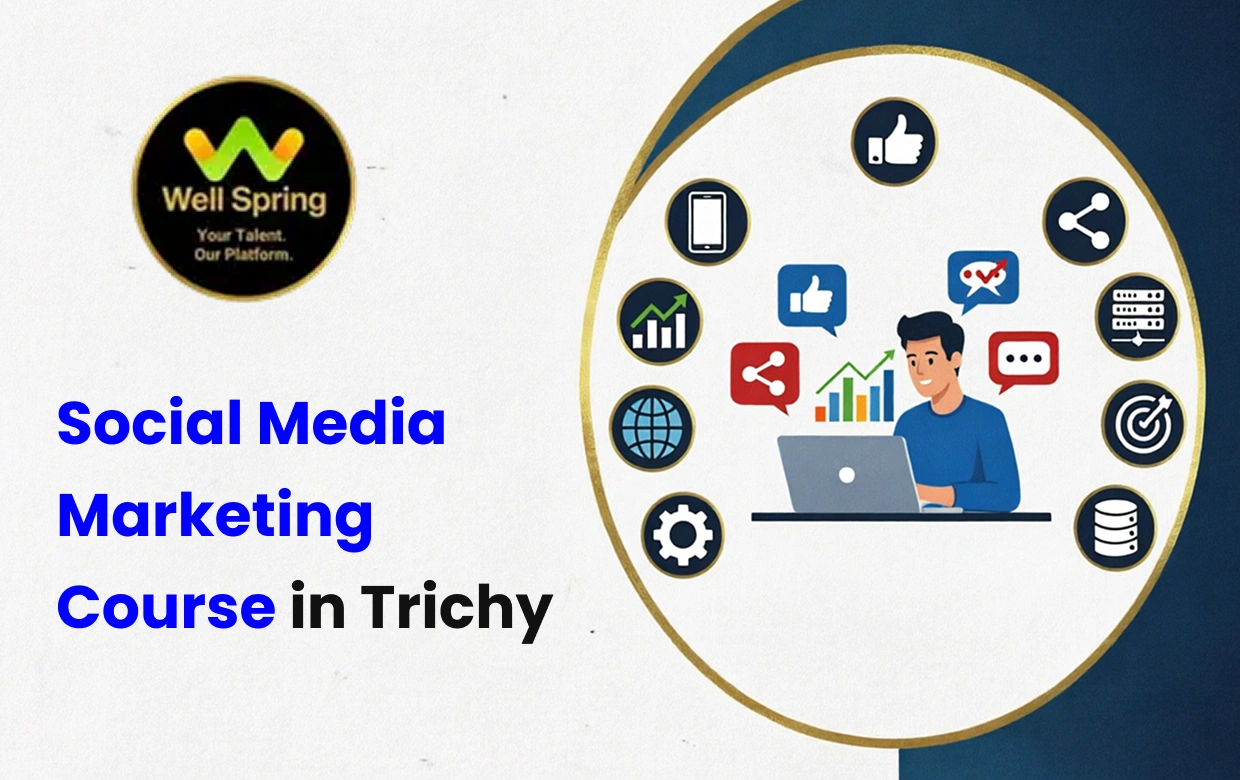
Social media is now an important part of how businesses connect with customers, promote their products and services, build their brands, and generate enquiries. For college students and fresh graduates in Trichy, learning social media marketing can be a useful way to develop practical digital skills.
But social media marketing is much more than creating Instagram posts. It involves understanding audiences, planning content, choosing the right platforms, managing communities, running paid campaigns, and analysing results.
This guide explains social media marketing from a beginner's perspective, including organic and paid marketing, content strategy, Instagram and Facebook marketing, social media tools, analytics, AI, practical projects, career opportunities, salary factors, and what to look for when choosing a Social Media Marketing Course in Trichy.
Finishing college is an exciting stage, but it can also bring an important question:
“What practical skill should I learn for my career?”
A degree gives you academic knowledge, but employers often look for practical skills that can be applied to real business situations.
If you enjoy social media, content creation, communication, marketing, or working with online businesses, social media marketing is one area you may want to explore.
Businesses in different industries use social media to reach their audiences. A training institute near Thillai Nagar may use Instagram to communicate with students. A restaurant on Salai Road may use short videos to showcase its food. A healthcare business may use educational content to answer common questions. A local retailer in Chatiram may use social platforms to introduce new products.
The strategy is different for every business.
That is why learning social media marketing should not be limited to understanding how to publish a post. You need to understand why the content is being created, who it is for, what action it should encourage, and how its performance should be measured.
If you are considering a Social Media Marketing Course in Trichy, understanding these fundamentals can help you choose the right training and build useful skills from the beginning.
Social media marketing is the use of social media platforms to communicate with an audience and support specific marketing or business objectives.
These objectives may include:
Building brand awareness
Reaching a specific audience
Increasing engagement
Generating enquiries
Driving website traffic
Promoting products or services
Increasing sales
Building customer relationships
Creating a community around a brand
Social media marketing can include both organic activities and paid advertising.
For example, imagine a training institute in Tiruchirappalli. Its social media strategy might include:
Sharing course information
Creating student-focused Reels
Posting educational tips
Answering questions through Stories
Sharing student experiences
Running advertisements to reach potential students
Tracking enquiries generated from campaigns
The posts themselves are only one part of the process. A social media marketer needs to understand the complete journey from audience research to campaign measurement.
These terms are related, but they are not always the same.
| Feature | Social Media Management | Social Media Marketing |
|---|---|---|
| Primary Focus | Day-to-day profile and account management | Strategic marketing and business growth |
| Main Tasks | Scheduling posts, responding to comments and messages | Content strategy, audience targeting and advertising |
| Main Goals | Maintain brand presence and engagement | Generate awareness, traffic, leads and conversions |
| Measurement | Reach, engagement, comments and followers | CTR, CPC, conversions, leads and campaign performance |
Social media management can therefore be considered one part of a broader social media marketing strategy.
Someone managing a social media page may focus on publishing and engagement, while a social media marketer may also be responsible for strategy, advertising, audience research, and performance analysis.
Successful social media marketing usually follows a process.
Let's understand each stage:
Research: Before creating content, understand the business, target customers, competitors, industry, customer problems, and relevant platforms.
Strategy: Decide what you want to achieve. For example: Increase awareness of a new training programme among college students, or generate enquiries for a local service.
Content: Create content that supports the objective. This could include posts, Reels, Stories, videos, carousels, infographics, or customer stories.
Publishing: Decide when and where the content should be published.
Promotion: Use paid advertising when it makes sense for the campaign.
Engagement: Respond to comments, messages, questions, reviews, and community interactions.
Analytics: Measure the results.
Improvement: Use the data to make future campaigns better.
This cycle is one of the most important concepts for beginners to understand.
Students often search for skills that can complement their degree and help them understand modern business.
Social media marketing can help you develop a combination of:
You can also combine social media marketing with other digital skills such as SEO, Google Ads, content marketing, web development, email marketing, and analytics.
For example, a student who learns both SEO and social media marketing can understand how businesses attract audiences through search engines as well as social platforms.
You don't need to become an expert on every platform immediately. Start by understanding the major platforms and how businesses commonly use them.
Instagram is heavily focused on visual and video content. Beginners can learn:
A local business might use Instagram to showcase products, educate customers, share reviews, or introduce its team.
Facebook remains useful for many businesses and communities. Students can learn Business Pages, Posts, Groups, Reels, Facebook advertising, audience targeting, and Insights. Facebook can be particularly useful for businesses that want to combine community activity with advertising.
YouTube is useful for businesses that can communicate through video. Important topics include long-form videos, YouTube Shorts, video titles, thumbnails, descriptions, audience retention, and YouTube Analytics. A business could use YouTube for tutorials, demonstrations, interviews, educational content, or product explanations.
LinkedIn is particularly useful for professional and business-focused audiences. It can support personal branding, B2B marketing, professional networking, recruitment, industry content, and company branding. For students, LinkedIn can also be useful for building a professional online presence.
WhatsApp can support direct communication between businesses and customers. Businesses may use it for customer enquiries, product information, service communication, business profiles, catalogues, and customer support. Businesses should always communicate responsibly and respect customer privacy and applicable platform rules.
Organic social media marketing refers to activities that do not involve paying for every individual impression or interaction.
Examples include regular posts, Reels, Stories, educational content, community engagement, customer responses, and brand storytelling.
Organic content can help businesses:
However, organic reach can change over time and is not guaranteed. For this reason, businesses may combine organic content with paid campaigns.
Paid social media marketing involves paying a social media platform to display advertisements to selected audiences.
A basic paid campaign can be understood as:
Objective → Audience → Creative → Budget → Placement → Campaign → Measurement → Optimisation
A beginner should understand some basic advertising terms:
Reach: The number of people who saw an advertisement or piece of content.
Impressions: The number of times content was displayed.
Clicks: The number of times people clicked the advertisement or link.
CPC: Cost Per Click — the average amount spent for each click.
CTR: Click-Through Rate — the percentage of people who clicked after seeing the advertisement.
CPM: Cost Per Thousand Impressions — a common advertising cost metric.
Conversion: A completed action that matters to the business, such as registration, enquiry, purchase, or form submission.
Before spending money on advertising, a marketer should understand what the campaign is trying to achieve.
Good social media marketing starts with understanding the audience. Instead of trying to reach everyone, identify the people who are most relevant to the business.
Demographics: Consider age, location, language, and occupation.
Interests: Understand hobbies, topics, products, services, and content preferences.
Behaviour: Consider which platforms they use, what content they interact with, what problems they are trying to solve, and what type of information influences their decisions.
A buyer persona is a simple representation of a typical customer.
For example:
Student Persona
Age: 20–24
Location: Trichy
Stage: Final-year student or recent graduate
Interests: Career development and digital skills
Platforms: Instagram, YouTube, and LinkedIn
Goal: Develop practical skills before entering the workplace
This helps a marketer think about the audience before creating content.
Local context can make social media strategy easier to understand. Consider a few examples:
Training Institute: May create student-focused Reels, course explanations, trainer introductions, student experiences, and career tips.
Restaurant: May focus on food videos, new dishes, customer reviews, offers, and behind-the-scenes content.
Healthcare Centre: May create educational information, general awareness content, doctor introductions, frequently asked questions, and service information.
Retail Business: May publish new product arrivals, product demonstrations, offers, customer content, and seasonal promotions.
These examples show why social media strategy should be based on the business, audience, and objective, rather than using the same content approach for every company.
Posting randomly is not a strategy. Before creating content, ask:
Who are we trying to reach?
What problem do they have?
What should they learn?
What should they do after seeing the content?
Which platform is suitable?
A simple content strategy can include several content categories:
Educational Content: Teach something useful (tips, tutorials, explanations, industry information).
Promotional Content: Introduce products, services, courses, or offers.
Engagement Content: Encourage participation through questions, polls, discussions, or quizzes.
Entertainment Content: Use suitable content to make the brand more relatable.
Trust-Building Content: Testimonials, case studies, behind-the-scenes content, team introductions, and demonstrations.
Different formats can serve different purposes:
Static Posts: Useful for announcements, simple information, and graphics.
Carousels: Useful when several related points need to be explained within one post.
Reels: Useful for short-form videos and quick educational or entertaining content.
Stories: Useful for updates, questions, polls, and frequent interactions.
Long-Form Videos: Useful for tutorials, interviews, demonstrations, and detailed educational content.
Live Videos: Can help brands communicate directly with their audience.
User-Generated Content: Customer-created content can help build trust when shared appropriately and with permission.
The best format depends on the audience, platform, and marketing objective.
A content calendar helps businesses plan content instead of posting randomly.
Choose the Objective: Decide what you want the content to achieve.
Research the Audience: Understand their interests and problems.
Select Topics: Choose useful topics that support the strategy.
Choose Formats: Decide whether each idea works better as a Reel, Story, carousel, image, or video.
Select Platforms: Not every piece of content needs to be published everywhere.
Create the Content: Prepare the visual, caption, and CTA.
Schedule or Publish: Follow the planned schedule.
Measure: Review the results and improve future content.
| Day | Content | Format | Goal |
|---|---|---|---|
| Monday | Educational tip | Carousel | Awareness |
| Tuesday | Short tutorial | Reel | Reach |
| Wednesday | Audience question | Story | Engagement |
| Thursday | Service information | Post | Consideration |
| Friday | Helpful video | Reel | Engagement |
There is no universal rule that every business must post a certain number of times every week. Consistency and content quality are more useful than publishing simply to increase the number of posts.
Social media marketing also requires good writing. A marketer may need to create captions, hooks, headlines, ad copy, calls to action, and video scripts.
For example:
Basic: We offer digital marketing services.
More audience-focused: Not getting enough enquiries from your website? Here are three areas you can check before increasing your advertising budget.
The second example starts with a problem that may be relevant to the target audience.
Good social media copy should be clear, relevant, easy to understand, appropriate for the platform, and consistent with the brand.
Social platforms also have their own search and discovery systems. Depending on the platform, discoverability can be influenced by words used in captions, video titles, descriptions, profile information, relevant hashtags, content topics, and user interactions.
Hashtags should be relevant to the content. Using large numbers of unrelated hashtags simply because they are popular does not create a strong social media strategy. The better approach is to create useful content around topics your audience actually cares about.
A consistent brand can be easier for audiences to recognise. Branding can include logo, colours, fonts, visual style, photography style, tone of voice, profile information, and content style.
For example, if a training institute uses one visual style for its Instagram posts but completely different branding on LinkedIn and Facebook, the overall experience may feel inconsistent. A social media marketer should understand how to maintain a consistent identity while adapting content to each platform.
Creating content is only part of the job. You also need to understand whether the content achieved its objective.
Reach: How many people saw the content?
Impressions: How many times was the content displayed?
Engagement: This can include likes, comments, shares, saves, and replies.
Clicks: How many users clicked the link or CTA?
Leads: How many potential customers contacted the business?
Conversions: How many people completed the desired action?
A campaign designed to generate leads should not be judged only by likes. The right measurement depends on the original objective.
A beginner can follow a simple process:
Check the Objective: What was the campaign supposed to achieve?
Review Reach: How many people saw it?
Review Engagement: Did people interact with it?
Review Clicks: Did people take the next step?
Check Leads or Conversions: Did it produce the intended result?
Find the Best Content: Which content performed well?
Find Areas to Improve: Which content or campaign elements performed poorly?
Apply the Learning: Use the findings to improve the next campaign.
This is how social media marketing becomes a continuous improvement process rather than simply a publishing activity.
You do not need to master every marketing tool available. Start with tools that support real tasks.
Canva: Useful for creating social media posts, carousels, presentations, and basic marketing graphics.
Meta Business Suite: Useful for managing Meta-related content and reviewing available insights.
Platform Analytics: Learn the analytics provided by platforms such as Instagram, Facebook, YouTube, and LinkedIn.
CapCut: Useful for learning basic short-form video editing.
Google Trends: Can help you explore interest in topics and compare trends.
Figma: Can be useful for basic creative layouts, design collaboration, and understanding digital design workflows.
AnswerThePublic: Can help discover questions and topics people may be interested in.
Keyword Tool: Can be used to explore search suggestions and discover potential topics across different platforms.
The important thing is not how many tools you know. It is whether you understand how to use the information to make marketing decisions.
AI has become another tool available to digital marketers. It can assist with content ideas, caption drafts, brainstorming, content calendars, research, creative concepts, and content repurposing.
However, AI-generated content should not simply be published without review. A marketer should check accuracy, originality, brand voice, relevance, factual information, and copyright considerations.
Human judgement is still important because understanding the audience and business objective cannot be replaced by simply generating text or images.
Posting Without a Strategy: Publishing every day without a clear objective can waste time.
Copying Competitors: Competitor research is useful, but copying another brand's content does not create a unique strategy.
Focusing Only on Followers: A large follower count does not automatically mean a campaign is successful.
Ignoring Comments and Messages: Social media is a communication channel, not just a publishing platform.
Using Irrelevant Hashtags: Relevance should come before quantity.
Inconsistent Branding: Changing the brand style from post to post can make the business look less consistent.
Ignoring Analytics: Without measurement, you won't know what needs improvement.
Running Ads Without a Clear Objective: Advertising should begin with a defined goal and audience.
Using Copyrighted Content Without Permission: Images, videos, music, and other creative assets may have usage restrictions.
Theory is useful, but practical projects can help students understand how social media marketing works in real situations. If you are considering Social Media Marketing Training in Trichy, ask whether the programme includes practical work.
Project 1: Local Business Social Media Strategy. Choose a local business and prepare target audience, competitor research, platform selection, content pillars, and posting plan.
Project 2: 30-Day Content Calendar. Create a complete monthly plan containing posts, Reels, Stories, educational content, promotional content, and engagement content.
Project 3: Paid Campaign Plan. Prepare campaign objective, target audience, creative concept, budget, CTA, and measurement plan.
Project 4: Competitor Analysis. Compare three competing businesses. Analyse posting frequency, content formats, engagement, branding, offers, and audience interaction.
Project 5: Monthly Social Media Report. Prepare a report covering reach, engagement, followers, clicks, best-performing content, weak-performing content, and recommendations.
These projects can later become examples in a student's portfolio.
A useful course should cover both the fundamentals and practical application. Look for topics such as:
Social media fundamentals & Audience research
Platform strategy & Content strategy
Content creation & Social media copywriting
Organic marketing & Paid advertising
Audience targeting & Campaign planning
Analytics & Reporting
Branding & Community management
Influencer marketing & AI-assisted marketing
Practical projects
A course that only teaches how to create posts may not be enough for someone who wants to understand professional social media marketing.
The basics are accessible to most beginners, but becoming good at social media marketing requires practice.
You don't need to be an advanced programmer, a professional graphic designer, or an experienced marketer. However, you should be willing to develop creativity, communication, research skills, basic design knowledge, analytical thinking, audience understanding, and consistency.
The more projects you complete, the easier it becomes to understand what works and what needs improvement.
No advanced coding knowledge is required to start learning social media marketing. However, basic website knowledge can become useful.
Social media campaigns often send users to websites, landing pages, registration forms, product pages, and contact pages. Understanding how these work can help you understand the complete customer journey. Basic knowledge of analytics and conversion tracking can also help you become a more capable digital marketer.
Many beginners confuse these two terms.
| Social Media Marketing | Digital Marketing |
|---|---|
| Mainly focuses on social media platforms | Covers several digital channels |
| Instagram, Facebook, YouTube, LinkedIn and others | SEO, PPC, social media, email, content and more |
| Social content and advertising | Broader digital marketing strategy |
| One area of digital marketing | Wider marketing field |
Social media marketing is therefore one part of digital marketing.
SEO and social media marketing are different areas, but both can contribute to a broader digital marketing strategy.
| Social Media Marketing | SEO |
|---|---|
| Focuses on social platforms | Focuses on search engines |
| Social content and advertising | Organic search visibility |
| Audience engagement | Search-driven website traffic |
| Platform analytics | Search and website analytics |
| Social strategy | Website and search optimisation |
Students who learn both areas can develop a broader understanding of how businesses attract and communicate with online audiences.
Learning social media marketing can support several career paths. Depending on your experience and skills, possible roles include:
Social Media Executive
Social Media Marketing Executive
Social Media Specialist
Content Marketing Executive
Digital Marketing Executive
Social Media Manager
Paid Social Executive
The exact responsibilities vary between companies. For example, a Social Media Executive may focus mainly on content and community management, while a Social Media Manager may also be responsible for strategy, reporting, campaigns, and team coordination.
Salary is one of the most common questions students ask before choosing a career. There is no single fixed salary for everyone working in digital marketing or social media marketing.
Your earning potential can depend on job role, experience, location, company, practical skills, portfolio, communication skills, advertising knowledge, analytics knowledge, and responsibilities.
Fresh graduates may start with positions such as Digital Marketing Executive, Social Media Executive, SEO Executive, Content Marketing Executive, or Paid Advertising Executive. At this stage, gaining practical experience and developing a portfolio can be more important than focusing only on the starting salary.
Professionals may progress into roles such as Social Media Specialist, Performance Marketing Specialist, Digital Marketing Specialist, Social Media Manager, or Digital Marketing Manager. Senior positions may involve campaign strategy, budgets, client accounts, reporting, and team management.
Digital marketing can be a suitable career for people who enjoy a combination of marketing, creativity, content, social media, websites, advertising, and data analysis. However, completing a digital marketing course or social media marketing course does not guarantee a particular salary or job. Practical ability, experience, communication, portfolio quality, and the requirements of individual employers all matter.
Students who develop sufficient practical skills can also explore freelance opportunities. Possible services include social media management, content planning, content creation, social media advertising, local business marketing, and social media reporting.
However, freelancing is not instant income. A student usually needs to develop a portfolio, communication skills, service knowledge, client management skills, consistent delivery, and the ability to find clients. Starting with practice projects can help build confidence before taking on paid client work.
A portfolio can be extremely useful when applying for internships or entry-level positions. You don't always need to wait for a company job before creating examples of your work.
You can create practice projects for a local business, a college club, a fictional brand, a personal project, or a small business (with permission).
Your portfolio could include:
Audience Research: Show who the target audience is.
Content Strategy: Explain your content categories and objectives.
Content Calendar: Create a 30-day social media plan.
Sample Creatives: Prepare sample posts, carousels, and Reel concepts.
Campaign Plan: Show how you would structure a paid campaign.
Performance Report: Use real project data where available, or clearly label sample data, and explain what you would improve.
A portfolio gives employers something practical to evaluate instead of only seeing a course certificate.
Choosing the right course matters, particularly if you are new to digital marketing. Don't choose a course only because it has a certificate, a discount, a low fee, attractive advertising, or big promises. Instead, examine the actual training.
Check the Syllabus: A good Social Media Marketing Course in Trichy should ideally cover social media fundamentals, content strategy, Instagram marketing, Facebook marketing, YouTube marketing, LinkedIn marketing, organic marketing, paid advertising, audience targeting, analytics, and reporting.
Ask About Practical Training: Find out whether you will actually create content and work through campaigns.
Check the Tools: Ask which tools and platforms you will use during training.
Look for Projects: Practical projects can help you understand how the concepts work together.
Ask About Mentoring: Feedback can help you identify mistakes and improve your work.
Check Portfolio Support: Ideally, you should finish with practical work that you can show during interviews.
Ask About Career Support: If the institute provides career support, ask exactly what it includes, such as resume support, interview preparation, internship opportunities, and placement assistance.
Don't choose a course based only on promises. Compare the curriculum, practical training, projects, and support.
College is a useful time to begin developing practical digital skills. Students from different educational backgrounds can explore social media marketing if they have an interest in marketing and online communication.
You do not necessarily need to study computer science, engineering, or marketing. Students from backgrounds such as B.Com, BBA, BCA, B.Sc, Arts, Engineering, or other degree programmes can explore social media marketing, depending on their interests and the course requirements.
The important thing is to move beyond theory. Try to follow this cycle:
Research → Create → Publish → Measure → Improve
This will teach you much more than simply memorising social media definitions.
If you're completely new, don't try to learn everything at once. Follow a simple progression:
Understand Social Platforms: Learn how Instagram, Facebook, YouTube, and LinkedIn work.
Learn Audience Research: Understand who the business wants to reach.
Learn Content Strategy: Understand why different types of content are created.
Learn Content Creation: Practise posts, carousels, Reels, Stories, and captions.
Learn Organic Marketing: Understand regular content and community management.
Learn Paid Advertising: Understand objectives, audiences, creatives, budgets, and measurement.
Learn Analytics: Understand reach, impressions, engagement, clicks, leads, and conversions.
Complete a Practical Project: Build a social media strategy for a real or practice business.
Build Your Portfolio: Document the work you have completed.
Explore Career Opportunities: Consider internships, entry-level employment, freelancing, or further digital marketing education.
Social media marketing is much more than uploading posts to Instagram or Facebook. A good social media marketer needs to understand audiences, content, platforms, communication, advertising, and data.
For college students and fresh graduates, learning these skills can provide a practical introduction to the wider digital marketing industry.
If you are searching for a Social Media Marketing Course in Trichy, don't choose a course only because it offers a certificate. Look at the syllabus, practical training, projects, tools, mentoring, and opportunities to build a portfolio.
Most importantly, practise what you learn. Research an audience. Create a content plan. Design a few posts. Write captions. Analyse a competitor. Plan a campaign. Study the results. Improve your strategy. That practical process can help you understand social media marketing much better than simply studying theory.
For a student, the long-term learning path can be:
Learning → Practising → Building a Portfolio → Gaining Experience → Exploring Career Opportunities
That is a more realistic and useful way to approach a career in social media marketing.
24 Sep 2026
23 Sep 2026
23 Sep 2026
23 Sep 2026
22 Sep 2026
A social media marketing course teaches students how to plan, create, manage, promote, and measure marketing activities across social media platforms.
Yes. Beginners can start with basic platform knowledge and gradually learn content strategy, advertising, and analytics.
Yes. Students can learn it alongside their degree and build practical projects before graduation.
No advanced coding knowledge is required. Basic website and analytics knowledge can become useful as you progress.
Instagram, Facebook, YouTube, and LinkedIn are useful platforms to understand. The best platform depends on the target audience and business.
Organic social media marketing includes activities such as regular posts, Reels, Stories, educational content, and community engagement without paying for every interaction.
Paid social media marketing involves paying a social media platform to display advertisements to selected audiences based on campaign objectives and targeting.
Beginners can start with platform analytics, Canva, Meta Business Suite, basic video-editing tools, and research tools such as Google Trends.
The basics can be learned relatively quickly, but becoming confident requires ongoing practice with content, campaigns, and analytics.
It can be a suitable career for people interested in marketing, content, creativity, social platforms, and data. Career growth depends on individual skills, experience, and opportunities.
There is no fixed salary. Earnings depend on the role, experience, location, company, skills, portfolio, and responsibilities.
Yes. After developing sufficient skills and a portfolio, students can explore freelance services such as content creation, social media management, and advertising.
Look for practical training covering content strategy, major platforms, organic marketing, paid advertising, analytics, reporting, tools, and real projects.
Get internship updates, IT training news, placement opportunities, and career tips directly to your inbox.
Join our WhatsApp community for internship updates, IT courses, placement support, and latest job opportunities.
Join Now