Blog Details
Home Blog Details
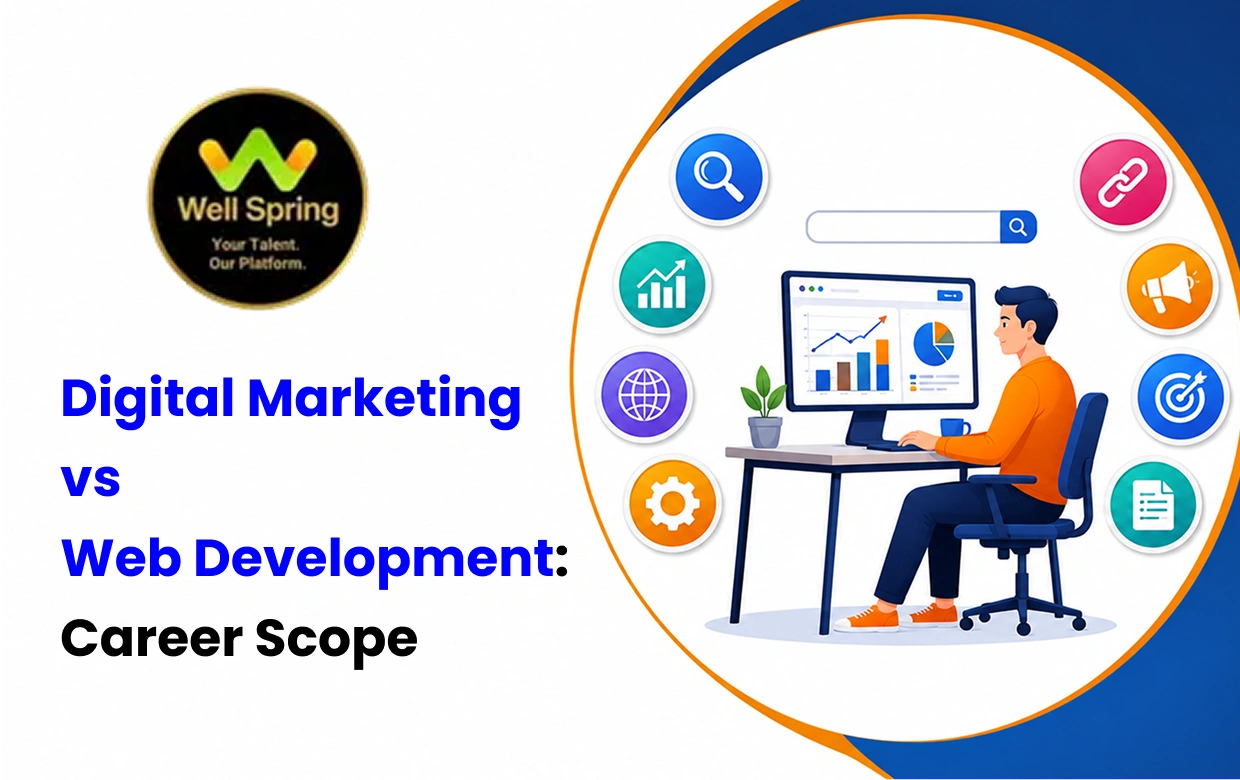
Choosing between digital marketing and web development can be challenging for students, freshers and career changers who want to enter the digital industry. Both fields offer career opportunities, but they involve very different types of work, skills and day-to-day responsibilities.
Digital marketing focuses on reaching audiences, generating leads, improving online visibility and supporting business growth. Web development focuses on building and maintaining websites, web applications and digital products. Digital marketing is generally more accessible to learners without programming experience, while web development requires a stronger foundation in coding, logic and technical problem-solving.
This guide compares digital marketing vs web development across career scope, skills, coding requirements, salary factors, learning time, freelancing, AI's impact and future opportunities. It also explains which path may suit different learners and what students in Trichy should consider before choosing a training program.
Digital marketing is generally better suited to people interested in communication, audiences, content, analytics and business growth, while web development is better suited to people interested in coding, technology, problem-solving and building digital products.
If you do not have programming experience and prefer marketing, communication or business-oriented work, digital marketing can be a practical starting point.
If you enjoy coding and want to build websites or applications, web development may be the stronger choice.
Neither career is universally better. The right option depends on your interests, aptitude, preferred type of work, willingness to practise and long-term goals.
Choosing a career course is different from learning a short-term skill. The field you select can influence the internships you pursue, projects you build, jobs you apply for and additional skills you develop later.
India's growing digital economy provides a broader backdrop for both technology and digital-business careers. According to the Ministry of Electronics and Information Technology's Estimation and Measurement of India's Digital Economy report, the digital economy accounted for 11.74% of India's national income in 2022–23, and the government projects that it could reach around 20% of GVA by 2029–30. (MeitY – Estimation and Measurement of India's Digital Economy)
This expansion creates opportunities across different parts of the digital ecosystem. Businesses need professionals who can build and maintain digital platforms, as well as professionals who can attract audiences, generate leads, improve visibility and support online growth.
Therefore, the better question is not simply:
"Which course has more scope?"
It is:
"Which career gives me the best opportunity to develop skills I can use consistently and professionally?"
|
Factor |
Digital Marketing |
Web Development |
|
Primary purpose |
Grow visibility, leads and business results |
Build websites and applications |
|
Main skills |
SEO, content, advertising, analytics |
HTML, CSS, JavaScript, programming |
|
Coding |
Not usually central |
Fundamental |
|
Creativity |
High |
High, expressed through technical solutions |
|
Communication |
Very important |
Important |
|
Analytics |
Very important |
Important |
|
Technical depth |
Depends on specialization |
Generally high |
|
Typical portfolio |
Campaigns, audits, strategies and reports |
Websites, applications and coding projects |
|
Freelancing |
Strong potential |
Strong potential |
|
Business exposure |
High |
Moderate to high |
|
Suitability for non-coders |
Generally accessible |
Requires programming knowledge |
|
Learning style |
Broad and continuously changing |
Technical and progressive |
|
Best fit |
Business and audience growth |
Technology and product creation |
The two careers are therefore not direct substitutes. Digital marketing is primarily concerned with attracting and engaging audiences, while web development focuses on creating the technology and digital experiences those audiences use.
Digital marketing involves using online channels, platforms and data to help businesses reach potential customers and achieve commercial objectives.
Depending on the role, a professional may work in:
An SEO specialist may research search behaviour, improve website content and monitor organic performance.
A performance marketer may manage paid campaigns and optimize metrics such as cost per lead and return on advertising spend.
A social media professional may plan content, manage communities and measure audience engagement.
Digital marketing is therefore a broad career category rather than a single job.
Web development focuses on creating, improving and maintaining websites and web-based applications.
A developer may work with:
There are several development paths.
Front-end developers primarily work on user-facing interfaces.
Back-end developers work with server-side functionality, databases and APIs.
Full-stack developers work across both front-end and back-end development.
Web development is therefore more than creating web pages. Professional developers may be involved in architecture, functionality, security, performance, integrations and ongoing maintenance.
A digital marketer typically asks:
How can we attract the right people and turn attention into business results?
A web developer typically asks:
How can we build and maintain the technology that solves this problem?
Both questions are important to a successful digital business.
A website can be technically excellent but receive very little traffic. Similarly, a successful marketing campaign can send thousands of visitors to a website that provides a poor user experience.
That is why digital marketing and web development often work together rather than competing for exactly the same role.
Digital marketing requires a combination of communication, analytical and commercial skills.
Depending on your specialization, useful skills include:
Programming is not normally the central requirement for entry-level digital marketing roles. However, basic knowledge of websites, HTML, analytics and technical SEO can become increasingly useful as your career develops.
Web development requires stronger technical foundations.
Important areas include:
Developers also need communication and collaboration skills because professional development often involves working with designers, product teams, marketers and other developers.
The answer depends on the type of work you want to perform.
A simple decision rule is:
|
If you enjoy... |
Consider |
|
SEO and content |
Digital Marketing |
|
Advertising and campaigns |
Digital Marketing |
|
Communication and audience research |
Digital Marketing |
|
Analytics and business growth |
Digital Marketing |
|
Coding |
Web Development |
|
Building websites |
Web Development |
|
Debugging |
Web Development |
|
Technical problem-solving |
Web Development |
This is not a rigid rule. People can develop interests outside their initial specialization, and both careers benefit from complementary knowledge.
The Ministry of Electronics and Information Technology estimates that India's digital economy represented 11.74% of national income in 2022–23, equivalent to approximately ₹31.64 lakh crore in GDP. The same assessment projects that the digital economy could account for around 20% of GVA by 2029–30. (MeitY – Digital Economy Assessment)
This provides context for both technology-oriented and digital-business careers.
According to the FICCI-EY Stories, scale and impact: Unlocking India's media and entertainment economy report, India's digital advertising revenue increased 26% in 2025 to ₹947 billion, accounting for approximately 63% of total advertising revenue. (EY – India Media & Entertainment Report)
For students considering digital marketing, this illustrates the continuing importance of digital channels within India's advertising ecosystem.
The World Economic Forum's Future of Jobs Report 2025 identifies e-commerce specialists, digital transformation specialists and digital marketing and strategy specialists among roles expected to grow significantly. Its outlook places these roles within a broader group experiencing approximately 25–35% growth, corresponding to an estimated 2 million additional jobs globally. South Asia is also projected to experience growth of more than 30% for these roles. (World Economic Forum – Future of Jobs Report 2025)
These figures represent employer expectations and forecasts, not guarantees of employment for individual learners.
The NASSCOM Strategic Review 2025 reported India's technology-industry workforce at approximately 5.80 million, with 126,000 net new employees added during the period covered by the review. (NASSCOM Strategic Review 2025 source document)
The technology sector continues to be influenced by AI-led transformation, cloud technologies, cybersecurity and changing digital delivery models.
Software and application developers are among the fastest-growing job categories identified by the World Economic Forum for 2025–2030. (World Economic Forum – Jobs Outlook)
This is relevant to web-development learners because web development forms part of the wider software and application-development ecosystem.
These figures indicate continued economic activity across digital business and technology, but they should not be interpreted as a promise of employment.
Industry growth becomes valuable to an individual when it is combined with relevant skills, practical ability, specialization and continuous learning.
Digital marketing offers several specialization options.
A common progression can look like:
Digital fundamentals → SEO/Paid Ads → Analytics → Specialization
Potential career directions include:
Your specialization can influence the tools you use, the type of work you perform and the career opportunities you pursue.
A typical development progression can look like:
Programming fundamentals → Front-end/Back-end → Frameworks → Specialization
Possible directions include:
The exact path depends on the technologies you learn and the type of development work you want to pursue.
Both careers can support freelancing, but the services offered are different.
A digital marketer may provide:
A web developer may provide:
In either career, technical or professional skill alone is not enough. Freelancers also need to communicate with clients, understand requirements, demonstrate value and deliver work reliably.
Salary should not be the only reason for choosing a career.
There is no single salary figure that applies to every digital marketer or web developer. Compensation varies according to:
In digital marketing, earning potential can vary between areas such as SEO, performance marketing, paid advertising, analytics and marketing automation.
In web development, compensation can differ between front-end, back-end, full-stack and specialized technical roles.
Freelancers have a different income model because earnings can depend on client acquisition, project value, recurring contracts and workload.
Therefore, instead of asking only:
"Which career pays more?"
consider:
"Which field can I become genuinely skilled in, and which specialization can I build strong professional value around?"
That is a more useful long-term career question than comparing isolated salary figures.
Course Cost
There is no universal cost for digital marketing or web development training.
Fees can vary according to:
Compare the complete learning experience rather than selecting a course based only on price.
Learning Time
A beginner can understand the fundamentals through structured training, but becoming job-ready requires practice beyond classroom lessons.
The time required depends on your existing knowledge, consistency, learning speed and desired specialization.
The important question is not simply how quickly you can complete a course, but whether you can apply what you have learned independently.
The two careers use different performance indicators.
Digital Marketing
Marketing performance can involve:
Web Development
Development performance can involve:
Understanding these measures helps learners see what professional work actually looks like beyond completing a course.
Advantages
Limitations
Advantages
Limitations
AI is changing both digital marketing and web development, but its impact is not simply a matter of jobs disappearing or remaining unchanged.
For marketers, AI can support:
For developers, AI can assist with:
The important skill is knowing how to use AI productively while retaining enough subject knowledge to evaluate its output.
The World Economic Forum expects technology-driven changes to reshape employment patterns through 2030, while software and application developers remain among the fastest-growing job categories in its 2025–2030 outlook. (World Economic Forum – Future of Jobs Report 2025)
For learners, AI literacy should therefore complement—not replace—fundamental marketing, programming, analytical and problem-solving skills.
You do not need to become an expert in both fields.
Developing one strong primary skill first is usually more practical.
However, complementary knowledge can be valuable.
A marketer can learn:
A developer can learn:
This knowledge can improve collaboration and help professionals understand the wider digital environment.
Learning both can become particularly useful if you plan to:
Digital marketing may be a strong fit if you:
Digital marketing can be an accessible starting point for people from non-technical backgrounds, although technical knowledge becomes increasingly valuable as you progress.
Web development may be a stronger fit if you:
Web development requires patience because learning programming and becoming comfortable with debugging takes consistent practice.
Salary varies according to experience, specialization, location, employer, portfolio and performance.
A salary associated with an experienced professional should never be treated as a guarantee for a fresher.
Modern marketing involves websites, analytics, tracking, automation and digital platforms.
Advanced programming may not be necessary for many roles, but technical awareness can make a marketer more effective.
Developers also need communication, collaboration, product understanding and problem-solving skills.
Professional development involves more than writing code.
Watching tutorials alone does not demonstrate professional ability.
Marketing learners can create audits, campaign plans, content strategies and analytics exercises.
Development learners can build websites, landing pages and applications.
The goal is to create evidence that you can apply what you have learned.
Beginners can waste time collecting tools without developing meaningful expertise.
Learn the fundamentals, practise them properly and then specialize.
AI is changing both professions.
Instead of avoiding AI, learn to use it productively while understanding the fundamentals well enough to verify its output.
Before enrolling, review:
A course should be judged by the skills and experience it helps you develop, not only by the certificate attached to it.
Imagine a local clothing business that wants to increase online sales.
The company needs a website where customers can browse products, view information and complete orders.
A web developer can work on the website structure, functionality, responsive design, technical integrations and performance.
But having a website does not automatically bring customers.
A digital marketing professional can work on SEO, social media, advertising, content and analytics to bring potential customers to the website.
Now imagine the business receives thousands of visitors from advertising, but customers leave before completing an order because the website is slow.
Increasing the advertising budget will not solve the fundamental problem. The technical experience needs improvement.
This example demonstrates why digital marketing and web development are complementary. A business may need both a reliable digital product and an effective way to attract the right customers.
For students and freshers in Trichy, the choice between digital marketing and web development can also be influenced by the type of training and practical exposure available locally.
A student considering digital marketing training in Trichy may look for practical coverage of:
A student considering web development training in Trichy may look for exposure to:
When comparing training providers, look at the actual syllabus, practical assignments, mentor support, project exposure, internship structure and career guidance.
Well Spring Talent Solutions can be considered alongside other training providers when evaluating digital marketing and web development courses in Trichy. The important factor is not simply the course title or location, but the quality and relevance of the learning experience.
Before enrolling in either a digital marketing or web development course, compare the following:
Does the syllabus cover current tools, concepts and practical skills rather than only theoretical topics?
Will you actually perform tasks related to the job you want?
Will you create work that can demonstrate your ability to potential employers or clients?
Will you have access to instructors who can help you understand and correct practical problems?
Does the program provide meaningful opportunities to experience professional workflows?
Does the training include interview preparation, portfolio development or career guidance?
A strong course should help you move from learning concepts to applying them independently.
If you are still undecided, do not make the decision based only on course advertisements.
Spend some time experimenting with beginner activities.
For marketing, try:
For development, try:
The purpose is not to become proficient immediately. It is to discover which type of work keeps your attention.
Ask yourself:
"Which activity makes me want to solve the next problem?"
That question can reveal more than simply asking which course appears easier.
Look at entry-level vacancies and identify the skills employers repeatedly request.
This gives you a more realistic picture of workplace expectations than course advertisements alone.
Compare:
Do not wait until the end of your course to demonstrate your skills.
Build relevant work as you learn so that you gradually develop evidence of your ability.
Once you understand the fundamentals, select an area where your interests and strengths overlap.
Specialization can help you develop deeper expertise rather than remaining at a basic level across many unrelated tools.
Digital marketing and web development solve different business problems.
Digital marketing focuses on audiences, visibility, leads and business growth.
Web development focuses on websites, applications and digital products.
India's digital economy accounted for 11.74% of national income in 2022–23 and is projected to reach around 20% of GVA by 2029–30. (MeitY – Digital Economy Assessment)
India's digital advertising revenue grew 26% in 2025 to ₹947 billion, according to the FICCI-EY report. (EY – India Media & Entertainment Report)
India's technology workforce was approximately 5.80 million according to NASSCOM's 2025 review. (NASSCOM Strategic Review 2025)
Software and application developers remain among the fastest-growing occupations in the WEF's 2025–2030 outlook. (World Economic Forum – Future of Jobs Report 2025)
Neither field guarantees employment simply because the industry is growing.
Salary varies according to experience, specialization, location, employer and professional ability.
Practical projects are important for demonstrating what you can actually do.
AI is changing both careers, making strong fundamentals and adaptability increasingly important.
Digital marketing is generally better suited to audience and business-focused learners.
Web development is generally better suited to technology and coding-focused learners.
The best career choice depends on your interests, aptitude, preferred work style and long-term goals.
Choosing between digital marketing vs web development becomes easier when you stop searching for a universal winner and instead consider the type of work you genuinely want to perform.
Digital marketing is a strong direction for learners interested in audiences, communication, content, analytics and business growth. Web development is better aligned with people who enjoy coding, technical problem-solving and creating functional digital products.
Both fields are connected to India's expanding digital economy, but industry growth alone does not guarantee employment or a particular salary. Your results will depend on the skills you develop, the specialization you choose, the quality of your practical experience and your ability to adapt as technology changes.
If you are still uncertain, experiment with basic activities from both fields, review real job descriptions and compare training programs before making your decision.
The goal should not be to choose the career that simply looks easier or more profitable today. Instead, choose the field where your interest and ability can develop into valuable professional expertise.
21 Oct 2026
21 Oct 2026
20 Oct 2026
20 Oct 2026
19 Oct 2026
Choose the course that best matches your interests and preferred work style. Marketing is more audience and business focused, while development is more technical and product focused.
Yes. Freshers can pursue areas such as SEO, content, social media, paid advertising and marketing support after developing relevant practical skills.
Yes. Freshers can pursue entry-level development opportunities after building programming fundamentals and completing practical projects.
No. Certificates demonstrate course completion, but employers also consider practical ability, relevant projects, communication and experience.
Review the curriculum, practical assignments, mentor support, internship opportunities, tools taught, interview preparation and career guidance before making your decision.
Yes. The two fields require different core skills, but knowledge from one can be useful in the other. For example, marketers can benefit from understanding websites and technical SEO, while developers can benefit from understanding user journeys, SEO and conversion principles.
Yes. Both fields offer freelance opportunities. Your potential will depend on your specialization, portfolio, client communication, ability to deliver results and the type of services you offer.
No. AI tools can support learning and professional work, but strong fundamentals remain important. You need enough subject knowledge to understand, evaluate and correct AI-assisted output.
We provide IT training, internships, and online learning for students in Trichy and across India.
We also welcome enquiries from students in these neighbourhoods, towns, and surrounding locations.
Can't attend classes in person? Explore online IT training opportunities with Well Spring Talent Solutions, designed to help learners develop practical technology skills from different locations across India.
Get internship updates, IT training news, placement opportunities, and career tips directly to your inbox.
Join our WhatsApp community for internship updates, IT courses, placement support, and latest job opportunities.
Join Now