
Introduction
Python is often recommended as a starting point for students who want to learn programming, but knowing that Python is beginner-friendly does not answer an important question:
What will you actually learn in a Python course?
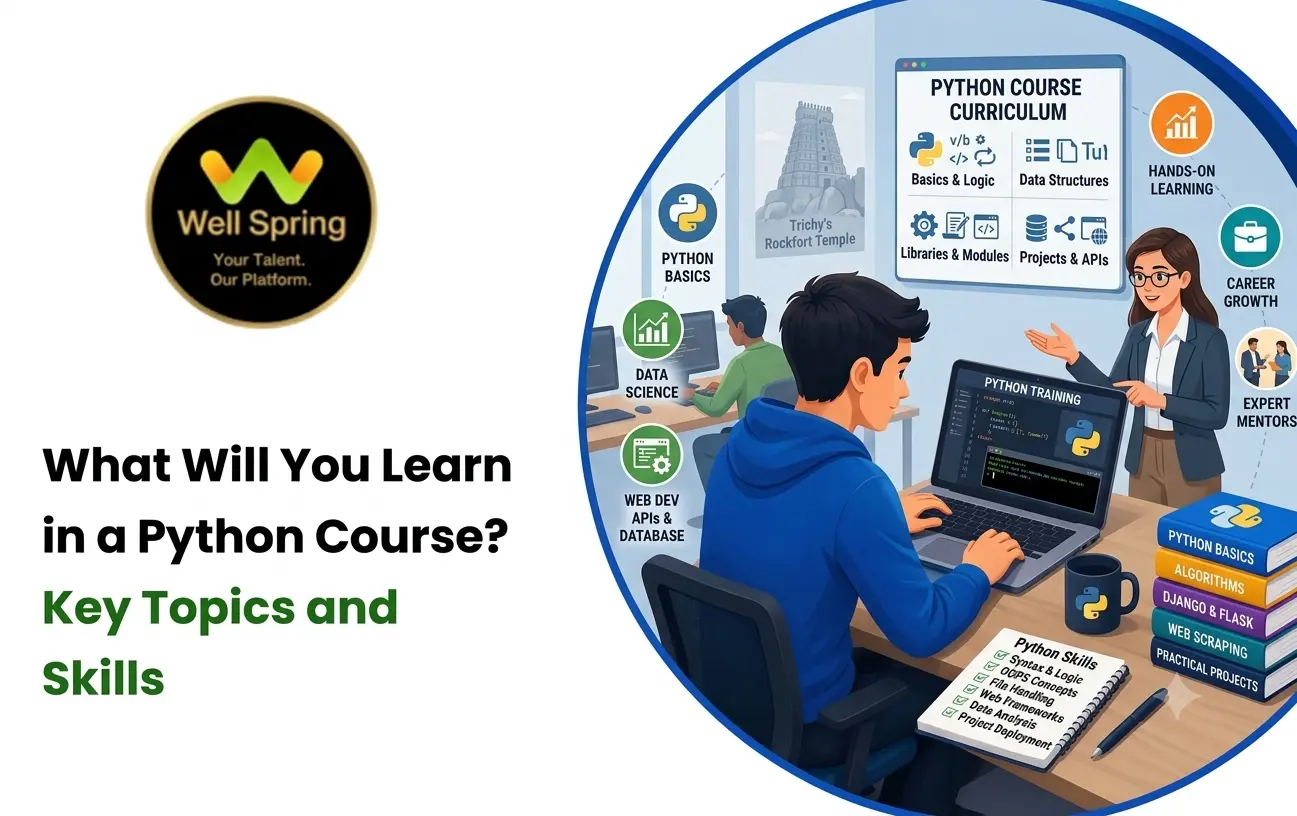
A structured Python course usually begins with programming fundamentals and gradually introduces more advanced concepts such as functions, data structures, object-oriented programming, file handling, error handling, modules, and practical project development.
The exact Python course syllabus can vary depending on the course level and learning objective. A beginner course may focus mainly on programming foundations, while a more comprehensive program may continue into databases, APIs, web development, automation, data analysis, or other areas.
Understanding the major Python course topics before choosing a program can help students know what to expect and identify which skills they should develop.
Quick Answer
A Python course typically covers Python fundamentals such as variables, data types, operators, conditions, loops, functions, data structures, file handling, exception handling, modules, and object-oriented programming. Practical courses may also include projects, databases, APIs, testing, automation, and career-oriented development skills.
What Are Python Fundamentals?
Python fundamentals are the core concepts that help beginners understand how Python programs are written and executed.
They provide the foundation for everything that comes later.
Important fundamentals include:
- Python syntax.
- Variables.
- Data types.
- Operators.
- Conditions.
- Loops.
- Functions.
- Data structures.
- Input and output.
- Error handling.
A student who understands these concepts can begin creating programs independently instead of relying entirely on copied examples.
A strong course should therefore focus on understanding rather than simply completing a list of topics.
What Is Usually Covered in a Python Course?
The exact syllabus depends on the course, but a structured beginner-to-intermediate program may progress approximately like this:
Programming Basics → Python Fundamentals → Data Structures → Functions → File Handling → Exception Handling → Object-Oriented Programming → Libraries → Projects
More comprehensive courses may then continue into:
APIs → Databases → Web Development → Automation → Data Analysis → Specialisation
This progression matters because advanced topics become easier when the underlying programming concepts are already understood.
1. Python Syntax and Basic Programming Concepts
The first stage of a Python course usually introduces students to the language itself.
Students may learn:
- How Python code is structured.
- How to write and run a Python program.
- Indentation.
- Comments.
- Basic input and output.
- Python's syntax conventions.
- Common beginner errors.
For example:
name = input("Enter your name: ")
print("Hello", name)
Although this is simple, it introduces several important concepts:
- Variables.
- User input.
- Strings.
- Output.
- Assignment.
Beginners should understand what each line does rather than simply memorising the example.
2. Variables and Data Types
Variables allow programs to store information.
Students typically learn how Python handles common data types such as:
- Integers.
- Floating-point numbers.
- Strings.
- Boolean values.
- Lists.
- Tuples.
- Sets.
- Dictionaries.
For example:
student_name = "Arun"
age = 20
marks = 87.5
is_passed = True
Students should also learn why choosing and working with appropriate data types matters.
This foundation becomes important when handling larger programs.
3. Operators and Expressions
Operators allow Python programs to perform calculations, comparisons, and logical operations.
A course may introduce:
Arithmetic Operators
Used for calculations.
- +
- -
- *
- /
- %
Comparison Operators
Used to compare values.
- ==
- !=
- >
- <
- >=
- <=
Logical Operators
Used to combine conditions.
- and
- or
- not
Students can use these operators to create program logic.
For example, a program might check whether a student's mark is above a particular threshold before displaying a result.
4. Conditional Statements
Conditional statements allow programs to make decisions.
Students typically learn:
- if
- elif
- else
For example:
if marks >= 50:
    print("Pass")
else:
    print("Needs improvement")
As students progress, they learn how to combine multiple conditions and create more structured decision-making logic.
Conditional statements are among the most important python programming topics because almost every practical application needs some form of decision-making.
5. Loops and Iteration
Loops allow programs to repeat tasks.
Students commonly learn:
- for loops.
- while loops.
- Loop control statements.
- Iteration over collections.
For example:
for number in range(1, 6):
    print(number)
Loops become particularly useful when processing:
- Lists.
- Files.
- User records.
- Transactions.
- API responses.
- Large datasets.
Students should learn not only how to write loops but also when a loop is an appropriate solution.
6. Functions
Functions allow developers to organise code into reusable blocks.
For example:
def calculate_total(price, quantity):
    return price * quantity
A Python course may cover:
- Defining functions.
- Parameters.
- Arguments.
- Return values.
- Local and global scope.
- Default arguments.
- Reusable code.
Functions help students move from writing small scripts toward organising larger programs.
A useful learning milestone is being able to take a long program and identify logical sections that can be separated into meaningful functions.
7. Lists, Tuples, Sets, and Dictionaries
Data structures are an important part of Python programming.
Lists
Useful when maintaining ordered collections of items.
Tuples
Useful for fixed collections of values.
Sets
Useful when working with unique values.
Dictionaries
Useful for storing key-value relationships.
For example:
student = {
    "name": "Arun",
    "age": 20,
    "course": "Python"
}
Students learn how to:
- Create collections.
- Access values.
- Add and remove items.
- Update information.
- Iterate through collections.
- Combine data structures.
These concepts are essential when building practical applications.
8. Strings and String Operations
Text processing is common in programming, so strings are another important area.
Students may learn:
- String creation.
- Indexing.
- Slicing.
- Concatenation.
- Formatting.
- Searching.
- Replacing text.
- Common string methods.
For example, a program may need to clean user input before storing it.
String manipulation is useful in applications involving forms, files, reports, data processing, and web content.
9. File Handling
Once students understand the fundamentals, many courses introduce file handling.
Students may learn how to:
- Open files.
- Read files.
- Write files.
- Append information.
- Work with different file formats.
- Handle file-related errors.
For example, a simple program could store student records in a text or CSV file.
This introduces an important idea:
Programs can work with information that exists outside the program's immediate memory.
File handling also provides a natural introduction to practical automation and data-processing tasks.
10. Exception Handling
Programs do not always behave as expected.
Users may enter invalid information, files may be unavailable, or external services may return errors.
Python provides exception-handling mechanisms such as:
- try
- except
- else
- finally
- raise
For example:
try:
    age = int(input("Enter your age: "))
except ValueError:
    print("Please enter a valid number.")
Students learn that good programs should anticipate reasonable error conditions rather than simply assuming everything will work perfectly.
11. Modules and Packages
As Python programs become larger, keeping everything in one file can become difficult.
Students can learn how to organise functionality using modules and packages.
They may learn:
- Importing modules.
- Creating their own modules.
- Using standard Python libraries.
- Installing third-party packages.
- Understanding package dependencies.
This helps students move from small exercises toward more structured applications.
12. Object-Oriented Programming
Object-oriented programming, commonly called OOP, introduces another way to organise software.
Students may learn concepts such as:
- Classes.
- Objects.
- Attributes.
- Methods.
- Constructors.
- Encapsulation.
- Inheritance.
- Polymorphism.
- Abstraction.
For example, a student management application might represent a student as an object containing relevant data and behaviour.
OOP becomes particularly useful when applications grow in complexity and need a clear structure.
13. Working With Libraries
One of Python's major strengths is its ecosystem of libraries.
Students may learn how to identify and use appropriate libraries rather than writing every feature from scratch.
Depending on the course, examples might include libraries for:
- Data processing.
- Numerical computation.
- Web development.
- API requests.
- Testing.
- Automation.
- Data visualisation.
However, using a library effectively requires understanding what problem it solves and how to use it correctly.
A student should not simply memorise library commands.
The more useful skill is learning how to read documentation and determine which functionality is appropriate.
14. APIs and External Data
More practical Python courses may introduce APIs.
An API allows software systems to communicate with each other.
For example:
Python Application → API Request → External Service → Response → Python Application
Students may learn:
- HTTP requests.
- GET and POST methods.
- JSON.
- Response handling.
- API parameters.
- Error handling.
A simple weather application is a common learning project because it demonstrates how a Python program can retrieve and process information from an external service.
15. Databases and Python
Once students become comfortable with Python fundamentals, they can learn how programs interact with databases.
Depending on the course, they may work with a database such as SQLite or another relational database system.
Important concepts can include:
- Tables.
- Records.
- Queries.
- CRUD operations.
- Connecting Python with a database.
- Reading and writing data.
- Basic database design.
For example, a student management system could use Python to create, retrieve, update, and delete student records.
This introduces students to application development beyond simple standalone scripts.
16. Testing and Debugging
A practical Python course should also help students understand that writing code is only part of development.
Students need to learn how to determine whether their code works correctly.
Debugging
Debugging involves identifying why a program behaves differently from what was expected.
Students can learn to:
- Read error messages.
- Reproduce problems.
- Check variables.
- Isolate problematic code.
- Test possible solutions.
- Verify the fix.
Testing
Testing can involve checking expected outputs and handling different inputs.
For example, an expense calculator should be tested with:
- Normal values.
- Zero values.
- Negative values where relevant.
- Invalid input.
- Large values.
This encourages students to think beyond the successful example.
17. Python Projects and Practical Learning
Projects are where many python course topics come together.
A beginner might start with:
Calculator
Practises variables, operators, conditions, and functions.
Quiz Application
Practises lists, dictionaries, loops, and functions.
To-Do List
Practises data structures and file handling.
Expense Tracker
Practises structured data, calculations, and persistence.
Weather Application
Practises APIs and JSON.
Student Management System
Practises CRUD operations and databases.
The objective is not to build a complex application immediately.
Projects should increase gradually in complexity so that students can apply previously learned concepts while introducing new ones.
18. Skills You Can Develop Through a Python Course
A good Python course should help students develop more than syntax knowledge.
Programming Skills
Students can develop an understanding of how programs are structured and how different programming concepts work together.
Problem-Solving Skills
Projects require students to break larger problems into smaller tasks.
Debugging Skills
Students learn to investigate errors rather than simply restarting or copying another solution.
Logical Thinking
Conditions, loops, functions, and data structures encourage students to think systematically.
Practical Development Skills
Projects provide opportunities to combine multiple concepts into working applications.
Research Skills
Students eventually need to read documentation, investigate errors, and understand unfamiliar libraries.
Communication Skills
Explaining how a project works and documenting technical decisions can improve technical communication.
These skills can support further learning in areas such as web development, automation, data analysis, testing, and other Python-based paths.
How to Evaluate a Python Course Syllabus
If you are comparing Python courses, do not look only at how many topics appear in the syllabus.
Consider how those topics are taught.
Does the Course Begin With Fundamentals?
A beginner should have enough time to understand core concepts before moving into advanced areas.
Does It Include Practical Exercises?
Students should regularly write code rather than only watch demonstrations.
Are Projects Included?
Projects provide an opportunity to combine multiple concepts.
Is Debugging Covered?
Understanding how to find and fix errors is essential for practical programming.
Does the Course Include Feedback?
Guidance and code reviews can help students identify mistakes that they may not notice independently.
Does the Course Match Your Goal?
Someone interested in web development may need a different learning path from someone interested in data analysis or automation.
Is the Syllabus Realistic?
A syllabus containing dozens of advanced technologies may look impressive, but covering too many subjects superficially may not produce strong fundamentals.
A well-designed program should have a logical progression.
Common Mistakes When Choosing a Python Course
Choosing Based Only on the Number of Topics
A long syllabus does not automatically mean better learning.
Depth and practical application matter.
Focusing Only on Certificates
A certificate can document course completion, but practical skills need to be developed through practice and projects.
Starting With Advanced Frameworks Too Early
Beginners who do not understand Python fundamentals may struggle when frameworks introduce additional complexity.
Ignoring Practical Work
If most of the course involves watching demonstrations, students may have limited opportunities to develop independent coding ability.
Not Checking the Project Component
Ask what students actually build.
A project should involve meaningful application rather than simply copying an instructor's code.
What Should You Be Able to Do After Learning Python Fundamentals?
After completing a solid fundamentals-focused course, students should ideally be able to:
- Write basic Python programs independently.
- Use variables and common data types.
- Apply conditions and loops.
- Create and use functions.
- Work with lists, dictionaries, tuples, and sets.
- Read and write files.
- Handle common errors.
- Organise code into modules.
- Understand basic object-oriented programming.
- Debug simple programs.
- Build small projects.
The exact level will depend on the course and the amount of practice completed.
The key question is not:
“How many topics did I finish?”
It is:
“What can I build and explain independently?”
Key Takeaways
A good Python course should help you move from understanding programming concepts to using them independently.
Python fundamentals provide the foundation for more advanced programming.
Important topics include variables, data types, conditions, loops, functions, data structures, files, exceptions, modules, and OOP.
Practical courses may extend into APIs, databases, testing, automation, web development, or data-related applications.
Projects help students combine individual concepts into working programs.
Debugging and problem-solving should be part of learning Python rather than treated as optional skills.
A long Python course syllabus is not automatically better; logical progression and practical depth matter.
Students should evaluate whether a course provides coding practice, projects, guidance, and opportunities to apply concepts.
The right next step after learning Python fundamentals depends on the student's intended area of development.
Conclusion
Learning Python is not simply about memorising commands and syntax. A structured course should help students understand programming fundamentals, practise those concepts, solve problems, and gradually build applications.
The Python course topics can range from basic variables and loops to functions, data structures, file handling, exception handling, object-oriented programming, APIs, databases, and practical projects.
At Well Spring Talent Solutions, Python learning can be approached as a progression from programming fundamentals to practical application, projects, problem-solving, and career-oriented skills. This kind of progression helps students understand not only how Python works, but also how to apply it when building real applications.