Blog Details
Home Blog Details
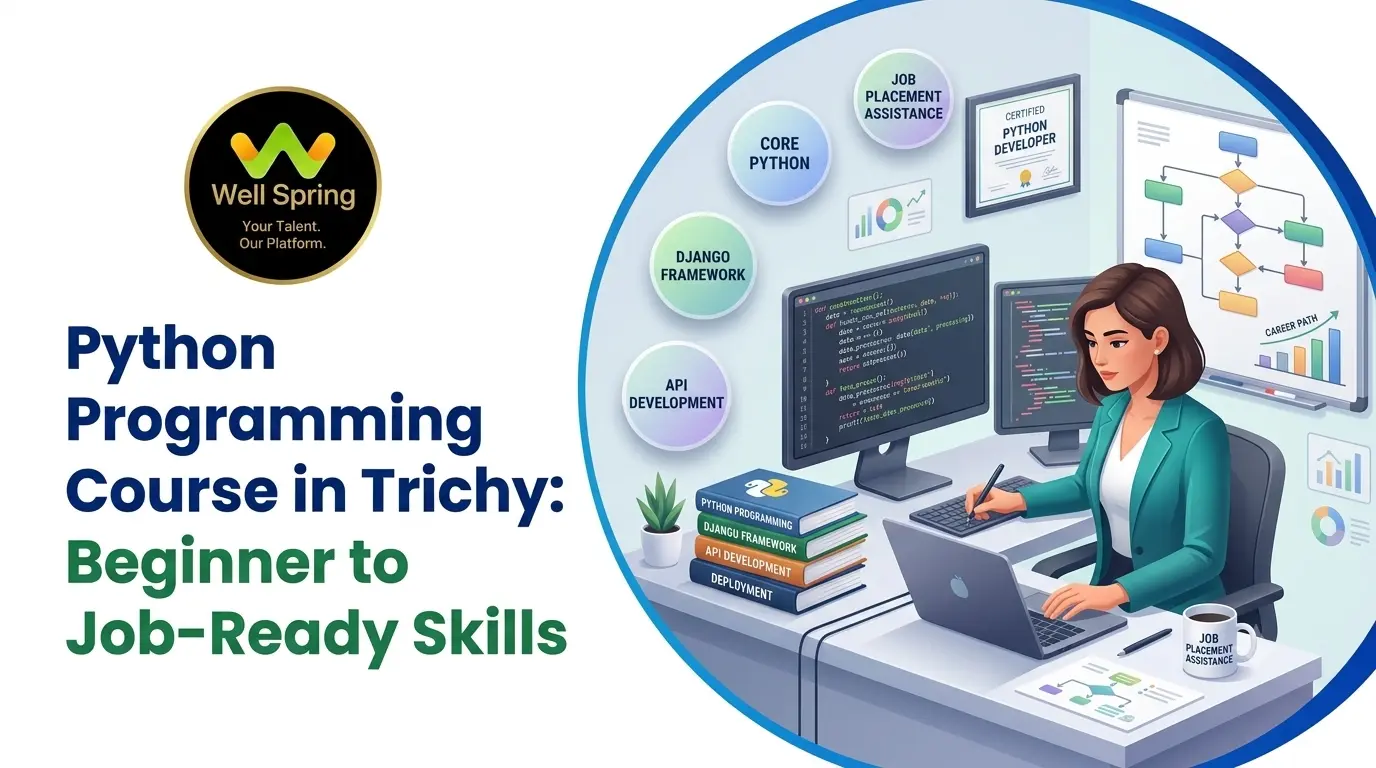
Choosing a Python Programming Course in Trichy is only the first step toward building a career in software development. The real challenge is knowing what to learn after the basics, how to practise effectively, which projects to build, and when to move into databases, APIs, frameworks or full-stack development. This guide explains the complete journey from learning Python fundamentals to developing practical applications, building a portfolio, preparing for interviews, and becoming more confident about entry-level technology opportunities.
A Python Programming Course in Trichy can be a strong starting point for students, fresh graduates, working professionals and career changers who want to develop programming skills.
But job-ready Python skills are broader than Python syntax.
A learner should ideally progress through:
Programming Logic → Python Fundamentals → Problem Solving → OOP → Databases → APIs → Frameworks → Projects → Git/GitHub → Interview Preparation
The most effective learning journey is not about completing the largest possible syllabus. It is about being able to take a problem, write a solution, build an application, identify errors, improve the code and explain what you have created.
That distinction is important when comparing Python courses and training institutes in Trichy.
You don't become a developer just because you know how to write a Python program.
That may sound obvious, but it is one of the biggest differences between learning a programming language and developing programming ability.
A beginner may learn variables, loops and functions in a few weeks. The harder questions usually come afterwards:
A useful Python Training in Trichy program should help answer these questions progressively.
WellSpring Talent Solutions positions its technology training around practical learning, including exercises, assignments, projects, live-project exposure and real-world scenarios rather than theory alone.
That practical direction is particularly relevant for beginners because programming becomes easier to understand when every new concept has a reason to exist.
Python is used across several technology domains, including software development, backend development, automation, data-related work and artificial intelligence.
For a beginner, however, its biggest advantage is simpler:
You can focus on learning programming concepts without spending all your energy fighting complicated syntax.
That makes Python a useful entry point for people searching for a Python Course for Beginners.
But beginner-friendly does not mean effortless.
You still need to develop:
The language may be accessible, but becoming good at programming requires practice.
A Python course can make sense for several different learners, but their goals may not be identical.
Students can use Python to strengthen their programming foundation while developing practical projects alongside their academic studies.
Instead of waiting until graduation to think about employability, they can start building a technical portfolio earlier.
A graduate may have studied programming during college but still lack confidence in building an application independently.
Structured training can help turn theoretical knowledge into practical experience.
For someone actively looking for an IT role, Python should become more than a resume keyword.
You should be able to demonstrate what you can actually build with it.
Python can be useful for professionals who want to strengthen their programming knowledge, automate tasks, move towards software development, or explore a new technical career path.
For someone entering technology from another field, a structured Python Course for Beginners can provide a more manageable starting point than trying to learn multiple technologies simultaneously.
A strong curriculum should have a logical progression.
You should not be taught twenty technologies simply because they look impressive on a course brochure.
The better question is:
Start with the building blocks:
At this stage, the objective is to understand how programs make decisions and process information.
Next, move towards writing reusable and organised code.
Learn:
Once you start writing larger programs, organisation becomes just as important as syntax.
This is where beginners should start thinking more like programmers.
You can practise:
Don't rush this stage.
Being able to solve a small problem independently is often more valuable than memorising another advanced library.
Object-Oriented Programming helps learners understand how larger applications can be structured.
Important concepts include:
WellSpring's listed Python trainer, Hassian, specifically covers Python fundamentals, OOP, data structures, functions, file handling, API development and database integration.
Real programs do not always receive perfect input.
You therefore need to understand:
Learning to debug is particularly important.
A developer's job is not to write code that never fails.
It is to understand why something failed and how to fix it.
This is the point where many beginners get stuck.
They understand the individual pieces but don't know how to connect them.
Consider a simple progression.
Create an expense calculator.
Store the expenses in a file.
Move the information into a database.
Create a web interface for managing expenses.
Add:
Suddenly, the learner isn't just “learning Python.”
They are learning how software is built.
That is the transition a career-focused Python program should encourage.
Python and Database Development
Python becomes considerably more useful when you understand how applications work with stored information.
A practical learning path should introduce:
For example, imagine building a student management application.
Python handles the application logic.
The database stores student information.
The interface allows users to interact with the application.
Understanding how these pieces communicate is much closer to real development than completing isolated Python exercises.
You don't need a web framework on your first day.
First build confidence with Python.
Then, once you understand functions, OOP, data structures and basic application logic, you can move into backend development.
Framework learning may include:
The exact framework depends on your career direction and the projects you want to build.
The principle is simple:
Learn the framework to build applications—not just to add another technology to your resume.
If your goal is to become a web developer, learning Python alone may not be enough.
A Python Full Stack Course in Trichy should introduce the technologies required to work across the frontend, backend and database layers.
The learning objective is to understand how the complete application works.
For example:
User Interface → API → Python Backend → Database
Once you understand that flow, you are no longer looking at Python as an isolated programming language.
You are using it as part of a software system.
Here is a practical progression for someone starting from scratch.
|
Stage |
What to Focus On |
Expected Outcome |
|
1. Beginner |
Programming logic |
Understand how programs work |
|
2. Foundation |
Core Python |
Write basic programs independently |
|
3. Development |
Functions, OOP, data structures |
Build organised programs |
|
4. Data |
SQL and databases |
Store and retrieve application data |
|
5. Backend |
Django/Flask and APIs |
Build web applications |
|
6. Tools |
Git/GitHub |
Manage and showcase code |
|
7. Projects |
Real applications |
Demonstrate practical ability |
|
8. Career |
Resume/interviews |
Prepare for job opportunities |
This roadmap is deliberately sequential.
Trying to learn everything simultaneously usually creates confusion rather than competence.
Projects should become progressively more challenging.
Beginner-Level Projects
Start with applications such as:
These reinforce fundamental programming concepts.
Intermediate Projects
Once you understand databases and application structure, try:
These projects introduce more realistic requirements.
Advanced Projects
Later, build:
The project does not have to be huge.
It needs to demonstrate that you understand the code you wrote.
Before calling yourself “job-ready,” ask yourself these questions.
Can you write Python without following a tutorial?
If yes, good.
Can you explain functions and OOP?
You should be able to explain them in simple language.
Can you work with a database?
You should understand basic SQL and Python-database integration.
Can you build something independently?
At least one meaningful project should be built without copying every step from a tutorial.
Can you debug your own code?
You should be comfortable investigating errors.
Can you use Git and GitHub?
You should know the basics of version control and repository management.
Can you explain your project?
If an interviewer asks why you chose a particular approach, you should have an answer.
If you can confidently answer most of these questions, you're moving beyond beginner-level learning.
There is a major difference between:
“I completed a Python course.”
and
“I built an application using Python, connected it to a database, fixed bugs, uploaded the project to GitHub, and can explain how it works.”
The second statement demonstrates capability.
That is why practical exposure matters.
WellSpring says its learners work through practical exercises, mini projects, assignments and live projects, with continuous mentor support. Its broader training approach is designed around applying concepts rather than focusing only on theory.
The same principle appears in its internship approach, where students apply their knowledge to real-world scenarios under mentor guidance.
Searching for the Best Python Course in Trichy can lead you to many institutes.
Don't compare them only by:
Instead, ask practical questions.
Does the Course Start at the Right Level?
A beginner should not be thrown into advanced frameworks before understanding programming fundamentals.
Is There Enough Coding Practice?
Ask how much of the course involves actually writing and debugging code.
Are Projects Included?
Find out whether students build projects independently or simply watch project demonstrations.
Can Trainers Review Your Work?
Feedback is valuable because beginners often don't know whether their approach is good, inefficient or incorrect.
Is There Internship Exposure?
Practical exposure can help bridge the gap between classroom learning and workplace expectations.
Is Career Preparation Included?
Look for support around:
Are Learning Schedules Practical?
Students and working professionals may require different schedules. WellSpring currently highlights flexible learning options for students, graduates and working professionals.
A good Python Training Institute in Trichy should not make you dependent on the trainer.
It should gradually make you more independent.
At the beginning, you may need help understanding a loop.
Later, you should be able to write functions independently.
After that, you should be able to design a small application.
Eventually, you should be able to look at a problem and decide:
What data do I need?
What logic should I use?
How should I structure the application?
Where should the data be stored?
How should the components communicate?
That is developer thinking.
WellSpring's current trainer information describes support through live demonstrations, coding practice, practical assignments, project mentoring, code reviews and technical doubt clarification.
For a learner comparing Python Training in Trichy, the training approach matters as much as the list of topics.
WellSpring Talent Solutions currently offers Python Programming as part of its wider technology-training portfolio, alongside Full Stack Development, Java, Web Development, AI, Cloud & DevOps, Software Testing and other programs.
Its learning environment focuses on:
The organisation also lists a dedicated Python trainer, Hassian, whose expertise includes Python fundamentals, OOP, data structures, functions, file handling, API development and database integration.
That combination is relevant to the beginner-to-job-ready journey because learners need more than explanations. They need opportunities to practise, build, receive feedback and improve.
Your institute can provide the roadmap.
But your habits determine how much you get from it.
Consistency matters more than occasional long study sessions.
Try solving the problem yourself before checking the answer.
Don't immediately delete failed code.
Understand why it failed.
You don't need to start with a huge application.
Five small projects can teach you more than one enormous project you copied from YouTube.
Upload projects that you can actually explain.
Instead of asking only:
“What is the answer?”
try asking:
“Why does this approach work?”
That change can significantly improve your learning.
Python + Java + JavaScript + AI + Cloud + DevOps all at once can become overwhelming.
Better: Build one strong foundation first.
A certificate can document course completion.
It cannot replace practical ability.
Better: Build projects that demonstrate your skills.
Following tutorials creates familiarity, but independent coding creates skill.
Better: Solve problems without looking at the solution first.
Many real applications need persistent data.
Better: Learn SQL and Python-database integration alongside application development.
Projects shouldn't be something you start only after completing the syllabus.
Better: Build small projects throughout your learning journey.
Don't wait until your course ends.
Better: Practise explaining concepts and projects from the beginning.
Python can become the foundation for several career directions.
Build Python-based applications, scripts and backend systems.
Work with Python frameworks, APIs, databases and application logic.
Combine Python backend skills with frontend technologies.
Use Python to automate repetitive processes and workflows.
With additional training in data analysis, statistics and relevant tools, Python can support data-related career paths.
Python is also an important foundation for AI and machine learning.
WellSpring's AI program, for example, starts with Python fundamentals before progressing into data handling, machine learning, deep learning, generative AI and AI application development.
This illustrates an important point:
Python does not have to be the final destination. It can be the foundation for your next technical specialisation.
Learning Python is not the finish line.
It is the beginning of a development journey.
If you're starting from zero, your first goal should be to understand programming logic.
Then build your Python fundamentals.
After that, strengthen problem-solving, learn OOP, work with databases, explore APIs and frameworks, and start creating projects.
Finally, bring everything together through GitHub, portfolio development, interview preparation and practical experience.
That is what turns a Python learner into a job-ready candidate.
For someone searching for a Python Programming Course in Trichy, the most important question isn't:
“Which course has the longest syllabus?”
It is:
“Which learning environment will help me understand, practise, build and become independent?”
WellSpring Talent Solutions' current training approach is built around practical learning, projects, internships, mentor support and career-oriented skill development.
So if your goal is to Learn Python in Trichy, start with the fundamentals, practise consistently, build real projects and choose a training path that matches the developer you want to become.
Don't aim merely to finish a Python course. Aim to become someone who can use Python to solve real problems.
15 Oct 2026
15 Oct 2026
14 Oct 2026
14 Oct 2026
13 Oct 2026
Yes. Python's relatively readable syntax makes it a practical starting point for people who are new to programming. Beginners should still develop programming logic and practise consistently.
Yes. A beginner-focused program can introduce programming concepts before progressing into more advanced Python development.
There is no fixed duration. It depends on your starting level, practice consistency, learning goals and the type of role you want. Learning Python fundamentals is much faster than becoming confident in full-stack development.
Python can provide a strong foundation, but most development roles require additional skills such as databases, APIs, frameworks, version control and project experience.
A practical program may cover Python fundamentals, data structures, functions, OOP, file handling, databases, APIs, frameworks, projects and development tools. The exact curriculum varies by institute.
It depends on your career goal. If you want backend or general Python programming, a Python-focused course may be sufficient initially. If your goal is web development across frontend and backend, a full-stack pathway may be more suitable.
Compare the curriculum, coding practice, trainer expertise, projects, mentor support, internship opportunities, career preparation and learning format. Don't make the decision based only on fees or certificates.
Look for practical coding, project development, experienced trainers, feedback on your work, mentor support, internship exposure and career preparation.
Yes. Working professionals can learn Python for skill development, automation, software development or career transition. A flexible schedule can make the process easier to manage.
Start with small applications such as calculators, quiz apps and expense trackers. Progress towards database applications, web applications, APIs and full-stack projects as your skills improve.
Yes. Python is widely used in AI and machine learning. However, learners should build strong programming fundamentals before moving into advanced AI topics.
An internship can provide practical exposure and help learners understand how technical skills are applied in real-world environments. It can also provide additional projects and experiences to discuss during interviews.
Get internship updates, IT training news, placement opportunities, and career tips directly to your inbox.
Join our WhatsApp community for internship updates, IT courses, placement support, and latest job opportunities.
Join Now