Blog Details
Home Blog Details

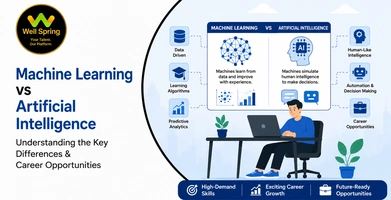
Choosing between Machine Learning vs Artificial Intelligence is one of the most common questions among students, software developers, and aspiring technology professionals. Although these terms are often used interchangeably, they are not the same. Artificial Intelligence (AI) is the broader field of creating machines capable of performing tasks that normally require human intelligence, whereas Machine Learning (ML) is a subset of AI that enables systems to learn from data and improve their performance without being explicitly programmed.
This comprehensive guide explores Machine Learning vs Artificial Intelligence, explaining their differences, career opportunities, salaries, required skills, industry demand, latest 2026 trends, and future growth. Whether you're considering an AI Course in Trichy or a Machine Learning Course in Trichy, this guide will help you choose the right career path.
If you're passionate about creating intelligent systems, robotics, natural language processing, and automation, Artificial Intelligence is the ideal career path. If you enjoy mathematics, predictive modeling, algorithms, and training systems using data, Machine Learning is the better specialization.
Both careers offer exceptional opportunities in 2026. However, Machine Learning is one of the core technologies within Artificial Intelligence, meaning professionals skilled in ML are also highly valuable in AI-driven industries.
Machine Learning vs Artificial Intelligence compares a specialized technology with its broader parent field.
Artificial Intelligence focuses on building intelligent systems that mimic human decision-making.
Machine Learning enables computers to learn from data without explicit programming.
Both careers are experiencing unprecedented global demand.
AI and ML professionals work across healthcare, finance, robotics, manufacturing, and cloud computing.
Practical projects and GitHub portfolios significantly improve employability.
Generative AI has accelerated demand for Machine Learning engineers.
Continuous learning is essential because AI technologies evolve rapidly.
Artificial Intelligence has evolved from a futuristic concept into one of the most transformative technologies of the 21st century. Today, AI powers virtual assistants, autonomous vehicles, recommendation engines, fraud detection systems, medical diagnostics, and intelligent chatbots.
Behind many of these innovations lies Machine Learning—the technology that enables computers to learn patterns from data and continuously improve their predictions.
According to PwC, Artificial Intelligence could contribute up to USD 15.7 trillion to the global economy by 2030, making it one of the largest economic opportunities in modern history. Meanwhile, Grand View Research estimates that the global Machine Learning market is expected to grow at a CAGR of more than 34% through the next decade, driven by increasing adoption across healthcare, finance, manufacturing, and cloud computing.
Additionally, the World Economic Forum identifies AI and Machine Learning Specialists among the fastest-growing job roles worldwide, reflecting strong global demand for skilled professionals.
This explosive growth has made Machine Learning vs Artificial Intelligence one of the most searched career comparisons.
Many students ask:
The answer depends on your interests, technical strengths, and career aspirations.
If you enjoy creating intelligent applications that simulate human thinking, Artificial Intelligence may be the ideal choice.
If you're fascinated by algorithms, predictive analytics, statistics, and teaching computers to learn from data, Machine Learning could be the perfect specialization.
At Well Spring Talent Solutions, students receive practical, industry-oriented training through live AI projects, Machine Learning models, portfolio development, expert mentorship, interview preparation, internships, and placement assistance. Whether enrolling in an AI Course in Trichy or a Machine Learning Course in Trichy, learners gain hands-on experience aligned with today's technology industry.
Organizations worldwide are investing heavily in intelligent technologies to automate operations, improve customer experiences, reduce costs, and make faster business decisions.
Industries actively hiring AI and Machine Learning professionals include:
Information Technology
Healthcare
Banking & Financial Services
Insurance
Manufacturing
Retail
E-commerce
Automotive
Agriculture
Telecommunications
Logistics
Education Technology
Government Organizations
AI and Machine Learning help businesses:
As organizations continue investing in automation and intelligent systems, demand for AI and ML professionals continues to increase globally.
One of the biggest misconceptions among beginners is believing that completing an AI certification alone guarantees employment.
In reality, employers evaluate practical implementation skills.
Recruiters typically assess:
Candidates who build recommendation systems, predictive models, chatbots, computer vision applications, or NLP projects generally stand out over those who possess only theoretical knowledge.
This is why live projects and portfolio development are essential for launching a successful AI career.
Artificial Intelligence (AI) is the broader branch of computer science that focuses on developing machines capable of performing tasks that typically require human intelligence.
AI systems can:
Artificial Intelligence combines multiple technologies, including:
Its objective is to create systems capable of performing intelligent tasks with minimal human intervention.
A professional AI Course in Trichy prepares students with comprehensive knowledge of intelligent technologies.
Students typically learn:
Python Programming
Artificial Intelligence Fundamentals
Machine Learning
Deep Learning
Neural Networks
Natural Language Processing
Computer Vision
Generative AI
Prompt Engineering
TensorFlow
PyTorch
AI Ethics
Model Deployment
Cloud AI
Intelligent Automation
Students also build real-world AI applications that strengthen their professional portfolios.
AI professionals are employed across almost every technology-driven industry.
Common employers include:
Software Companies
AI Startups
Healthcare Technology Firms
FinTech Companies
Robotics Companies
E-commerce Platforms
Cloud Computing Providers
Automotive Companies
Research Organizations
Government Projects
Manufacturing Industries
Educational Technology Companies
Cybersecurity Firms
Global Technology Enterprises
The rapid adoption of AI across industries makes Artificial Intelligence one of the most future-ready technology careers.
Artificial Intelligence has become a strategic business priority rather than an experimental technology.
Organizations use AI to:
Improve customer experiences
Build intelligent assistants
Detect fraud
Optimize manufacturing
Automate workflows
Enhance healthcare
Strengthen cybersecurity
Improve operational efficiency
Reduce business costs
Because AI directly influences innovation, efficiency, and competitive advantage, employers continue investing heavily in skilled AI professionals.
According to LinkedIn's Jobs on the Rise reports and multiple industry hiring studies, AI-related roles consistently rank among the fastest-growing technology careers worldwide.
Machine Learning (ML) is a specialized branch of Artificial Intelligence that enables computers to learn from data, identify patterns, and improve their performance without being explicitly programmed for every task.
Instead of following fixed instructions, Machine Learning algorithms analyze historical data, identify relationships, and make predictions or decisions based on new information.
Machine Learning powers many technologies we use every day, including:
Machine Learning is one of the core technologies driving the AI revolution and forms the foundation for many modern intelligent systems.
A professional Machine Learning Course in Trichy prepares students with practical knowledge required to develop intelligent predictive models.
Students typically learn:
Students also develop real-world predictive models using business datasets to strengthen their portfolios.
Machine Learning Engineers are employed across organizations that rely on predictive analytics and intelligent automation.
Common employers include:
As organizations continue integrating AI into their products and services, Machine Learning Engineers remain among the most sought-after professionals.
Modern organizations generate enormous amounts of data every day.
Machine Learning Engineers help businesses:
With Generative AI and intelligent automation becoming mainstream, organizations increasingly seek professionals who can build, train, optimize, and deploy Machine Learning models.
Although these terms are often used interchangeably, they represent different concepts.
|
Feature |
Artificial Intelligence |
Machine Learning |
|
Definition |
Broad field of intelligent systems |
Subset of Artificial Intelligence |
|
Primary Goal |
Simulate human intelligence |
Learn from data |
|
Scope |
Very Broad |
Specialized |
|
Includes |
ML, NLP, Robotics, Computer Vision |
Algorithms & Predictive Models |
|
Decision Making |
Can use multiple techniques |
Based on learning patterns |
|
Human Intervention |
Reduced |
Reduced after training |
|
Applications |
Chatbots, Robotics, Smart Assistants |
Fraud Detection, Recommendation Systems |
Simply put:
Many beginners compare AI vs Machine Learning, but the relationship is similar to comparing a vehicle with its engine.
Artificial Intelligence includes multiple technologies that enable machines to behave intelligently.
Machine Learning focuses specifically on enabling computers to improve automatically through experience and data.
For example:
An AI-powered virtual assistant uses:
Machine Learning is therefore one important component of Artificial Intelligence—not a competing technology.
Students frequently compare Artificial Intelligence vs Machine Learning Career because both offer exciting opportunities.
Choose Artificial Intelligence if you enjoy:
Choose Machine Learning if you enjoy:
Many professionals start with Machine Learning before expanding into broader Artificial Intelligence domains.
One of the most common questions students ask is Which is Better AI or Machine Learning?
There is no single answer because both fields complement each other.
Choose Artificial Intelligence if you prefer:
Choose Machine Learning if you prefer:
Professionals skilled in both AI and Machine Learning are among the most valuable technology experts in today's job market.
AI and Machine Learning professionals continue to rank among the highest-paid technology specialists.
|
Job Role |
Salary Growth Potential |
|
AI Engineer |
Very High |
|
Machine Learning Engineer |
Very High |
|
AI Research Engineer |
Excellent |
|
Data Scientist |
Very High |
|
Computer Vision Engineer |
Excellent |
|
NLP Engineer |
Excellent |
|
AI Solutions Architect |
Outstanding |
Salary depends on:
Professionals with expertise in Machine Learning, Deep Learning, Cloud AI, and Generative AI generally enjoy outstanding salary growth.
Professional AI Engineers typically develop expertise in:
Machine Learning Engineers generally master:
Machine Learning is a subset of Artificial Intelligence.
Understanding this distinction helps students choose the right specialization.
Machine Learning relies heavily on:
Building a strong mathematical foundation makes advanced concepts easier to understand.
Employers expect candidates to demonstrate practical implementation through real-world AI projects.
Maintaining a GitHub portfolio showcasing Machine Learning and AI projects significantly improves employability.
AI evolves rapidly.
Students should continuously explore:
Artificial Intelligence continues advancing at an unprecedented pace.
Key trends shaping the industry include:
Professionals who continuously upgrade their skills will remain highly competitive in the evolving AI ecosystem.
Students looking for an industry-oriented AI Course in Trichy or Machine Learning Course in Trichy receive practical training designed to meet modern industry expectations.
Training includes:
Students graduate with practical AI development experience that prepares them for high-growth technology careers.
1. Master Python First
Python remains the most important programming language for both Artificial Intelligence and Machine Learning.
2. Strengthen Mathematical Foundations
Statistics, probability, and linear algebra play a vital role in Machine Learning model development.
3. Build Real AI Projects
Develop projects such as:
4. Learn Cloud AI Platforms
Knowledge of AWS, Azure, and Google Cloud AI services significantly improves employability.
5. Stay Curious
Artificial Intelligence evolves rapidly. Read research papers, participate in AI communities, and continuously experiment with emerging technologies.
What is the difference between Machine Learning and Artificial Intelligence?
Artificial Intelligence is the broader field focused on creating intelligent systems, while Machine Learning is a subset of AI that enables systems to learn from data and improve automatically.
Which is better: AI or Machine Learning?
Both offer excellent career opportunities. AI provides broader career paths, while Machine Learning offers specialized expertise in predictive modeling and intelligent algorithms.
Can I learn Machine Learning without AI?
Yes. However, understanding basic Artificial Intelligence concepts helps provide context for Machine Learning applications.
Is Python necessary for Machine Learning?
Yes. Python is the most widely used programming language for Machine Learning because of libraries such as Scikit-learn, TensorFlow, and PyTorch.
Is Artificial Intelligence a good career in 2026?
Yes. AI remains one of the fastest-growing technology domains as organizations continue investing in automation, intelligent applications, and digital transformation.
The demand for Artificial Intelligence and Machine Learning professionals continues to rise across Trichy, Madurai, Thanjavur, Karur, Dindigul, Pudukkottai, Ariyalur, Perambalur, and other regions of Tamil Nadu. Organizations across software development, healthcare, finance, manufacturing, cloud computing, and e-commerce are actively recruiting professionals with AI and Machine Learning expertise.
At Well Spring Talent Solutions, students gain practical experience through an AI Course in Trichy and a Machine Learning Course in Trichy, featuring live AI projects, portfolio development, internships, expert mentorship, interview preparation, and placement assistance.
What is the difference between Artificial Intelligence and Machine Learning?
Artificial Intelligence is a broad field focused on creating intelligent systems capable of performing human-like tasks, while Machine Learning is a subset of AI that enables computers to learn patterns from data and improve automatically without explicit programming.
Which career has better job opportunities?
Both AI and Machine Learning offer excellent opportunities. AI provides broader career options across multiple domains, while Machine Learning specialists are highly sought after for predictive analytics, recommendation systems, and intelligent automation.
Which course should beginners choose?
Beginners interested in intelligent technologies should start with Artificial Intelligence fundamentals and then specialize in Machine Learning to build a strong foundation.
Does Machine Learning require mathematics?
Yes. A good understanding of statistics, probability, and linear algebra helps in developing and optimizing Machine Learning models.
Is learning AI and Machine Learning worth it in 2026?
Absolutely. As organizations continue investing in Generative AI, automation, cloud computing, and intelligent systems, professionals skilled in AI and Machine Learning remain among the most in-demand technology experts globally.
Machine Learning vs Artificial Intelligence compares a specialized technology with its broader parent discipline.
Artificial Intelligence focuses on creating intelligent systems, while Machine Learning enables those systems to learn from data.
Python, mathematics, and practical projects are essential for success in both fields.
Live projects and GitHub portfolios significantly improve employability.
Generative AI and Large Language Models are expanding career opportunities for AI and Machine Learning professionals.
Professionals with expertise in both Artificial Intelligence and Machine Learning enjoy exceptional long-term career growth.
Choosing between Machine Learning vs Artificial Intelligence isn't about selecting competing technologies—it's about deciding how deeply you want to specialize within one of the world's fastest-growing fields. Artificial Intelligence offers a broad and exciting career involving intelligent systems, automation, robotics, and natural language processing, while Machine Learning provides specialized expertise in building predictive models and data-driven intelligent applications.
At Well Spring Talent Solutions, students receive practical, industry-focused training through live AI projects, Machine Learning model development, internships, expert mentorship, interview preparation, and placement assistance. Whether you choose an AI Course in Trichy or a Machine Learning Course in Trichy, you'll gain the practical skills required to build a successful career in one of the most innovative industries of the future.
Start your journey today and become part of the next generation of AI and Machine Learning professionals.
15 Oct 2026
15 Oct 2026

14 Oct 2026

14 Oct 2026

13 Oct 2026
Both fields offer outstanding opportunities. Artificial Intelligence provides broader roles such as AI Engineer, NLP Engineer, Computer Vision Engineer, and AI Researcher, while Machine Learning focuses on specialized positions like Machine Learning Engineer and Predictive Analytics Specialist.
Yes. In fact, Machine Learning is a core component of Artificial Intelligence. Learning both provides a comprehensive understanding of intelligent systems and significantly improves career opportunities.
Basic programming knowledge, particularly Python, is highly recommended before learning Artificial Intelligence or Machine Learning because most AI frameworks and libraries are Python-based.
Yes. Employers often prioritize candidates who can demonstrate practical AI and Machine Learning projects, GitHub repositories, and real-world problem-solving abilities. Certifications strengthen your profile, but practical implementation showcases your capabilities.
Start by learning Python, mathematics, and data analysis fundamentals. Build real-world AI and Machine Learning projects, maintain an active GitHub portfolio, stay updated with Generative AI and emerging technologies, and enroll in an industry-oriented training program that provides live projects, internships, expert mentorship, and placement assistance.
Get internship updates, IT training news, placement opportunities, and career tips directly to your inbox.
Join our WhatsApp community for internship updates, IT courses, placement support, and latest job opportunities.
Join Now