
Computer vision is an important area of artificial intelligence (AI) that enables computers to analyse and interpret visual information from images and videos. It is used in applications such as healthcare, manufacturing, retail, transportation, security, and document processing.
From recognising objects in an image to classifying visual information, computer vision allows AI systems to work with data that people naturally understand through sight. This article explains what computer vision is, how it works, image recognition, image classification, object detection, and real-world computer vision applications.
What Is Computer Vision in AI?
Computer vision in AI is a technology that enables computers to process and interpret visual information from images and videos.
A computer vision system can analyse visual data to identify patterns, recognise objects, classify images, detect specific features, or extract useful information.
For example, a computer vision system can analyse an image and identify:
- A person
- A vehicle
- A product
- A road sign
- A building
- Other objects within the scene
Computer vision is closely connected with machine learning and deep learning, which allow models to learn patterns from data and use them when analysing new visual information.
To understand how computer vision fits into the wider AI field, it is also useful to understand the relationship between AI and machine learning. You can read our guide on Machine Learning vs Artificial Intelligence for a broader explanation of these technologies.
How Does Computer Vision Work?
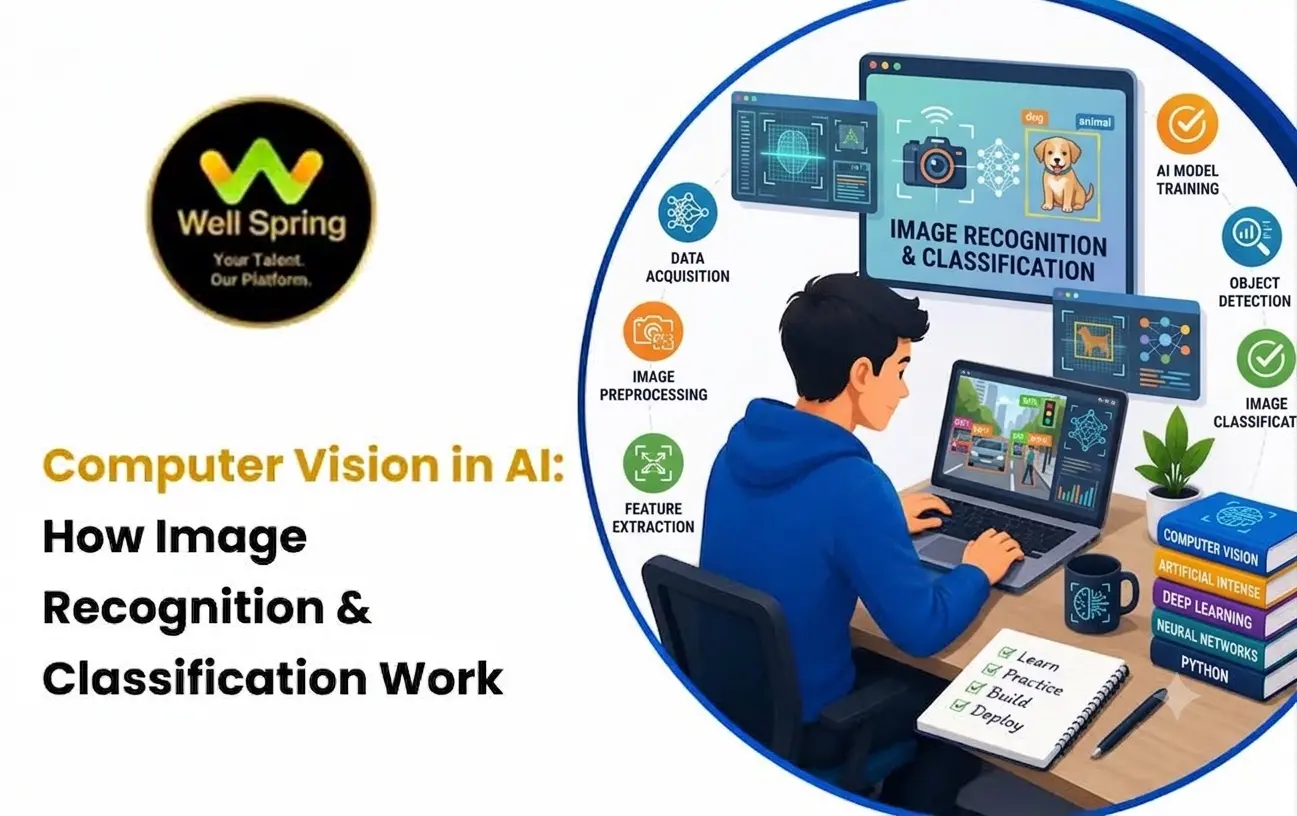
Computer vision typically involves several stages that transform visual information into a useful result.
1. Collecting Visual Data
The system first receives visual information from sources such as:
- Digital images
- Cameras
- Videos
- Scanned documents
- Medical imaging equipment
- Mobile devices
The quality and quantity of the available data can influence how effectively a computer vision model performs.
2. Image Processing
The collected images may need to be prepared before analysis.
Common image processing tasks include:
- Resizing images
- Removing unwanted noise
- Adjusting brightness
- Normalising data
- Converting image formats
These processes help prepare the visual data for further analysis.
3. Detecting Visual Patterns
The system identifies useful patterns within the visual information. These may include:
- Edges
- Shapes
- Textures
- Colours
- Objects
- Other visual features
Modern computer vision systems can learn many of these patterns through machine learning and deep learning models.
4. Analysing the Image
The processed information is then analysed by an appropriate model.
Depending on the application, the model may classify the image, recognise an object, detect multiple objects, or extract other information from the visual data.
5. Producing an Output
Finally, the system generates an output based on its analysis.
For example, it could determine that an image contains a vehicle, classify an image into a specific category, or identify several objects and their locations.
This process allows computers to perform a variety of visual analysis tasks.
What Is Image Recognition?
Image recognition is the process of identifying or interpreting the content of an image using computer vision techniques.
For example, an image recognition system could analyse an image and identify whether it contains:
- A car
- A dog
- A person
- A product
- A plant
AI image recognition systems can learn visual patterns from large collections of images and use those patterns when processing new images.
Image recognition can be used in applications such as smartphone features, security systems, retail platforms, healthcare systems, and digital image management.
What Is Image Classification?
Image classification is a computer vision task where an image is assigned to a predefined category.
For example, a system could classify images into categories such as:
- Cat
- Dog
- Bird
A specialised image classification system could also classify products, medical images, documents, or industrial components.
Deep learning models are commonly used for image classification because they can learn complex visual patterns from large datasets.
Image Recognition vs Image Classification
Image recognition and image classification are closely related, but they are not always used to describe exactly the same task.
Image classification generally determines which category an image belongs to.
Image recognition is a broader term that can refer to identifying or interpreting visual content.
For example, an image classification model might classify a photograph as containing a car, while another computer vision system could analyse the image in greater detail to identify multiple objects.
What Is Object Detection?
Object detection identifies individual objects within an image or video and determines their locations.
For example, a traffic-monitoring system could detect:
- Cars
- Buses
- Motorcycles
- Pedestrians
- Traffic signs
Object detection therefore provides more information than simple image classification.
Instead of only determining what an image represents, an object detection system can identify what objects are present and where they are located.
This makes object detection useful for applications that need to analyse multiple objects within the same image or video.
Computer Vision Applications
Computer vision applications are used across different industries to analyse visual information and automate specific tasks.
Healthcare
Computer vision can assist with analysing medical images such as X-rays and other diagnostic images.
It can help systems identify patterns within visual medical data and support specific image-analysis workflows.
Manufacturing
Manufacturing companies can use computer vision for:
- Product inspection
- Defect detection
- Quality control
- Product counting
- Production monitoring
Computer vision can help identify visual differences that may be difficult to monitor manually at scale.
Retail
Computer vision can be used to analyse products, inventory, store environments, and other visual information.
Retail applications may use image analysis to support product identification, inventory monitoring, and customer-related processes.
Transportation
Computer vision can analyse:
- Vehicles
- Pedestrians
- Traffic signs
- Road environments
- Surrounding objects
This makes it useful for different transportation and driver-assistance applications.
Security
Security systems can use computer vision for visual monitoring, object detection, face detection, and other forms of image and video analysis.
Document Processing
Computer vision and related technologies can process scanned documents, forms, invoices, and other visual documents.
For example, image-based systems can be combined with text recognition technologies to extract useful information from documents.
Computer Vision Examples in Everyday Technology
Computer vision is already part of many technologies people use regularly.
Common computer vision examples include:
- Face unlocking on smartphones
- QR code scanning
- Number plate recognition
- Automatic document scanning
- Photo search
- Product recognition
- Security camera analysis
- Driver-assistance systems
These applications demonstrate how computers can process visual information and convert it into useful digital results.
Computer Vision Technology and Deep Learning
Modern computer vision technology is strongly connected with deep learning.
Deep learning models can learn complex visual patterns from large datasets. Instead of manually defining every visual rule, the model can learn useful representations from training examples.
For example, an image classification model can learn patterns associated with different categories during training. When the model receives a new image, it can use the learned patterns to produce a classification.
The effectiveness of a computer vision system can depend on factors such as:
- Quality of the training data
- Size of the dataset
- Model architecture
- Data preprocessing
- Training methods
- Model evaluation
This is why computer vision involves more than simply providing an image to an AI system.
What Are the Main Computer Vision Use Cases?
Different computer vision tasks can be applied depending on the problem being solved.
Image Classification
Determines which predefined category an image belongs to.
Image Recognition
Identifies or interprets visual content within an image.
Object Detection
Identifies objects and their locations within an image or video.
Image Segmentation
Separates an image into different regions or objects for more detailed analysis.
Text Recognition
Extracts text from images, scanned documents, or other visual sources.
Face Detection
Identifies the presence and location of faces within an image or video.
Video Analysis
Analyses objects, movements, or activities across video frames.
Different applications can combine several of these computer vision capabilities to solve a specific problem.
How Computer Vision Fits Into AI
Computer vision is one part of the broader artificial intelligence ecosystem.
Other areas of AI include:
- Machine learning
- Deep learning
- Natural language processing
- Generative AI
- Large language models
- Data analysis
These technologies can also work together.
For example, a system could use computer vision to analyse an image and another AI technology to generate a text-based description of what the image contains.
Understanding these relationships can help explain how different AI technologies are used to solve different types of problems.
From Computer Vision Concepts to Practical AI Applications
Understanding computer vision concepts is different from developing a working AI application.
A practical computer vision project may involve:
- Selecting a suitable dataset
- Preparing and cleaning the data
- Processing the images
- Choosing an appropriate model
- Training the model
- Evaluating the results
- Testing the model with new data
- Improving the system based on the results
This shows how computer vision concepts can move from theoretical understanding to practical implementation.
Students interested in exploring AI technologies through a structured learning path can learn more about the AI Course in Trichy.
Those looking specifically for practical exposure can also explore the AI Internship in Trichy to understand how AI concepts can be applied through project-based work.
Computer Vision and Machine Learning
Computer vision and machine learning are closely connected, but they describe different concepts.
Machine learning is a broader approach in which systems learn patterns from data to make predictions or decisions.
Computer vision focuses specifically on processing and understanding visual information.
Machine learning and deep learning techniques can therefore be used to build computer vision systems for tasks such as image classification and object detection.
Practical machine learning work can involve datasets, model development, testing, and evaluation. For readers interested in understanding the practical side of machine learning, our Machine Learning Internship Guide provides additional information.
Computer Vision and AI Skills
Computer vision is one example of how AI technologies can be applied to real-world problems.
Depending on the type of application, working with computer vision can involve concepts such as:
- Python
- Machine learning
- Deep learning
- Neural networks
- Image processing
- Datasets
- Model training
- Model evaluation
The specific technologies and skills required can vary depending on the role and application.
AI is also changing the technical skills expected across different types of jobs. Our article on How AI Is Changing Job Requirements explores this broader topic.
For readers comparing AI with related technology fields, our guide on AI vs Data Science explains some of the differences between these areas.
Why Is Computer Vision Important in AI?
Visual information is generated every day through cameras, smartphones, medical equipment, manufacturing systems, security devices, and other technologies.
Computer vision provides methods for processing this visual information and converting it into useful results.
It can help AI systems:
- Recognise visual patterns
- Classify images
- Detect objects
- Analyse videos
- Extract information from documents
- Support visual inspection
- Interpret image-based data
As AI applications continue to use different forms of data, computer vision remains an important area for understanding how artificial intelligence can work with visual information.
Conclusion
Computer vision in AI enables computers to analyse and interpret visual information from images and videos. Technologies such as image recognition, image classification, and object detection allow AI systems to perform different visual analysis tasks.
Computer vision is used across healthcare, manufacturing, retail, transportation, security, document processing, and other areas where visual data needs to be analysed.
Understanding how computer vision works also provides a useful foundation for seeing how machine learning and deep learning can be applied to real-world AI problems.