
Introduction
Python is one of the most widely used programming languages for learning, software development, automation, data analysis, artificial intelligence, and many other technical applications.
One reason for its popularity is that Python can be used across different types of projects. A beginner might use it to automate a repetitive task, while a professional development team might use it as part of a web application, data pipeline, or machine learning system.
But what exactly can you build with Python?
Understanding what Python is used for is useful for students and beginners because it helps connect programming concepts with real applications. Instead of learning Python simply because it is popular, learners can understand which career and project areas use the language and decide where they want to develop deeper skills.
Quick Answer
Python is used for web development, automation, data analysis, artificial intelligence and machine learning, scientific computing, testing, scripting, cybersecurity-related tasks, education, and many other software applications. Its libraries and frameworks allow developers to use Python for different types of real-world problems.
What Is Python?
Python is a general-purpose, high-level programming language known for its relatively readable syntax and broad ecosystem of libraries and tools.
It can be used for different types of programming rather than being restricted to one specific application area.
Developers use Python to write programs that can:
- Process information.
- Automate repetitive tasks.
- Build web applications.
- Analyse data.
- Communicate with databases and APIs.
- Train and use machine learning models.
- Run scientific calculations.
- Test software.
- Create scripts and utilities.
Python's flexibility is one reason it appears across both education and professional software development.
What Is Python Used For?
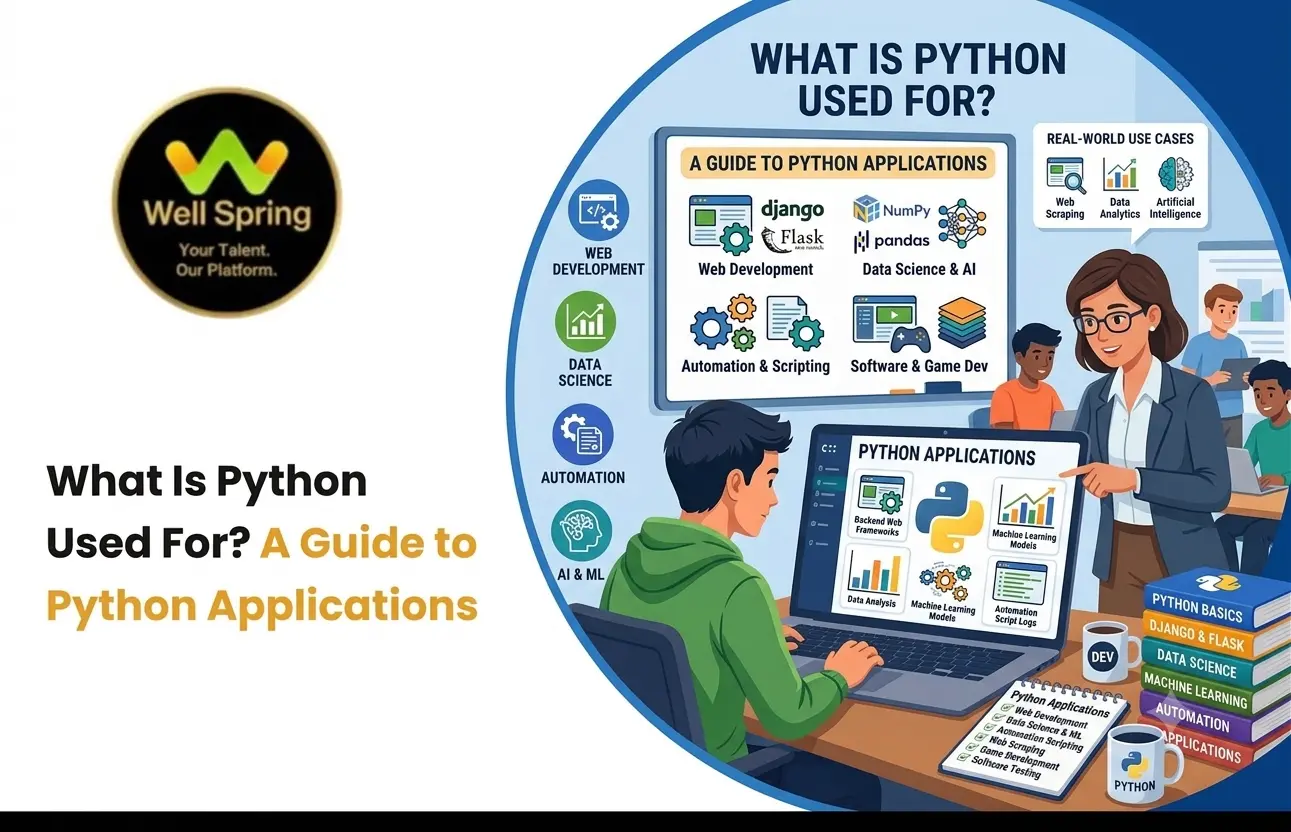
The uses of Python can be grouped into several major areas:
| Area | Typical Python Applications |
|---|---|
| Web Development | Websites, web applications, APIs, backend services |
| Automation | File processing, repetitive tasks, scripts |
| Data Analysis | Data cleaning, analysis, visualisation |
| AI and Machine Learning | Model development, experimentation, AI applications |
| Scientific Computing | Numerical analysis, simulations, research |
| Testing | Automated software tests and test utilities |
| Cybersecurity | Security tooling, analysis, automation |
| Education | Programming education and learning projects |
| Desktop Utilities | Small applications and productivity tools |
| Business Applications | Data processing, internal tools, reporting and automation |
The appropriate use depends on the requirements of the project, the surrounding technology stack, performance needs, and the skills of the development team.
Python for Web Development
One of the major Python applications is web development.
Python can be used on the backend of websites and web applications.
Frameworks and tools in the Python ecosystem allow developers to build:
- Web applications.
- REST APIs.
- Backend services.
- Content-driven websites.
- Data-driven applications.
- Authentication systems.
- Administrative interfaces.
Popular Python web frameworks include Django, Flask, and FastAPI, although they serve somewhat different development needs.
Example
Imagine an online course platform.
A Python backend could handle:
- User registration.
- Login and authentication.
- Course information.
- Student enrolments.
- Database operations.
- API requests.
- Application logic.
The user may interact with a frontend interface, while Python handles part of the server-side functionality behind it.
Python for Automation and Scripting
One of the most accessible Python programming uses is automation.
Many tasks that are repetitive and rule-based can potentially be automated with scripts.
For example, Python can be used to:
- Rename large numbers of files.
- Organise folders.
- Process spreadsheets.
- Generate reports.
- Convert files.
- Extract structured information.
- Send automated notifications.
- Process large collections of documents.
- Perform routine data transformations.
Example
Suppose a company receives hundreds of files every week.
A Python script could identify file types and organise them into appropriate folders according to predefined rules.
Instead of manually repeating the same task, the script performs the process consistently.
This is one reason Python is popular among people who want to automate everyday technical or business workflows.
Python for Data Analysis
Python is widely used for working with data.
A data analyst may need to:
- Import datasets.
- Clean inconsistent information.
- Filter records.
- Combine data sources.
- Calculate statistics.
- Identify patterns.
- Create visualisations.
- Generate reports.
Python's ecosystem includes tools such as pandas and NumPy that support different types of data-processing and numerical work.
Visualization libraries can also help analysts turn datasets into charts and other forms of visual communication.
Example
A retail business could use Python to analyse sales data and investigate:
- Which products generate the most revenue.
- How sales vary over time.
- Which locations perform differently.
- Which product categories are growing.
- Where unusual patterns appear.
Python does not replace analytical thinking. It provides tools that help process and explore data efficiently.
Python for Artificial Intelligence and Machine Learning
Another major area where Python is used is artificial intelligence and machine learning.
Python has a large ecosystem for:
- Machine learning.
- Deep learning.
- Natural language processing.
- Computer vision.
- Data preparation.
- Model experimentation.
- AI application development.
Libraries and frameworks such as scikit-learn, PyTorch, and TensorFlow are part of the broader Python ecosystem.
Example
A machine learning project might involve:
Collect Data → Clean Data → Prepare Features → Train Model → Evaluate Model → Deploy or Use Model
Python can be involved in several stages of this workflow.
For example, a student might build a simple classification model to predict whether a dataset belongs to one category or another.
As projects become more advanced, Python can be used alongside specialised infrastructure and other programming technologies.
Python for Scientific Computing
Python is also used in scientific and research environments.
Researchers can use Python for:
- Numerical calculations.
- Data analysis.
- Simulations.
- Statistical analysis.
- Scientific visualisation.
- Experiment processing.
- Research automation.
Its extensive ecosystem allows researchers to combine mathematical computation, data processing, and visualisation in a single workflow.
Example
A researcher working with experimental measurements might use Python to:
- Import collected data.
- Remove or identify invalid observations.
- Perform calculations.
- Generate visualisations.
- Compare experimental results.
- Export findings for further analysis.
This makes Python useful when programming is closely connected to quantitative research.
Python for Software Testing
Python can also be used in software testing.
Testing teams can use Python to automate checks that would otherwise require repeated manual execution.
Depending on the project, Python can support:
- Unit testing.
- Integration testing.
- API testing.
- Test automation.
- Data validation.
- Test utilities.
Frameworks and libraries can help developers create automated tests that check whether software behaves as expected.
Example
Suppose an application calculates the total price of an order.
Instead of manually checking the calculation every time the code changes, automated tests can verify expected results against predefined test cases.
This helps development teams detect regressions more efficiently.
Python for Cybersecurity
Python can also be useful in cybersecurity-related development and analysis.
Security professionals and researchers may use Python for tasks such as:
- Log analysis.
- Data processing.
- Security automation.
- Network-related analysis.
- Security testing tools.
- Incident investigation utilities.
For example, a script could process large numbers of log entries and identify patterns that require further investigation.
Python is a programming tool in this context; using it responsibly requires appropriate authorisation when interacting with systems or data.
Python for Education
Python is widely used for programming education because its syntax can be relatively accessible to beginners.
Students can use Python to learn concepts such as:
- Variables.
- Conditions.
- Loops.
- Functions.
- Data structures.
- Object-oriented programming.
- File handling.
- Algorithms.
Once students understand these concepts, they can build practical projects.
For example:
Beginner: Calculator
Next: Quiz application
Next: Expense tracker
Next: File automation tool
Next: API-based application
Next: Database-driven application
This progression helps learners connect individual programming concepts with complete applications.
Python for Desktop and Utility Applications
Python can also be used to create certain desktop applications and utilities.
Depending on the requirements, developers can create programs with graphical interfaces using appropriate Python libraries and frameworks.
Possible applications include:
- Productivity tools.
- Data-entry utilities.
- Internal business applications.
- Small management systems.
- File-processing tools.
- Educational applications.
However, whether Python is the best choice for a desktop application depends on the platform, user-interface requirements, performance needs, deployment environment, and existing technology stack.
Python in Real-World Business Applications
The phrase Python in real world covers many different types of business use.
A company may use Python for a customer-facing application, an internal automation tool, a data-processing pipeline, or a machine learning service.
Consider an e-commerce business.
Python could potentially be used for:
Backend Services
Handling application logic and API requests.
Data Processing
Processing customer or sales information.
Recommendation Systems
Supporting machine learning workflows where appropriate.
Automation
Generating reports or processing files.
Testing
Automating software checks.
Analytics
Exploring business data and generating insights.
The same language can therefore appear in different parts of an organisation for different reasons.
Where Is Python Used by Developers?
When asking where is Python used, it is useful to think beyond industries and consider development roles.
Web Developers
Backend developers may use Python to create APIs and server-side applications.
Data Analysts
Analysts can use Python to clean, process, analyse, and visualise datasets.
Data Scientists
Data scientists may use Python for statistical analysis, experimentation, and machine learning workflows.
Machine Learning Engineers
Python can be part of model development and AI application workflows.
Automation Developers
Developers can use Python to automate repetitive technical or business processes.
QA and Test Engineers
Python can be used to create automated tests and testing utilities.
Researchers
Scientists and researchers can use Python for numerical analysis, simulations, and data processing.
DevOps and Engineering Teams
Python can be used for scripts, automation, tooling, and infrastructure-related workflows depending on the organisation.
The exact responsibilities vary between roles and companies.
What Can Students Build With Python?
Students who are learning Python do not need access to a large company project to start applying the language.
They can build projects such as:
Calculator
Practise functions, conditions, and user input.
Quiz Application
Practise lists, dictionaries, loops, and functions.
Expense Tracker
Practise structured data and file handling.
Student Management System
Practise CRUD operations and data organisation.
Weather Application
Practise APIs and JSON.
File Organizer
Practise automation and file handling.
Web Application
Move into frameworks and database-backed development after learning the fundamentals.
The most valuable project is not necessarily the most complicated one.
A project becomes more useful when the student understands the problem, writes the code independently, handles errors, tests the application, and can explain the design decisions.
Python Career Paths
Learning Python can support different career directions, but learning the language alone does not define a career.
Students can combine Python with other skills depending on their interests.
| Career Direction | Additional Skills to Explore |
|---|---|
| Python Web Development | Django/Flask/FastAPI, databases, APIs, frontend basics |
| Data Analysis | Statistics, SQL, pandas, visualisation |
| Data Science | Statistics, machine learning, experimentation |
| Machine Learning | Mathematics, ML concepts, model evaluation, deployment |
| Automation | APIs, scripting, file handling, workflow design |
| Testing | Test automation, QA concepts, API testing |
| Backend Development | APIs, databases, authentication, system design fundamentals |
This is why beginners should think beyond the question “Should I learn Python?”
A more useful question is:
“What do I want to build with Python?”
That answer can help determine what to learn next.
Limitations and Considerations When Using Python
Python is versatile, but it is not automatically the best choice for every programming problem.
Project requirements may favour another language when factors such as:
- Runtime performance.
- Memory constraints.
- Mobile development requirements.
- Browser-side execution.
- Hardware-level programming.
- Existing organisational technology.
- Platform-specific capabilities.
are particularly important.
Python can also be combined with other technologies rather than being used alone.
For example, a web application might use Python on the backend while using JavaScript-based technologies on the frontend.
The right technology therefore depends on the problem being solved.
Key Takeaways
Python is not limited to one type of software. Its ecosystem allows developers to apply the language to many different technical and business problems.
- Python is used across web development, automation, data, AI, testing, scientific computing, and other areas.
- Python's libraries and frameworks expand what developers can build with the language.
- Automation is one of the most accessible ways for beginners to see Python solving practical problems.
- Data analysis and machine learning are major areas where Python is widely used.
- Students can begin with small projects and gradually progress toward APIs, databases, web applications, and automation.
- Learning Python is more valuable when combined with problem-solving and domain-specific skills.
- Python does not need to be used alone; it can work alongside other programming languages and technologies.
- The best learning direction depends on what you want to build and which problems you want to solve.
Conclusion
So, what is Python used for? The answer extends far beyond basic programming exercises.
Python can be used to automate repetitive work, build backend applications, analyse data, develop machine learning systems, support scientific research, automate software testing, create utilities, and teach programming fundamentals.
For beginners and students, the most useful next step is not simply memorising more Python syntax. Start building something. A small project can show you what the language is capable of and help you discover which area of technology interests you most.
Once you understand where Python is used, you can make a more informed decision about whether you want to explore web development, automation, data, AI, testing, or another Python-based path.