Blog Details
Home Blog Details

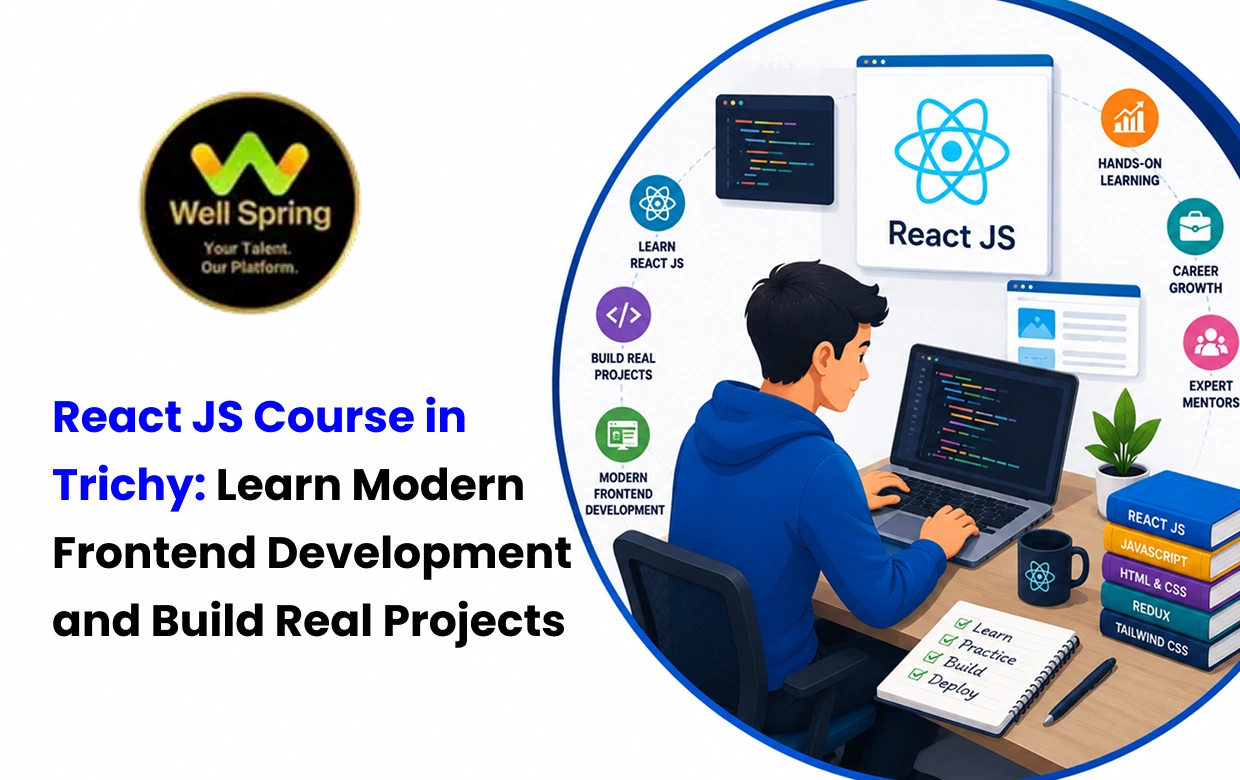
A React JS Course in Trichy can help students, freshers, and aspiring developers build the practical skills needed for modern frontend development. React is widely used to create fast, interactive, and reusable user interfaces for websites and web applications. Through structured React JS Training, learners can understand components, Hooks, routing, APIs, state management, and responsive design while working on practical projects.
This guide explains what you can learn in a React course, why hands-on practice matters, common mistakes to avoid, industry trends shaping frontend development in 2026, and how industry-focused training and internships can help learners build stronger portfolios and job-ready skills.
A React JS Course in Trichy teaches students how to build modern, interactive web applications using React. Learners typically study JSX, components, props, state, React Hooks, routing, API integration, responsive design, and project development. The most effective React JS Training combines structured lessons with hands-on coding, real-world projects, mentorship, practical exposure, and career preparation. This approach can help learners move beyond theory and develop a portfolio that demonstrates their frontend development skills.
Many students learn HTML, CSS, and JavaScript but face a common challenge: they understand the basics but are unsure how to build a complete modern web application. Development teams often expect developers to understand reusable components, APIs, responsive interfaces, version control, debugging, and practical project workflows.
This is where a structured React JS Course in Trichy can be useful.
React gives learners a practical way to understand modern frontend development. Instead of building every part of an interface from scratch, developers can create reusable components and organise applications more effectively.
For students and job seekers in Trichy, practical learning can help bridge the gap between understanding a technology and applying it to real development tasks. A structured training environment can provide a clearer path from JavaScript fundamentals to complete frontend application development.
React JS is a JavaScript library used to build interactive user interfaces. Developers use it to create applications from smaller, reusable components. A navigation bar, login form, product card, or dashboard widget, for example, can be created as an individual component and reused where needed.
This approach offers several benefits:
However, learning React syntax alone is not enough. Students also need to understand how to structure projects, manage data, debug problems, and turn requirements into working applications.
A structured React JS Course in Trichy can help learners move from JavaScript fundamentals to complete frontend application development.
Students can learn:
The goal is not simply to complete a list of topics. Learners should understand how these concepts work together to create a complete application.
A Frontend Development Course in Trichy can provide a clearer learning path for students who feel overwhelmed by the number of technologies available.
For example, a learner may understand JavaScript but struggle to build a complete application. Another student may know React components but not understand how to fetch API data or create navigation between pages. A structured learning path can connect these separate skills.
Modern frontend development is also rarely about writing isolated code. A frontend developer may need to:
This is why React JS Classes that include hands-on practice can be more useful than passive learning alone. The goal should be to understand how different parts of an application work together.
A structured approach can make React easier to understand and practise.
Before moving deeply into React, understand variables, functions, arrays, objects, ES6 syntax, promises, and asynchronous JavaScript.
Next, understand how React combines JavaScript logic with user interface elements. Learn the difference between reusable components and complete application pages.
Props help pass data between components, while state helps manage information that changes when users interact with an application.
Hooks such as useState and useEffect are important for managing state and handling side effects in modern React applications.
Learn how users move between different pages or views in a single-page application.
Practise fetching, displaying, and managing external data. This is an important step towards building practical applications.
Finally, combine everything. Create applications with multiple components, responsive layouts, forms, API integration, and useful user interactions.
A practical React Developer Course in Trichy can offer several important benefits.
Some learners start React before understanding modern JavaScript.
Solution: Spend time learning functions, arrays, objects, destructuring, promises, and asynchronous programming.
Copying code may produce a finished project, but it does not always build problem-solving ability.
Solution: Rebuild important sections independently and explain what each component does.
Simple tutorials are useful, but they may not prepare learners for larger applications.
Solution: Build projects with multiple pages, forms, APIs, loading states, and error handling.
A good application should work across different screen sizes.
Solution: Test projects on desktop, tablet, and mobile layouts.
AI tools can speed up learning, but blindly accepting generated code can create confusion.
Solution: Use AI to ask questions, review ideas, and explore alternatives. However, always read, test, and understand the final code yourself.
Frontend development continues to evolve as AI-assisted tools, automation, modern frameworks, and changing workplace expectations become part of everyday software development.
For developers in 2026, the focus is expanding beyond simply writing code. Learners increasingly benefit from combining technical knowledge with adaptability, problem-solving, and the ability to use AI-assisted tools responsibly.
Important areas include:
The World Economic Forum's Future of Jobs Report 2025 reported that an estimated 39% of workers' existing skill sets are expected to be transformed or become outdated between 2025 and 2030. The report also identified technology-related skills among the fastest-growing skill areas.
Research from organisations including LinkedIn, Deloitte, and McKinsey has also highlighted changing skill requirements, increasing AI adoption, and the growing importance of continuous learning and practical experience.
For students, the key lesson is clear: learning a framework alone is not enough. Strong technical foundations should be combined with practical projects, independent problem-solving, adaptability, and continuous skill development.
Source note: Before publishing, link each external statistic or industry claim to the relevant original report or research page from the World Economic Forum, LinkedIn, Deloitte, or McKinsey.
Start with these actions:
When choosing the Best React JS Course, students should look beyond the number of topics listed in the syllabus. The quality of practice, mentorship, project work, and career preparation also matter.
Well Spring Talent Solutions focuses on a practical, industry-oriented learning approach designed to help learners develop technical skills and gain confidence through application.
Students can benefit from:
The aim is to help learners connect what they study with how those skills can be applied in real development environments.
This training can be useful for:
|
Area |
Traditional Learning |
Industry-Focused Training |
|
Learning method |
Often theory-focused |
Theory combined with practical work |
|
Coding practice |
Limited exercises |
Regular hands-on development |
|
Projects |
Small academic tasks |
Real-world-style applications |
|
Feedback |
Periodic |
More continuous during practice |
|
Portfolio |
May not be a priority |
Projects can support portfolio building |
|
Career preparation |
General |
Includes resume and interview guidance |
|
Workplace exposure |
Limited |
Can include internships and practical workflows |
Workplace skill requirements continue to change as organisations adopt new technologies and development workflows.
Recent workforce research has highlighted several important trends:
These trends support one clear lesson: students can benefit from combining strong technical foundations with practical experience and continuous learning.
Important publishing note: Add direct links to the original reports supporting these claims rather than relying only on brand-name references.
Is React JS good for beginners?
React can be a good next step for beginners who already understand basic HTML, CSS, and JavaScript. Learners do not need to know every advanced JavaScript concept before starting, but a strong foundation makes the learning process easier.
Beginners should first focus on components, props, state, events, and simple projects. As confidence grows, they can move to Hooks, routing, APIs, and more advanced application patterns.
How long does it take to learn React JS?
The time required depends on your JavaScript knowledge, study schedule, and project practice. A learner with strong JavaScript fundamentals may understand the basics more quickly, while becoming comfortable with practical applications requires consistent practice.
Instead of focusing only on a specific number of weeks, aim to complete projects that demonstrate components, state management, routing, API integration, responsive design, and debugging skills.
What projects should I build after learning React?
Start with projects that solve simple user problems, such as a task manager, weather dashboard, expense tracker, product catalogue, or portfolio website.
Then move to larger projects such as an e-commerce interface, admin dashboard, booking application, or API-driven application. Each project should introduce new skills. For example, one project can focus on forms, while another can focus on APIs, routing, and state management.
Does React JS require strong JavaScript knowledge?
Yes, JavaScript knowledge is important because React is built with JavaScript. You should understand functions, variables, arrays, objects, ES6 features, events, promises, and asynchronous operations.
However, you can continue improving JavaScript while learning React. The key is to avoid memorising React syntax without understanding the JavaScript concepts behind components, data handling, and application logic.
Is a React JS Course in Trichy worth it for career growth?
A React JS Course in Trichy can be worthwhile when it provides structured learning, regular practice, meaningful projects, and career-focused guidance. Completing a course alone does not guarantee a job.
The real value comes from the skills you develop and your ability to demonstrate them. Learners who combine training with projects, internships, problem-solving, communication, and continuous learning can build a stronger foundation for frontend development opportunities.
Trichy is home to many college students, engineering graduates, freshers, and aspiring technology professionals looking for practical pathways into the IT industry.
For learners in Trichy, Tamil Nadu, access to industry-focused training and internship opportunities can help reduce the gap between academic learning and practical work.
Students in Trichy and nearby areas can benefit from a structured learning environment that combines React JS Training with hands-on projects and practical exposure.
Students across South India can also benefit from a learning model that combines technical concepts with real project development. Instead of studying React only for examinations or certificates, learners can focus on building applications, understanding user requirements, improving code, and developing a professional portfolio.
For local students, this practical approach can make skill development more focused and measurable.
What is a React JS Course?
A React JS Course teaches learners how to build modern and interactive user interfaces using React. Students usually learn components, JSX, props, state, Hooks, routing, APIs, responsive design, and real project development.
Why is React JS important?
React is important because it supports reusable, component-based frontend development. It can help developers organise complex interfaces and build interactive web applications more efficiently.
Who should learn React JS?
College students, freshers, JavaScript learners, aspiring frontend developers, and web developers who want to improve their modern frontend skills can consider learning React.
How does practical React training help?
Practical training helps learners apply concepts by building projects, solving errors, working with APIs, and understanding how different parts of an application connect.
Is React JS worth learning in 2026?
React remains a valuable frontend skill in 2026. However, the strongest career approach is to combine React knowledge with JavaScript, responsive design, APIs, debugging, problem-solving, code quality, and an understanding of AI-assisted development workflows.
Learning React is not only about understanding components or memorising Hooks. The real goal is to develop the ability to build useful, responsive, and maintainable applications.
For students and freshers, a structured React JS Course in Trichy can provide direction. However, consistent practice, independent problem-solving, real projects, and practical experience are equally important.
Well Spring Talent Solutions supports learners through practical, industry-oriented training that includes hands-on learning, project development, internship opportunities, and career-focused preparation.
For aspiring developers in Trichy, Tamil Nadu, and other parts of South India, building practical frontend development skills today can be an important step towards becoming a more confident, capable, and adaptable technology professional.
15 Oct 2026
15 Oct 2026
14 Oct 2026
14 Oct 2026
13 Oct 2026
A comprehensive React course can cover the JavaScript concepts required for React, JSX, components, props, state, Hooks, event handling, conditional rendering, routing, forms, API integration, Context API concepts, and responsive application development. The exact syllabus may vary between training providers. The most useful courses also include practical assignments and projects, allowing students to apply each concept instead of learning React only through theory.
A programming background can be helpful, but the most important requirements are a willingness to learn and regular practice. Basic HTML, CSS, and JavaScript knowledge will make the transition to React easier. Students who are new to programming can start by strengthening these fundamentals before moving into more advanced React topics. A structured learning path can help learners progress from basic concepts to project development step by step.
Internships can give learners exposure to practical expectations that are difficult to understand through tutorials alone. Depending on the internship structure, students may work on projects, receive feedback, follow deadlines, collaborate with others, and learn how requirements change during development. This experience can help learners understand how technical skills are applied in professional settings and can also provide useful project experience for a portfolio and career preparation.
A strong portfolio should focus on a few complete projects rather than many unfinished ones. Include a short explanation of the problem each project solves, the technologies used, important features, challenges you faced, and how you solved them. Useful React projects can demonstrate responsive design, component reuse, API integration, forms, authentication interfaces, dashboards, and data handling. Keep your code organised and clearly explain your contribution to each project.
Well Spring Talent Solutions can support aspiring React developers through industry-oriented training, practical learning, project development, expert guidance, internship opportunities, career guidance, resume-building support, interview preparation, skill development, and placement assistance. This approach aims to help students move beyond theoretical knowledge and gain experience applying their skills. Learners should also practise consistently, build independent projects, and take responsibility for understanding the technologies they use.
Get internship updates, IT training news, placement opportunities, and career tips directly to your inbox.
Join our WhatsApp community for internship updates, IT courses, placement support, and latest job opportunities.
Join Now