Blog Details
Home Blog Details

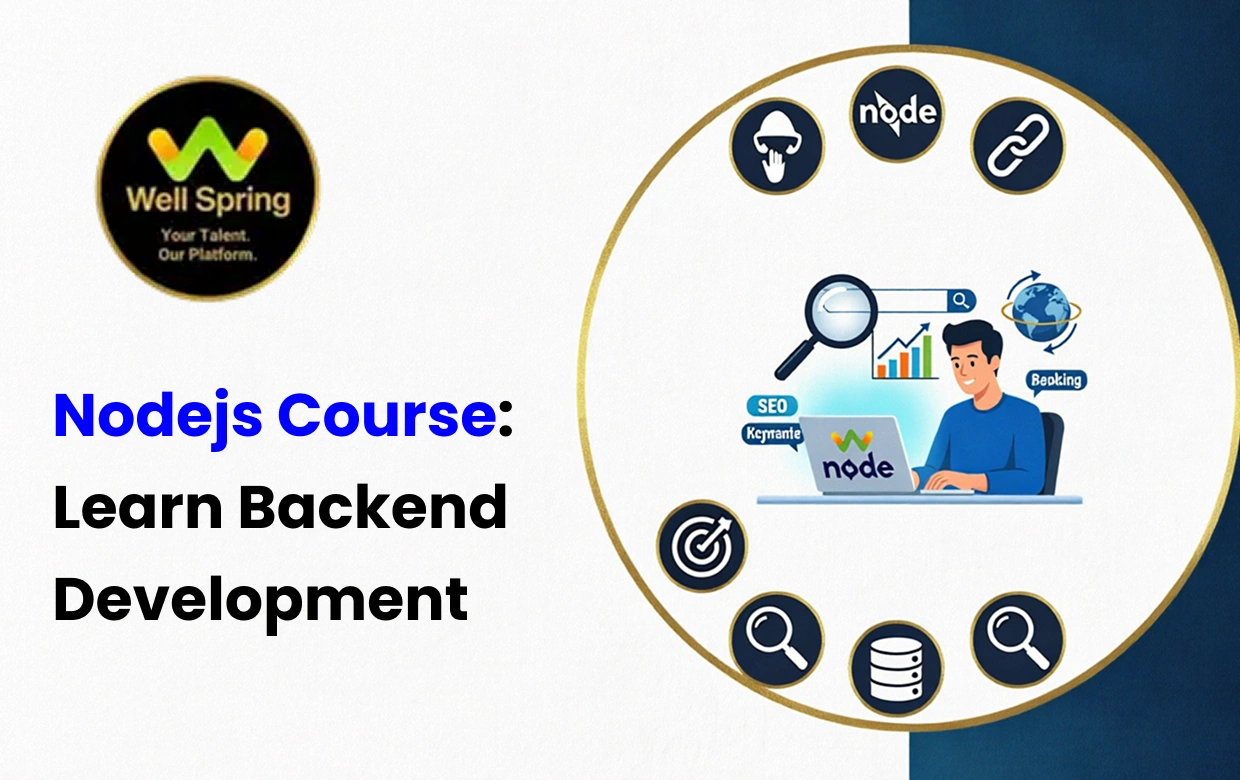
A nodejs course is designed to help learners understand how to build fast, scalable, server-side applications using Node.js. Because Node.js allows JavaScript to be used for backend development, it has become an important technology for learners who want to move beyond frontend development and build complete web applications.
A structured Node.js training program can take learners from JavaScript and Node.js fundamentals through APIs, databases, authentication, asynchronous programming, testing, security, and application deployment. Depending on the learner's goals, a Node.js programming course, Node.js development course, or Node.js backend development course can provide a more focused learning path.
This guide explains what a Node.js course covers, what learners can expect from Node.js classes, the skills required, career opportunities, common mistakes, development trends, and how to choose the right learning path in Trichy. It also explains when a Node.js certification course can be useful and how practical training can support career development.
A nodejs course is a good choice for learners who want to develop backend applications using JavaScript. A comprehensive course should cover Node.js fundamentals, modules, asynchronous programming, HTTP, Express.js, REST APIs, databases, authentication, error handling, testing, security, and deployment.
For beginners, the best option is usually a structured course that introduces the required JavaScript concepts before moving into server-side development. Learners who already understand JavaScript can progress more quickly into APIs, databases, and backend projects.
When comparing Node.js classes or training programs, look at the curriculum, practical work, instructor support, project quality, and alignment with your career goal rather than choosing solely based on the course title.
Node.js can be used for APIs, web application backends, real-time systems, cloud services, and other backend applications.
JavaScript fundamentals provide an important foundation for learning Node.js effectively.
A practical learning path should combine concepts with coding exercises and application development.
A Node.js backend development course should cover architecture, databases, authentication, testing, security, and deployment.
A Node.js certification course can document course completion, but it should complement practical development skills.
Learners in Trichy can compare training options based on curriculum, projects, mentor support, and learning outcomes.
The right course depends on the learner's current knowledge, career objective, preferred learning format, and intended area of development.
Modern web applications depend on backend systems that process requests, manage information, apply business rules, and communicate with other services. Although users primarily interact with a website or application interface, the backend handles much of the underlying functionality.
Node.js allows developers to use JavaScript outside the browser. This makes it possible to build servers, APIs, backend services, and other software using a language familiar to many frontend developers.
A nodejs course can therefore be useful for students, graduates, aspiring developers, and working professionals who want to develop server-side programming skills. It can also be a natural progression for learners who already understand HTML, CSS, and JavaScript.
In 2026, learning Node.js involves more than memorising commands. Developers need to understand how applications communicate, how information is managed, how users are authenticated, how errors are handled, and how applications are tested and deployed.
Learners often ask questions such as: How long does it take to learn Node.js? Is Node.js suitable for beginners? What should a Node.js course include? Is certification useful? Which projects should I build? The answers depend on the learner's current skills and career objectives.
For learners looking for structured training in Trichy, Well Spring Talent Solutions can be considered alongside other local professional training options.
Node.js remains relevant because it fits several patterns used in modern software development. Many applications depend on APIs, cloud services, real-time communication, distributed services, and JavaScript-based development.
Its relevance can be seen across application categories such as:
Web applications
SaaS platforms
E-commerce systems
REST APIs
Real-time applications
Cloud-based services
Microservices
Mobile application backends
Internal business tools
Automation services
Data-driven applications
Its connection to the wider JavaScript ecosystem is another consideration. Developers can use JavaScript across frontend and backend environments while working with tools that support different stages of application development.
For learners, this makes Node.js a relevant technology to consider as part of a broader web or full-stack development skill set.
Completing a course does not automatically make someone job-ready. Employers and development teams generally need evidence that a candidate can apply technical knowledge to real development problems.
A strong Node.js learner should gradually develop the ability to:
Understand JavaScript fundamentals
Build backend applications
Create REST APIs
Work with databases
Handle asynchronous operations
Implement authentication
Validate user input
Handle application errors
Organise backend code
Use Git and version control
Understand API security
Debug application problems
Test backend functionality
Deploy applications
Read technical documentation
The important difference is between knowing a concept and being able to use it. A developer may understand what an API is, for example, but still need practical experience designing routes, validating requests, handling errors, connecting data sources, and testing responses.
This is why effective Node.js training should provide opportunities to apply concepts through coding exercises and progressively more complex applications.
Node.js is a JavaScript runtime environment that enables JavaScript code to run outside a web browser. It is widely used for server-side and backend application development.
Instead of limiting JavaScript to browser-based interfaces, Node.js allows developers to create servers, APIs, command-line applications, backend services, and other software.
Important characteristics of Node.js include:
A well-designed Node.js programming course should explain both the runtime and how it fits into complete application development.
A practical nodejs course should introduce concepts in a logical order so that each stage prepares learners for the next.
A recommended learning progression is:
JavaScript Fundamentals → Node.js Fundamentals → npm & Modules → Asynchronous Programming → HTTP → Express.js → REST APIs → Databases → Authentication → Testing → Security → Git → Deployment → Projects
Typical learning areas include:
Express.js is a commonly used framework for building Node.js web applications and APIs. It provides tools that make it easier to organise backend applications and handle HTTP requests.
Learners should understand how Express.js supports:
The goal is to move from individual concepts toward the ability to build, test, troubleshoot, and deploy functional backend applications.
Node.js skills can be applied across different industries and development environments.
Common areas include:
Node.js developers may work on customer-facing applications, internal business systems, APIs, backend services, or specialised software.
The actual responsibilities depend on the organisation, project architecture, developer experience, and additional technologies used by the team.
The value of Node.js for backend development comes from its technical characteristics and how they fit particular application requirements.
Developers who already work with JavaScript on the frontend can use the same language for server-side development. This can make the transition into backend programming more straightforward.
Node.js uses an asynchronous, non-blocking programming model that can be useful for applications handling many input/output operations, such as network requests and database interactions.
Node.js provides an environment for building REST APIs and backend services that communicate with websites, mobile applications, and external systems.
The npm ecosystem provides packages for many common development requirements, including validation, authentication, testing, application utilities, and integrations.
Node.js can support applications that require ongoing communication between clients and servers, including chat, notifications, and other real-time features.
Node.js can be used within different architectural approaches, including monolithic applications, API-driven systems, and microservices.
These characteristics make Node.js a practical option for many backend scenarios, although the appropriate technology should always be selected according to project requirements.
Node.js backend development refers to using Node.js to create the server-side portion of an application.
The backend processes requests and implements functionality that users do not directly see. Depending on the application, this can include managing accounts, processing information, applying business rules, communicating with databases, and connecting external services.
The key distinction is that Node.js is the technology environment, while backend development describes the broader responsibilities involved in creating and maintaining server-side applications.
A specialised Node.js backend development course should build on Node.js fundamentals and focus on the architecture and implementation of complete backend systems.
The curriculum can include:
Learners can apply the curriculum through projects such as:
The purpose of this specialised learning path is not to repeat introductory Node.js concepts. Instead, it should help learners understand how backend components are designed, connected, tested, and deployed as part of a complete application.
Node.js backend developers can contribute to:
Potential roles include:
The responsibilities associated with each role can vary considerably. Employers may also expect knowledge of databases, Git, testing, deployment, frontend technologies, cloud platforms, or other tools depending on the position.
Choosing a nodejs course should involve more than comparing course names. Learners should evaluate what they will actually build, which technologies they will study, how much practical coding is included, and whether the curriculum matches their career goals.
Factor |
General Node.js Course |
Backend-Focused Node.js Course |
|
Main Focus |
Node.js fundamentals |
Backend application development |
|
JavaScript |
Essential |
Essential |
|
Node.js Fundamentals |
Core component |
Core component |
|
REST APIs |
Usually included |
Major focus |
|
Databases |
Basic to intermediate |
Strong focus |
|
Authentication |
May be included |
Important component |
|
Middleware |
Included |
Detailed application |
|
Backend Architecture |
Basic understanding |
Greater emphasis |
|
Testing |
Introductory to intermediate |
More practical |
|
Deployment |
Fundamentals |
Greater practical focus |
|
Projects |
General applications |
Backend/API projects |
|
Best For |
Beginners |
Backend-focused learners |
The most appropriate learning path depends on the learner's existing JavaScript knowledge and intended role.
Someone starting from the beginning may benefit from a broad curriculum. Someone who already knows frontend JavaScript may prefer a backend-focused path.
A nodejs course can be suitable for beginners when the curriculum introduces concepts in a logical sequence.
Beginners should ideally understand basic JavaScript concepts before moving deeply into Node.js. Important foundations include functions, objects, arrays, modules, promises, and asynchronous programming.
The best starting point is the path that matches your current programming knowledge and long-term objective.
Node.js is a technology used for backend development, while backend development itself is a broader discipline involving servers, databases, APIs, authentication, business logic, security, testing, deployment, and architecture.
Learning Node.js is therefore one component of developing broader backend engineering skills.
There is no universally best backend technology. The right choice depends on the type of application, existing team skills, ecosystem requirements, project constraints, and long-term career direction.
|
Technology |
May Be a Good Fit For |
|
Node.js |
JavaScript-based backend, API, real-time, and full-stack development |
|
Java / Spring |
Enterprise applications and organisations using the Java ecosystem |
|
Python |
Backend development combined with AI, data, automation, or scripting |
|
PHP / Laravel |
Web application development within the PHP ecosystem |
Choose Node.js When:
Consider Another Technology When:
The important objective is not simply choosing the most popular option. Developing strong programming, problem-solving, API, database, testing, and deployment skills allows learners to transfer their knowledge across technologies.
A Node.js learning path can lead toward several development roles, depending on the additional skills a learner develops.
Career Area |
Typical Focus |
Additional Skills That Help |
Entry-Level Suitability |
|
Node.js Developer |
Server-side JavaScript and backend applications |
Node.js, Express, APIs, databases |
Suitable with practical projects |
|
Backend Developer |
APIs, databases, business logic and services |
Security, testing, deployment, architecture |
Suitable with strong fundamentals |
|
Full-Stack Developer |
Frontend and backend development |
HTML, CSS, JavaScript, frontend frameworks |
Suitable with broader training |
|
API Developer |
Designing and implementing APIs |
HTTP, REST, authentication, testing |
Suitable with API projects |
|
Web Application Developer |
Complete web application development |
Frontend, backend, databases |
Suitable with project experience |
|
Software Developer |
Broader application development |
Programming, problem-solving, Git |
Depends on role requirements |
|
Junior Backend Developer |
Entry-level backend implementation |
Node.js, APIs, databases, Git |
Suitable for beginners with projects |
|
JavaScript Developer |
JavaScript-based application development |
Frontend or backend frameworks |
Suitable with strong JavaScript skills |
Actual compensation varies based on experience, location, company, technical skills, project exposure, and role responsibilities. A course alone should not be treated as a guarantee of a particular salary.
The second skill set extends the first by placing Node.js knowledge within a broader backend engineering context.
Node.js is built around JavaScript, so weak programming fundamentals can make backend concepts unnecessarily difficult.
How to avoid it: Build a foundation in functions, objects, arrays, modules, promises, and asynchronous programming before moving into complex backend projects.
Reading tutorials without writing code can create the impression that a concept is understood when it has not been practically applied.
How to avoid it: Build small applications after each major topic and gradually increase project complexity.
Many backend applications need to store and retrieve information.
How to avoid it: Learn database fundamentals and practise CRUD operations through a Node.js application.
Copying an existing project does not necessarily teach API design or backend architecture.
How to avoid it: Create APIs independently and understand requests, responses, status codes, routes, middleware, and validation.
A backend application should not assume that every request is valid.
How to avoid it: Learn input validation, authentication, authorisation, error handling, and basic security practices as part of application development.
Several development patterns continue to influence how Node.js is used in modern applications:
API-first application architectures
Cloud-based backend development
Microservices
Containerised applications
Serverless application patterns
TypeScript adoption alongside JavaScript
Automated testing
Modern authentication approaches
Real-time application development
Third-party API integrations
AI-enabled application features
Event-driven architectures
Developer automation
Full-stack JavaScript development
Learners do not need to master every trend immediately. A better approach is to establish strong fundamentals and then add technologies based on the type of applications they want to develop.
For learners in Trichy considering professional technical training, Well Spring Talent Solutions can be evaluated based on how its learning opportunities align with their development goals.
When evaluating a training provider, learners should look for practical features such as:
The most important consideration is whether the training experience helps learners move from understanding concepts to applying them independently.
For someone comparing Node.js classes in Trichy, curriculum depth, practical exposure, instructor support, projects, and learning outcomes provide a more useful basis for evaluation than the course name alone.
A solid understanding of JavaScript makes it easier to work with Node.js. Focus on core programming concepts and asynchronous programming before moving into advanced backend topics.
Start with simple applications and gradually introduce more complex backend functionality as your confidence improves.
Understand HTTP methods, status codes, request data, response formats, validation, and error handling rather than simply memorising routes.
Work with real data through CRUD operations so that database concepts become part of your development workflow.
Document the applications you build and explain your contribution, technologies, functionality, and development decisions.
Useful portfolio projects can include:
What is a Node.js course?
A nodejs course teaches learners how to use Node.js for server-side JavaScript and backend application development. Depending on the curriculum, it may cover APIs, databases, authentication, testing, deployment, and projects.
Is Node.js suitable for beginners?
Yes, Node.js can be learned by beginners, although a basic understanding of JavaScript is highly useful. A structured learning path can make the transition into backend development easier.
What is included in Node.js training?
Node.js training commonly covers the Node.js runtime, npm, modules, asynchronous programming, HTTP, Express.js, APIs, databases, authentication, error handling, testing, and backend projects.
Is a Node.js certification course useful for jobs?
A certification can demonstrate that you completed a particular learning program, but practical development skills are also important. Projects, coding ability, problem-solving, and backend knowledge can strengthen a candidate's profile.
What is the difference between a Node.js course and a backend development course?
A Node.js course focuses primarily on using Node.js and related JavaScript technologies. A backend development course generally has a broader scope covering APIs, databases, authentication, architecture, security, testing, and deployment.
The demand for technical skills has made professional programming education an important consideration for students, graduates, career changers, and working professionals in Trichy.
Learners searching for a nodejs course in Trichy may have different objectives. Some may want to become backend developers, while others may want to expand existing frontend skills and move toward broader web development.
When comparing training options in Trichy, learners should consider:
Learners may encounter classroom-based, instructor-led, practical, and flexible learning formats. The most suitable option depends on the learner's schedule, experience, and preferred learning style.
For those specifically interested in backend development, a Node.js backend development course can provide a more focused route into server-side programming.
A structured learning environment can be particularly useful for beginners who prefer guided instruction and hands-on practice rather than learning entirely through self-study.
What is the best way to learn Node.js in 2026?
The best approach is to learn JavaScript fundamentals first and then progress through Node.js, npm, modules, asynchronous programming, HTTP, Express.js, APIs, databases, authentication, testing, security, Git, and deployment. Building projects throughout the process helps turn concepts into practical development skills.
Is a Node.js course good for beginners?
Yes. A nodejs course can be suitable for beginners when it starts with the required JavaScript concepts and gradually introduces server-side programming. Beginners should focus on understanding fundamentals before moving into complex frameworks or architectures.
Should I choose Node.js classes or self-learning?
The choice depends on your learning style and experience. Structured classes can provide instructor guidance, a planned curriculum, practical exercises, and support when development problems arise, while self-learning provides greater flexibility.
Is Node.js a good choice for backend development?
Node.js can be a practical choice for backend development when a project benefits from JavaScript-based server-side programming, API development, asynchronous operations, real-time functionality, or integration with the broader JavaScript ecosystem. The best technology still depends on project requirements.
What should I learn after completing a Node.js programming course?
After completing a Node.js programming course, strengthen areas such as database design, API architecture, authentication, testing, security, Git, deployment, and application monitoring. Building independent projects can also help demonstrate your ability to apply these skills.
A nodejs course provides a structured pathway into server-side JavaScript and backend development.
A clear progression from fundamentals through Node.js, Express.js, APIs, databases, testing, security, Git, and deployment can make learning more effective.
Node.js is one backend technology among several, so learners should choose an ecosystem that matches their project and career objectives.
Practical coding and portfolio projects are important for demonstrating the ability to apply backend concepts.
A Node.js certification course can document learning, but certification should complement practical skills and project experience.
Learners in Trichy should compare curriculum, practical exposure, mentorship, and career relevance before choosing a training program.
A nodejs course can be a valuable learning path for students, graduates, aspiring developers, and professionals who want to build server-side applications using JavaScript. Node.js can support APIs, web application backends, real-time services, database-driven applications, and other modern software systems.
The strongest learning path combines Node.js with the supporting skills required to build and maintain backend applications, including databases, API development, security, testing, Git, and deployment.
For learners in Trichy, choosing the right Node.js training program should involve more than looking at the course name or certification. Evaluate the curriculum, practical projects, instructor support, development tools, and opportunities to build real applications. Well Spring Talent Solutions can be considered alongside other local training options when looking for a structured learning environment.
With consistent coding practice and meaningful project experience, learners can build a stronger foundation for backend or full-stack development careers.
24 Sep 2026
23 Sep 2026
23 Sep 2026

23 Sep 2026
22 Sep 2026
The time required depends on your JavaScript background, learning pace, course structure, and the depth of the curriculum. A practical learning path should allow enough time to understand Node.js fundamentals, APIs, databases, authentication, testing, security, deployment, and project development.
Yes, a basic understanding of JavaScript is highly recommended because Node.js is a JavaScript runtime environment. Learners should be comfortable with concepts such as functions, objects, arrays, modules, promises, and asynchronous programming before moving into advanced Node.js development.
You can build projects such as REST APIs, student management systems, authentication applications, e-commerce backends, booking systems, inventory management APIs, content management systems, and real-time chat applications. Building independent projects helps demonstrate your ability to apply Node.js concepts in practical development scenarios.
Yes, Node.js can be part of a full-stack development workflow because JavaScript can be used on both the frontend and backend. Learners can combine Node.js with frontend technologies, databases, APIs, authentication, and deployment tools to develop complete web applications.
Compare the curriculum, JavaScript prerequisites, practical coding sessions, API and database coverage, project work, mentor support, learning format, development tools, and career-oriented guidance. A course that provides consistent hands-on development can be more valuable than one focused mainly on theory or certification.
Get internship updates, IT training news, placement opportunities, and career tips directly to your inbox.
Join our WhatsApp community for internship updates, IT courses, placement support, and latest job opportunities.
Join Now