
Quick Answer: What Are the Best Skills to Learn in 2026?
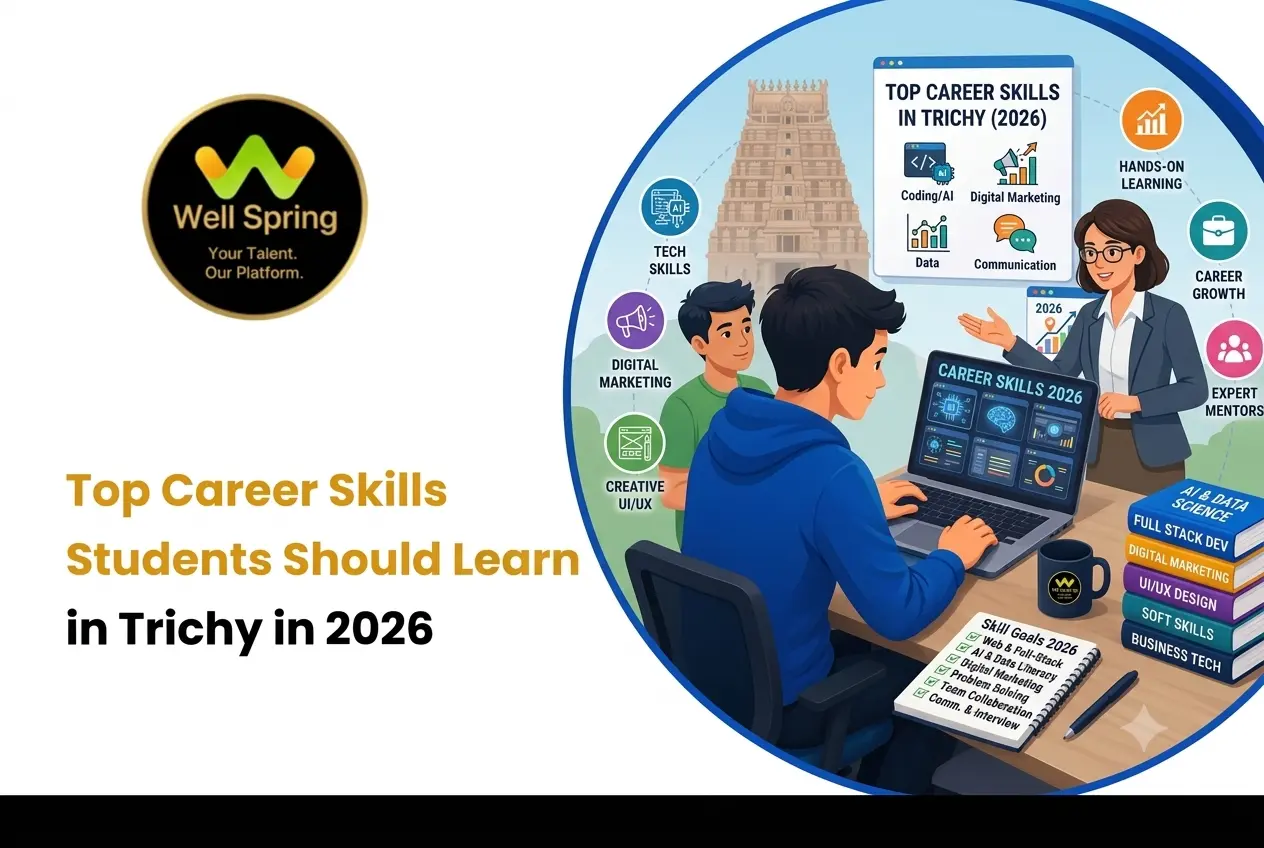
The best skills to learn in 2026 combine technical expertise, digital capabilities and human skills. For students in Trichy, valuable areas include Artificial Intelligence and Data Skills, Full Stack Development, Cybersecurity, Digital Marketing, UI/UX Design, and Communication and Problem-Solving.
The World Economic Forum's Future of Jobs Report 2025 identifies AI and big data, networks and cybersecurity, technological literacy, creative thinking, resilience, flexibility, agility, curiosity and lifelong learning among the skills expected to increase in importance through 2030.
The important lesson for students is that learning one technology is not enough. A stronger career foundation combines a practical technical or creative skill with communication, analytical thinking, adaptability and project experience.
Introduction
Choosing what to learn after school or college can be difficult.
Students in Trichy have access to many courses, certifications and career paths, but the bigger question is:
Which skills can actually help me become more prepared for employment?
Academic qualifications continue to matter, but employers increasingly look for candidates who can demonstrate what they can actually do.
A student may have a degree in computer science, commerce, engineering, management or another discipline, but practical skills can make it easier to demonstrate career readiness.
This is why students should focus on job oriented skills rather than collecting certificates without developing practical ability.
The current employment landscape is also changing quickly. The World Economic Forum reports that employers expect a significant portion of existing skills to change by 2030, while AI, big data, cybersecurity and technological literacy are among the fastest-growing skill areas.
For students planning their careers in 2026, the goal should therefore be to build skills that combine technology, creativity, problem-solving and human interaction.
Why Students Need Career Skills Along With a Degree
A degree can provide academic knowledge, but career skills help students apply that knowledge in practical situations.
Employers may evaluate candidates based on their ability to:
- Apply concepts to real projects.
- Solve practical problems.
- Communicate ideas clearly.
- Work effectively with others.
- Learn unfamiliar tools.
- Adapt to changing technology.
- Demonstrate relevant technical knowledge.
- Build a portfolio or project record.
- Handle interviews and workplace situations.
The World Economic Forum identifies analytical thinking as a leading core skill and also highlights resilience, flexibility, agility, creative thinking and technological literacy as important capabilities for the evolving workplace.
This means the most useful career skills for students are not limited to coding or software.
A well-rounded student should develop both professional skills and technical or domain-specific expertise.
1. Artificial Intelligence and Data Skills
Artificial Intelligence and data skills are among the most important areas for students exploring technology-focused careers.
The World Economic Forum identifies AI and big data as the fastest-growing skill category in its 2025–2030 employer outlook. Networks and cybersecurity and technological literacy also rank among the fastest-growing areas.
Students do not necessarily need to become AI researchers immediately.
They can begin by understanding:
- AI fundamentals.
- Machine learning concepts.
- Data analysis.
- Generative AI tools.
- Prompt design and evaluation.
- Python fundamentals.
- Data visualisation.
- AI-assisted productivity.
- Responsible use of AI.
- Basic model and data concepts.
Why AI Skills Matter
AI is increasingly becoming a tool used across different professions rather than something limited to specialised technology companies.
A marketing student may use AI for research and content workflows.
A developer may use AI-assisted coding tools.
A designer may use AI during ideation.
A business student may use AI for data analysis and reporting.
This makes AI literacy one of the most useful skills in demand in 2026 for students across different academic backgrounds.
How Students Can Build the Skill
A practical progression can be:
AI Fundamentals → Python/Data Basics → Practical Tools → Guided Projects → Portfolio → Industry Application
The objective should be to understand how AI can solve problems rather than simply learning how to generate content with an AI tool.
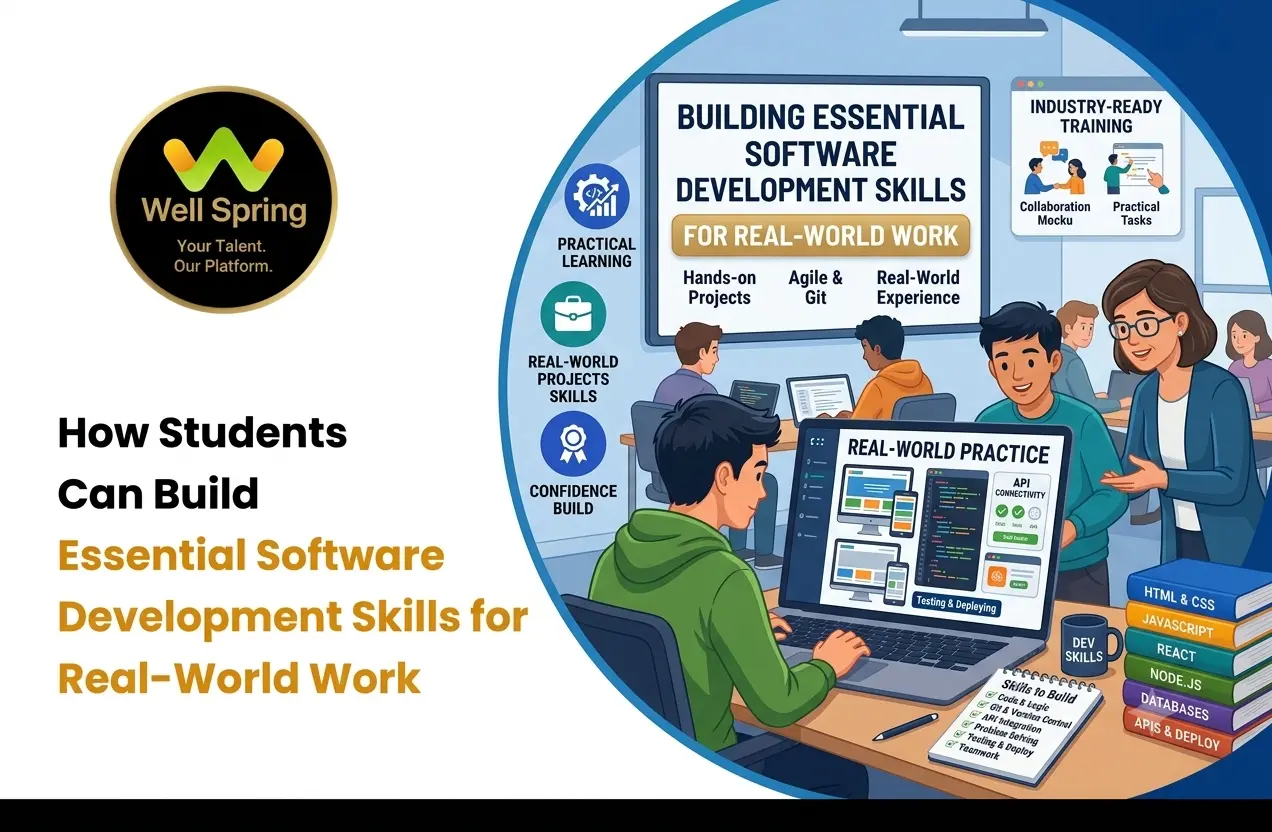
2. Full Stack and Web Development
Web development remains a practical career path for students who enjoy programming and building digital products.
The World Economic Forum continues to identify programming and technological literacy as important skills within the changing employment landscape, while information and technology services are expected to see continued technology-driven transformation.
Students interested in development can build skills across:
- HTML and CSS.
- JavaScript.
- Front-end frameworks.
- React or similar technologies.
- Backend development.
- Databases.
- APIs.
- Git and GitHub.
- Responsive web development.
- Testing and debugging.
- Deployment and hosting.
Why Web Development Is a Job-Oriented Skill
A strong web developer can demonstrate skills through actual projects.
Instead of saying:
“I know JavaScript.”
A student can show:
“I built and deployed a responsive web application using JavaScript and an API.”
That difference can make a portfolio much more meaningful.
What Students Should Build
A beginner portfolio could include:
Personal Website → Business Website → Interactive Web App → Full Stack Application
Students should also learn how to read requirements, debug problems, test their work and explain their technical decisions.
Well Spring Talent Solutions currently offers web development and full-stack-oriented training and internships in Trichy, with practical project work forming part of its career-focused learning approach.
3. Cybersecurity and Digital Security
As businesses depend increasingly on websites, cloud platforms, applications, networks and digital data, cybersecurity knowledge is becoming increasingly relevant.
The World Economic Forum lists networks and cybersecurity among the fastest-growing skill areas expected through 2030.
Students can start with foundational areas such as:
- Networking fundamentals.
- Operating system security.
- Web security.
- Authentication and access control.
- Cybersecurity principles.
- Threat awareness.
- Vulnerability concepts.
- Security monitoring.
- Basic ethical hacking concepts.
- Data protection.
Why Cybersecurity Is a Valuable Career Skill
Cybersecurity is not limited to penetration testing.
Career opportunities can exist across security operations, application security, network security, cloud security, compliance and risk management.
Students interested in this field should focus on understanding how systems work before moving into advanced security techniques.
A Practical Learning Path
Networking → Linux → Security Fundamentals → Web Security → Security Tools → Labs → Projects
Hands-on practice is especially important because cybersecurity knowledge is difficult to demonstrate through certificates alone.
4. Digital Marketing and Online Business Skills
Digital marketing is another practical option for students who enjoy communication, creativity, analytics and business.
Modern digital marketing can involve:
- Search engine optimisation.
- Google Ads.
- Meta Ads.
- Social media marketing.
- Content marketing.
- Email marketing.
- WhatsApp marketing.
- Google Business Profile optimisation.
- Analytics.
- Conversion optimisation.
- Website optimisation.
- AI-assisted marketing workflows.
Why Digital Marketing Is Among the Best Skills to Learn for Jobs
Digital marketing combines several different abilities.
A student needs to understand customers, content, platforms, search behaviour, advertising, data and business objectives.
For example:
Business Goal → Audience Research → Content → Campaign → Website → Lead → Analytics → Optimisation
This makes digital marketing useful for students who may not want a purely programming-oriented career.
Skills Students Should Combine
Rather than learning only social media posting, students can build a broader skill set:
SEO + Content + Paid Ads + Analytics + Communication
This combination can create more practical career opportunities than knowing a single platform.
5. UI/UX Design and Digital Product Design
Students with an interest in creativity, technology and user behaviour can explore UI/UX design.
The World Economic Forum includes design and user experience among skill areas expected to grow in importance, alongside technological and human-centred capabilities.
UI/UX students can learn:
- User research.
- User personas.
- User journeys.
- Information architecture.
- User flows.
- Wireframing.
- Interface design.
- Typography.
- Visual hierarchy.
- Responsive design.
- Prototyping.
- Usability testing.
- Design systems.
Why UI/UX Is Different From Graphic Design
Graphic design often focuses strongly on visual communication.
UI/UX goes further by asking:
Who is using the product?
What are they trying to accomplish?
Where might they become confused?
How can the interface make the task easier?
A strong UI/UX portfolio should therefore demonstrate the thinking behind a design rather than only showing attractive screens.
Portfolio Development
A student can create:
Problem → Research → User Flow → Wireframe → Prototype → UI Design → Testing → Case Study
Well Spring's current UI/UX internship curriculum includes user research, personas, user journeys, user flows, information architecture, wireframing, interface design, prototyping and usability testing.
6. Communication, Analytical Thinking and Problem-Solving
Technical skills alone do not make a student job-ready.
Communication, analytical thinking, adaptability and problem-solving remain important even as technology changes.
The World Economic Forum identifies analytical thinking as the leading core skill in its employer survey, while resilience, flexibility and agility, creative thinking and curiosity and lifelong learning are also expected to rise in importance.
Students should therefore develop:
- Verbal communication.
- Written communication.
- Presentation skills.
- Logical reasoning.
- Analytical thinking.
- Problem-solving.
- Teamwork.
- Time management.
- Adaptability.
- Professional behaviour.
- Interview communication.
Why Soft Skills Are Still Important
Consider a software developer who can write code but cannot explain a technical issue to a client.
Or a digital marketer who understands advertising platforms but cannot present campaign results.
Or a designer who creates attractive interfaces but cannot explain why a particular design solves a user problem.
Technical ability becomes more valuable when students can communicate their thinking.
A Useful Formula
Technical Skill + Communication + Problem-Solving + Professional Behaviour = Stronger Career Readiness
Technical Skills vs Soft Skills: What Should Students Learn?
Students should not treat technical and soft skills as separate career choices.
They work together.
| Technical / Domain Skill | Complementary Human Skill |
|---|---|
| AI & Data | Analytical Thinking |
| Web Development | Problem-Solving |
| Cybersecurity | Attention to Risk |
| Digital Marketing | Communication |
| UI/UX Design | Empathy |
| Data Analysis | Presentation |
| Software Testing | Critical Thinking |
| Project Development | Teamwork |
The strongest learning plan is therefore not:
“I will learn only one technical tool.”
It is:
“I will develop one career-focused skill and the professional abilities required to use it effectively.”
How Students Can Choose the Right Career Skill
There is no single skill that every student needs to learn.
The right choice depends on interests, academic background and career goals.
If You Enjoy Coding
Consider:
Python → Web Development → Full Stack → AI / Data
If You Enjoy Creativity
Consider:
Graphic Design → UI/UX → Product Design → Creative Technology
If You Enjoy Business and Communication
Consider:
Digital Marketing → SEO → Paid Advertising → Analytics
If You Enjoy Technology and Security
Consider:
Networking → Linux → Cybersecurity → Cloud Security
If You Enjoy Data and Mathematics
Consider:
Excel → SQL → Python → Data Analytics → AI
If You Enjoy People and Communication
Consider:
Communication → Sales → Digital Marketing → Customer Success → Business Development
The key is to select a pathway and develop enough depth to demonstrate practical ability.
Why Practical Projects Matter for Job-Oriented Skills
Learning through videos or classroom explanations can introduce concepts, but projects force students to apply them.
Web Development
Instead of only learning HTML, build a responsive website.
Digital Marketing
Instead of only learning SEO theory, optimise a practical website and analyse search performance.
UI/UX
Instead of only learning Figma tools, design an application and document the complete user journey.
AI
Instead of only learning AI terminology, build a small AI-powered application or data project.
Cybersecurity
Instead of only memorising security concepts, practise within controlled labs and document what you learned.
This is why project-based learning can make a major difference in career preparation.
Well Spring's current internship information emphasises live project experience, practical exposure, workplace understanding and career preparation across areas including software development, digital marketing, Python, full stack development, mobile app development, AI, graphic design and video editing.
Building a Job-Ready Portfolio in 2026
A certificate tells an employer that a student completed a learning program.
A portfolio can show what the student can actually do.
Students should consider creating:
1. LinkedIn Profile
Show relevant skills, projects, certifications and learning experience.
2. GitHub Profile
Useful for students pursuing software, programming, data or development careers.
3. Design Portfolio
UI/UX and creative students can showcase selected projects and case studies.
4. Digital Marketing Portfolio
Students can document SEO projects, campaign planning, content strategies, analytics work and sample campaigns.
5. Project Case Studies
Explain:
Problem → Approach → Tools → Work Completed → Result / Learning
This gives interviewers something concrete to discuss.
Well Spring's current training approach also highlights practical projects, assignments and project experience as part of career-focused learning.
Best Skills to Learn for Jobs: A Practical Learning Formula
Students can use the following framework when planning their skill development:
Step 1: Select One Core Skill
Choose one area such as:
AI / Web Development / Cybersecurity / Digital Marketing / UI/UX
Step 2: Learn the Fundamentals
Understand the concepts before depending heavily on tools or AI.
Step 3: Learn Industry Tools
Use the platforms, frameworks and software commonly associated with your chosen area.
Step 4: Build Projects
Turn theoretical knowledge into practical work.
Step 5: Create a Portfolio
Document your strongest projects.
Step 6: Develop Communication
Practise explaining your work clearly.
Step 7: Gain Industry Exposure
Internships, practical assignments and live projects can help students understand professional expectations.
Step 8: Prepare for Interviews
Practise technical questions, aptitude, communication and project-based discussions.
Step 9: Keep Learning
Technology changes continuously, so students should develop the habit of updating their skills.
Skills Students Should Not Learn in Isolation
Students should also avoid choosing a skill only because it is currently trending.
For example, learning an AI tool without understanding the underlying problem can create shallow knowledge.
Similarly:
- Learning SEO without understanding search intent can limit practical results.
- Learning coding syntax without building projects can limit development ability.
- Learning Figma without understanding users can produce attractive but ineffective interfaces.
- Learning cybersecurity tools without understanding networking can make security knowledge difficult to apply.
- Learning advertising platforms without understanding customers can lead to poor campaign decisions.
The better approach is:
Fundamentals → Tool → Practice → Project → Feedback → Portfolio
How Trichy Students Can Prepare for the 2026 Job Market
Students in Trichy can start developing career skills while they are still studying rather than waiting until graduation.
A simple yearly approach could be:
College Foundation Stage
Focus on fundamentals and identify areas of interest.
Skill Development Stage
Choose one job-oriented domain and learn it systematically.
Project Stage
Build practical projects related to the chosen skill.
Internship Stage
Gain exposure to professional workflows and workplace expectations.
Portfolio Stage
Document projects, achievements and practical experience.
Interview Stage
Develop communication, aptitude, technical interview and presentation skills.
This approach can help students move from:
Student → Learner → Practitioner → Intern → Job-Ready Candidate
Common Mistakes Students Make When Learning Career Skills
Learning Too Many Skills at Once
Trying to learn AI, coding, digital marketing, design and cybersecurity simultaneously can result in shallow knowledge.
Choosing a Skill Only Because It Is Trending
A skill should match the student's interests and career direction.
Collecting Certificates Without Projects
Certificates can support a profile, but practical projects provide evidence of application.
Ignoring Communication
Technical knowledge still needs to be explained during interviews and in professional environments.
Avoiding Internships
Internships can expose students to practical workflows, teamwork and professional expectations.
Depending Completely on AI
AI can support learning and productivity, but students still need fundamentals, reasoning and independent problem-solving ability.
Stopping After Completing a Course
Technology changes continuously, so career development should continue after formal training ends.
A 2026 Skill-Building Roadmap for Students
Students can use this simple roadmap:
Month 1–2:
Understand fundamentals and select a career direction.
Month 3–4:
Learn industry tools and complete guided exercises.
Month 5–6:
Build practical projects.
Month 7–8:
Create a portfolio and improve communication.
Month 9–10:
Complete an internship or industry-oriented project.
Month 11:
Prepare for interviews and refine the resume.
Month 12:
Apply for suitable opportunities while continuing skill development.
The exact timeline can change depending on the student's academic schedule and chosen domain.
How Well Spring Talent Solutions Supports Career Skill Development
Well Spring Talent Solutions provides IT and professional skill-development programs in Trichy across areas such as Full Stack Development, Python, Java, Web Development, Digital Marketing, Software Testing, Cloud & DevOps, Artificial Intelligence, Mobile App Development, UI/UX Design, Graphic Design and Video Editing. Its current learning approach combines guided learning, practical exercises, projects, internship opportunities and career preparation.
The organisation also offers internships across software development, digital marketing, Python, full stack development, mobile app development, artificial intelligence, graphic design and video editing, with practical project experience and placement-oriented guidance.
For students, the important consideration is not simply where they study a skill, but whether the learning process helps them understand, practise, build, communicate and demonstrate that skill.
Final Thoughts
The best skills to learn in 2026 are not necessarily the skills with the most attention on social media.
They are the skills students can understand deeply, practise consistently and demonstrate through meaningful work.
For one student, that may be AI and data.
For another, it may be full stack development.
Someone interested in creativity may choose UI/UX.
A student interested in business may choose digital marketing.
Another may build a career in cybersecurity or software testing.
The common factor is practical capability.
Students should aim to build this combination:
Career Skill + Practical Projects + Communication + Problem-Solving + Industry Exposure + Continuous Learning
As technology continues to change, students who develop the ability to learn, adapt and apply their knowledge will be better prepared to navigate new career opportunities.