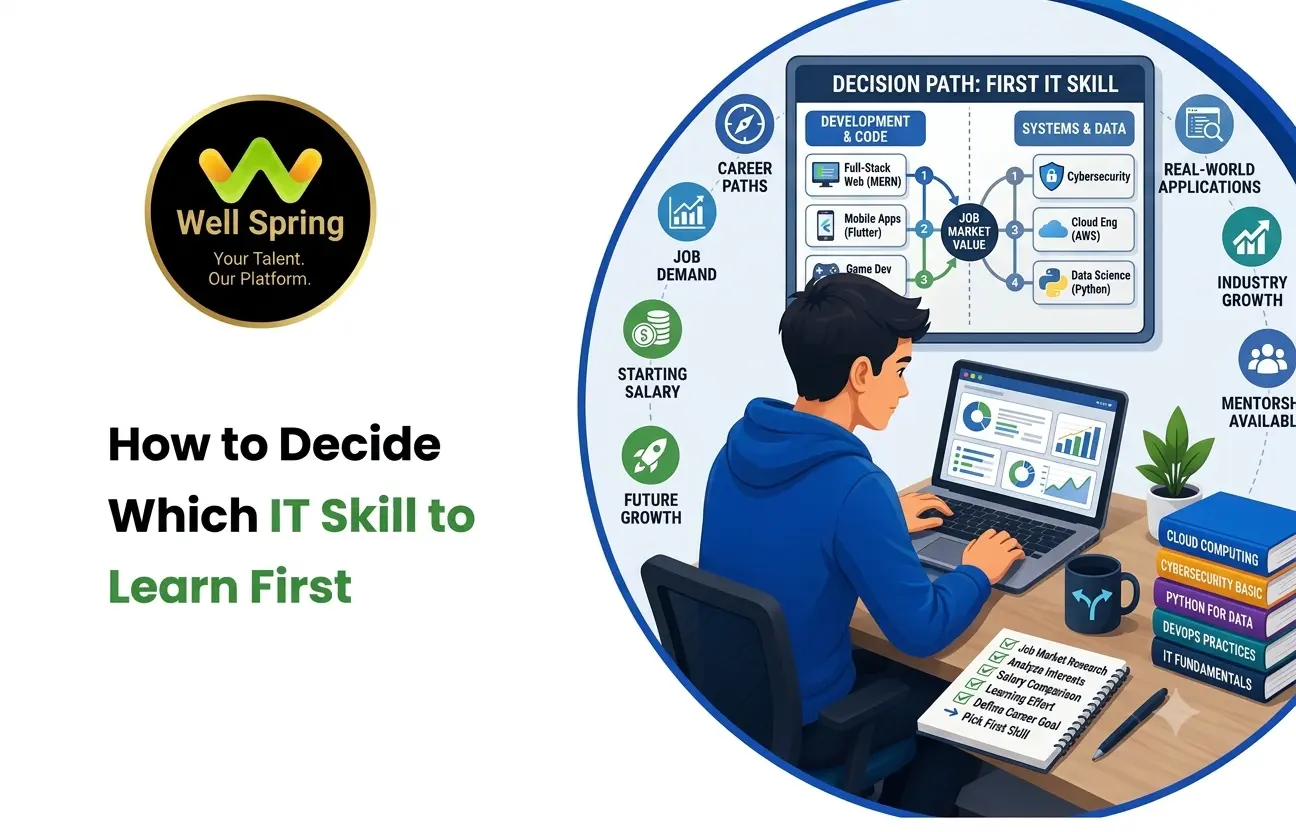

Starting an IT career can feel confusing when there are so many skills to choose from. Students may come across programming, web development, data analytics, artificial intelligence, cloud technologies, software testing, digital marketing, UI/UX design, and many other areas.
The challenge is not finding an IT skill to learn. The real challenge is deciding which IT skill to learn first.
Choosing a skill simply because it is popular may not always be the right approach. A better starting point is to understand your interests, current abilities, career goals, learning time, and the type of work you want to do.
For students and freshers, the first IT skill should provide a strong foundation and give them enough practical exposure to understand whether that career direction suits them.
Why Is Choosing Your First IT Skill Important?
Learning an IT skill requires time and consistent practice. If you keep changing from one technology to another without building enough knowledge in any area, it can become difficult to develop practical ability.
Your first skill does not have to define your entire career. Instead, it should help you:
- Understand how technology is used in real work
- Develop problem-solving ability
- Build practical projects
- Discover the type of IT work you enjoy
- Create a foundation for advanced learning
- Prepare for internships and entry-level opportunities
The goal is not to learn everything at once. It is to choose one suitable starting point and build from there.
How to Decide Which IT Skill to Learn First
1. Start With Your Career Interest
The first question to ask is:
“What type of work would I enjoy doing?”
Different IT roles involve different types of work.
For example, you may enjoy:
- Building websites and applications — Web development
- Writing code and solving logical problems — Programming
- Working with numbers and information — Data-related skills
- Creating visual interfaces — UI/UX design
- Finding and fixing software problems — Software testing
- Working with online business growth — Digital marketing
- Understanding intelligent systems — AI and related technologies
- Working with infrastructure and online services — Cloud technologies
This does not mean you have to permanently choose one area. It simply gives you a starting direction based on your interests.
2. Consider Your Current Skill Level
Your starting point matters.
A student with no programming experience may need to begin with basic programming concepts before moving into more advanced development topics.
Similarly, a student interested in design may benefit from first understanding design principles, layouts, typography, user experience, and design tools.
Before selecting a skill, ask yourself:
- Do I already have basic knowledge?
- Have I worked on any related projects?
- Am I comfortable using computers and software?
- Do I enjoy logical problem-solving?
- Do I prefer creative work?
- Am I willing to learn technical concepts?
Being a beginner is not a disadvantage. The important thing is choosing a learning path that matches your current level.
3. Think About the Type of Work You Prefer
Two students may both want an IT career but prefer completely different types of work.
One student may enjoy writing code for several hours. Another may prefer designing interfaces or working with visual content. Someone else may enjoy analysing information and finding patterns.
Think about whether you prefer:
- Coding and development
- Creative and visual work
- Data and analysis
- Testing and quality checking
- Business and online marketing
- Infrastructure and technology management
This can help you narrow down your options before investing significant time in a particular skill.
4. Look at the Learning Requirements
Some IT skills require a stronger foundation in programming or mathematics, while others may have a different starting point.
Before joining a course or beginning self-learning, check:
- What prerequisites are required?
- Is programming knowledge necessary?
- How difficult are the fundamentals?
- What tools will you need to learn?
- How much practice is required?
- Can a beginner start learning it?
Do not choose a skill only because someone says it is in demand. Make sure you understand what learning it actually involves.
5. Choose a Skill You Can Practise
IT skills become more useful when you can apply what you learn.
For example, instead of only watching lessons, a learner can practise by creating a small project, analysing a dataset, designing an interface, testing an application, or working through programming exercises.
When choosing your first skill, ask:
“What can I build or practise after learning the basics?”
A skill that allows you to practise regularly can help you understand concepts more effectively and identify areas where you need improvement.
6. Consider Your Available Learning Time
Your available time should also influence your decision.
College students may have classes, assignments, exams, and other responsibilities. Working professionals may have even less time available for learning.
Instead of choosing several skills and trying to study everything together, start with one.
For example:
One skill → fundamentals → regular practice → small projects → deeper learning
This approach can make learning more manageable and help you build consistency.
7. Think Beyond the First Skill
Your first IT skill does not have to be your final skill.
Many IT careers require a combination of skills.
For example, a learner may first develop programming fundamentals and later move into web development, application development, data-related technologies, or another technical area.
Similarly, someone interested in design may begin with fundamental design concepts and later develop skills related to UI/UX, visual design, or other digital design areas.
Think of your first skill as a starting point in a longer learning path.
8. Compare Skills Based on Your Own Goals
Instead of asking:
“Which IT skill is the best?”
ask:
“Which IT skill fits my current goals?”
You can compare your options using a simple checklist:
| Factor | Questions to Ask |
|---|---|
| Interest | Do I actually enjoy this type of work? |
| Skill level | Can I start learning it from my current level? |
| Learning time | Can I consistently practise it? |
| Practical work | Can I build projects or practise regularly? |
| Career direction | Does it match the type of work I want to explore? |
| Future learning | Can I build additional skills on this foundation? |
| Motivation | Am I willing to continue learning when it becomes difficult? |
There may not be one correct answer for every student. The right starting point depends on the individual learner.
9. Do Not Choose a Skill Only Because It Is Popular
Technology changes quickly. A skill that receives a lot of attention today may not necessarily be the right starting point for every beginner.
Popularity should be only one consideration.
A better approach is to combine:
Interest + ability + career direction + practical learning + consistency
For example, if you choose a technology because it is popular but have no interest in working with it, staying motivated may become difficult.
On the other hand, choosing an area that matches your interests can make regular practice easier.
10. Try Before Making a Long-Term Decision
If you are unsure between different areas, get a basic introduction to each one before making a major commitment.
You can:
- Watch beginner-level lessons
- Try simple exercises
- Read introductory guides
- Attend a workshop or demo session
- Complete a small beginner project
- Talk to trainers or people working in the field
This can help you understand what the actual learning experience is like instead of choosing based only on course names or online trends.
How Well Spring Can Help Students Start Their IT Learning Journey
Choosing an IT skill is easier when students have access to structured guidance and practical learning.
At Well Spring Talent Solutions, students can explore different IT learning paths based on their interests and career goals. Instead of trying to learn multiple technologies at once, students can identify a suitable starting area, learn the fundamentals, practise through projects, and gradually build additional skills.
For a beginner, the focus should not only be on completing a course. It should also be on understanding the concepts, applying them practically, and developing the confidence to continue learning independently.
Students who are unsure about where to begin can use their learning goals, existing knowledge, interests, and preferred type of work as a starting point when discussing their options.
A Simple Way to Choose Your First IT Skill
If you are still confused, follow this simple process:
Step 1: Identify what interests you
Think about the type of technology-related work you enjoy.
Step 2: Check your current knowledge
Understand what you already know and where you need to start.
Step 3: Select one area
Do not try to learn multiple technical skills simultaneously.
Step 4: Learn the fundamentals
Build a strong understanding of the basic concepts before moving to advanced topics.
Step 5: Practise regularly
Use exercises and small projects to apply what you learn.
Step 6: Review your progress
After gaining some practical experience, decide whether you want to continue deeper into that area.
Step 7: Add complementary skills
Once you have a foundation, you can gradually expand into related technologies and tools.
Common Mistakes Students Make When Choosing an IT Skill
Choosing a skill only because it is trending
Trends can change. Your interest and long-term learning ability are more important starting considerations.
Trying to learn too many technologies
Learning several technologies at the same time can make it difficult to develop a strong foundation.
Ignoring practical work
Reading or watching lessons alone is not enough. Practical application helps you understand how concepts work.
Choosing based only on salary expectations
Career decisions involve more than potential earnings. Consider the type of work, learning requirements, personal interests, and long-term goals.
Giving up too early
Every technical skill has a learning curve. Beginners may find the initial concepts difficult, but regular practice can gradually improve understanding.
Final Thoughts
There is no single IT skill that every student should learn first.
The right starting point depends on your interests, current knowledge, career goals, available time, and preferred type of work.
Instead of asking which IT skill is universally the best, start by asking:
“Which IT skill is the right starting point for me?”
Once you choose a direction, focus on the fundamentals, practise consistently, build small projects, and then decide which related skills to learn next.
For students in Trichy who need guidance while choosing an IT learning path, Well Spring Talent Solutions can be a starting point for exploring structured IT learning and practical skill development based on individual career goals.