
Introduction
Getting a job is not only about knowing how to perform a technical task.
A software developer needs programming knowledge, but also needs to communicate with teammates. A graphic designer needs design skills, but also needs to understand client feedback. A digital marketer needs knowledge of SEO or advertising platforms, but also needs analytical thinking and communication skills.
This is where the difference between hard skills and soft skills becomes important.
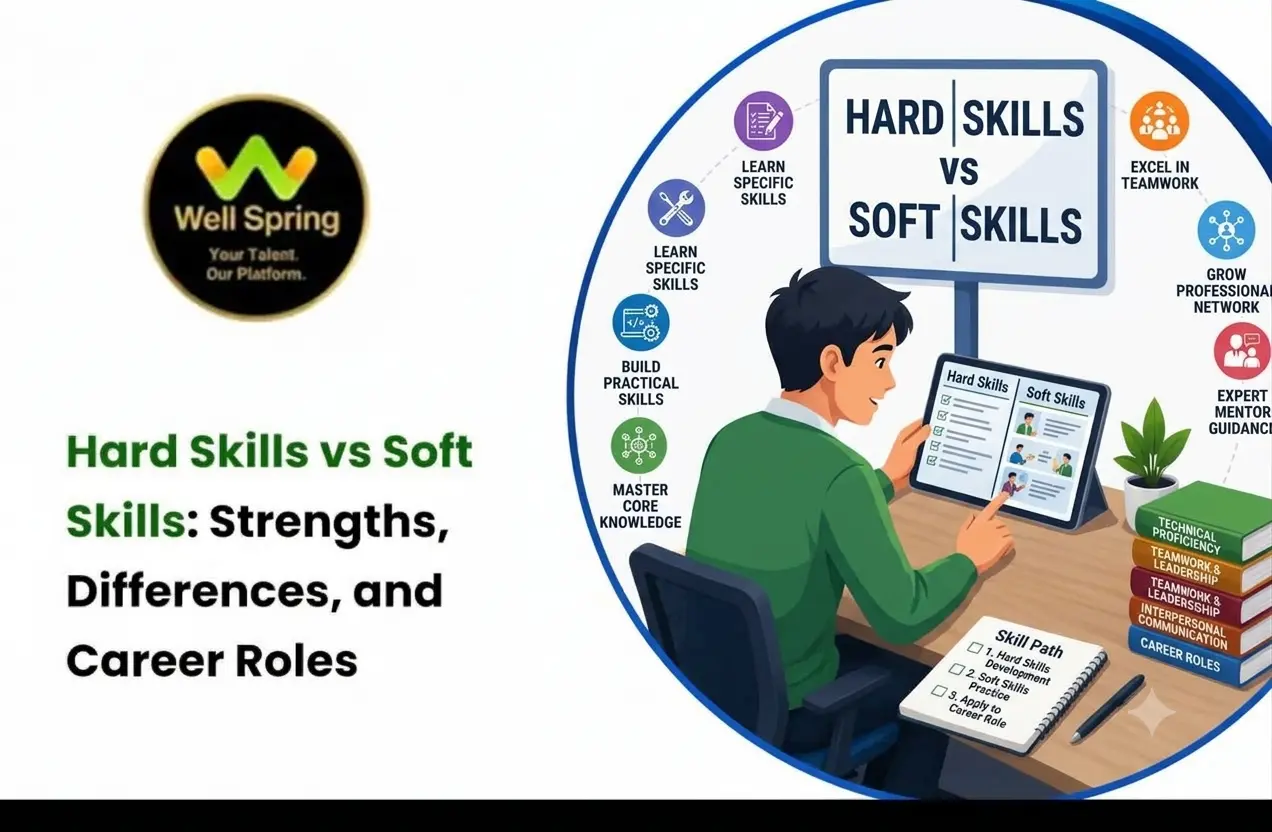
Hard skills are usually specific, teachable abilities that can be demonstrated or assessed. Soft skills relate more to how you communicate, collaborate, solve problems, manage responsibilities, and work with other people.
Neither category should be treated as a replacement for the other.
For students and freshers, developing both types of skills can create a stronger foundation for internships, interviews, workplace performance, and long-term career growth.
Quick Answer: What Is the Difference Between Hard Skills and Soft Skills?
Hard skills are specific, job-related abilities that can usually be taught, practiced, and assessed, such as programming, data analysis, graphic design, accounting, or operating a software tool. Soft skills relate to how you work and interact with others, including communication, teamwork, adaptability, problem-solving, and time management. Most careers require a combination of both.
What Are Hard Skills?
Hard skills are specific abilities that are directly related to performing a particular task, role, or profession.
They are often acquired through:
- Education.
- Courses.
- Training.
- Practice.
- Projects.
- Certifications.
- Internships.
- Workplace experience.
Hard skills are sometimes called technical skills, although the terms are not always perfectly interchangeable. Technical skills generally refer to specialized knowledge or abilities used to perform particular tasks, while hard skills can also include structured job-specific abilities outside traditional technology roles.
Examples include:
- Python programming.
- Java development.
- SQL.
- Data analysis.
- Graphic design.
- UI/UX design.
- Video editing.
- SEO.
- Digital advertising.
- Accounting.
- CAD software.
- Software testing.
- Cloud computing.
For example, a beginner learning Python can demonstrate a hard skill by creating a program that reads data, processes it, and produces an output.
The skill can be practiced, evaluated, and improved.
What Are Soft Skills?
Soft skills are personal, interpersonal, and professional abilities that influence how effectively you work with people, manage responsibilities, and respond to situations.
Common soft skills include:
- Communication.
- Teamwork.
- Problem-solving.
- Adaptability.
- Time management.
- Critical thinking.
- Collaboration.
- Leadership.
- Active listening.
- Creativity.
- Professionalism.
- Conflict management.
Soft skills can be more difficult to measure than technical abilities because they often appear through behavior and real-world situations.
For example, instead of taking a simple "communication test," an employer may observe how a candidate explains a project, responds to questions, listens to feedback, or communicates a problem.
Hard Skills vs Soft Skills: Key Difference
The hard skills vs soft skills comparison becomes clearer when you look at what each type primarily represents.
| Area | Hard Skills | Soft Skills |
|---|---|---|
| Main focus | Job-specific capability | How you work and interact |
| Examples | Python, SQL, design, testing | Communication, teamwork, adaptability |
| Learning | Courses, training, practice | Practice, experience, feedback |
| Assessment | Tests, projects, demonstrations | Behavioral observation and examples |
| Application | Performing specific tasks | Working effectively in different situations |
| Evidence | Portfolio, certification, project | Workplace behavior, project collaboration |
| Improvement | Practice and technical learning | Reflection, feedback and experience |
The two categories overlap in real work.
A developer may need programming knowledge to build a feature and communication skills to explain that feature to a teammate.
Difference Between Technical Skills and Soft Skills
The difference between technical skills and soft skills is mainly about the type of capability they represent.
Technical skills help you perform specialized tasks.
For example:
A data analyst uses SQL to retrieve information from a database.
Soft skills help you work effectively while performing those tasks.
For example:
The same data analyst explains the findings clearly to a non-technical manager.
One skill helps produce the work.
The other helps you collaborate, communicate, and make that work useful to others.
This is why career preparation should not focus exclusively on technical training.
Technical Skills and Soft Skills Examples
Here are some examples across different career areas.
| Career Area | Technical / Hard Skills | Soft Skills |
|---|---|---|
| Software Development | Programming, APIs, Git, databases | Problem-solving, teamwork, communication |
| Data Analysis | Python, SQL, statistics, visualization | Analytical thinking, communication, curiosity |
| Digital Marketing | SEO, analytics, paid advertising, content | Creativity, communication, adaptability |
| Graphic Design | Typography, design software, layouts | Creativity, feedback handling, communication |
| UI/UX Design | Figma, wireframing, prototyping, usability | Empathy, communication, collaboration |
| Software Testing | Test cases, automation, SQL, API testing | Attention to detail, communication, problem-solving |
| Video Editing | Editing software, motion graphics, sound | Storytelling, creativity, time management |
| Cloud / DevOps | Cloud platforms, Linux, CI/CD | Troubleshooting, collaboration, adaptability |
These are examples rather than fixed requirements.
The exact skills needed depend on the role, organization, technology stack, and level of responsibility.
Why Hard Skills Matter
Technical capability is essential because it determines whether you can perform the core responsibilities of a role.
For example:
A web developer needs to understand web technologies.
A data analyst needs to work with data.
A graphic designer needs to understand visual design.
A software tester needs to understand testing concepts and tools.
Without the relevant hard skills, soft skills alone usually cannot demonstrate that you can perform the technical work.
Hard skills therefore provide the foundation for professional competence.
Why Soft Skills Matter
Technical knowledge does not exist in isolation.
Most professional work involves people, deadlines, changing requirements, feedback, and unexpected problems.
Soft skills help professionals:
Communicate Clearly
You may need to explain a technical issue to someone without a technical background.
Work in Teams
Projects often involve developers, designers, testers, managers, clients, and other stakeholders.
Handle Feedback
Work frequently changes after review.
Adapt to Change
Tools, technologies, customer expectations, and business priorities can change.
Solve Problems
Real-world problems rarely arrive with perfectly defined instructions.
Manage Time
Professionals often need to balance multiple tasks and deadlines.
These abilities can strongly influence how effectively someone applies their technical knowledge.
How Hard Skills and Soft Skills Work Together
The most useful way to think about soft skills vs technical skills is not as a competition.
Think of them as complementary capabilities.
Consider a software developer.
Hard Skill
The developer knows how to build an API.
Soft Skill
The developer can explain the API clearly to the frontend team.
Hard Skill
The developer can debug a technical issue.
Soft Skill
The developer can communicate the problem and proposed solution without creating unnecessary confusion.
Hard Skill
The developer can use Git.
Soft Skill
The developer can collaborate with other developers using a shared workflow.
The technical ability allows the work to be performed.
The soft skill helps the work happen effectively within a real organization.
Hard Skills vs Soft Skills by Career
Different careers require different combinations.
Software Developer
Important hard skills may include:
- Programming.
- Data structures.
- Databases.
- APIs.
- Git.
- Testing.
Important soft skills may include:
- Problem-solving.
- Communication.
- Teamwork.
- Adaptability.
Data Analyst
Hard skills may include:
- SQL.
- Python.
- Excel.
- Statistics.
- Data visualization.
Soft skills may include:
- Analytical thinking.
- Communication.
- Curiosity.
- Business understanding.
Graphic Designer
Hard skills may include:
- Design principles.
- Typography.
- Layout.
- Design software.
- Image editing.
Soft skills may include:
- Creativity.
- Communication.
- Receiving feedback.
- Time management.
Digital Marketer
Hard skills may include:
- SEO.
- Analytics.
- Content marketing.
- Paid advertising.
- Social media platforms.
Soft skills may include:
- Creativity.
- Communication.
- Adaptability.
- Strategic thinking.
Software Tester
Hard skills may include:
- Test case creation.
- Manual testing.
- Automation.
- API testing.
- SQL.
Soft skills may include:
- Attention to detail.
- Communication.
- Problem-solving.
- Collaboration.
Hard Skills for IT Students
Students preparing for IT careers can build technical skills according to their chosen specialization.
Programming
Learn at least one programming language and understand fundamental programming concepts.
Databases
Understand how data is stored, retrieved, and managed.
Version Control
Learn Git and basic collaboration workflows.
Web Technologies
For web development, understand relevant frontend and backend technologies.
Testing
Learn how software is validated and how defects are identified.
APIs
Understand how applications communicate with other systems.
Tools
Become comfortable with the tools commonly used in your chosen field.
The goal should not be to collect as many technologies as possible.
It is better to develop useful depth in skills relevant to your career direction.
Soft Skills for IT Students
Technical students sometimes underestimate soft skills because they do not appear in programming tutorials.
However, these abilities become increasingly important as students move into internships and professional environments.
Communication
Practice explaining technical concepts in simple language.
Teamwork
Learn how to contribute to group projects and manage shared responsibilities.
Problem-Solving
Do not immediately search for a solution every time something goes wrong. First understand the problem.
Time Management
Break large assignments into smaller tasks and manage deadlines.
Adaptability
Technology changes quickly, so professionals need to continue learning.
Critical Thinking
Question assumptions and evaluate possible solutions before selecting one.
Professionalism
Be reliable, respectful, prepared, and accountable for your work.
How Employers Evaluate Both Skill Types
Employers may evaluate hard and soft skills differently.
Hard Skills Can Be Evaluated Through:
- Technical interviews.
- Coding tests.
- Design assignments.
- Portfolio projects.
- Practical assessments.
- Certifications.
- Demonstrations.
Soft Skills Can Be Evaluated Through:
- Behavioral interview questions.
- Group discussions.
- Project discussions.
- Situational questions.
- Communication during interviews.
- Examples from internships or projects.
For example, an interviewer might ask:
"Tell me about a time when you disagreed with a teammate."
They are not necessarily testing technical knowledge.
They may be assessing communication, collaboration, judgment, and conflict management.
How to Develop Hard Skills
Hard skills improve through deliberate practice.
Learn the Fundamentals
Understand the concepts behind the tool rather than only memorizing commands.
Practice Regularly
Consistent practice is more useful than studying a technology once and abandoning it.
Build Projects
Projects turn theoretical knowledge into practical ability.
Solve Problems
Try tasks that require you to apply what you have learned independently.
Learn From Mistakes
Debugging and correcting mistakes are part of technical skill development.
Document Your Work
Keep examples of your projects so you can demonstrate what you have learned.
How to Develop Soft Skills
Soft skills also require deliberate practice.
Practice Explaining Your Work
After completing a project, explain:
- What you built.
- Why you built it.
- What problems you faced.
- How you solved them.
Work on Team Projects
Team projects provide opportunities to practice communication, collaboration, and responsibility.
Ask for Feedback
Ask teachers, mentors, teammates, or colleagues what you could improve.
Practice Active Listening
Do not focus only on preparing your response. Understand what the other person is saying.
Take Responsibility
If you make a mistake, acknowledge it and focus on solving the problem.
Learn to Receive Criticism
Useful feedback is an opportunity to improve rather than automatically something negative.
How to Show Hard Skills and Soft Skills on a Resume
A common mistake is simply listing skills without providing evidence.
Instead of writing:
Communication, teamwork, Python, problem-solving.
Show how these skills were used.
Example
Student Sales Analysis Project
- Used Python and Pandas to clean and analyze sales data.
- Created visualizations to communicate key findings.
- Worked with two teammates to divide analysis tasks and review results.
- Presented the final findings to the project group.
This example demonstrates both technical and soft skills through actual work.
How to Demonstrate Skills in an Interview
During an interview, avoid giving only one-word answers.
Suppose the interviewer asks:
"How do you handle a technical problem you cannot solve immediately?"
A stronger answer can explain a process:
Understand → Investigate → Test → Ask → Document
You first understand the problem, investigate possible causes, test reasonable solutions, ask for guidance when necessary, and document what you learned.
This demonstrates both technical problem-solving and professional behavior.
Do Certifications Prove Both Hard and Soft Skills?
Certifications can provide evidence of structured technical learning, but they do not automatically demonstrate every practical ability required for a job.
For example, a certification may show that you completed an assessment related to a particular technology.
It may not fully demonstrate:
- How you work in a team.
- How you handle feedback.
- How you communicate.
- How you solve unfamiliar problems.
- How you apply the knowledge to a real project.
That is why certifications are generally more useful when combined with practical projects and experience.
What Should Students Prioritize First?
The answer depends on their current level.
Beginners
Start by developing foundational technical skills alongside basic communication and learning habits.
Students With Technical Knowledge
Begin applying technical knowledge through projects while deliberately improving teamwork and communication.
Students Preparing for Internships
Focus on demonstrating both technical capability and professional behavior.
Freshers Preparing for Jobs
Build a portfolio that shows what you can actually do and prepare examples that demonstrate teamwork, problem-solving, adaptability, and communication.
The goal is not to divide your time into an exact percentage between hard and soft skills.
The right balance changes as your career develops.
A Practical Skill-Building Framework
A useful approach for students is:
Learn → Practise → Build → Explain → Receive Feedback → Improve
Learn
Understand the concept.
Practise
Work through exercises.
Build
Apply the skill to a project.
Explain
Describe what you did and why.
Receive Feedback
Ask someone else to review your work.
Improve
Make changes based on what you learned.
This cycle works for both technical and soft skills.
Common Mistakes Students Make
Focusing Only on Technical Skills
A strong technical foundation is important, but professional work also requires communication and collaboration.
Treating Soft Skills as Personality Traits
Soft skills can be developed through practice. They are not simply qualities someone either has or does not have.
Listing Skills Without Evidence
A resume containing twenty skills does not prove that you can use them.
Projects provide stronger evidence.
Learning Too Many Technologies
Knowing the names of many tools is less valuable than being capable with the tools relevant to your target role.
Ignoring Feedback
Feedback can reveal gaps that you may not notice yourself.
Waiting Until Job Interviews to Improve Communication
Communication should be developed throughout your learning journey.
Avoiding Team Projects
Individual projects are useful, but collaborative projects provide opportunities to practice professional communication and teamwork.
Career Roles That Require Both Skill Types
| Career Role | Hard Skills | Soft Skills |
|---|---|---|
| Software Developer | Programming, APIs, databases | Teamwork, problem-solving |
| Data Analyst | SQL, Python, statistics | Communication, critical thinking |
| UI/UX Designer | Figma, prototyping, usability | Empathy, collaboration |
| Digital Marketer | SEO, analytics, advertising | Creativity, communication |
| Software Tester | Testing, automation, SQL | Attention to detail, teamwork |
| Cloud Engineer | Cloud platforms, Linux, CI/CD | Troubleshooting, collaboration |
| Graphic Designer | Design software, typography, layout | Creativity, feedback handling |
| Project Coordinator | Project tools, documentation | Organization, communication |
The combination varies by role, but the pattern is consistent: technical competence and professional behavior often reinforce each other.
How Well Spring Talent Solutions Can Support Balanced Skill Development
For students preparing for technical careers, Well Spring Talent Solutions can provide a practical learning environment where technical knowledge can be connected with projects, hands-on practice, and career preparation.
A strong learning experience should give students opportunities to develop technical abilities while also practicing communication, teamwork, problem-solving, presentations, and professional responsibility.
This combination helps learners move from simply knowing a concept toward being able to apply and explain it in a realistic environment.
Key Takeaways
Hard skills help you perform the technical work, while soft skills help you apply that knowledge effectively with people, problems, and changing situations.
- Hard skills are specific, teachable abilities related to a job or profession.
- Soft skills influence how effectively you communicate, collaborate, solve problems, and adapt.
- Technical skills and soft skills are complementary rather than competing categories.
- A strong technical skill set provides the foundation for performing specialized work.
- Soft skills become especially important when working with teams, clients, managers, and stakeholders.
- Projects can provide evidence of both technical ability and professional behavior.
- Certifications can support technical credibility but do not automatically demonstrate workplace skills.
- Students should practice communication, teamwork, problem-solving, and adaptability alongside technical learning.
- The most useful skills depend on the career role and the level of responsibility.
- Building skills through learning, practice, projects, feedback, and improvement creates stronger career readiness.
Conclusion
Understanding hard skills vs soft skills is important for anyone preparing for a career.
Technical knowledge gives you the ability to perform specialized tasks, while soft skills influence how effectively you work with people, handle challenges, communicate ideas, and adapt to professional situations.
For students and freshers, the strongest approach is not to choose between the two.
Learn the technical skills required for your target career. Apply them through projects. Work with others. Explain your decisions. Ask for feedback. Improve continuously.
A career-ready professional is not simply someone who knows a tool.
It is someone who can use the right skills, solve problems, communicate clearly, collaborate effectively, and continue learning as the workplace changes.