Blog Details
Home Blog Details
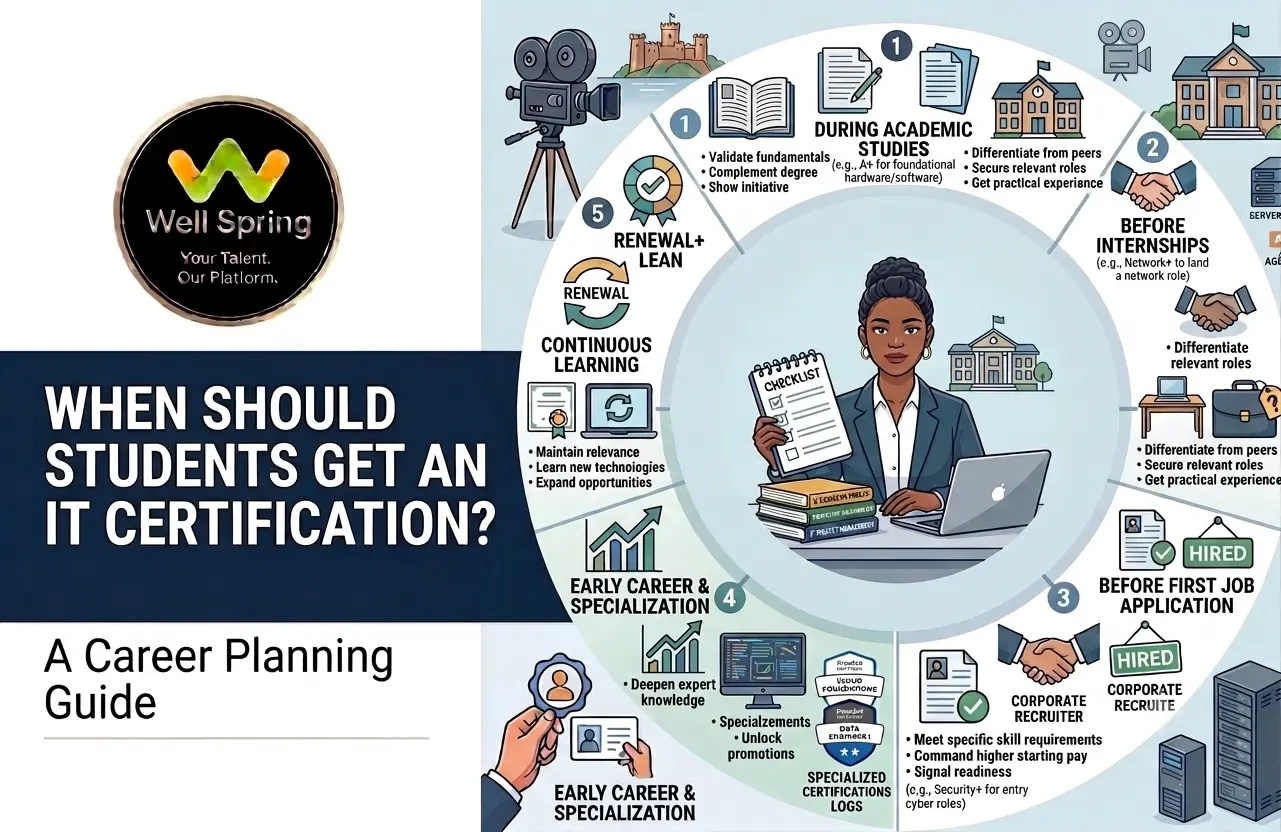
Choosing the right time to pursue an IT certification can be confusing for students. Some start collecting certificates from their first year, while others wait until graduation or their first job search. However, the number of certificates on a resume does not automatically translate into better career opportunities.
For students, timing matters. A certification is most useful when it supports a specific career goal, strengthens an existing skill, or provides structured preparation for an entry-level role.
For students exploring IT certification for students in Trichy, the better question is not simply "Which certification should I take?" but "What skill am I trying to prove, and am I ready to use it?"
This guide explains when students should consider certification, what benefits certifications can provide, how to choose an appropriate credential, common mistakes to avoid, and how certification can fit into a practical IT career plan.
Most students can start considering relevant IT certifications from their second or third year, once they have basic technical foundations and a clearer career direction. First-year students should generally focus on exploration and fundamentals, while final-year students and freshers can choose certifications that directly support their target roles.
A practical progression is:
Explore → Learn Fundamentals → Practise → Certify → Build Projects → Apply
Certification should support your career development rather than become a goal of collecting as many certificates as possible.
This guide is useful for:
An IT certification is a credential awarded after an individual completes a certification program or passes an assessment designed to demonstrate knowledge or competency in a particular technology, platform, methodology, or professional area.
Examples can include certifications related to:
A certification is different from simply completing an online course.
A course primarily focuses on learning.
A project demonstrates application.
An internship provides practical exposure to professional workflows.
A certification provides evidence of assessed knowledge or competency, depending on the credential and its assessment requirements.
That distinction is important when planning an IT career.
Getting certified too early is not necessarily harmful, but it may not provide the value students expect.
Consider two students.
Student A completes six certifications but cannot build a simple project independently.
Student B has two relevant certifications, three practical projects, and internship experience related to their target role.
For an entry-level employer, Student B may have stronger evidence of job readiness.
This is why certification should be treated as part of a broader development plan rather than a competition to collect credentials.
A useful way to think about certification is:
Career Value = Relevance × Knowledge × Application × Credibility
If a certification is highly relevant but the student cannot apply the knowledge, its practical value may be limited.
If the student has strong practical skills but chooses a certification unrelated to the target role, the credential may not strengthen the career story.
The goal is alignment between the career goal, skill development, practical application, and certification.
There is no single semester or age that is ideal for every student. The right timing depends on the student's academic stage, career direction, technical foundation, and intended role.
|
Academic Stage |
Main Focus |
Certification Approach |
|
First Year |
Explore |
Beginner-level or fundamental certification |
|
Second Year |
Build a direction |
Certification aligned with a chosen field |
|
Third Year |
Develop job-relevant evidence |
Certification + projects + practical experience |
|
Final Year |
Prepare for employment |
Role-specific certification |
|
After Graduation |
Target a career |
Certification based on actual job requirements |
First-year students usually benefit from understanding the IT landscape before committing heavily to one specialisation.
At this stage, focus on:
A beginner-level certification can be useful if it helps you explore a field.
However, collecting multiple advanced certificates before understanding your interests is usually inefficient.
Best goal: Discover what you want to learn.
By the second year, students often have enough academic exposure to begin identifying areas they enjoy.
Possible directions include:
This can be a suitable stage for a foundational certification that matches your chosen direction.
For example, a student interested in cloud computing can first strengthen networking and operating-system fundamentals before moving toward cloud concepts.
Best goal: Connect learning with a career area.
For many students, the third year is an important point to become more career-focused.
At this stage, combine:
Certification + Projects + Internship
For example, a student interested in cloud computing could:
Now the certification is supported by evidence of application.
Best goal: Demonstrate job readiness.
Final-year students should prioritise certifications that directly support their target role.
Before registering, ask:
A relevant certification can strengthen a fresher's profile, but it should not replace:
Best goal: Strengthen your employability story.
Graduates and freshers should generally avoid taking certifications simply because they are unsure what to do next.
Instead, start with the role you want.
For example:
Target role: Junior Data Analyst
↓
Required skills: Excel, SQL, data visualisation, basic statistics
↓
Practical evidence: Dashboard + SQL project
↓
Relevant certification: Certification aligned with analytics skills
↓
Applications: Data analyst internships and entry-level roles
This approach makes certification purposeful.
Certifications can provide several benefits when chosen appropriately.
1. Structured Learning
A certification syllabus can give students a defined learning path instead of forcing them to navigate hundreds of disconnected tutorials.
2. Skill Validation
A recognised certification can provide additional evidence that the student has studied a particular subject and met the credential's assessment requirements.
3. Career Exploration
Beginner certifications can help students understand whether they enjoy a particular technology area before investing more time in it.
4. Resume Differentiation
For entry-level candidates with limited professional experience, relevant certifications can add another layer of evidence to a resume.
However, relevance matters more than quantity.
5. Interview Preparation
Certification preparation can expose students to concepts and terminology that may also appear in technical interviews.
Students should still prepare separately for the practical and problem-solving aspects of interviews.
6. Professional Vocabulary
A structured curriculum can help students become familiar with industry terminology, tools, processes, and concepts.
7. Confidence
Completing a meaningful certification can give students a clearer understanding of their chosen field and provide momentum for further learning.
Certification can be particularly useful for students who:
Have Identified a Career Direction
If you know you want to work in cloud computing, cybersecurity, data analytics, software development, or another specific area, certification can support a focused learning plan.
Want Structured Learning
Some students struggle with self-directed learning. A certification syllabus can provide a defined sequence of topics.
Need Evidence Beyond Academic Coursework
A relevant certification can demonstrate additional learning outside the university curriculum.
Are Preparing for Entry-Level Roles
Final-year students and freshers can use carefully selected certifications as part of a broader employability portfolio.
Want to Transition Into Another IT Area
Students from one technical background may use suitable certifications to establish foundational knowledge in a new field.
The right certification depends on the career direction and current skill level.
|
Career Area |
Useful Starting Focus |
|
Cloud Computing |
Networking, operating systems, cloud fundamentals |
|
Cybersecurity |
Networking, Linux, security fundamentals |
|
Networking |
Networking fundamentals and infrastructure concepts |
|
Data Analytics |
Excel, SQL, statistics, data visualisation |
|
AI & Machine Learning |
Python, statistics, AI/ML fundamentals |
|
Software Development |
Programming, Git, databases, development projects |
|
DevOps |
Linux, networking, Git, CI/CD and automation fundamentals |
|
Software Testing |
Testing fundamentals, SQL, automation basics |
|
IT Service Management |
Service management concepts and frameworks |
|
Project Management |
Entry-level project management concepts |
|
Databases |
Database concepts, SQL and administration fundamentals |
Certification providers, prerequisites, exam formats, costs, and recognition can change. Students should verify the current requirements directly with the certification provider before enrolling.
Students sometimes assume that a certification, course, project, or internship serves the same purpose. They do not.
|
Option |
Main Purpose |
What It Can Demonstrate |
|
Degree |
Academic qualification |
Formal education |
|
Course |
Skill development |
Knowledge gained |
|
Certification |
Validate defined knowledge or competency |
Credential and assessment |
|
Project |
Demonstrate application |
Practical ability |
|
Internship |
Gain workplace exposure |
Professional workflow experience |
The strongest student profile often combines several of these rather than relying on only one.
Example
A student wants to become a software developer.
Degree: Provides academic foundation
Course: Learn Java and web development
Project: Build a working web application
Certification: Validate relevant technical knowledge where appropriate
Internship: Gain exposure to development workflows
Portfolio: Present projects and experience
This creates a stronger career narrative than collecting unrelated certificates.
Students searching for IT certification for students in Trichy should evaluate certification as part of a wider career preparation plan.
The first step is to identify the type of IT role you want to pursue.
Interested in Software Development?
Focus on:
Interested in Data?
Build skills in:
Interested in Cloud?
Start with:
Interested in Cybersecurity?
Develop:
The key is to avoid selecting a certification solely because it is popular.
Instead of asking:
"What certification can I get?"
Ask:
"What roles am I targeting, and which skills do those roles actually require?"
Then work backwards.
Students in Trichy can consider certification alongside the skills and entry-level opportunities relevant to their target career.
A practical approach is:
Target Role → Required Skills → Learning → Practice → Certification → Project → Internship → Job Search
This approach helps students choose certifications based on their career direction instead of selecting credentials in isolation.
For students who need structured technical learning and practical exposure, training and internship programs can complement certification preparation.
For students searching for IT certification for freshers in Trichy, the best approach is to build a profile around evidence rather than credentials alone.
A fresher's career profile can include:
Suppose a graduate wants to enter software testing.
Instead of:
Resume:
10 certificates + basic testing knowledge
A stronger profile might be:
Resume:
Software testing fundamentals + one relevant certification + test-case project + bug-reporting exercise + internship exposure + interview preparation
The second profile tells a clearer story about job readiness because the certification is supported by practical evidence.
Before paying for any certification, evaluate it using these questions.
1. Is It Relevant to My Target Role?
A certification should have a clear connection to the job you want.
2. Is It Appropriate for My Current Level?
Do not jump into an advanced certification without the required foundation.
3. Who Issues the Certification?
Research the provider and understand what the credential actually represents.
4. Is There an Assessment?
Understand whether the certification requires an exam, practical assessment, coursework, or another form of evaluation.
5. Do Employers Recognise It?
Look at current job descriptions and employer requirements where possible.
Avoid assuming that every certification has equal value across all employers.
6. What Are the Prerequisites?
Check experience, education, prior certifications, technical knowledge, and other eligibility requirements.
7. What Is the Total Cost?
Consider:
8. Can I Apply the Knowledge?
If you cannot imagine using the skill in a project or workplace, reconsider whether this is the right certification right now.
Use this five-question test before enrolling.
R — Relevance
Does it match my target career?
E — Entry Readiness
Do I have the required foundation?
A — Application
Can I use the knowledge in a project?
L — Labour-Market Value
Do relevant employers ask for or value this credential?
S — Strategic Timing
Is now the right point in my academic or career journey?
If most answers are yes, the certification is more likely to fit your career plan.
This framework helps students evaluate a certification based on purpose rather than popularity.
Collecting Certificates Without Building Skills
Ten certificates cannot compensate for an inability to apply basic concepts.
Choosing Based on Popularity Alone
A popular certification may not be relevant to your desired job.
Taking Advanced Certifications Too Early
Skipping foundational knowledge can make preparation harder and reduce practical understanding.
Ignoring Projects
Projects turn theoretical knowledge into evidence of application.
Ignoring Internships
Certification demonstrates assessed learning, while an internship can provide exposure to professional workflows.
Paying Without Researching
Always check the provider, syllabus, assessment method, validity, renewal requirements, and total cost.
Treating Certification as a Job Guarantee
A certification can strengthen a profile, but it does not guarantee employment.
Employers may also consider:
Do not simply create a long list of certificate names.
Use a clear format.
Recommended Format
Certification Name
Issuing Organisation | Year
Relevant skills: Cloud fundamentals, networking, deployment basics
If the certification involved a practical project, connect the two.
Certification: Cloud Fundamentals
Project: Deployed a basic web application using cloud services
Skills: Cloud concepts, deployment, storage, networking
This provides context and makes the credential more meaningful.
Where Should Certifications Appear?
For freshers, a certification section can be placed after:
The exact placement depends on how relevant the credential is to the target role.
If a certification is highly relevant to the position, it can receive greater visibility on the resume.
A practical four-stage roadmap can help students understand how certification fits into their wider career development.
Stage 1: Explore
Academic stage: Early college
Focus on:
Outcome: Identify areas of interest.
Stage 2: Build
Academic stage: Middle years
Focus on:
Outcome: Establish technical foundations.
Stage 3: Validate
Academic stage: Pre-final/final year
Focus on:
Outcome: Build evidence of employability.
Stage 4: Launch
Academic stage: Final year / graduate
Focus on:
Outcome: Move from student learning to professional work.
Good IT career guidance for students in Trichy should not begin with a list of certifications. It should begin with the student's intended career direction.
A useful planning process should answer:
This prevents students from making certification decisions in isolation.
Certification Should Fit the Career Plan
Think of your career plan as a chain:
Career Goal → Required Skills → Learning → Practice → Certification → Project → Internship → Job Search
Certification is one link in that chain—not the entire chain.
A professional certification for students in Trichy can be useful when it provides structured preparation or validates knowledge relevant to the student's intended career.
However, students should distinguish between:
Not every certificate carries the same meaning.
Before choosing one, investigate:
For students, the most sensible starting point is usually a credential that matches their current level rather than one chosen simply because it sounds advanced.
Certification works best when students can connect what they learn to something they can demonstrate.
For example:
Career Goal: Data Analyst
↓
Learn: Excel + SQL + Python + statistics
↓
Practise: Analyse real or sample datasets
↓
Build: Dashboard + SQL project
↓
Certify: Choose an appropriate analytics credential
↓
Gain Exposure: Internship or practical project
↓
Prepare: Resume + portfolio + interviews
↓
Apply: Entry-level roles
This model can be adapted to software development, cloud, cybersecurity, testing, UI/UX, data, and other technology careers.
An IT certification is most useful when it arrives at the right point in a student's career journey.
Rather than collecting certificates, students should build a progression from fundamentals to practical skills, relevant certification, projects, internships, and job preparation.
For students considering IT certification for students in Trichy, the most effective approach is to start with the career goal and work backwards. Identify the skills required, build those skills through structured learning and practice, choose certification where it adds meaningful evidence, and gain practical exposure through projects or internships.
The objective is not to have the longest certificate list.
It is to become a candidate who can learn, apply, demonstrate, and explain valuable IT skills.
If you are unsure whether you should pursue a certification, course, project, or internship, start by identifying your target IT role and the skills required for it. A practical training and career-planning approach can then help you decide what to learn, practise, certify, and demonstrate next.
18 Sep 2026
18 Sep 2026
18 Sep 2026
17 Sep 2026
17 Sep 2026
A student can pursue an IT certification once they have enough foundational knowledge to understand the subject and a clear reason for taking it. First-year students may benefit from beginner-level certifications for exploration, while later-year students can choose credentials that support a specific career direction.
Yes, relevant certifications can strengthen a fresher's profile by providing evidence of additional learning. Their value is usually stronger when supported by projects, practical skills, internships, and interview preparation.
There is no ideal number. Two highly relevant certifications supported by practical work can be more useful than a long list of unrelated certificates.
Not always. Requirements vary by role and employer. Many entry-level positions place significant emphasis on technical skills, projects, problem-solving, communication, interview performance, and practical ability alongside any certifications.
There is no single best certification for every student. The right choice depends on whether the student is targeting software development, data, cloud, cybersecurity, testing, networking, UI/UX, or another IT career. The certification should match the student's current level and target role.
No. A certification can support a candidate's profile, but employment decisions depend on multiple factors including skills, experience, projects, interview performance, communication, and employer requirements.
First-year students can explore beginner-level certifications if they support their learning goals. However, they should generally establish fundamentals and explore different IT fields before committing to advanced professional credentials.
It depends on the specific certification. Some beginner-level and technology certifications may have limited prerequisites, while advanced professional credentials can require prior experience, education, or other certifications. Students should always check the current eligibility requirements with the certification provider before enrolling.
Get internship updates, IT training news, placement opportunities, and career tips directly to your inbox.
Join our WhatsApp community for internship updates, IT courses, placement support, and latest job opportunities.
Join Now