Blog Details
Home Blog Details
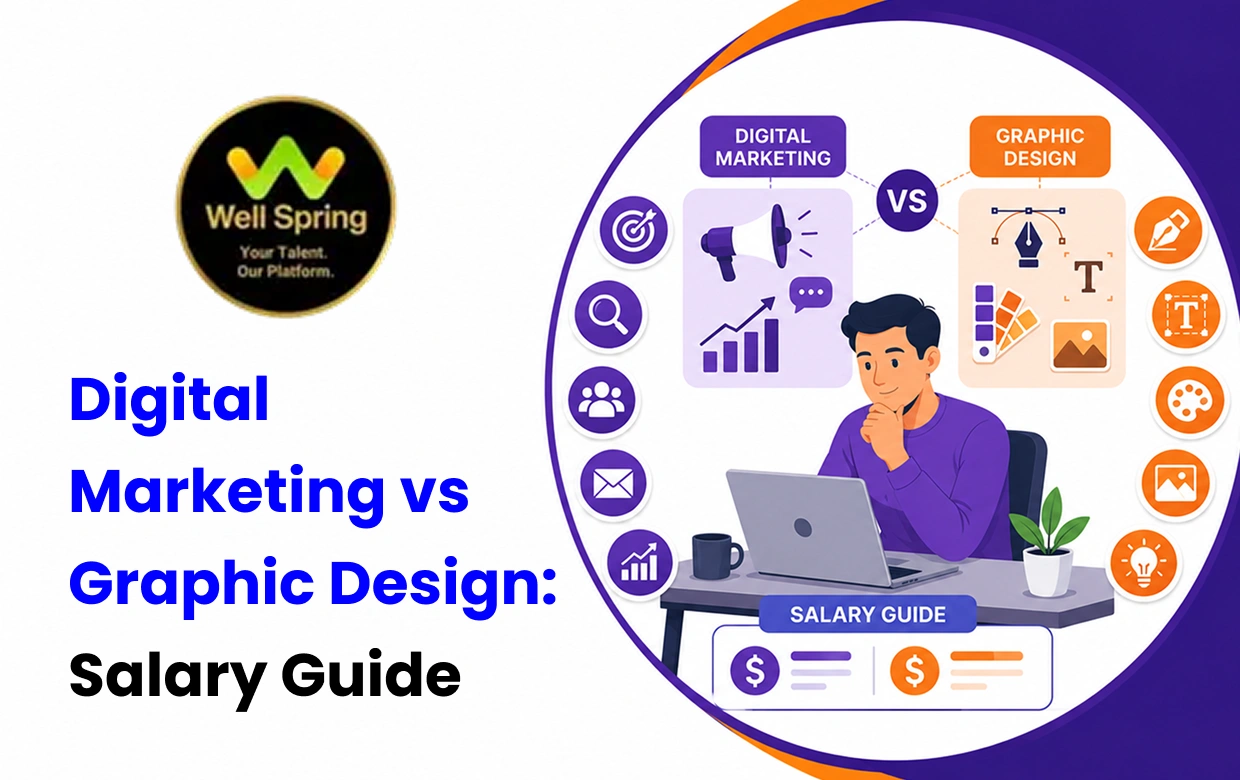
Digital Marketing and Graphic Design are both valuable career options, but they focus on different types of work. Digital Marketing is mainly concerned with reaching audiences, building online visibility, generating leads and supporting business growth, while Graphic Design focuses on communicating ideas through visual elements such as branding, layouts, advertisements and digital creatives. Because both fields are widely used by businesses, students and freshers often wonder which one offers better career opportunities, salary potential and long-term scope. The right choice depends on your interests, strengths and the kind of problems you enjoy solving. This guide compares the two fields through skills, job roles, learning paths, salary factors, practical work, AI, career scope and course-selection considerations so you can make a more informed decision.
If you enjoy communication, customer behaviour, SEO, advertising, content, analytics and business growth, Digital Marketing may be the better fit.
If you enjoy visual creativity, typography, branding, layouts, colour and visual storytelling, Graphic Design may suit you better.
There is no universal winner. The better choice depends on whether you are more interested in growing an audience or communicating an idea visually.
Digital Marketing and Graphic Design often work together, but their primary responsibilities are different.
Digital Marketing focuses on promoting businesses, products or services through digital channels. It can involve SEO, social media, content marketing, paid advertising, email marketing, analytics and lead generation.
Graphic Design focuses on visual communication. Designers create logos, brand identities, social media creatives, advertisements, brochures, presentations, packaging and other visual materials.
A simple way to remember the difference is:
Digital Marketing focuses on reaching and influencing the audience, while Graphic Design focuses on communicating the message visually.
For example, if a company launches a new product, the marketer may plan the campaign, identify the audience and measure results, while the designer creates the visuals used across the campaign.
Digital Marketing is a broad field, so daily responsibilities vary according to the role.
A Digital Marketing professional may work on:
Search engine optimisation.
Content marketing.
Paid advertising.
Email campaigns.
Lead generation.
Website optimisation.
Competitor research.
Campaign planning.
Marketing analytics.
Conversion optimisation.
For example, a Digital Marketer promoting a training institute might research its target audience, optimise course pages, plan social media content, manage advertising campaigns and analyse which activities generate enquiries.
The work combines communication, creativity, technology and performance measurement.
Graphic Designers turn information, concepts and messages into visual communication.
Their work may include:
Logo design.
Brand identity.
Social media creatives.
Posters.
Brochures.
Advertisements.
Presentations.
Packaging.
Marketing materials.
Digital campaign visuals.
A professional designer considers more than whether something looks attractive. They think about hierarchy, typography, colour, spacing, composition, audience and brand consistency.
The objective is to make a message easier to understand, recognise and remember.
| Factor | Digital Marketing | Graphic Design |
|---|---|---|
| Main focus | Audience growth and business results | Visual communication |
| Core objective | Attract, engage and convert audiences | Communicate ideas visually |
| Creativity | High | Very high |
| Analytics | Highly important | Useful but less central |
| Communication | Highly important | Important |
| SEO | Important in relevant roles | Usually not central |
| Advertising | Frequently involved | Often supports campaigns |
| Branding | Important | Core area |
| Portfolio | Campaigns, content and results | Visual projects |
| Freelancing | SEO, social media, ads, content | Branding and creative design |
| Career breadth | Broad marketing ecosystem | More specialised creative ecosystem |
| Performance measurement | Central | Usually indirect |
| AI impact | Marketing workflows and analysis | Design production and ideation |
A Digital Marketer needs a combination of communication, analytical and technical abilities.
You should understand search intent, keyword research, on-page optimisation, technical basics and content optimisation.
This includes content planning, audience engagement, platform strategy and performance tracking.
Depending on the role, you may work with search advertising, social advertising, retargeting and campaign optimisation.
You need to understand how useful and relevant content can attract and educate potential customers.
Marketing decisions often depend on data such as traffic, leads, engagement, conversions and campaign performance.
Digital Marketers need to communicate ideas clearly to customers, clients and team members.
Graphic Design requires strong visual thinking and creative problem-solving.
You should understand balance, contrast, alignment, hierarchy, proportion, spacing and composition.
Typography affects readability, hierarchy and the personality of a design.
Colour knowledge helps designers create attractive and consistent visual communication.
Designers need to understand how colours, fonts, logos and visual elements work together to build an identity.
Professional designers use different digital design and image-editing tools depending on their role.
However, learning software alone does not make someone a strong designer. Design judgement and communication are equally important.
A designer often receives a business requirement and must turn it into a visual solution that communicates the intended message.
Both careers can be applied across industries, but their career ecosystems are different.
Digital Marketing is used by:
E-commerce companies.
Educational institutions.
Real estate businesses.
Healthcare organisations.
Technology companies.
Hospitality businesses.
Retail brands.
Startups.
Professional service companies.
Career opportunities can include employment, agency work, freelancing, consulting and entrepreneurship.
Graphic Design is used in:
Branding.
Advertising.
Publishing.
Social media.
Packaging.
E-commerce.
Corporate communication.
Events.
Entertainment.
Marketing.
Designers can work with agencies, companies or clients independently.
The major difference is that Digital Marketing often connects directly with audience growth and measurable business performance, whereas Graphic Design is primarily responsible for visual communication and brand expression.
Career statistics should be interpreted carefully because Digital Marketing is not one single occupational category.
The U.S. Bureau of Labor Statistics projects 7% employment growth from 2024 to 2034 for Market Research Analysts, with about 87,200 openings per year on average. The occupation had a 2024 median annual wage of $76,950.
For Graphic Designers, the BLS projects 2% employment growth from 2024 to 2034, with about 20,000 openings per year. The reported 2024 median annual wage was $61,300.
These are U.S. statistics, not Indian salary guarantees, and the occupational categories are not perfectly equivalent to Digital Marketing and Graphic Design as course names.
The figures are therefore best used as broad labour-market indicators rather than a promise that one career will always pay more than the other.
Salary is one of the most searched factors when comparing these careers, but there is no single salary figure that applies to everyone.
Earnings can vary according to:
A fresher and a professional with several years of specialised experience can have very different compensation.
In Digital Marketing, areas such as SEO, performance marketing, analytics and conversion optimisation can lead to different career paths.
In Graphic Design, branding, visual design, motion graphics and creative leadership can create different opportunities.
Company size, industry and responsibilities can significantly influence compensation.
Salaries vary between cities, regions and countries.
For Graphic Designers, portfolio quality can strongly influence opportunities.
For Digital Marketers, demonstrated campaign performance and measurable results can become increasingly important.
Freelance income is not directly comparable to an employee salary because it depends on clients, pricing, workload and business development.
At senior levels, responsibility also changes compensation significantly. For example, the BLS reports a 2024 median annual wage of $161,030 for advertising, promotions and marketing managers in the U.S.
This illustrates why career progression matters when evaluating Graphic Design vs Digital Marketing Salary rather than comparing entry-level course titles alone.
Both careers require creativity, but they use it differently.
Graphic Design generally involves more visual creativity through:
Typography.
Colour.
Layout.
Composition.
Branding.
Visual storytelling.
Digital Marketing uses creativity for:
Campaign ideas.
Content.
Audience engagement.
Advertising concepts.
Brand positioning.
Marketing strategies.
So the distinction is not creative versus non-creative.
It is more accurately:
Graphic Design → visual creativity
Digital Marketing → strategic and communication-focused creativity
There is no universal learning period for either career.
A beginner can learn basic concepts relatively quickly, but professional ability takes longer because both fields require practice.
A beginner can progress through:
Fundamentals → Content → SEO → Social Media → Advertising → Analytics → Projects → Specialisation
A beginner can progress through:
Design Fundamentals → Typography → Colour → Composition → Design Tools → Branding → Projects → Portfolio
The important point is that learning the software or concepts is only the beginning.
Professional confidence develops through repeated practical work and feedback.
Digital Marketing can lead to roles such as:
Digital Marketing Executive.
SEO Executive.
SEO Specialist.
Social Media Executive.
Performance Marketing Specialist.
Content Marketing Specialist.
Digital Marketing Analyst.
Marketing Strategist.
With experience, professionals can progress toward:
Digital Marketing Manager.
SEO Manager.
Performance Marketing Manager.
Growth Marketing Specialist.
Marketing Strategist.
Graphic Design can lead to:
Graphic Designer.
Visual Designer.
Brand Designer.
Marketing Designer.
Creative Designer.
Social Media Designer.
With experience, professionals may move toward:
Senior Graphic Designer.
Art Director.
Brand Design Lead.
Creative Director.
Creative Strategist.
Job titles vary between companies, agencies and industries.
AI is changing workflows in both fields, but it is not affecting every task in the same way.
The World Economic Forum's Future of Jobs Report 2025 identifies AI and big data, technological literacy and creative thinking among important skill areas expected to grow through 2030.
For Digital Marketing, AI can support:
Content ideation.
Data analysis.
Audience research.
Reporting.
Ad variations.
Campaign experimentation.
For Graphic Design, AI can assist with:
Concept exploration.
Image generation.
Editing.
Mockups.
Design variations.
Rapid experimentation.
The important skill is not simply knowing how to use an AI tool.
Professionals still need strategy, judgement, creativity, communication and the ability to evaluate results.
The BLS also notes that automated design tools, including AI, may reduce demand for some freelance graphic design work.
That makes it increasingly valuable for designers to develop skills beyond routine production.
Both fields benefit from practical evidence, but the portfolio looks different.
A beginner could demonstrate:
SEO audit.
Keyword research.
Content strategy.
Social media campaign.
Advertising campaign concept.
Website optimisation project.
Basic analytics report.
A good case study can show:
Problem → Strategy → Execution → Result → Learning
A designer could showcase:
Brand identity.
Logo system.
Social media campaign.
Poster series.
Brochure.
Packaging concept.
Advertising creative.
A strong project can explain:
Brief → Audience → Concept → Design Decisions → Final Output
A smaller portfolio of well-developed work is often more useful than a large collection of unrelated designs.
There is no single answer for everyone.
Enjoy communication.
Like understanding customers.
Are interested in business growth.
Enjoy analysing performance.
Like content and advertising.
Are interested in SEO.
Enjoy experimenting with campaigns.
Enjoy visual creativity.
Like typography and layouts.
Notice colours and visual details.
Enjoy branding.
Like turning ideas into visuals.
Prefer creative production.
Enjoy visual problem-solving.
Want to work in a digital agency.
Enjoy both strategy and design.
Work with small businesses.
Want to build your own brand.
Want to become a creative or content strategist.
Want to understand both campaign planning and visual communication.
A senior-level salary does not mean a beginner will immediately earn the same amount. Focus on building valuable skills first.
Social media is only one part of Digital Marketing. SEO, advertising, content, analytics and strategy can all be important.
Tools are necessary, but professional design also requires visual judgement, communication, composition and branding knowledge.
Certificates can show course completion, but practical projects demonstrate what you can actually do.
A visually attractive design still needs to communicate the right message. A marketing campaign also needs to support a meaningful business objective.
AI is becoming part of professional workflows. Learn how to use it responsibly while strengthening the skills that require human judgement.
Before joining either course, look beyond the course title.
Make sure the course covers relevant concepts, tools and practical activities.
Assignments should allow you to apply what you learn rather than simply watch demonstrations.
Ask whether the course helps you create work that can actually be presented to employers or clients.
Feedback from experienced trainers can help identify mistakes and improve your work.
Internships, realistic assignments and client-style projects can provide useful exposure.
AI should be taught as a practical professional tool rather than simply added as a marketing keyword.
Interview preparation, career guidance and role-specific training can be useful for freshers.
The most important question is:
“What will I be able to create or accomplish after completing this course?”
For students searching for training in Trichy, the choice should be based on the curriculum and practical exposure rather than the course title alone.
A Digital Marketing course should ideally provide exposure to:
SEO.
Social Media Marketing.
Content Marketing.
Paid Advertising.
Analytics.
Campaign Planning.
Practical Projects.
A Graphic Design course should ideally cover:
Design Fundamentals.
Typography.
Colour.
Layout.
Branding.
Design Tools.
Marketing Creatives.
Portfolio Projects.
Students should also ask whether the training includes practical assignments, mentor guidance, internships, portfolio development and career support.
For learners considering professional training, Well Spring Talent Solutions can be evaluated alongside other training options based on the actual curriculum, project work and career support offered.
Instead of choosing immediately, test both fields with a small project.
Choose a fictional local business and create:
Target audience.
Customer problem.
Keyword ideas.
Content ideas.
Social media strategy.
Basic campaign concept.
Then ask:
Did I enjoy thinking about audiences, strategy and results?
Use the same fictional business and create:
Logo concept.
Colour palette.
Typography.
Social media creative.
Promotional poster.
Simple brand identity.
Then ask:
Did I enjoy turning the business idea into a visual identity?
A short practical experiment can reveal more about your natural preference than simply comparing course descriptions.
Digital Marketing focuses on audience growth, visibility, campaigns and measurable business outcomes.
Graphic Design focuses on visual communication, branding and creative execution.
Digital Marketing generally places greater emphasis on analytics, customer behaviour and performance.
Graphic Design places greater emphasis on visual judgement, typography, composition and creative thinking.
Salary depends on experience, specialisation, location, company and responsibility.
AI is changing workflows in both careers, making creativity, strategy and adaptability increasingly important.
Practical projects and a strong portfolio can help demonstrate ability beyond certificates.
Choosing between Digital Marketing and Graphic Design is not about finding one career that is automatically better for everyone. Digital Marketing may suit learners who enjoy communication, customer behaviour, SEO, advertising, content and business growth, while Graphic Design can be a better fit for those who enjoy visual storytelling, branding, typography, layouts and creative problem-solving.
Both fields offer opportunities across companies, agencies and freelance work, but your long-term progress will depend more on practical ability, specialisation, experience and continuous improvement than on the course title alone. AI is also changing professional workflows in both areas, making creativity, strategic thinking, adaptability and sound judgement increasingly valuable. If you are still unsure, try a small project in each field and observe which type of work you naturally enjoy.
The right choice is ultimately the career that matches your strengths and gives you enough interest to keep learning, building and improving over time.
21 Oct 2026
21 Oct 2026
20 Oct 2026
20 Oct 2026
19 Oct 2026
Choose Digital Marketing if you enjoy audiences, campaigns and business growth. Choose Graphic Design if you enjoy visual communication and creative work.
Yes. Freshers can start with SEO, social media, content, advertising and analytics and build experience through practical projects.
Yes. Beginners can learn design fundamentals, visual communication and design tools while developing a portfolio.
No. Employers may also evaluate practical skills, portfolio quality, communication, problem-solving and relevant experience.
Check the curriculum, practical projects, mentor support, portfolio development, internships, industry exposure and career guidance.
Yes. The combination can be useful for social media, branding, content marketing, advertising and freelance work.
Yes. Digital Marketers can provide SEO, social media, content and advertising services, while Graphic Designers can offer branding and creative design services.
No. Learn the fundamentals first, then use AI as a productivity tool while developing your own professional judgement.
We provide IT training, internships, and online learning for students in Trichy and across India.
We also welcome enquiries from students in these neighbourhoods, towns, and surrounding locations.
Can't attend classes in person? Explore online IT training opportunities with Well Spring Talent Solutions, designed to help learners develop practical technology skills from different locations across India.
Get internship updates, IT training news, placement opportunities, and career tips directly to your inbox.
Join our WhatsApp community for internship updates, IT courses, placement support, and latest job opportunities.
Join Now