Blog Details
Home Blog Details

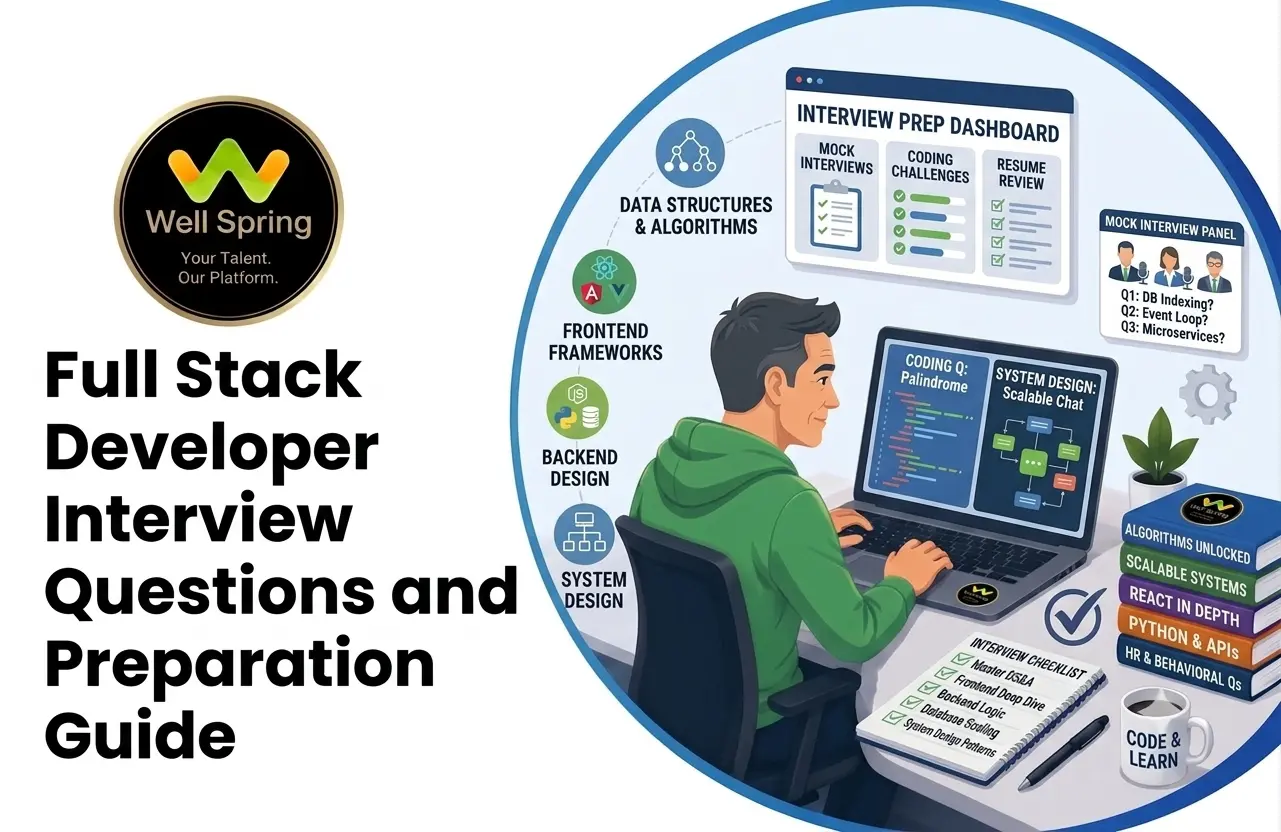
Preparing for a full stack developer interview can feel challenging because you are expected to demonstrate knowledge across multiple areas of software development. An interviewer may begin with basic programming concepts and then move into frontend development, backend logic, databases, APIs, authentication, debugging, and real-world project scenarios.
The good news is that you do not need to memorize hundreds of unrelated questions. Most full stack developer interview questions test a smaller set of core concepts and your ability to apply them.
This guide covers commonly asked full stack interview questions, coding problems, project-based questions, and fresher-level questions. It also explains how to prepare effectively so you can answer with clarity and demonstrate practical development skills.
Full stack developer interviews usually evaluate frontend, backend, database, API, programming, debugging, and project knowledge. Prepare by strengthening core concepts, solving practical coding problems, understanding how your projects work end to end, and practising scenario-based questions rather than memorizing definitions alone.
What Does a Full Stack Developer Do?
A full stack developer works across different layers of an application.
A typical web application can be viewed as several connected layers:
User Interface → Frontend → API/Backend → Database
The frontend manages what users see and interact with. The backend processes business logic and communicates with databases or external services. The database stores application data.
A full stack developer should understand how these layers communicate rather than treating them as completely separate technologies.
Depending on the organization and role, a full stack developer may work on:
The depth expected in each area varies by company and role. A junior developer may be evaluated primarily on fundamentals and practical problem-solving, while a more experienced candidate may face deeper questions about architecture, performance, security, scalability, and system design.
There is no single interview format used by every company, but a full stack interview commonly includes several stages.
|
Stage |
What May Be Evaluated |
|
Resume screening |
Technologies, projects, experience |
|
Technical screening |
Programming and core concepts |
|
Coding round |
Problem-solving and implementation |
|
Frontend/backend discussion |
Technical depth |
|
Database/API questions |
Data and application communication |
|
Project discussion |
Practical experience |
|
Behavioral round |
Communication and teamwork |
|
Final discussion |
Role fit and expectations |
For freshers, project discussions can be particularly important because projects provide evidence that you have actually applied what you learned.
Full stack development involves building and maintaining both the frontend and backend portions of an application, along with working with databases and APIs.
A full stack developer understands how these components interact to deliver a complete application.
Frontend development focuses on the user-facing portion of an application.
Common frontend technologies include:
Backend development handles server-side processing, business logic, authentication, APIs, and database communication.
Common backend technologies include:
The important distinction is not simply the technology used. It is where the responsibility lies in the application's architecture.
A technology stack is a collection of technologies used to build an application.
For example, a JavaScript-based application might use:
React → Node.js/Express → PostgreSQL
Another application could use:
Angular → Java/Spring Boot → MySQL
There is no single technology stack that every full stack developer must know.
A strong interview answer should explain the complete flow.
For example:
This type of explanation demonstrates that you understand end-to-end application flow, rather than knowing frontend and backend technologies independently.
Client-side processing happens primarily in the user's browser.
Examples include:
Server-side processing happens on the server.
Examples include:
Security-sensitive operations should not rely solely on client-side validation because users can manipulate client-side code and requests.
Frontend questions are a major part of many full stack interviews.
For example, HTML can create a button, CSS can style it, and JavaScript can define what happens when the user clicks it.
Semantic HTML uses elements according to their meaning rather than using generic elements for everything.
Examples include:
Semantic markup can improve accessibility, maintainability, and the browser's understanding of page structure.
DOM stands for Document Object Model.
It represents a webpage as a tree of objects that JavaScript can access and manipulate.
For example, JavaScript can use the DOM to:
Event bubbling is a mechanism where an event triggered on a nested element can propagate upward through its parent elements.
For example, if a button exists inside a <div>, a click on the button can trigger handlers associated with the button and then propagate toward its parent elements.
Event delegation can make use of this behavior to efficiently handle events for multiple elements.
Responsive web design allows an interface to adapt to different screen sizes and devices.
Common techniques include:
A developer should test interfaces at multiple viewport sizes rather than assuming that a layout that works on a desktop will automatically work on mobile.
A component is a reusable part of a user interface.
For example, an e-commerce application might contain:
Component-based development can make applications easier to maintain and extend.
State represents information that can change during an application's lifecycle.
Examples include:
When state changes, the interface may need to update accordingly.
A backend server processes requests from clients and performs operations such as:
The backend then returns an appropriate response to the client.
Middleware is software that executes during the processing of a request, often before the request reaches the final route handler.
It can be used for:
For example, an authentication middleware can check whether a user has a valid token before allowing access to a protected endpoint.
Authentication answers:
Who are you?
Authorization answers:
What are you allowed to do?
For example, logging into an application authenticates a user. Checking whether that user has permission to access an admin dashboard is authorization.
Server-side validation checks incoming data on the backend before processing or storing it.
Suppose a registration form requires an email address.
The frontend may check whether the email appears valid, but the backend should perform its own validation before creating the account.
This is important because the server cannot assume that requests came through the application's intended frontend.
Asynchronous programming allows an application to perform operations that may take time without unnecessarily blocking other work.
Common examples include:
In JavaScript, asynchronous operations are commonly handled using:
A good candidate should understand not just the syntax but also how asynchronous execution affects application behavior.
SQL databases generally organize data into structured tables and commonly use relationships between tables.
Examples include:
NoSQL databases use different data models, such as documents, key-value pairs, or graphs.
Examples include:
The appropriate choice depends on data structure, query patterns, consistency requirements, scalability needs, and application architecture.
A primary key uniquely identifies a record in a table.
For example:
CREATE TABLE users (
id INT PRIMARY KEY,
name VARCHAR(100),
email VARCHAR(150)
);
Here, id can uniquely identify each user.
A foreign key creates a relationship between records in different tables.
For example, an orders table might contain a user_id that references the id of a user in the users table.
This helps maintain relationships between related data.
Normalization is a database design technique used to organize data and reduce unnecessary duplication.
For example, instead of storing the same customer information repeatedly in every order record, customer information can be stored separately and referenced through a relationship.
However, database design involves trade-offs. In some systems, carefully chosen denormalization may improve read performance.
A database index is a data structure that can make certain queries faster by helping the database locate records more efficiently.
However, indexes are not free.
They can:
Therefore, indexes should be created based on actual query patterns rather than added indiscriminately.
API stands for Application Programming Interface.
In web development, an API commonly allows one application or component to communicate with another through defined endpoints.
For example:
GET /api/products
POST /api/products
GET /api/products/25
DELETE /api/products/25
A frontend application can use these endpoints to communicate with a backend service.
REST, or Representational State Transfer, is an architectural style commonly used for web APIs.
RESTful APIs commonly use HTTP methods such as:
|
Method |
Typical Purpose |
|
GET |
Retrieve data |
|
POST |
Create data |
|
PUT |
Replace/update data |
|
PATCH |
Partially update data |
|
DELETE |
Delete data |
The exact behavior depends on the API design, but using HTTP methods consistently makes APIs easier to understand.
HTTP status codes communicate the result of a request.
Examples:
An interviewer may ask you to explain when different codes should be returned.
JWT stands for JSON Web Token.
A server can issue a signed token after successful authentication. The client can then send that token with subsequent requests to access protected resources.
A simplified flow is:
Login → Server verifies credentials → Token issued → Client sends token → Server validates token
JWTs are not automatically a complete authentication solution. Token storage, expiration, revocation strategy, transport security, and application architecture all matter.
CORS stands for Cross-Origin Resource Sharing.
Browsers enforce security restrictions when frontend code attempts to access resources from another origin. CORS allows a server to specify which cross-origin requests are permitted.
A common mistake is to think CORS is a backend connectivity problem. It is primarily a browser security mechanism.
Coding rounds evaluate how you think, not simply whether you remember syntax.
Example:
function reverseString(str) {
return str.split("").reverse().join("");
}
console.log(reverseString("hello"));
Expected output:
olleh
An interviewer may then ask you to solve the same problem without using built-in reversal methods.
That follow-up tests whether you understand the underlying logic.
One simple approach is to use a Set.
function findDuplicates(arr) {
const seen = new Set();
const duplicates = new Set();
for (const value of arr) {
if (seen.has(value)) {
duplicates.add(value);
} else {
seen.add(value);
}
}
return [...duplicates];
}
console.log(findDuplicates([1, 2, 3, 2, 4, 3]));
Output:
[2, 3]
During an interview, explain the data structure choice and its expected time and space complexity.
function findLargest(arr) {
let largest = arr[0];
for (const value of arr) {
if (value > largest) {
largest = value;
}
}
return largest;
}
The important part of the answer is not just the code. Explain that the array is traversed once, giving an O(n) time complexity.
== performs loose equality comparison and may perform type conversion.
=== performs strict equality comparison without implicit type conversion.
For example:
5 == "5" // true
5 === "5" // false
In most application code, strict equality is generally preferred when you want predictable type-sensitive comparisons.
A basic pagination design might accept parameters such as:
GET /api/products?page=2&limit=20
The backend can then:
For larger datasets, cursor-based pagination may be more appropriate than large offsets.
Do not immediately assume that the server needs more hardware.
First identify the bottleneck.
Possible areas to investigate include:
A strong interview answer should begin with measurement and diagnosis, followed by a targeted optimization.
Project questions are especially important because they allow interviewers to determine whether you understand the systems listed on your resume.
A strong structure is:
Problem → Users → Solution → Architecture → Your contribution → Challenges → Result
For example:
“I built an online appointment application where users can browse available services and schedule appointments. I developed the frontend for the booking flow, created backend APIs for users and appointments, and connected the application to a relational database. One challenge was preventing duplicate bookings, so I added server-side validation and database-level controls around appointment availability.”
This is stronger than simply listing technologies.
Do not answer only:
“Because it is popular.”
Instead, connect the technology to the project's requirements.
For example:
The interviewer wants to know whether you made a reasoned technical choice.
Choose a genuine technical problem.
A good answer explains:
Avoid claiming that your biggest challenge was simply “writing the code.”
Discuss both frontend and backend handling.
For example:
This demonstrates practical application development knowledge.
Depending on the project, you might discuss:
Do not claim that an application is “100% secure.” Security is a continuous process of reducing and managing risks.
This question tests self-awareness.
Good answers might include:
Choose improvements that genuinely relate to your project's current limitations.
Freshers are not always expected to know everything. Interviewers often focus on fundamentals, problem-solving ability, projects, and willingness to learn.
Give a structured answer.
For example:
“I have learned HTML, CSS, JavaScript, React for frontend development, Node.js and Express for backend development, and MySQL for database management. I have also used Git for version control and built projects that connect the frontend, backend, and database.”
Only mention technologies you can actually discuss.
A tutorial mainly demonstrates how something can be built.
A project requires you to make decisions, solve unexpected problems, debug errors, and modify the implementation according to requirements.
Therefore, when preparing for a full stack interview, do not stop after completing tutorials.
Build something where you have to make technical decisions yourself.
A reasonable foundation includes:
You do not need expert-level knowledge of every technology in the ecosystem.
Depth in a smaller, coherent stack is often more useful than superficial familiarity with many tools.
Do not invent an answer.
A better approach is:
“I haven't worked with that directly yet, but I understand the related concept. My current understanding is…”
Then explain what you know and, if possible, describe how you would learn or investigate the missing part.
Honest reasoning is generally more useful to an interviewer than confidently giving incorrect technical information.
Avoid generic statements such as:
“I am hardworking and passionate.”
Instead, connect your answer to evidence.
For example:
“I have built projects where I worked across the frontend, backend, and database rather than focusing on only one layer. I am comfortable debugging problems, explaining my technical decisions, and learning technologies I have not used before. I believe that combination gives me a strong foundation for a junior full stack development role.”
Adapt the answer to your actual experience.
Memorizing full stack developer interview questions and answers can help with familiarity, but it should not be your entire preparation strategy.
Use a layered approach.
Step 1: Strengthen Programming Fundamentals
Revise:
You should be able to explain your logic while coding.
Step 2: Choose One Primary Full Stack Stack
Do not attempt to master every framework before your first interview.
For example, you might focus on:
HTML → CSS → JavaScript → React → Node.js → Express → PostgreSQL
Or:
HTML → CSS → JavaScript → Angular → Java → Spring Boot → MySQL
The exact stack is less important than having enough depth to build and explain an application.
Step 3: Build at Least One End-to-End Project
Your project should demonstrate a complete flow.
For example:
Frontend
→ Registration
→ Login
→ Dashboard
→ Form submission
Backend
→ Authentication
→ Validation
→ Business logic
→ REST API
Database
→ Users
→ Application data
→ Relationships
This gives you something concrete to discuss during the interview.
Step 4: Practise Full Stack Coding Interview Questions
Do not practise only algorithm puzzles.
Prepare problems involving:
For every problem, practise explaining:
Approach → Code → Complexity → Edge cases
Step 5: Practise Debugging
Interviewers may give you code that does not work and ask you to identify the problem.
Practise debugging:
A developer's ability to diagnose problems is often more valuable than simply being able to write code from scratch.
Step 6: Prepare Your Project Explanation
Create a short explanation of each major project covering:
Practise explaining the project without reading from notes.
Step 7: Conduct Mock Interviews
Ask someone to interrupt you with follow-up questions.
For example:
You: “I used JWT for authentication.”
Interviewer: “Where did you store the token?”
You: “In the client…”
Interviewer: “Why did you choose that approach?”
This type of follow-up is what makes technical interviews different from written examinations.
1. Memorizing Definitions
Knowing that REST means Representational State Transfer is not enough.
Be ready to explain how you would design and consume an API.
2. Listing Technologies You Cannot Explain
If React appears on your resume, expect questions about React.
If you list MongoDB, expect database questions.
Your resume should represent your actual skill level.
3. Ignoring Databases
Some candidates focus heavily on frontend frameworks and underestimate SQL, relationships, queries, and data modelling.
Full stack development requires understanding how application data is stored and retrieved.
4. Writing Code Without Explaining It
Interviewers want to understand your reasoning.
Explain your approach before immediately typing.
5. Ignoring Edge Cases
After solving a problem, consider:
6. Claiming You Built Everything Alone When You Didn't
Be clear about your actual contribution to team projects.
Being able to explain one feature deeply is better than claiming ownership of an entire system you cannot discuss.
7. Giving Memorized Project Answers
Interviewers often ask follow-up questions specifically to test whether you understand the implementation.
Know your own code.
If your interview is approaching quickly, use this focused schedule.
|
Day |
Focus |
|
Day 1 |
Programming fundamentals + JavaScript |
|
Day 2 |
HTML, CSS + frontend concepts |
|
Day 3 |
Backend + REST APIs |
|
Day 4 |
SQL + database concepts |
|
Day 5 |
Authentication + security + debugging |
|
Day 6 |
Coding problems + project revision |
|
Day 7 |
Mock interview + weak-topic revision |
Do not spend the final day trying to learn an entirely new framework. Use it to strengthen the areas you are most likely to discuss.
Preparing for a full stack developer interview is not about knowing every framework, library, or technology available. It is about demonstrating that you understand how software works from the user interface to the database and can solve problems along the way.
Use common full stack interview questions as a preparation checklist, but spend most of your time building, debugging, coding, and explaining real projects. When you can clearly describe your decisions and demonstrate the reasoning behind your implementation, you are much better prepared to handle both familiar and unexpected interview questions.
21 Sep 2026
21 Sep 2026
21 Sep 2026
18 Sep 2026
18 Sep 2026
Common questions cover frontend fundamentals, JavaScript, backend development, REST APIs, databases, authentication, Git, debugging, coding problems, and project architecture. The exact depth depends on the role and your experience level.
Freshers should focus on programming fundamentals, HTML/CSS, JavaScript, one frontend framework, backend fundamentals, REST APIs, databases, Git, basic data structures and algorithms, and at least one end-to-end project they can explain confidently.
Yes. Many interviews include coding or problem-solving rounds. Questions can range from basic array and string problems to data transformation, API logic, validation, and practical programming scenarios.
Start with a clear definition when appropriate, then explain how the concept works in practice. For technical problems, describe your approach, consider edge cases, implement the solution, and explain its complexity or trade-offs.
Prioritize the stack mentioned in the job description, revise core programming and web concepts, solve practical coding problems, review your projects, practise API and database questions, and complete at least one mock interview. Focus on understanding rather than memorizing answers.
Get internship updates, IT training news, placement opportunities, and career tips directly to your inbox.
Join our WhatsApp community for internship updates, IT courses, placement support, and latest job opportunities.
Join Now