Blog Details
Home Blog Details

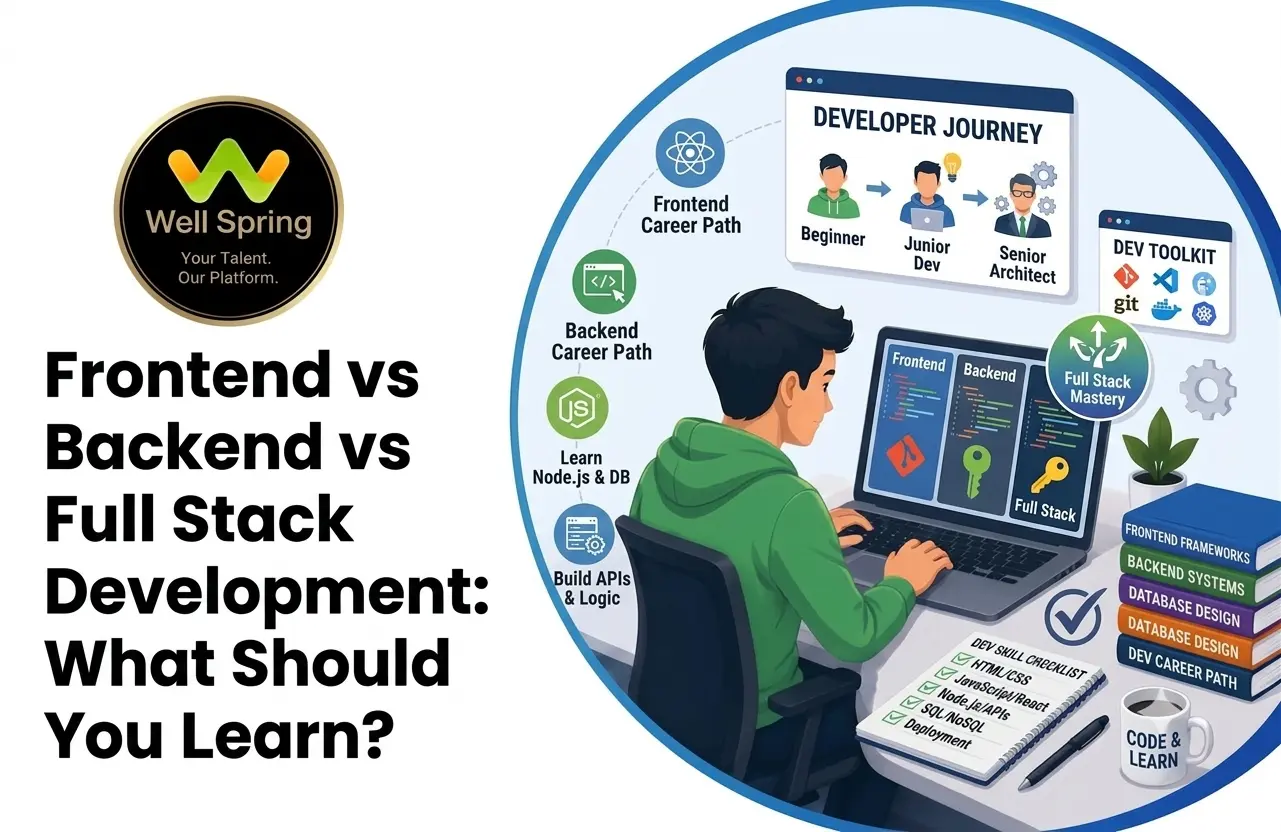
If you are planning to start a career in web development, one of the first decisions you will face is whether to learn frontend and backend development, specialise in one area, or pursue full stack development.
The difference between frontend and backend is primarily about where and how each part of a web application works. Frontend development focuses on the interface users see and interact with, while backend development handles server-side logic, data, authentication, and application operations. Full stack development combines skills from both sides.
However, choosing between frontend, backend, and full stack is not simply a matter of deciding which one is “better.” Your choice should depend on your interests, existing skills, learning goals, and the type of developer role you want to pursue.
This guide compares frontend vs backend vs full stack development and provides a practical framework for deciding what you should learn.
Frontend development focuses on the user-facing part of a website or application, while backend development manages server-side logic, databases, APIs, authentication, and application infrastructure. Full stack development covers both frontend and backend. Beginners who enjoy visual design and user interaction may prefer frontend, those who enjoy logic and data may prefer backend, while learners who want broader web-development skills may choose full stack.
Frontend development is the development of the client-side part of a website or web application—the portion that users see and interact with through a browser.
A frontend developer may work on:
For example, when you click a button on a website and a menu opens, the interface behaviour involved is generally part of the frontend.
The three fundamental technologies are:
HTML — structures web content.
CSS — controls presentation and layout.
JavaScript — adds programming logic and interactivity.
Developers can then use frameworks and libraries such as React, Angular, or Vue to build more complex interfaces.
Example
A simple frontend button might look like:
The browser executes the JavaScript and responds to the user's interaction.
Backend development focuses on the server-side part of an application.
The backend can handle:
Suppose a user logs into an e-commerce website.
The frontend provides the login form.
The backend may:
The user may never see the backend directly, but it powers many of the application's operations.
Backend developers can work with languages and platforms such as:
The appropriate choice depends on the project, organisation, ecosystem, and role.
Full stack development involves working across both the frontend and backend layers of a web application.
A full stack developer may work with:
User
↓
Frontend
↓
API / Backend
↓
Database
↓
Infrastructure / Deployment
For example, a full stack developer building a task-management application might work on:
Full stack does not necessarily mean being an expert in every technology involved in modern software development.
It means having sufficient breadth across the application stack to build, understand, connect, and maintain multiple layers.
The simplest way to understand the difference between frontend and backend is to consider what each side is responsible for.
|
Area |
Frontend |
Backend |
|
Primary focus |
User interface |
Application logic |
|
Runs mainly in |
Browser |
Server |
|
User interaction |
Direct |
Usually indirect |
|
Common languages |
HTML, CSS, JavaScript |
Java, Python, JavaScript, C#, etc. |
|
Data display |
Yes |
Provides/processes data |
|
Database access |
Usually through APIs/services |
Directly manages application data access |
|
Authentication logic |
Interface/session interaction |
Credential and access-control processing |
|
APIs |
Consumes APIs |
Creates/provides APIs |
|
Main concern |
Experience and interaction |
Logic, data, security, processing |
The distinction is useful, but modern web architectures can be more complicated than a simple browser-versus-server division.
For example, some applications use server-side rendering, edge functions, serverless services, or other architectures where responsibilities are distributed differently.
The three paths can be compared at a high level.
|
Factor |
Frontend |
Backend |
Full Stack |
|
Main focus |
Interface |
Server-side systems |
Both |
|
User-facing work |
High |
Low |
Medium to high |
|
Logic and data |
Medium |
High |
High |
|
Visual work |
High |
Low |
Medium |
|
Database knowledge |
Basic to moderate |
High |
Moderate to high |
|
API knowledge |
Consumer perspective |
Provider perspective |
Both |
|
Breadth required |
Focused |
Focused |
Broad |
|
Typical starting point |
HTML/CSS/JS |
Programming fundamentals |
Frontend + backend |
|
Best for |
UI/interactions |
Logic/data |
Broad application development |
The important difference is specialisation versus breadth.
Frontend and backend paths allow deeper focus on one area.
Full stack requires understanding how the different layers connect.
If you choose frontend development, build your skills progressively.
HTML
Learn:
CSS
Learn:
JavaScript
Learn:
Frontend frameworks
After understanding the fundamentals, explore a framework or library relevant to your goals.
For example:
Do not skip HTML, CSS, and JavaScript simply because a framework is popular.
Additional frontend skills
A professional frontend developer should also understand:
Backend development starts with strong programming fundamentals.
Programming
Choose one backend language and learn it properly.
Examples include:
Learn:
Databases
Understand:
You can later explore NoSQL databases depending on your project requirements.
APIs
Learn how applications communicate.
Important concepts include:
Authentication and security
Backend developers should understand concepts such as:
Security is not an optional add-on to backend development.
A full stack learner needs enough knowledge to connect multiple layers.
A typical learning stack could look like:
Frontend: HTML + CSS + JavaScript + React
Backend: Node.js / Java / Python
Database: PostgreSQL / MySQL or another suitable database
API: REST or another appropriate API architecture
Tools: Git + GitHub + development environment
Deployment: Basic cloud/deployment knowledge
The exact stack is less important than understanding the underlying concepts.
You are learning multiple domains simultaneously.
A single project might require you to understand:
This is why full stack learning can feel broader than either frontend or backend specialisation.
There is no universal answer.
Difficulty depends on your background and what type of problems you naturally enjoy solving.
But full stack can also feel harder initially because the learning scope is larger.
The better question is not:
“Which is easiest?”
It is:
“Which type of problems do I want to spend most of my time solving?”
All three paths can lead to professional software-development roles.
Possible roles include:
These roles may involve building interfaces, implementing designs, improving usability, and creating interactive web experiences.
Possible roles include:
Backend roles can involve application logic, databases, APIs, integrations, authentication, and system development.
Possible roles include:
The exact responsibilities vary considerably between organisations.
A company may use “full stack developer” to mean someone who contributes across frontend and backend, while another may expect additional deployment or infrastructure knowledge.
You do not necessarily have to choose your permanent specialisation on day one.
A useful approach is to start with common foundations.
Learn:
Learn:
Build a few simple websites.
Learn:
Build a simple backend service.
After experiencing both sides, decide whether you want to:
Go deeper into frontend
or
Go deeper into backend
or
Continue toward full stack
This approach reduces the risk of choosing a path based entirely on assumptions.
One of the biggest mistakes beginners make is trying to learn the entire technology ecosystem before building anything.
You do not need:
Instead, build a coherent stack.
HTML → CSS → JavaScript → One framework → APIs → Projects
Backend-focused learner
Programming language → Data structures → Database → APIs → Authentication → Projects
Full stack learner
Frontend fundamentals → Backend fundamentals → Database → APIs → Integration → Deployment
The depth can increase as your projects become more complex.
Month 1: Programming Fundamentals
Focus on:
Build small programs.
Month 2: Frontend Fundamentals
Learn:
Build:
Month 3: Backend Fundamentals
Learn:
Build a simple API.
Month 4: Connect Frontend and Backend
Build an application where:
Frontend → API → Backend → Database
Examples:
Month 5: Improve the Project
Add:
Month 6: Portfolio and Career Preparation
Prepare:
The goal is not to finish a fixed number of technologies. It is to reach the point where you can build and explain a working application.
Use these questions.
Choose frontend if you enjoy:
Choose backend if you enjoy:
Choose full stack if you enjoy:
|
If you enjoy... |
Consider learning... |
|
Visual interfaces |
Frontend |
|
User interaction |
Frontend |
|
Logic and data |
Backend |
|
APIs and systems |
Backend |
|
Building complete applications |
Full Stack |
|
Working across multiple layers |
Full Stack |
This is a starting point, not a permanent career commitment. Developers can move between specialisations as their skills and interests develop.
There is no universal winner.
Choose frontend when:
You are strongly interested in interfaces, interaction, responsive design, and user-facing experiences.
Choose backend when:
You prefer programming logic, data, APIs, databases, and server-side systems.
Choose full stack when:
You want to understand and build applications across both frontend and backend layers.
For complete beginners
If you are unsure, learning basic frontend and backend concepts before specialising can be a sensible approach.
You do not need to become a full stack expert immediately.
Start with the fundamentals, build something, identify what you enjoy, and then increase depth.
Trying to learn everything simultaneously
Learning React, Angular, Vue, Node.js, Java, Python, MongoDB, PostgreSQL, Docker, and several cloud platforms at once can create breadth without sufficient depth.
Skipping fundamentals
Framework knowledge without understanding JavaScript, HTTP, databases, or programming fundamentals can make debugging much harder.
Choosing based only on salary
Career decisions should consider interests, strengths, learning ability, job requirements, and long-term development—not just a single salary figure.
Avoiding projects
Watching tutorials is not the same as building software.
Projects expose gaps in your understanding.
Confusing full stack with “expert in everything”
Full stack development means working across multiple application layers. It does not mean knowing every programming language, framework, database, cloud platform, and infrastructure tool.
Ignoring Git
Version control is an important part of modern software development. Learn basic Git workflows early.
Building only tutorial projects
Use tutorials to learn, but eventually create projects where you decide the architecture, features, and implementation yourself.
Regardless of your chosen path, your projects should demonstrate practical ability.
Frontend project
Build a responsive business website with:
Backend project
Build an API with:
Full stack project
Build an application with:
Frontend + API + Backend + Database + Authentication
For each project, explain:
This is much more useful than simply listing technology names.
The choice between frontend vs backend vs full stack development should begin with understanding what kind of work you enjoy and what type of developer you want to become.
Frontend focuses on the interface and user experience. Backend focuses on application logic, data, APIs, and server-side operations. Full stack connects both areas and provides a broader view of how web applications are built.
If you are uncertain, start with programming fundamentals and gain basic exposure to both frontend and backend development. Then choose an area where you can develop deeper skills and build meaningful projects.
Ultimately, the strongest developer is not the person who knows the most technology names. It is the person who can understand a problem, choose appropriate technologies, build a working solution, and explain why the solution works.
21 Sep 2026
21 Sep 2026
21 Sep 2026
18 Sep 2026
18 Sep 2026
Frontend development focuses primarily on the user-facing interface and browser-side functionality, while backend development handles server-side logic, data processing, APIs, authentication, and database interactions.
Neither is universally easier. Frontend may be more intuitive for people who enjoy visual interfaces and immediate feedback, while backend may appeal more to people who enjoy logic, data, and systems.
Frontend development specialises primarily in the user-facing layer. Full stack development involves working across both frontend and backend parts of an application.
Not necessarily. Full stack provides broader coverage, while frontend and backend specialisations allow deeper focus. The better choice depends on your career goals and interests.
Learning basic frontend and backend concepts before choosing a specialisation can be useful if you are unsure. If you already know that you prefer interfaces or server-side programming, you can begin with that area.
Yes. A fresher can learn both frontend and backend technologies and build complete projects. However, becoming comfortable across the full stack takes time, so it is usually better to build a strong foundation rather than trying to master everything at once.
There is no single best backend language for every situation. Java, Python, JavaScript/Node.js, C#, Go, PHP, and Ruby are all used in different ecosystems. Choose based on your target roles, learning goals, and the technologies used by relevant employers.
They do not need to become backend specialists, but understanding basic backend concepts, APIs, HTTP, authentication, and data flow can make frontend development more effective.
Basic deployment and infrastructure knowledge can be useful for full stack developers, but the exact expectations vary by organisation and role. Full stack development itself does not automatically mean being a DevOps specialist.
There is no universal answer. Focus on one clear skill direction, build strong projects, understand the fundamentals, and match your portfolio to the roles you apply for. Breadth can help, but demonstrable competence is more important than simply listing many technologies.
Get internship updates, IT training news, placement opportunities, and career tips directly to your inbox.
Join our WhatsApp community for internship updates, IT courses, placement support, and latest job opportunities.
Join Now