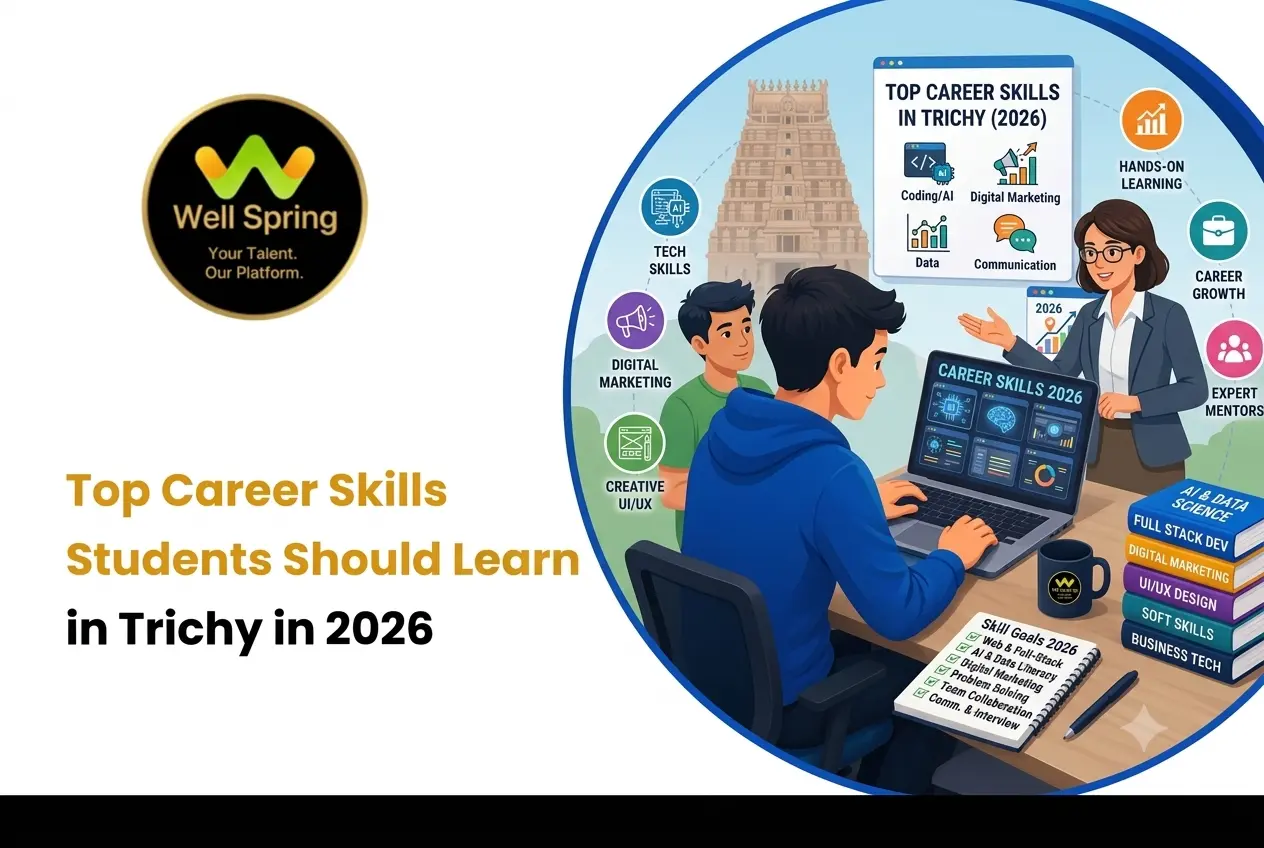

Quick Answer: Which Job-Oriented Courses Are Best for Freshers?
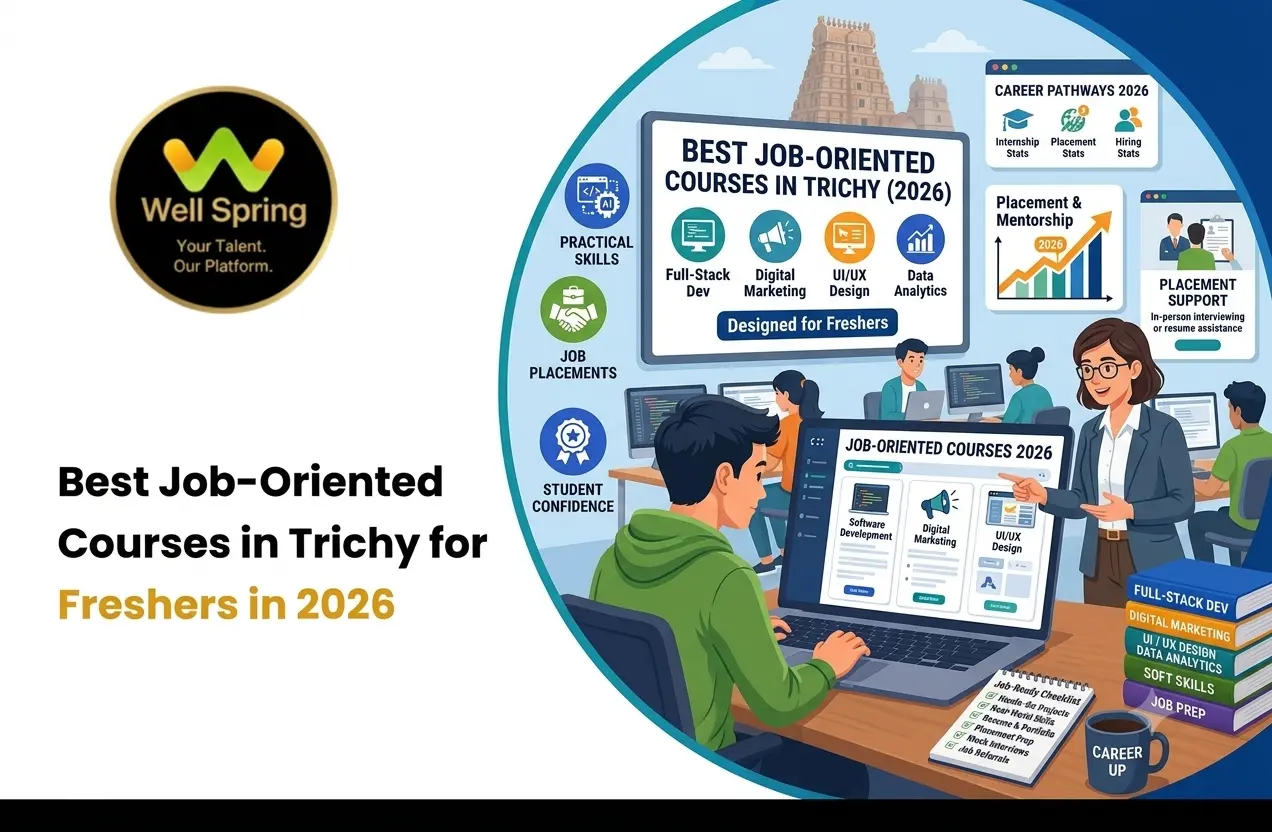
Some of the most practical job oriented courses in Trichy for freshers in 2026 include:
- Full Stack Development.
- Python Programming.
- Artificial Intelligence and Machine Learning.
- Data Analytics and Data Science.
- Digital Marketing.
- UI/UX Design.
- Software Testing.
- Cloud Computing and DevOps.
- Mobile App Development.
- Graphic Design and Video Editing.
The right course depends on a student's interests, educational background, existing skills, and intended career path.
Current labour-market research supports placing particular attention on technology-related capabilities. The World Economic Forum identifies AI and big data, networks and cybersecurity, and technological literacy as the fastest-growing skill areas in its 2025–2030 outlook. It also highlights creative thinking, resilience, flexibility, agility, curiosity, and lifelong learning as skills expected to increase in importance.
For freshers, however, choosing a course is only the beginning.
A stronger career-development pathway is:
Learn → Practise → Build Projects → Gain Experience → Create Portfolio → Prepare for Interviews → Apply
Why Job-Oriented Courses Matter for Freshers in 2026
Graduating from college is an important milestone, but moving from college to the workplace requires another set of abilities.
A fresher may understand concepts academically but still face questions such as:
Can I apply what I learned?
Can I work on a practical project?
Can I use industry tools?
Can I explain my project confidently in an interview?
Can I solve a problem without following a textbook example?
This is where career-focused learning becomes useful.
The World Economic Forum reports that nearly 40% of skills required on the job are expected to change by 2030, based on its survey of more than 1,000 employers. This does not mean every existing skill will disappear; rather, it reinforces the importance of continuous learning and adapting to changing workplace requirements.
For students and graduates in Trichy, the goal should therefore be to choose a course that develops demonstrable skills rather than simply adding another certificate to a resume.
1. Full Stack Development
Full Stack Development is one of the most practical options for freshers interested in software and web application development.
A full stack developer works across different parts of an application, which may include the user interface, server-side logic, databases, APIs, and deployment.
What Can Freshers Learn?
A structured Full Stack Development course may cover:
- HTML and CSS.
- JavaScript.
- Responsive web development.
- Front-end development.
- React or another modern front-end framework.
- Backend programming.
- Databases.
- APIs.
- Authentication.
- Git and GitHub.
- Testing and debugging.
- Application deployment.
The exact technology stack can vary between training programs.
Why Is Full Stack Development Job-Oriented?
It gives students opportunities to demonstrate their skills through complete projects.
Instead of writing on a resume:
“Completed Full Stack Development Course.”
A student can potentially demonstrate:
“Designed, developed, tested, and deployed a full-stack application with a database and API integration.”
That gives an interviewer something practical to discuss.
Projects Freshers Can Build
Students could develop:
Portfolio Website → Business Website → CRUD Application → Authentication Project → Full Stack Application
Suitable pathways can include junior web development, front-end development, backend development, and full-stack development, depending on the student's actual proficiency and employer requirements.
2. Python Programming
Python is another useful starting point because it can support several career pathways rather than a single job role.
It is used across areas such as:
- Web development.
- Automation.
- Data analysis.
- Artificial Intelligence.
- Machine Learning.
- Scripting.
- Backend development.
- Testing.
What Should a Fresher Learn in Python?
A practical course should move beyond basic syntax.
Students can progress through:
Variables → Conditions → Loops → Functions → Data Structures → OOP → Files → Libraries → Database → APIs → Projects
After learning the fundamentals, students can choose a specialization.
For example:
Python → Django/Flask → Backend Development
or
Python → Pandas → Data Analysis
or
Python → Machine Learning Libraries → AI/ML
Who Can Consider Python?
Python can be suitable for students who enjoy:
- Programming.
- Logical thinking.
- Automation.
- Data.
- AI.
- Problem-solving.
Students should avoid treating Python itself as the final career destination. The stronger question is: What can you build or solve using Python?
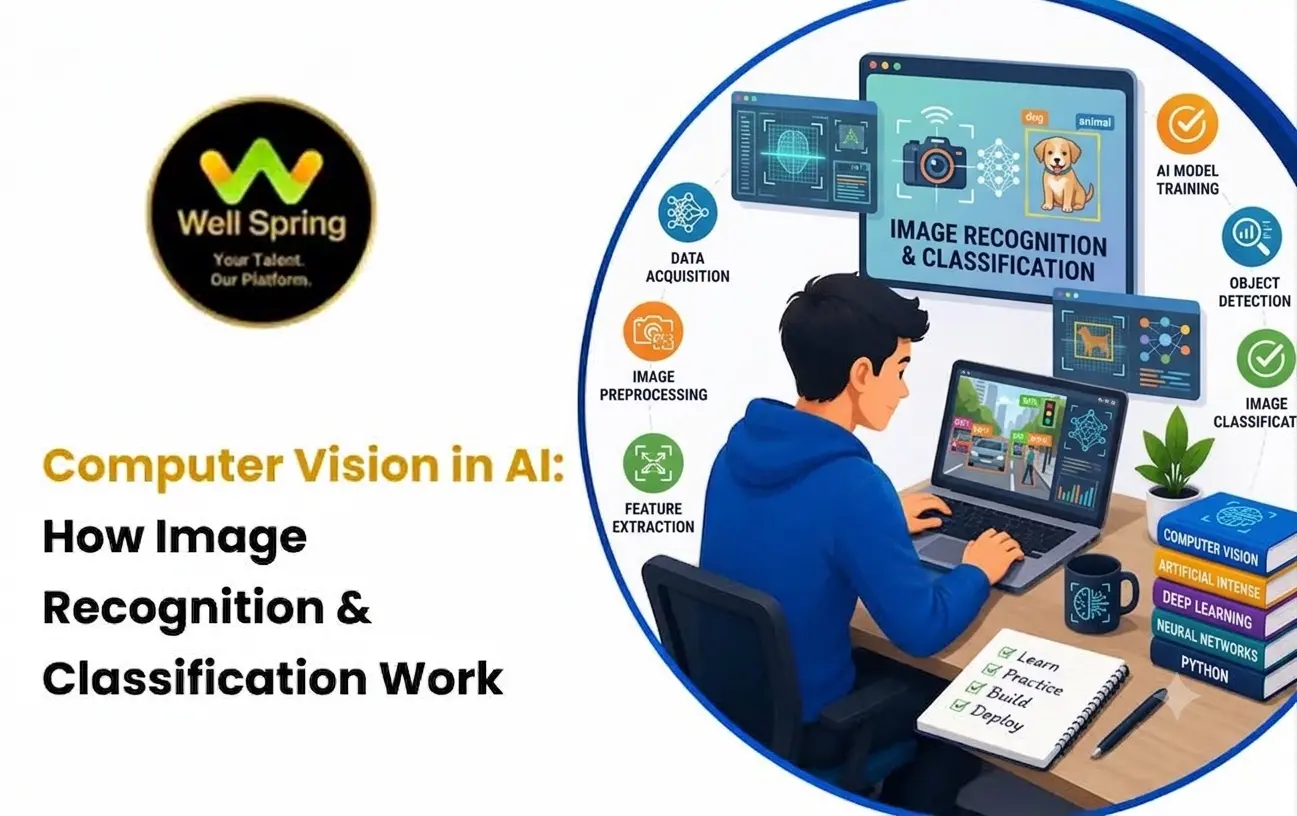
3. Artificial Intelligence and Machine Learning
AI is one of the most discussed career areas in 2026, but freshers should approach it with realistic expectations.
Learning to use a generative AI chatbot is not equivalent to developing professional AI or Machine Learning expertise.
The World Economic Forum identifies AI and big data as the fastest-growing skill category in its current employer outlook.
What Should Students Learn?
A stronger foundation can include:
- Python.
- Data handling.
- Statistics fundamentals.
- Machine Learning concepts.
- Data preprocessing.
- Model training.
- Model evaluation.
- Generative AI concepts.
- Prompt design and evaluation.
- AI APIs and tools.
- Responsible AI practices.
- Practical AI projects.
A Better Learning Sequence
Instead of jumping directly into advanced AI terminology, students can follow:
Python → Data → Statistics → Machine Learning → AI Tools → Projects → Specialization
Practical AI Projects
Freshers could explore beginner projects such as:
- Classification systems.
- Recommendation concepts.
- Data prediction projects.
- AI-assisted applications.
- Simple chat interfaces.
- Data analysis projects.
The project should demonstrate understanding, not simply show that the student connected an application to an existing AI API.
4. Data Analytics and Data Science
Students who enjoy working with numbers, patterns, reports, and business information can explore data-related careers.
Data Analytics generally focuses on converting raw information into useful insights.
Skills to Learn
A beginner pathway may include:
- Microsoft Excel.
- SQL.
- Python.
- Data cleaning.
- Data visualization.
- Statistics.
- Power BI or similar BI tools.
- Dashboard creation.
- Reporting.
- Business problem-solving.
A simple learning sequence can be:
Excel → SQL → Power BI → Python → Data Projects
Why Projects Matter
Instead of only creating charts, students should learn to answer questions.
For example:
Which product category generates the most revenue?
Which month experienced the strongest sales growth?
Which customer segment has the highest repeat-purchase rate?
The technical tool produces the analysis, but the student's ability to interpret it creates business value.
5. Digital Marketing
Digital Marketing can be one of the best courses for freshers who are interested in business, communication, creativity, technology, or analytics rather than traditional software development.
Modern digital marketing is much broader than posting on Instagram.
What Should a Digital Marketing Course Cover?
Students can learn areas such as:
- Search Engine Optimization.
- Keyword research.
- Content marketing.
- Google Business Profile.
- Social media marketing.
- Google Ads.
- Meta Ads.
- Email marketing.
- WhatsApp marketing.
- Lead generation.
- Web analytics.
- Conversion tracking.
- Landing-page fundamentals.
- AI-assisted marketing workflows.
A Practical Digital Marketing Workflow
Students should understand how channels work together:
Business Goal → Customer → Search/Social → Content/Ads → Website → Lead → Conversion → Analytics → Optimization
What Can Students Add to Their Portfolio?
A fresher can document:
- Keyword research.
- Website SEO audits.
- Sample Google Ads structures.
- Social media campaigns.
- Content calendars.
- Landing-page analysis.
- Google Business Profile strategies.
- Analytics reports.
- Competitor research.
Digital marketing can therefore combine creativity with measurable business thinking.
6. UI/UX Design
UI/UX Design can be a strong career path for students who enjoy creativity but also want to work on websites, mobile applications, software, and digital products.
UI and UX are related but not identical.
UI focuses heavily on the interface users interact with.
UX examines the broader experience of completing a task through the product.
Skills Students Can Learn
A career-oriented UI/UX program may include:
- User research.
- Personas.
- User journeys.
- Information architecture.
- User flows.
- Wireframing.
- Typography.
- Colour and visual hierarchy.
- Interface design.
- Responsive design.
- Prototyping.
- Usability testing.
- Design systems.
The Portfolio Is Critical
A UI/UX portfolio should not contain only attractive screens.
A stronger case study explains:
Problem → Research → User Need → User Flow → Wireframe → Prototype → Interface → Testing → Improvement
This demonstrates how the student thinks as a designer.
7. Software Testing
Not every technology career requires becoming a full-time developer.
Software Testing can provide another pathway into software and IT.
What Can Students Learn?
A structured course may introduce:
- Software Development Life Cycle.
- Software Testing Life Cycle.
- Test scenarios.
- Test cases.
- Bug reporting.
- Functional testing.
- Regression testing.
- Integration testing.
- API testing.
- SQL fundamentals.
- Automation testing fundamentals.
Students can later explore automation tools and frameworks depending on their intended role.
What Makes Testing a Practical Skill?
Testing requires students to think beyond:
“Does the application work?”
They must ask:
“Under what conditions can it fail?”
That requires analytical thinking, attention to detail, communication, and systematic problem-solving.
8. Cloud Computing and DevOps
Cloud technologies increasingly support modern websites, applications, software platforms, and enterprise infrastructure.
Students interested in infrastructure and software deployment can explore Cloud Computing and DevOps.
Useful Foundations
Freshers can start with:
- Linux.
- Networking fundamentals.
- Git.
- Cloud fundamentals.
- AWS or another cloud platform.
- Deployment.
- Containers.
- Docker.
- CI/CD concepts.
- Infrastructure basics.
- Monitoring.
The World Economic Forum's findings around technological literacy and network-related capabilities provide broader evidence for the growing importance of technology infrastructure skills.
Learning Roadmap
A practical sequence can be:
Linux → Networking → Git → Cloud Fundamentals → Docker → CI/CD → Deployment Project
Freshers should understand the fundamentals rather than memorising cloud-service names only for certification exams.
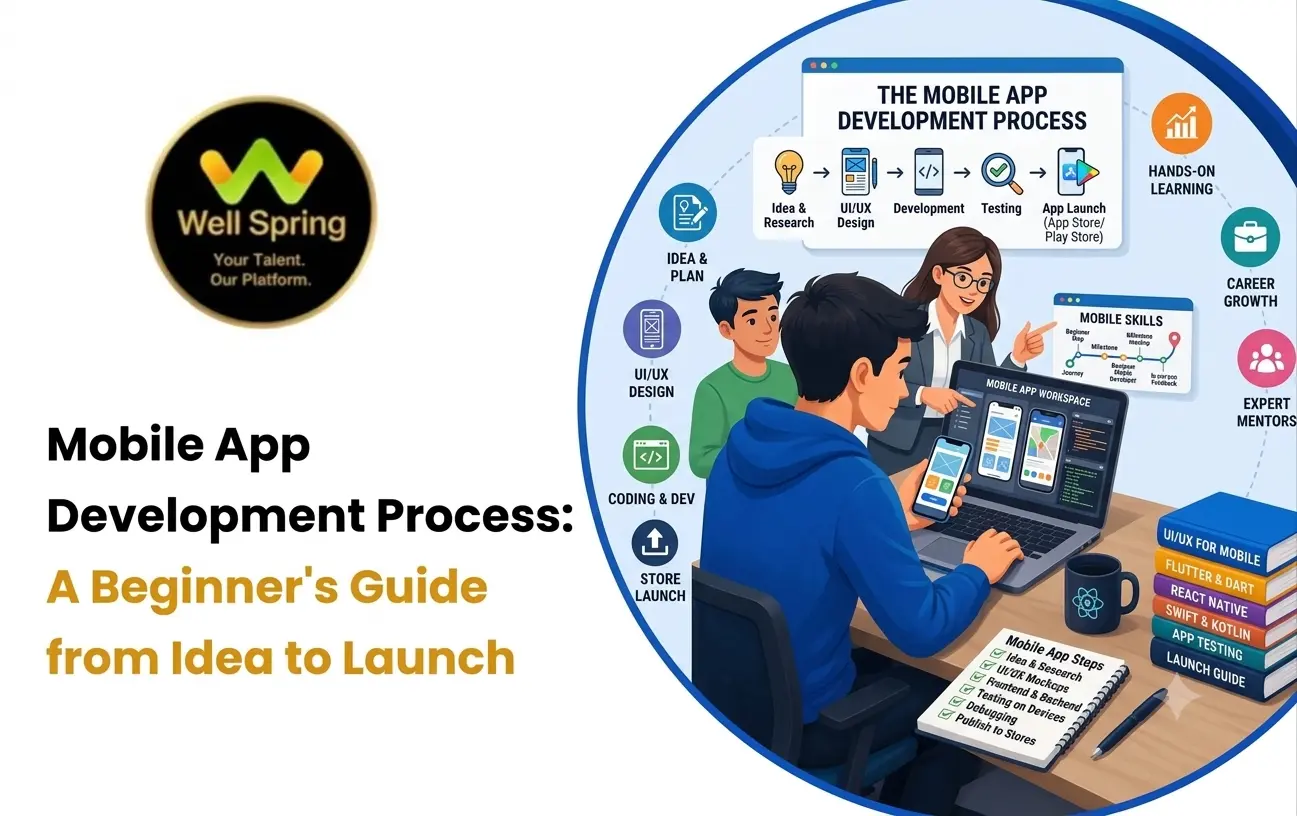
9. Mobile App Development
Mobile App Development can be suitable for students interested in creating applications for smartphones and other mobile devices.
What Students Can Learn
Depending on the course, topics may include:
- Programming fundamentals.
- Mobile UI design.
- App navigation.
- API integration.
- Authentication.
- Local storage.
- Database integration.
- Notifications.
- Testing.
- App deployment.
Students may learn native or cross-platform technologies depending on their chosen pathway.
Portfolio Ideas
Freshers can create applications such as:
Task Manager → Expense Tracker → Appointment App → eCommerce Prototype → API-Based Application
The objective should be to demonstrate both technical development and understanding of how users interact with an application.
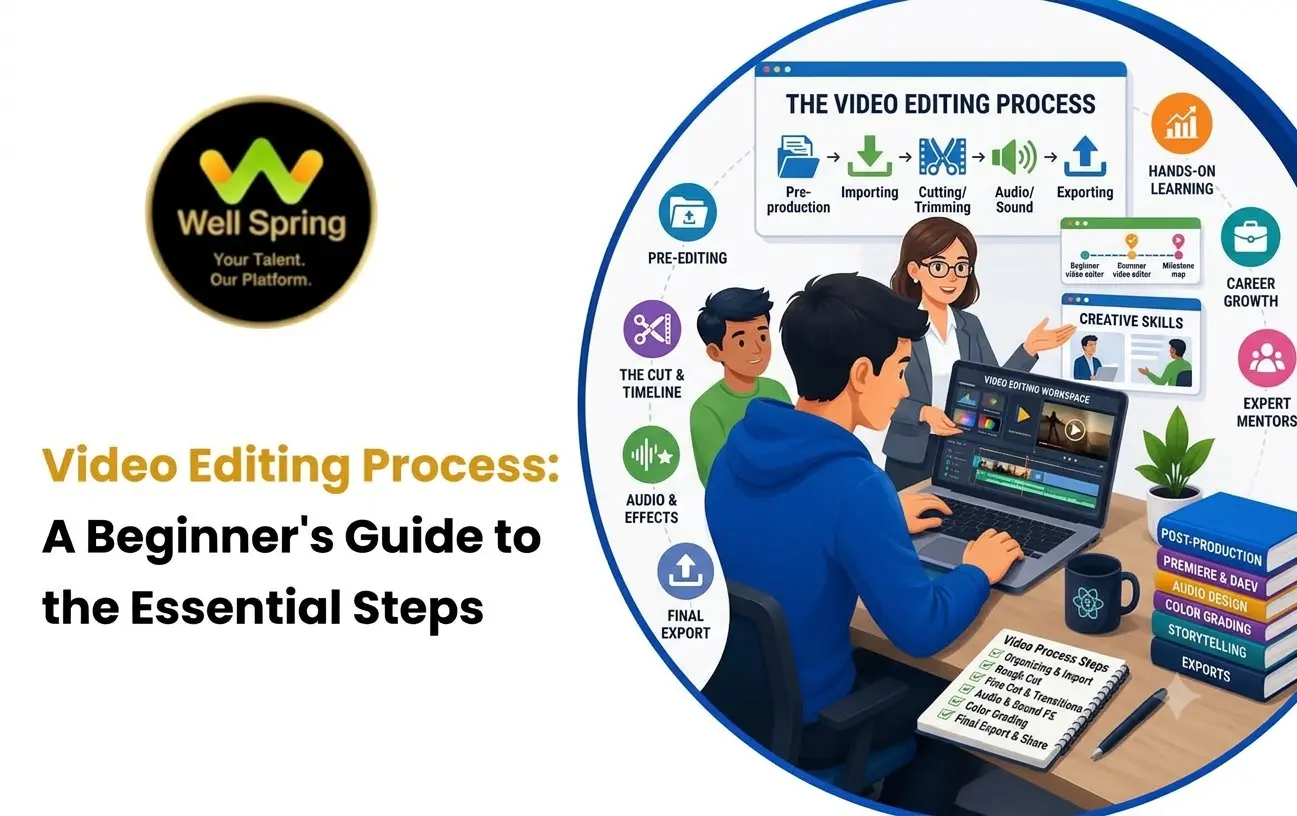
10. Graphic Design and Video Editing
Not every job-oriented course needs to be programming-focused.
Businesses continually create visual material for websites, advertisements, social media, branding, presentations, product marketing, and video platforms.
Students interested in creative careers can explore Graphic Design and Video Editing.
Graphic Design Skills
Students can learn:
- Design principles.
- Typography.
- Colour.
- Composition.
- Branding.
- Social media creatives.
- Advertising creatives.
- Print design.
- Digital design tools.
Video Editing Skills
Students can learn:
- Editing fundamentals.
- Story structure.
- Transitions.
- Audio.
- Colour correction.
- Motion graphics fundamentals.
- Social media video.
- Reels and short-form video.
- Promotional videos.
For creative careers, portfolios are particularly important.
Employers and clients need to see what the student can create.
Which Course Should You Choose After Graduation?
There is no universal answer to the best courses after graduation in Trichy.
Students can use their interests as a starting point.
| If You Enjoy... | Courses to Explore |
|---|---|
| Coding and software | Full Stack Development / Python |
| AI and emerging technology | AI & Machine Learning |
| Numbers and analysis | Data Analytics |
| Creativity and technology | UI/UX Design |
| Business and communication | Digital Marketing |
| Finding software problems | Software Testing |
| Infrastructure and deployment | Cloud & DevOps |
| Mobile technology | App Development |
| Visual creativity | Graphic Design / Video Editing |
The table is a starting framework rather than a rule.
A student should research the actual work involved in a career before enrolling.
Short-Term Job-Oriented Courses: What Should Freshers Expect?
The phrase short term job oriented courses can sometimes create unrealistic expectations.
Short duration does not automatically mean quick employment.
A three-month program with serious projects and daily practice may be more valuable than a longer course completed passively.
When evaluating a short-term course, students should ask:
Does It Teach Fundamentals?
Tools change. Fundamentals help students adapt.
Does It Include Practical Work?
Students should actually perform tasks related to the subject.
Are There Projects?
Projects provide evidence of practical application.
Is Feedback Provided?
Without feedback, students may repeat the same mistakes.
Does It Include Career Preparation?
Resume development, portfolio building, interview practice, and communication can help students transition toward applications.
Does It Promise a Job?
Students should be careful with unrealistic employment guarantees.
Training can improve skills and career readiness, but employment ultimately depends on factors such as skill level, available openings, interviews, employer requirements, location, and individual performance.
How to Evaluate Job-Oriented Courses in Trichy
Before paying course fees, students should compare the actual learning experience.
1. Curriculum
Check whether the syllabus covers current fundamentals and practical applications.
2. Trainer Guidance
Students should have opportunities to clarify doubts and receive feedback.
3. Practical Exercises
A job-oriented program should involve more than lectures.
4. Projects
Ask what projects students will complete.
5. Internship Opportunities
Determine whether internships provide meaningful practical exposure rather than simply a certificate.
6. Portfolio Development
Check whether the program helps students document practical work.
7. Interview Preparation
Freshers may benefit from resume guidance, mock interviews, aptitude preparation, and communication practice.
8. Tools and Technologies
Check whether students gain practical experience with tools relevant to their intended career.
9. Course Outcomes
Instead of asking only:
“Will I get a certificate?”
Ask:
“What will I be able to do independently when I finish?”
That question is far more useful.
Course Certificate vs Practical Skills: What Matters More?
Certificates can be useful.
But certificates and skills serve different purposes.
A certificate can show that you completed a program.
A project can show that you applied the knowledge.
A portfolio can show multiple examples of your work.
An interview can show whether you understand what you built.
The stronger career profile therefore looks like:
Course + Skills + Projects + Portfolio + Internship + Communication
rather than:
Course + Certificate
Why Internships Matter After Completing a Course
A training environment teaches skills.
An internship can help students understand how those skills are applied to practical tasks.
For example, a digital marketing student may understand SEO theoretically.
During an internship, the student might need to:
Audit Website → Research Keywords → Optimize Page → Monitor Data → Report Findings
Similarly, a development student may move from:
Tutorial Project
to:
Requirement → Development → Testing → Revision → Delivery
This exposure can help freshers understand deadlines, feedback, teamwork, client requirements, documentation, and professional communication.
Job-Oriented Learning at Well Spring Talent Solutions
Well Spring Talent Solutions focuses its current Trichy offering on training, internships, and career development. Its official website describes the learning model as career-oriented, with guided lessons, practical projects, internship opportunities, and career-preparation activities depending on the program.
The organisation's current online presence also covers career topics and learning pathways including Python, AWS, Digital Marketing, Data Science, internships, and other IT-oriented areas, reflecting its broader focus on students and early-career learners.
For a fresher, the useful question when evaluating any program should therefore be:
What will I learn? → What will I practise? → What will I build? → How will I demonstrate it?
That approach keeps career development focused on capability rather than course completion alone.
A Practical Career Roadmap for Freshers
Students can use a five-stage framework.
Stage 1: Explore
Identify the type of work you genuinely enjoy.
Coding / Data / Design / Marketing / Testing / Infrastructure / Creative
Stage 2: Learn
Select one primary career skill and understand its fundamentals.
Avoid attempting five unrelated courses simultaneously.
Stage 3: Build
Complete increasingly challenging projects.
Beginner Exercise → Guided Project → Independent Project → Portfolio Project
Stage 4: Experience
Look for internships, project experience, practical assignments, or other opportunities to apply your knowledge.
Stage 5: Prepare
Work on:
Resume → Portfolio → LinkedIn → Aptitude → Technical Interview → Communication → Applications
This creates a much stronger transition from education to employment.
Common Mistakes Freshers Make When Choosing Career Courses
Choosing Only Based on Salary Videos
High salary figures often refer to experienced professionals or particular markets. Freshers should first focus on developing employable skills.
Learning Whatever Is Trending
A trending technology is not automatically the right career for every student.
Joining Multiple Courses Together
Depth in one useful skill can be more valuable than shallow exposure to many unrelated technologies.
Ignoring Projects
Practical projects help convert knowledge into demonstrable capability.
Depending Entirely on Certificates
Certificates support a profile but cannot replace practical understanding.
Ignoring Communication Skills
Technical interviews still require candidates to explain their thinking.
Copying Projects
A copied GitHub project provides little value if the student cannot explain how it works.
Expecting Immediate Results
Career development takes practice, feedback, improvement, and consistent applications.
How to Make a Course More Valuable
Whatever course you select, follow this learning loop:
Learn → Practise → Make Mistakes → Get Feedback → Improve → Build → Explain
For every major concept, ask yourself:
Can I explain this without notes?
Can I use it independently?
Can I solve a slightly different problem?
Can I show an example in my portfolio?
Can I explain my decisions in an interview?
If the answer becomes yes, the skill is becoming useful.
Final Thoughts
Choosing among the job oriented courses in Trichy should not begin with the question:
“Which course guarantees a job?”
A better question is:
“Which course can help me build a skill that I am willing to practise until I can demonstrate it professionally?”
For freshers in 2026, areas such as AI, data, software development, cybersecurity-related technology skills, cloud, digital marketing, UI/UX, and other technology-enabled disciplines provide several learning directions. Current employer research particularly highlights the growing importance of AI and big data, cybersecurity, technological literacy, and complementary human skills such as creative thinking and adaptability.
But choosing the course is only the first step.
The complete journey is:
Choose a Direction → Learn Fundamentals → Practise → Build Projects → Gain Practical Exposure → Create a Portfolio → Prepare for Interviews → Apply → Keep Learning
For freshers searching for the best career courses in Trichy, that practical, skill-first approach can provide a stronger foundation than chasing certificates, trends, or unrealistic employment promises.