Blog Details
Home Blog Details

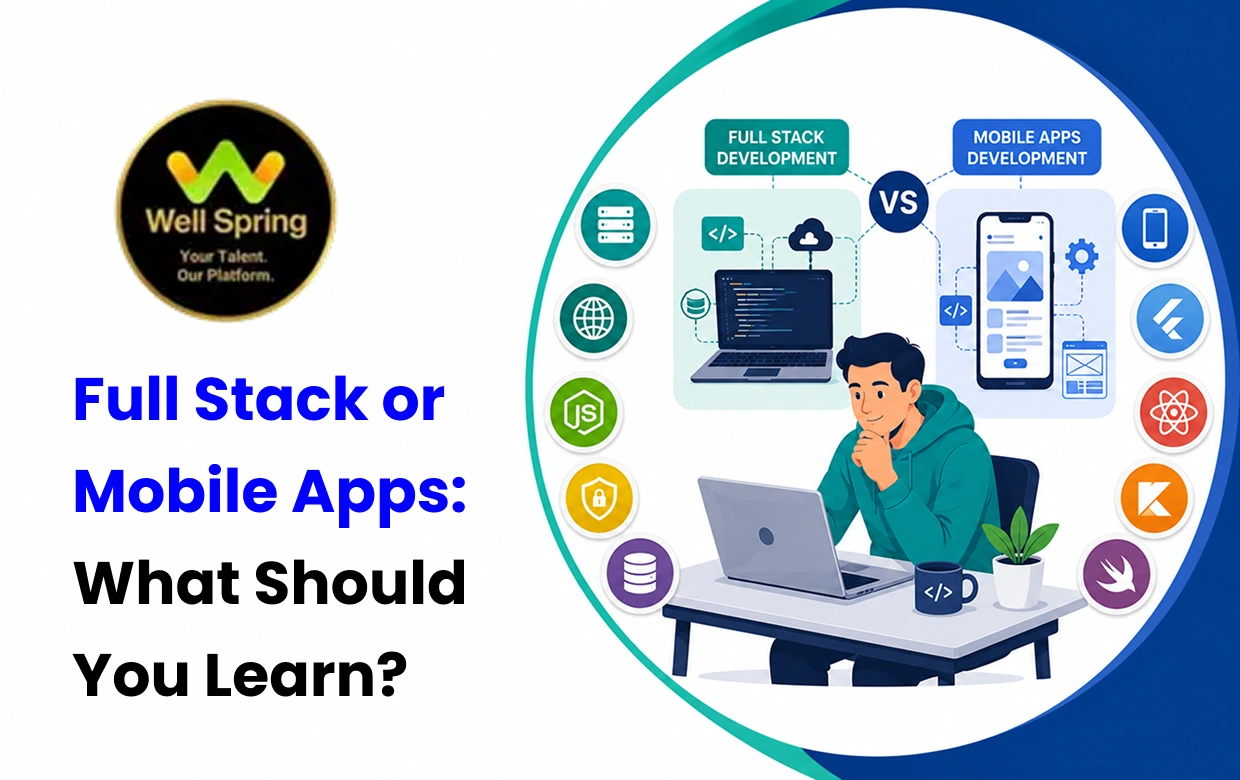
Choosing between Full Stack Development and Mobile App Development can be difficult for students and freshers because both careers involve programming, application building and strong technical skills, but the products they create are different. Full Stack developers generally work across the front end and back end of web applications, while mobile developers specialise in creating applications for smartphones and tablets. Both areas offer opportunities across startups, technology companies, agencies, product businesses and freelance work, but they require different learning paths and technical interests. This guide compares their skills, job roles, learning requirements, salary factors, career scope, project opportunities and future relevance to help you decide which direction fits your goals.
If you want to build websites, web applications, dashboards, e-commerce platforms and complete online systems, Full Stack Development can be a strong choice.
If you are more interested in creating Android, iOS or cross-platform smartphone applications, Mobile App Development may be a better fit.
Neither is universally better.
Your choice should depend on the type of products you want to build, the programming concepts you enjoy and the career direction you want to develop.
The simplest distinction is based on the platform you are building for.
Full Stack Development generally involves building both the user-facing and server-side parts of web applications.
Mobile App Development focuses on applications designed specifically for mobile devices such as smartphones and tablets.
For example, imagine a food-delivery business.
A Full Stack developer might build:
The customer website
Restaurant dashboard
Delivery management panel
Backend APIs
Database
Authentication system
Payment integration
A Mobile App Developer might build:
Android application
iOS application
Mobile ordering experience
Push notifications
Location-based features
Mobile-specific user interactions
In a real product company, these developers may work together.
A mobile application can consume APIs created by a backend developer, while a web application can use the same backend services.
So the two careers are different, but they are also connected.
Businesses increasingly depend on digital products to communicate with customers, sell products, provide services and manage internal operations.
A company may need:
A website
An e-commerce platform
A customer portal
A mobile application
An employee dashboard
APIs
Payment systems
Booking systems
Cloud-based applications
The World Economic Forum's Future of Jobs Report 2025 lists Software and Applications Developers among the fastest-growing job categories globally between 2025 and 2030.
The U.S. Bureau of Labor Statistics also projects 15% employment growth for software developers, quality assurance analysts and testers from 2024 to 2034, with about 129,200 openings per year on average across the combined occupational group.
These figures do not guarantee employment for every learner.
They indicate that software development remains an important part of the broader technology workforce.
Full Stack Development refers to working across different layers of a web application.
A typical web application has:
Frontend → Backend → Database → APIs → Deployment
A Full Stack developer may work with several of these layers.
The frontend is the part users interact with.
Common technologies include:
HTML
CSS
JavaScript
Angular
Vue
Frontend development involves creating interfaces, forms, navigation, responsive layouts and interactive features.
The backend handles the application logic and server-side operations.
Depending on the technology stack, developers may use:
Node.js
Java
PHP
.NET
Other server-side technologies.
Applications need a way to store and retrieve information.
Common database technologies include:
PostgreSQL
MongoDB
Other relational and NoSQL systems
APIs allow different parts of an application to communicate.
For example, a shopping website can request product information from a backend API and display the response to the customer.
Developers may also need to understand hosting, domains, cloud services, version control and basic application deployment.
This is what makes Full Stack Development broader than simply learning how to design a webpage.
Mobile App Development involves creating software applications designed for mobile devices.
Developers may build applications for:
Android
iOS
Both platforms through cross-platform technologies
Native development uses technologies specific to a platform.
For example, Android development can involve Kotlin and Android development tools.
Apple development commonly uses Swift and frameworks such as SwiftUI. Apple describes SwiftUI as a framework for declaring an application's user interface and behaviour across Apple platforms.
Cross-platform frameworks allow developers to create applications targeting multiple platforms from a shared codebase or development approach.
Examples include:
Flutter
React Native
Other cross-platform technologies
The right choice depends on the product requirements, team expertise and target platforms.
| Factor | Full Stack Development | Mobile App Development |
|---|---|---|
| Main focus | Web applications and systems | Mobile applications |
| Primary platforms | Browsers and web servers | Smartphones and tablets |
| Frontend | HTML, CSS, JavaScript, frameworks | Mobile UI frameworks |
| Backend | Commonly required | Often consumed through APIs |
| Database | Frequently involved | Usually connected through backend services |
| APIs | Important | Very important for connected apps |
| Programming | Highly important | Highly important |
| UI development | Web interfaces | Mobile interfaces |
| Responsive design | Important | Mobile-specific layouts |
| Device features | Limited to browser capabilities | Camera, GPS, notifications and other device APIs |
| Deployment | Web hosting/cloud | App stores or enterprise distribution |
| Testing | Browser/device testing | Device and OS testing |
| Portfolio | Websites and web applications | Mobile applications |
| Freelancing | Websites, dashboards, web systems | Mobile applications and app features |
| Career breadth | Broad web/software path | More specialised mobile path |
Full Stack Development requires learning multiple technologies, but you do not need to master everything at once.
These provide the basic structure and presentation of web pages.
You should understand:
Page structure.
Forms.
Layouts.
Responsive design.
Accessibility basics.
JavaScript adds behaviour and interaction to web applications.
It is also used in many modern frontend and backend development environments.
Once you understand the fundamentals, you can move into frameworks such as React, Angular or Vue.
You need to understand how servers process requests, handle business logic and communicate with databases.
Learn how applications store, retrieve and update information.
Understanding how frontend applications communicate with backend systems is essential for modern web development.
Developers commonly use version-control systems to manage code, collaborate with teams and track changes.
Basic knowledge of hosting and deployment can help you move projects from your development environment to a working application.
Mobile development requires many programming fundamentals that overlap with broader software development.
Depending on your chosen platform, you may work with languages such as:
Kotlin.
Swift.
Dart.
JavaScript or TypeScript.
The exact language depends on the development approach.
You need to understand how to create interfaces that work well on smaller screens and different device sizes.
Most modern mobile applications communicate with external services.
For example, an app may use APIs to retrieve:
User information.
Product details.
Orders.
Payments.
Location data.
Mobile applications can interact with device capabilities such as:
Camera.
GPS.
Notifications.
Sensors.
Local storage.
Mobile developers need to consider differences between devices, operating-system versions, screen sizes and performance conditions.
Developers also need to understand the process of preparing and distributing applications through the appropriate platforms.
The two paths require different learning sequences.
A practical beginner path can look like:
HTML → CSS → JavaScript → Frontend Framework → Backend → Database → APIs → Git → Deployment → Projects
This gives learners exposure to multiple layers of a web application.
A practical path can look like:
Programming Fundamentals → Mobile Framework/Language → UI Development → APIs → Database Integration → Device Features → Testing → Deployment → Projects
If you choose native development, your learning path will be tied more closely to a particular mobile platform.
If you choose cross-platform development, you may work toward building applications for more than one mobile operating system.
Neither path has a fixed learning time.
Full Stack Development can feel broad because you are learning several layers of a complete application.
Mobile App Development can become technically challenging when you work with device APIs, application lifecycle, performance, testing and multiple platforms.
The amount of time required depends on your background, learning consistency and target role.
A Full Stack background can lead toward roles such as:
Frontend Developer.
Backend Developer.
Full Stack Developer.
Web Application Developer.
Software Developer.
API Developer.
Junior Web Developer.
With experience, developers may progress into:
Senior Developer.
Technical Lead.
Software Architect.
Engineering Manager.
A Mobile App Development background can lead toward:
Android Developer.
iOS Developer.
Mobile Application Developer.
Flutter Developer.
React Native Developer.
Mobile Software Engineer.
Experienced mobile developers can also progress toward:
Senior Mobile Developer.
Mobile Tech Lead.
Mobile Architect.
Engineering Lead.
The exact titles vary between companies.
There is no simple answer because the two fields serve different product requirements.
Web technologies are used for:
Company websites.
E-commerce stores.
SaaS applications.
Booking systems.
Customer portals.
Learning platforms.
Business dashboards.
Internal management systems.
Online marketplaces.
Almost any organization with a digital presence may need web development.
Mobile development is useful for products that depend heavily on smartphone usage.
Examples include:
Banking applications.
Food-delivery applications.
Travel applications.
Fitness applications.
E-commerce applications.
Education applications.
Healthcare applications.
Social platforms.
On-demand services.
Mobile applications can also use device-specific capabilities that a conventional website cannot access in exactly the same way.
The right question is therefore not simply which has more scope.
Ask:
Do I want to build primarily for the web, or do I want to specialise in mobile experiences?
Software development continues to have strong employment relevance.
The U.S. Bureau of Labor Statistics projects 15% growth from 2024 to 2034 for software developers, quality assurance analysts and testers, and estimates around 129,200 openings per year for the combined group.
The BLS separately projects 7% growth for web developers and digital designers from 2024 to 2034, with about 14,500 openings per year on average.
The World Economic Forum also places Software and Applications Developers among the fastest-growing job categories globally through 2030.
These figures should be interpreted carefully.
BLS statistics describe the U.S. labour market, while the WEF data reflects a global employer survey.
They are useful indicators of broader demand, not promises of employment for a student in India.
Salary should not be compared using a single number because job titles and responsibilities differ significantly.
Compensation can depend on:
Experience.
Location.
Company.
Industry.
Programming skills.
Technology stack.
Specialisation.
Portfolio.
Product complexity.
Leadership responsibilities.
For a U.S. benchmark, the BLS reports a 2024 median annual wage of $133,080 for software developers.
For web developers, the BLS reports a 2024 median annual wage of $90,930.
These figures should not be directly interpreted as “mobile developers earn X and Full Stack developers earn Y.” The occupational categories are not perfectly equivalent to those course labels.
For Indian learners, actual compensation can differ substantially based on city, company, experience and technology specialization.
The better strategy is to focus on developing skills that qualify you for increasingly responsible software-development roles rather than selecting a course only because of a salary advertisement.
For development careers, practical work is especially valuable because it gives you something concrete to demonstrate.
Beginners can build:
E-commerce websites.
Student management systems.
Appointment booking platforms.
Inventory systems.
Job portals.
Learning management systems.
Restaurant ordering systems.
Business dashboards.
A strong Full Stack project could demonstrate:
Frontend → Backend → Database → Authentication → API → Deployment
Learners can create:
Expense tracking apps.
Food ordering apps.
Fitness apps.
To-do applications.
Booking applications.
E-commerce apps.
Learning apps.
Local-service applications.
A useful mobile project can demonstrate:
UI → Navigation → API → Data Storage → Device Features → Testing → Deployment
The project does not need to be enormous.
What matters is whether you can explain why you built it, how it works and what technical decisions you made.
For both careers, basic logical and problem-solving ability is more important at the beginning than advanced mathematics.
You should understand concepts such as:
Variables.
Conditions.
Loops.
Functions.
Data structures.
Algorithms.
Logical reasoning.
Advanced mathematics is not central to most beginner Full Stack or Mobile App Development work.
However, stronger mathematical and algorithmic thinking can become useful as you move into specialised areas such as graphics, game development, optimisation or advanced computing.
The priority for beginners should therefore be programming fundamentals and problem-solving.
AI is changing how developers approach coding, testing, documentation and application development.
Developers may use AI-assisted tools for:
Generating code suggestions.
Explaining unfamiliar code.
Finding possible bugs.
Creating test cases.
Writing documentation.
Prototyping interfaces.
Exploring technical approaches.
However, AI-generated code still needs to be reviewed.
A developer needs to understand:
What the code does.
Whether it is secure.
Whether it performs efficiently.
Whether it fits the application architecture.
Whether it introduces bugs.
Whether it handles user data appropriately.
The World Economic Forum identifies AI and big data among the fastest-growing skills through 2030 and also highlights technological literacy as an important growing skill.
For developers, this means AI familiarity can complement programming knowledge, but it does not eliminate the need to understand software fundamentals.
Trying to learn React, Node.js, Python, Flutter, Kotlin, Swift and several databases simultaneously can make your learning unfocused.
Start with one path.
Frameworks change.
Programming fundamentals remain useful.
Understand variables, functions, conditions, loops, data structures and debugging before chasing every new framework.
Following tutorials can teach concepts, but your portfolio should eventually contain projects where you made your own decisions.
Even frontend-focused developers benefit from understanding how APIs, authentication and databases work.
An application that works on one device or one browser is not automatically production-ready.
Learn to test your work.
Version control is an important part of modern software development workflows.
A technology stack that pays well for experienced developers does not mean a beginner will immediately receive that level of compensation.
Build skills first.
AI can accelerate development, but copying generated code without understanding it can create security, performance and maintenance problems.
There is no universal winner.
Enjoy building websites and web applications.
Want to understand frontend and backend systems.
Like working with databases and APIs.
Want a broad web-development foundation.
Enjoy building complete digital products.
Are interested in SaaS and business applications.
Want flexibility across frontend and backend roles.
Enjoy smartphone applications.
Want to build Android or iOS experiences.
Like designing interfaces for smaller screens.
Are interested in device features.
Enjoy application-focused development.
Want to specialise in mobile products.
Like creating apps people can install and use directly.
Want to become a broader software developer.
Enjoy both web and mobile products.
Want to understand how APIs support different platforms.
Plan to build your own digital product.
Want flexibility as your career develops.
You do not need to learn both at the beginning.
Choose one foundation, become comfortable with it and expand later if your career requires it.
For students in Trichy, the name of the course should not be the only deciding factor.
A course advertised as “Full Stack” should ideally teach more than a collection of frontend technologies.
Look for coverage of:
HTML
CSS
JavaScript
Frontend framework
Backend development
Databases
APIs
Git
Deployment
Practical projects
For Mobile App Development, check whether the course covers:
Programming fundamentals.
Android, iOS or cross-platform development
Mobile UI
API integration
Data storage
Device features
Testing
Application deployment
Practical projects
Also evaluate:
Mentor guidance
Portfolio development
Industry exposure
Live projects
Interview preparation
For a learner in Trichy, the strongest course is not necessarily the one with the largest number of technologies.
It is the one that provides a clear learning path and enough practical work to build genuine development ability.
Before enrolling in either program, consider these factors.
Look at the actual technologies and concepts covered rather than judging the course by its title.
Make sure the course teaches programming fundamentals rather than jumping directly into frameworks.
Projects should involve real application-building rather than only isolated coding exercises.
You should finish with projects you can demonstrate and explain during interviews.
Good feedback can help you understand and correct technical mistakes.
Internships, live projects and realistic assignments can provide useful experience.
Exposure to Git and collaborative development workflows can make your learning more practical.
The course should help you understand possible roles and the skills expected for them.
A certificate can show that you completed training.
Your ability to build, debug and explain software is more important when demonstrating technical capability.
Try building one small project in each direction.
Build a simple appointment-booking system.
Include:
User registration.
Login.
Service listing.
Booking form.
Database.
Admin dashboard.
Backend API.
Then ask yourself:
Did I enjoy working across the different parts of the application?
Build a simple expense-tracking application.
Include:
Add expense.
Expense categories.
Monthly summary.
Local data storage.
Simple interface.
Then ask:
Did I enjoy creating the mobile experience and working with app-specific functionality?
You do not need to build a professional production application.
The purpose is to discover which type of development you genuinely enjoy.
Full Stack Development focuses on building complete web applications across frontend and backend layers.
Mobile App Development focuses on applications designed for smartphones and tablets.
Both careers require programming and problem-solving skills.
Full Stack Development generally provides a broader exposure to web application architecture.
Mobile App Development provides deeper specialisation in mobile platforms and experiences.
Full Stack projects commonly involve frontend, backend, databases and APIs.
Mobile projects can involve device features such as notifications, location and camera access.
The U.S. BLS projects 15% growth for software developers, quality assurance analysts and testers from 2024 to 2034.
The BLS projects 7% growth for web developers and digital designers from 2024 to 2034.
The World Economic Forum lists Software and Applications Developers among the fastest-growing global job categories through 2030.
Salary varies according to experience, location, company, technology stack and specialization.
Practical projects can help demonstrate development ability.
Programming fundamentals are more important than trying to learn every framework immediately.
AI tools can support coding and development, but developers still need to understand and verify their output.
Students in Trichy should evaluate curriculum, projects, mentorship and career support before choosing a course.
The better career depends on whether you prefer building web-based systems or mobile applications.
Choosing between Full Stack Development and Mobile App Development is ultimately a decision about the type of software you want to build rather than simply choosing which technology is more popular. Full Stack Development can be a strong option for learners who want broader exposure to frontend interfaces, backend systems, databases, APIs and complete web applications, while Mobile App Development can be a better fit for those who are particularly interested in smartphone experiences, mobile interfaces and device-specific capabilities.
Current employment data indicates that software development remains an important technology career area: the U.S. Bureau of Labor Statistics projects 15% growth for software developers, quality assurance analysts and testers from 2024 to 2034, while web developers and digital designers are projected to grow by 7% over the same period. The World Economic Forum also places Software and Applications Developers among the fastest-growing global roles through 2030.
For students and freshers, the best approach is to build strong programming fundamentals, choose one development path, practise through original projects and gradually expand your skills as your interests become clearer.
Instead of choosing a course only because of salary claims or the latest technology trend, consider what you actually enjoy building, whether you prefer web systems or mobile applications and what kind of developer you want to become over time.
21 Oct 2026
21 Oct 2026
20 Oct 2026
20 Oct 2026
19 Oct 2026
Choose the course that matches the type of software you want to build. Full Stack Development is suitable for learners interested in complete web applications, while Mobile App Development is more focused on smartphone and tablet applications.
Yes. Freshers can begin with HTML, CSS, JavaScript, programming fundamentals and gradually learn frontend, backend, databases and APIs through practical projects.
Yes. Freshers can start with programming fundamentals and then learn Android, iOS or cross-platform development. Building small applications can help develop practical experience.
No. A certificate demonstrates that you completed training, but employers can also evaluate programming ability, projects, problem-solving, communication and technical understanding.
Check the curriculum, technologies taught, practical projects, mentor support, internship opportunities, portfolio development, industry exposure, interview preparation and career guidance.
Yes. Both fields rely on programming fundamentals and software-development concepts. A developer with a strong foundation can learn another platform or framework later.
Yes. Freelancers can work on websites, web applications, dashboards, APIs and mobile applications depending on their skills and experience. A strong portfolio can help demonstrate the type of work you can deliver.
No. AI tools can assist with coding and learning, but programming fundamentals remain important. You should understand the code you use so that you can test, debug, secure and maintain your applications.
We provide IT training, internships, and online learning for students in Trichy and across India.
We also welcome enquiries from students in these neighbourhoods, towns, and surrounding locations.
Can't attend classes in person? Explore online IT training opportunities with Well Spring Talent Solutions, designed to help learners develop practical technology skills from different locations across India.
Get internship updates, IT training news, placement opportunities, and career tips directly to your inbox.
Join our WhatsApp community for internship updates, IT courses, placement support, and latest job opportunities.
Join Now