Blog Details
Home Blog Details
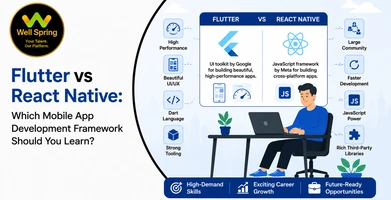
Choosing between Flutter vs React Native is one of the most important decisions for students and developers who want to build a successful career in mobile app development. Both frameworks enable developers to create high-quality cross-platform applications for Android and iOS using a single codebase, reducing development time and costs. However, they differ in programming languages, architecture, performance, ecosystem, UI rendering, and career opportunities.
This comprehensive guide compares Flutter vs React Native, covering their features, career scope, salaries, required skills, industry demand, latest trends, and future growth. Whether you're planning to enroll in a Flutter Course in Trichy, a React Native Course in Trichy, or a Mobile App Development Course, this guide will help you choose the right framework for your career.
If you enjoy building visually appealing applications with smooth performance and a consistent UI across platforms, Flutter is an excellent choice. If you're already familiar with JavaScript and React and want to develop mobile applications quickly while leveraging a vast JavaScript ecosystem, React Native is the ideal option.
Both frameworks offer outstanding career opportunities in 2026. Flutter has experienced rapid adoption because of Google's strong ecosystem and excellent UI capabilities, while React Native remains a top choice for businesses seeking efficient cross-platform mobile app development using JavaScript.
Flutter vs React Native compares two of the world's most popular cross-platform mobile app development frameworks.
Flutter uses the Dart programming language and Google's rendering engine.
React Native uses JavaScript and React to build native mobile applications.
Both frameworks significantly reduce development time by using a single codebase.
Mobile App Developers continue to be among the most in-demand software professionals globally.
Practical app development projects greatly improve employability.
AI-powered mobile applications are driving demand for skilled app developers.
Continuous learning is essential as mobile technologies evolve rapidly.
Mobile applications have transformed how people communicate, shop, learn, bank, travel, and entertain themselves. From food delivery and digital payments to healthcare, education, and social networking, nearly every business today relies on mobile applications to engage customers and deliver services.
Instead of developing separate applications for Android and iOS, organizations increasingly choose cross-platform frameworks like Flutter and React Native to reduce costs, accelerate development, and maintain consistent user experiences.
According to Statista, the global mobile application market is projected to generate more than USD 780 billion in revenue by 2029, driven by increasing smartphone adoption, digital services, and mobile commerce. Additionally, Grand View Research estimates that the global mobile application development market will continue growing at a strong CAGR throughout the decade as organizations invest in digital transformation.
This growing demand has made Flutter vs React Native one of the most searched comparisons among aspiring mobile developers.
Many students ask:
The answer depends on your programming background, preferred development style, and long-term career goals.
If you enjoy designing beautiful user interfaces and working with Google's modern framework, Flutter may be the right choice.
If you're already comfortable with JavaScript and React development, React Native provides a smooth transition into mobile app development.
At Well Spring Talent Solutions, students receive industry-oriented training through live mobile app projects, portfolio development, expert mentorship, internships, interview preparation, and placement assistance. Whether enrolling in a Flutter Course in Trichy, a React Native Course in Trichy, or a Mobile App Development Course, learners gain practical experience aligned with current industry standards.
Mobile applications have become essential for businesses of every size. Organizations continue investing heavily in mobile-first strategies to improve customer engagement, automate services, and expand digital offerings.
Industries actively hiring mobile app developers include:
Software Development
Healthcare
Banking & Financial Services
E-commerce
Food Delivery
Education Technology
Logistics
Travel & Tourism
Entertainment
Gaming
Retail
Manufacturing
Real Estate
Government Organizations
Digital Marketing
Mobile developers help organizations:
As smartphone usage continues increasing worldwide, demand for skilled mobile application developers remains exceptionally strong.
One of the biggest misconceptions among beginners is believing that completing a mobile app development course alone guarantees employment.
In reality, employers prioritize practical skills and project experience.
Recruiters commonly evaluate:
Candidates who have built e-commerce apps, chat applications, food delivery apps, booking systems, and business management applications often have a significant advantage over those with only theoretical knowledge.
This is why portfolio development and live projects are essential for launching a successful mobile development career.
Flutter is Google's open-source UI toolkit used to build beautiful, high-performance applications for Android, iOS, Web, Windows, macOS, and Linux using a single codebase.
Unlike traditional cross-platform frameworks, Flutter uses its own rendering engine called Skia, allowing developers to create highly customized user interfaces with consistent performance across platforms.
Flutter uses the Dart programming language and provides a rich collection of customizable widgets that simplify application development.
Flutter is widely used for developing:
Popular companies using Flutter include:
A professional Flutter Course in Trichy equips students with practical skills required to build modern cross-platform mobile applications.
Students typically learn:
Students also build multiple live applications that strengthen their professional portfolios.
Flutter developers are employed across organizations developing cross-platform mobile applications.
Common employers include:
Flutter's ability to build applications for multiple platforms from a single codebase makes it one of the fastest-growing mobile development technologies.
Organizations increasingly adopt Flutter because it accelerates application development while maintaining excellent performance and consistent user experiences.
Businesses use Flutter to:
Because Flutter enables rapid cross-platform development without compromising user experience, skilled Flutter developers continue to enjoy strong global demand.
React Native is an open-source mobile application development framework developed by Meta (formerly Facebook). It enables developers to build native Android and iOS applications using JavaScript and React, allowing businesses to develop cross-platform apps with a single codebase while maintaining near-native performance.
Unlike traditional hybrid frameworks, React Native renders native UI components instead of web views, providing users with a smooth and responsive mobile experience.
React Native is widely used for developing:
Popular companies using React Native include:
Its strong JavaScript ecosystem and large developer community continue to make React Native one of the most popular mobile app development frameworks worldwide.
A professional React Native Course in Trichy equips students with practical skills required to develop modern cross-platform mobile applications.
Students typically learn:
JavaScript (ES6+)
React Fundamentals
JSX
React Native Components
Navigation
State Management
Hooks
Redux Toolkit
REST API Integration
Firebase
Local Storage
Push Notifications
Authentication
Native Modules
Performance Optimization
App Deployment
Students also develop real-world applications that help build strong portfolios for job interviews.
React Native developers are employed across organizations that develop mobile applications efficiently using JavaScript technologies.
Common employers include:
React Native remains one of the preferred choices for companies looking to reduce development time while maintaining native-like performance.
Organizations increasingly choose React Native because it enables faster application development while leveraging existing JavaScript expertise.
Businesses use React Native to:
Its strong community support and mature ecosystem continue to drive high demand for React Native developers.
Although both Flutter and React Native enable cross-platform mobile development, they differ in architecture, programming languages, rendering engines, and development philosophy.
|
Feature |
Flutter |
React Native |
|
Developed By |
|
Meta (Facebook) |
|
Programming Language |
Dart |
JavaScript |
|
UI Rendering |
Skia Rendering Engine |
Native UI Components |
|
Performance |
Excellent |
Very Good |
|
Learning Curve |
Moderate |
Easier for JavaScript Developers |
|
Hot Reload |
Yes |
Yes |
|
Community |
Rapidly Growing |
Large & Mature |
|
Best For |
Rich UI Applications |
JavaScript Ecosystem |
|
Third-party Libraries |
Growing |
Extensive |
|
Multi-platform Support |
Android, iOS, Web, Desktop |
Android & iOS (primarily) |
Both frameworks provide outstanding solutions for cross-platform application development.
One of the most searched comparisons is Flutter vs React Native Performance.
Flutter generally delivers superior rendering performance because it uses its own rendering engine (Skia) instead of relying on native UI components.
React Native communicates with native components through a bridge architecture, although recent improvements such as the New Architecture (Fabric and TurboModules) have significantly enhanced its performance.
Flutter Performance Advantages
React Native Performance Advantages
For graphics-intensive applications, Flutter often provides better consistency, while React Native excels in productivity for JavaScript teams.
Many students ask Which is Better Flutter or React Native?
The answer depends on your background and career goals.
Choose Flutter if you enjoy:
Choose React Native if you enjoy:
Learning either framework provides excellent career opportunities, while mastering both significantly increases your employability.
Mobile App Developers continue to enjoy strong salary growth across the technology industry.
|
Job Role |
Salary Growth Potential |
|
Flutter Developer |
Very High |
|
React Native Developer |
Very High |
|
Mobile App Developer |
Excellent |
|
Cross-platform Developer |
Excellent |
|
Senior Mobile Engineer |
Outstanding |
|
Full Stack Mobile Developer |
Outstanding |
Salary depends on:
Professionals with expertise in Flutter, React Native, Firebase, APIs, and cloud technologies generally receive highly competitive compensation.
Professional Flutter developers typically develop expertise in:
Professional React Native developers generally master:
Many beginners jump directly into Flutter or React Native without understanding Dart or JavaScript.
Mastering the programming language first makes framework learning much easier.
2. Ignoring UI/UX Principles
A successful mobile application should be both functional and user-friendly.
Developers should understand:
Following tutorials helps beginners, but employers prefer original applications that demonstrate problem-solving skills.
Modern mobile applications require integration with APIs, authentication services, databases, and cloud platforms.
Publishing apps on the Google Play Store or Apple App Store demonstrates practical development experience and strengthens a professional portfolio.
Mobile development continues evolving rapidly.
Major trends include:
Developers who stay updated with these technologies will remain highly competitive.
Students looking for an industry-oriented Flutter Course in Trichy, React Native Course in Trichy, or Mobile App Development Course receive practical training designed to meet today's mobile industry requirements.
Training includes:
Dart Programming
JavaScript
Flutter
React Native
Firebase
API Integration
Database Management
State Management
Live Mobile App Projects
Portfolio Development
Internship Opportunities
Resume Building
Mock Interviews
Placement Assistance
Students graduate with real-world application development experience that prepares them for careers in modern software companies.
1. Learn Programming Fundamentals First
Build a strong foundation in Dart or JavaScript before learning Flutter or React Native.
2. Build Real Mobile Applications
Develop practical applications such as:
3. Learn Firebase and APIs
Most mobile applications rely on authentication, cloud databases, and REST APIs.
4. Publish Your Apps
Deploying applications to the Google Play Store demonstrates practical experience and increases employer confidence.
5. Stay Updated
Explore emerging technologies such as AI-powered mobile applications, Flutter AI integrations, cloud services, and advanced state management techniques.
Which is better: Flutter or React Native?
Both frameworks offer excellent opportunities. Flutter is known for high-performance UI and consistent cross-platform experiences, while React Native is ideal for JavaScript developers and rapid application development.
Is Flutter faster than React Native?
Flutter generally delivers better rendering performance because it uses its own rendering engine, while React Native relies on native UI components. However, both frameworks provide excellent performance for most business applications.
Can I learn both Flutter and React Native?
Yes. Many mobile developers learn both frameworks to expand their career opportunities and adapt to different project requirements.
Is mobile app development a good career in 2026?
Yes. Mobile application development continues to be one of the fastest-growing software careers due to increasing smartphone usage and digital transformation across industries.
Which framework should beginners learn first?
Beginners with JavaScript experience often find React Native easier, while those starting fresh and focusing on modern cross-platform development may prefer Flutter.
The demand for mobile application developers continues to grow across Trichy, Madurai, Thanjavur, Karur, Dindigul, Pudukkottai, Ariyalur, Perambalur, and other regions of Tamil Nadu. Organizations across software development, healthcare, e-commerce, fintech, education, and logistics are actively hiring developers skilled in Flutter, React Native, Firebase, and cross-platform application development.
At Well Spring Talent Solutions, students receive industry-oriented practical training through a Flutter Course in Trichy, React Native Course in Trichy, and Mobile App Development Course, featuring live projects, portfolio development, internships, expert mentorship, interview preparation, and placement assistance.
What is the difference between Flutter and React Native?
Flutter is Google's UI toolkit that uses Dart and its own rendering engine to build high-performance cross-platform applications, while React Native is Meta's framework that uses JavaScript and native UI components to develop Android and iOS applications.
Which framework has better job opportunities?
Both Flutter and React Native offer excellent career opportunities. Flutter adoption is growing rapidly across startups and enterprises, while React Native remains widely used by companies with existing JavaScript and React ecosystems.
Which framework is easier for beginners?
Developers with JavaScript experience generally find React Native easier to learn. Beginners without prior frontend experience can also succeed with Flutter because of its comprehensive documentation and widget-based architecture.
Is Flutter better than React Native for performance?
Flutter often provides better UI consistency and rendering performance because of its Skia engine, whereas React Native offers strong performance through native components and ongoing architectural improvements.
Is mobile app development worth learning in 2026?
Yes. Mobile app development remains one of the fastest-growing technology careers as businesses continue investing in Android, iOS, AI-powered applications, and digital customer experiences.
Flutter vs React Native compares two of the world's leading cross-platform mobile development frameworks.
Flutter uses Dart and offers exceptional UI performance and design consistency.
React Native uses JavaScript and provides a mature ecosystem with native component rendering.
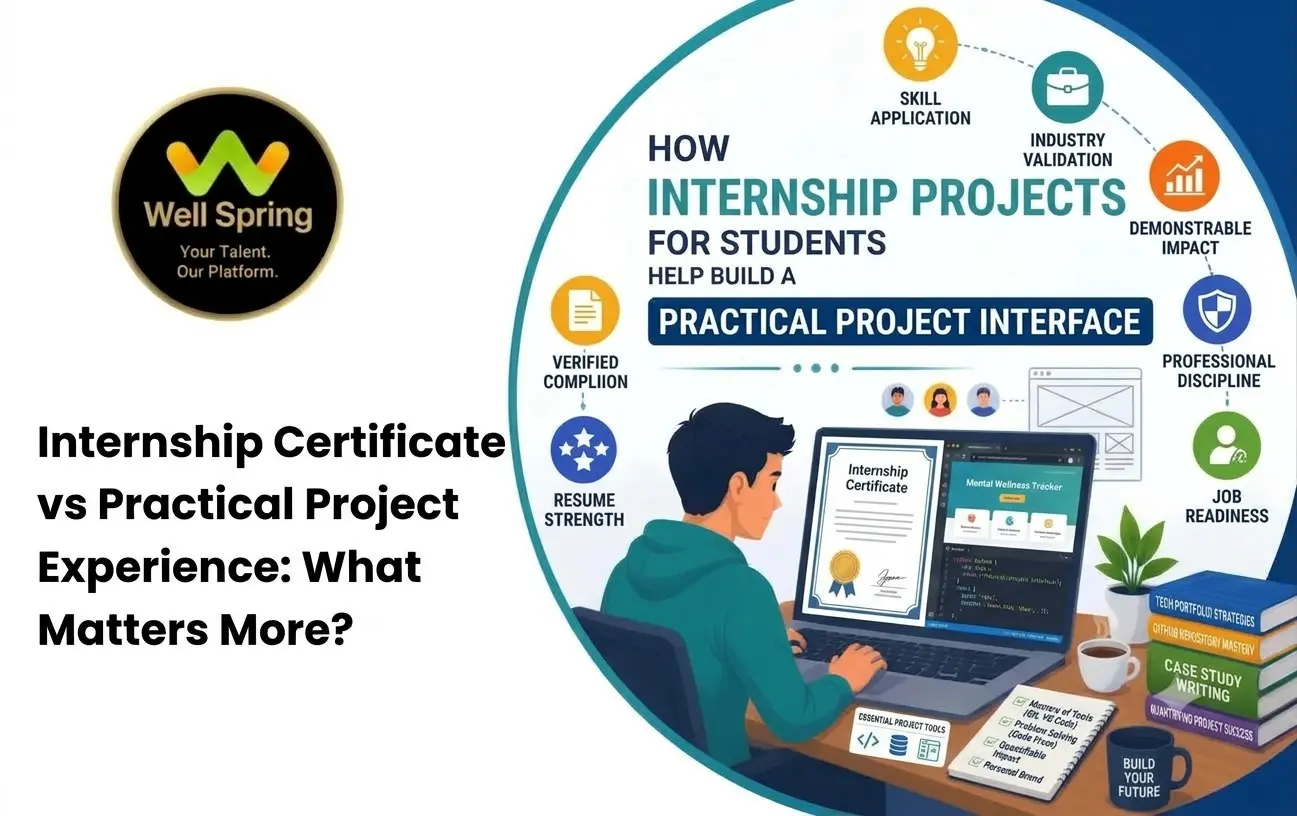
Practical app development projects are more valuable than certifications alone.
Firebase, APIs, state management, and UI/UX principles are essential skills for mobile developers.
Professionals proficient in both Flutter and React Native enjoy broader career opportunities and long-term growth.
Choosing between Flutter vs React Native depends on your programming background, career aspirations, and the type of mobile applications you want to build. If you're passionate about creating visually rich, high-performance applications with a modern development framework, Flutter is an excellent choice. If you're already familiar with JavaScript and React and want to transition into mobile development quickly, React Native offers an equally rewarding path.
At Well Spring Talent Solutions, students receive practical, industry-oriented training through live mobile app projects, portfolio development, internships, expert mentorship, interview preparation, and placement assistance. Whether you choose a Flutter Course in Trichy, a React Native Course in Trichy, or a Mobile App Development Course, you'll gain the practical skills needed to build high-quality mobile applications and succeed in today's competitive software industry.
Start your mobile app development journey today and build innovative applications that power the digital world.
15 Oct 2026
15 Oct 2026
14 Oct 2026

14 Oct 2026
13 Oct 2026
Both frameworks are in high demand. Flutter is rapidly expanding across startups and enterprises because of its cross-platform capabilities, while React Native continues to be widely adopted by organizations with JavaScript-based development teams.
Yes. Learning both frameworks significantly expands your career opportunities, allowing you to work on a wider range of mobile application projects across different industries.
Yes. Learning Dart is recommended before Flutter, while a solid understanding of JavaScript and React fundamentals is beneficial before starting React Native.
Yes. Employers often evaluate candidates based on live mobile applications, GitHub repositories, UI quality, problem-solving skills, and published apps. Certifications add value, but practical experience demonstrates real capability.
Start by learning programming fundamentals, master Flutter or React Native, build real-world applications, integrate APIs and Firebase, publish your apps on app stores, maintain a strong GitHub portfolio, and enroll in an industry-oriented training program that offers live projects, internships, expert mentorship, and placement assistance.
Get internship updates, IT training news, placement opportunities, and career tips directly to your inbox.
Join our WhatsApp community for internship updates, IT courses, placement support, and latest job opportunities.
Join Now