
Introduction
Students have access to more learning resources than ever before. They can attend classes, watch tutorials, read articles, practise with digital tools, participate in workshops, complete projects, and learn from mentors. Yet having access to resources does not automatically create a meaningful learning experience.
The quality of learning often depends on what students do with the opportunities available to them.
A student who actively asks questions, practises concepts, reflects on mistakes, applies knowledge, and seeks feedback can gain considerably more from the same learning environment than someone who only completes the minimum required work.
Making the most of learning is therefore less about studying for longer and more about learning with purpose.
Quick Answer
Students can make the most of their learning experience by setting clear goals, actively participating, practising what they learn, asking questions, applying knowledge through projects, seeking feedback, reflecting on mistakes, and exploring learning opportunities beyond regular classes.
What Does a Learning Experience Mean?
A learning experience is the complete process through which a student gains knowledge, develops skills, applies ideas, receives feedback, and gradually improves.
It is broader than attending a class.
For example, a student's learning experience in programming might include:
- Listening to an explanation of a programming concept.
- Writing code independently.
- Testing the code.
- Finding and fixing errors.
- Asking questions about alternative approaches.
- Building a small application.
- Receiving feedback.
- Improving the application.
Each activity contributes something different to learning.
This means that effective student learning is not simply measured by how much information a student has consumed. It is also reflected in whether the student can understand, apply, explain, and improve what they have learned.
Why Does the Learning Experience Matter?
Students often focus heavily on results such as marks, grades, certificates, or course completion.
These outcomes can be useful, but the learning process behind them matters too.
A meaningful learning experience can help students develop:
Deeper Understanding
Instead of memorising isolated facts, students can understand how concepts relate to one another.
Practical Ability
Applying knowledge helps students discover how theoretical ideas work in realistic situations.
Independence
Students gradually become more comfortable researching, experimenting, troubleshooting, and finding solutions without constant assistance.
Confidence
Repeated successful practice provides evidence that a student can handle increasingly difficult tasks.
Adaptability
Students who learn how to learn can continue developing their skills when technologies, tools, or requirements change.
Self-Awareness
Reflection helps students recognise their strengths, weaknesses, interests, and areas requiring improvement.
This makes learning valuable beyond a single examination or course.
How Students Can Take Ownership of Learning
One of the biggest changes students can make is moving from passive participation to active ownership.
Instead of asking only, “What do I need to study?”, students can also ask:
- What do I want to understand?
- Why is this concept important?
- Where can I apply it?
- What am I struggling with?
- What can I practise today?
- How can I test whether I actually understand it?
This shift encourages students to become participants in their own education.
Set Small and Specific Learning Goals
Large goals such as “I want to learn programming” are difficult to measure.
A more useful goal could be:
“By the end of this week, I will be able to create a simple program using functions, conditions, and loops.”
A specific goal makes it easier to decide what to study and how to evaluate progress.
Keep Track of Progress
Students can maintain a simple learning record containing:
- Topics completed.
- Concepts that remain unclear.
- Projects completed.
- Questions to ask.
- Mistakes discovered.
- Skills that need more practice.
This can make learning more intentional.
Essential Learning Skills for Students
Academic knowledge is only one part of becoming an effective learner.
Several learning skills for students can improve both academic and practical development.
Active Listening
Students should focus on understanding the reasoning behind an explanation rather than simply copying notes.
Note-Making
Useful notes should capture important concepts, relationships, examples, questions, and personal observations.
Questioning
Asking precise questions can reveal gaps in understanding and lead to deeper learning.
Research
Students should learn how to locate reliable information, compare sources, and verify unfamiliar claims.
Time Management
Breaking learning into manageable sessions makes consistent progress easier.
Problem-Solving
Students should practise analysing problems before immediately looking for solutions.
Reflection
Reviewing what worked, what failed, and what remains unclear helps students adjust their learning approach.
Communication
Explaining a concept to another person is a useful way to test whether the student genuinely understands it.
Effective Learning Strategies for Students
There is no single study technique that works equally well for every student or every subject.
However, several effective learning strategies for students can make learning more active and measurable.
1. Learn, Then Recall
After studying a topic, close the book or learning material and try to explain the main ideas from memory.
This can reveal which parts have actually been understood.
2. Practise Instead of Only Re-Reading
A student learning Excel, Java, graphic design, testing, or digital marketing should spend time performing relevant tasks rather than repeatedly reading about them.
3. Break Complex Topics Into Smaller Problems
If a concept seems difficult, divide it into smaller questions.
For example:
What is it? → Why is it used? → How does it work? → Where is it applied? → Can I use it independently?
4. Use Examples
Examples can make abstract concepts easier to understand.
A database concept can be connected to a college management system. A UI/UX principle can be examined through a familiar mobile application. A programming concept can be explored through a small practical problem.
5. Teach or Explain the Concept
Trying to explain a topic in simple language can expose gaps in understanding.
If a student cannot explain why a particular approach works, that is a signal to revisit the concept.
6. Review Mistakes
Instead of simply correcting an incorrect answer, students should ask:
What went wrong?
Why did I make that mistake?
How can I recognise this problem next time?
This turns an error into a learning opportunity.
Why Practice Should Be Part of Student Learning
Knowing how something works and being able to use it are different abilities.
Consider a student learning web development.
Reading about responsive design may provide conceptual knowledge. Creating a website that works across different screen sizes requires the student to make decisions, test layouts, identify problems, and revise the implementation.
Practice creates this transition.
A useful progression is:
Understand → Try → Make Mistakes → Fix → Repeat → Apply Independently
Students do not need to begin with large projects.
They can start with small exercises and gradually increase complexity.
For example:
Beginner: Create a simple webpage.
Intermediate: Build a responsive multi-page website.
Advanced: Develop a complete website with forms, validation, database interaction, and deployment.
The specific progression will vary by subject, but the principle remains the same.
Learning Through Questions and Curiosity
Questions are one of the most useful tools students have.
A student should not feel that asking questions indicates a lack of ability.
Questions can reveal how deeply a student is thinking.
Compare:
“What is inheritance?”
with:
“Why would I choose inheritance here instead of composition?”
The second question requires the student to think about application and trade-offs.
Students can develop better questions by asking:
- Why does this work?
- Why does this approach fail?
- What would happen if I changed this?
- Is there another way to solve the problem?
- Where would this concept be used?
- What are the limitations?
- How would this work in a larger project?
This habit supports deeper student learning.
Using Feedback to Improve
Feedback is useful when students treat it as information rather than simply as a judgment.
Suppose a student submits a design project and receives feedback that the hierarchy is unclear.
The useful response is not simply to change the design once.
The student can investigate:
- Which elements compete for attention?
- Is the heading sufficiently distinct?
- Is spacing creating confusion?
- Does the visual order match the intended user journey?
- Can the improvement be tested with another person?
The student then applies the feedback and compares the revised result.
This creates a cycle of:
Attempt → Feedback → Revision → Better Attempt
Repeated cycles like this can significantly improve practical ability.
Making the Most of Learning Opportunities for Students
Learning does not have to happen only during scheduled classes.
There are many learning opportunities for students, depending on their interests, educational stage, and available resources.
Workshops
Workshops can provide focused exposure to a specific subject or practical skill.
Projects
Projects allow students to combine multiple concepts and create something tangible.
Internships
Internships can provide exposure to professional environments, responsibilities, workflows, and expectations.
Competitions and Challenges
Competitions can encourage students to solve problems under defined constraints.
Peer Learning
Explaining concepts to classmates and discussing different approaches can expose students to perspectives they may not encounter individually.
Online Resources
Online courses, documentation, tutorials, lectures, and practice platforms can supplement structured learning.
Industry Events
Seminars, talks, conferences, and professional sessions can help students understand how skills are used beyond academic environments.
The important point is not to participate in everything.
Students should choose opportunities that support their current learning goals.
The Role of Projects in Student Development
Projects can contribute significantly to student development because they require students to combine knowledge rather than use concepts in isolation.
Imagine a student building a simple online store.
The project may require:
- Planning the interface.
- Creating pages.
- Writing code.
- Working with data.
- Testing functionality.
- Fixing errors.
- Improving usability.
- Documenting the work.
- Presenting the final result.
One project can therefore expose a student to several interconnected skills.
Projects also create opportunities for students to discover what they enjoy.
A student may begin a web development project and realise that they particularly enjoy interface design. Another may discover an interest in databases, testing, analytics, or problem-solving.
This kind of discovery can influence future learning decisions.
Learning From Mistakes and Difficult Problems
Students sometimes try to avoid mistakes because they associate them with poor performance.
However, mistakes can provide valuable information.
If a student repeatedly gets a programming error, for example, the problem can reveal a misunderstanding about data types, logic, syntax, or program structure.
The productive approach is to investigate the error.
Ask:
- What did I expect to happen?
- What actually happened?
- Where did the behaviour change?
- What assumption was incorrect?
- What can I test next?
This turns troubleshooting into a learning activity.
Difficulty should also be managed carefully.
If every task is far beyond the student's current ability, frustration can dominate the experience. If every task is extremely easy, there may be little opportunity for development.
The most useful challenges are often those that require effort while remaining achievable with appropriate guidance and practice.
Balancing Digital Resources With Active Learning
Digital resources can make learning more accessible, but consuming content is not the same as learning effectively.
A student might watch ten programming tutorials without writing ten lines of code.
Similarly, a student might save dozens of design tutorials without completing a single design project.
A useful rule is:
Use content as input, but use practice as proof of learning.
For every learning session, students can ask:
What will I do with what I just learned?
The answer could be a short exercise, a project update, a written explanation, a test, a design variation, or a problem-solving activity.
This keeps digital learning connected to active participation.
How to Build a Better Learning Routine
A learning routine does not need to be complicated.
Students can structure a session into four stages.
Stage 1: Understand
Spend focused time learning the concept.
Stage 2: Practise
Immediately apply the concept through an exercise or task.
Stage 3: Review
Check the result and identify errors or unclear areas.
Stage 4: Reflect
Write down what was learned, what remains difficult, and what should be practised next.
For example:
Topic: Java exception handling
Understand: Learn how try, catch, throw, throws, and finally work.
Practise: Write a small program that handles invalid input.
Review: Test different input conditions.
Reflect: Identify which exception types remain confusing.
This approach creates a more active learning experience than simply completing a chapter.
Common Mistakes That Limit Learning
Studying Only Before Examinations
Last-minute study can help with immediate academic requirements, but it may not provide enough time for repeated practice and deeper understanding.
Focusing Only on Marks
Grades provide one form of feedback, but they do not represent every practical or professional skill a student can develop.
Avoiding Questions
Unresolved confusion can accumulate when students avoid asking for clarification.
Collecting Resources Instead of Using Them
Having many courses, videos, books, and notes does not help much if they are never converted into practice.
Copying Projects Without Understanding Them
A completed project has limited learning value if the student cannot explain how it works or why decisions were made.
Trying to Learn Everything at Once
Too many simultaneous goals can reduce focus and make it difficult to complete meaningful work.
Ignoring Reflection
Students can repeat the same ineffective habits when they never review how they are learning.
A Simple Student Learning Cycle
Students can use the following cycle for almost any technical, creative, or academic subject:
1. Set
Choose one specific learning objective.
2. Learn
Understand the core concept using reliable learning resources.
3. Apply
Use the concept in an exercise or practical task.
4. Review
Check the result and identify gaps.
5. Improve
Correct mistakes and try again.
6. Demonstrate
Explain, present, or use the skill in a larger project.
7. Reflect
Record what was learned and decide what to learn next.
The cycle can then begin again with a more advanced topic.
This makes learning continuous rather than treating education as a sequence of disconnected subjects.
Key Takeaways
A meaningful learning experience is created through active participation, not simply through access to information.
- Students should take ownership of their learning by setting clear and achievable objectives.
- Strong learning skills include questioning, research, practice, reflection, communication, and problem-solving.
- Practical application helps students understand whether they can use a concept independently.
- Feedback becomes more valuable when students use it to revise and improve their work.
- Projects can connect multiple concepts while helping students discover their interests and strengths.
- Learning opportunities such as workshops, internships, competitions, and peer activities can complement structured education.
- Digital resources work best when students convert information into active practice.
- Mistakes can become useful learning opportunities when students investigate why they occurred.
- Consistent small learning cycles can be more sustainable than relying entirely on last-minute study.
Conclusion
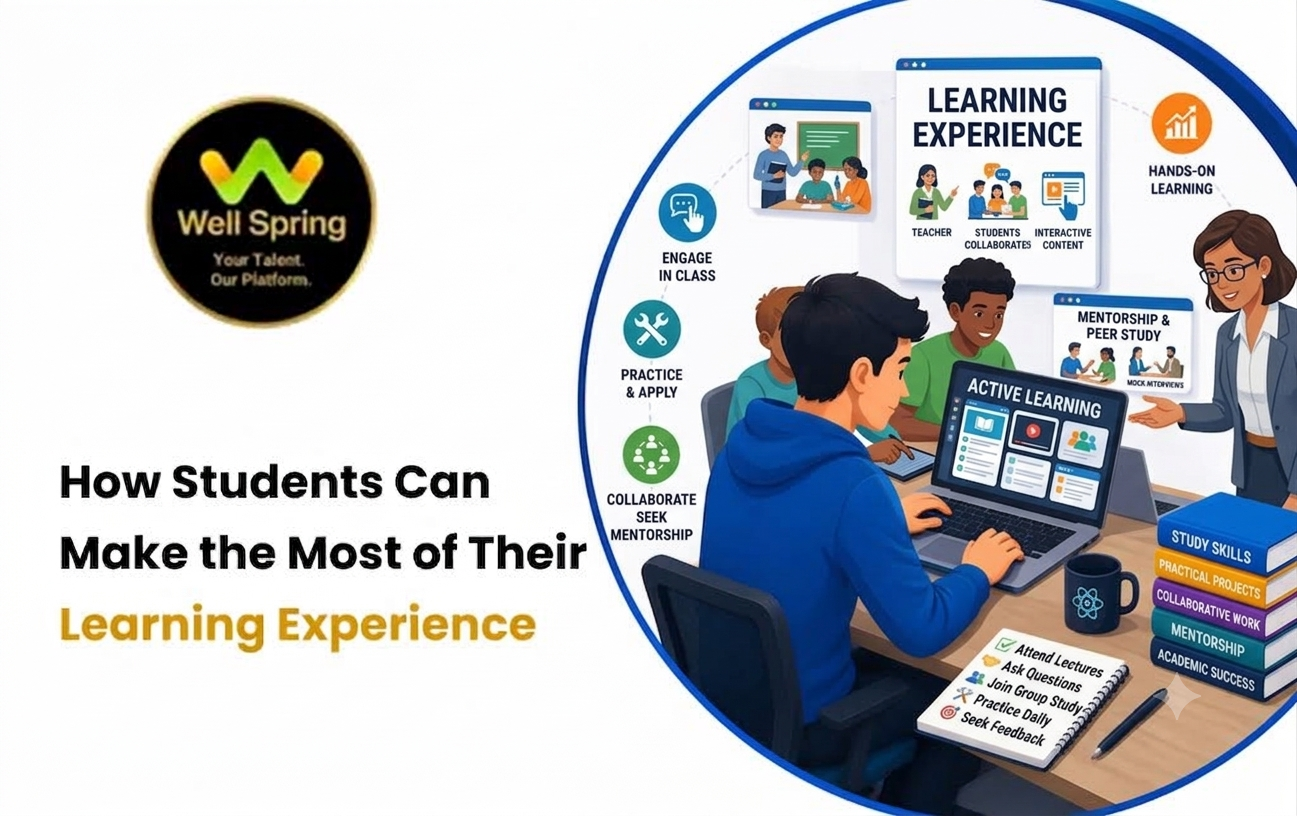
Making the most of a learning experience requires students to become active participants in their own development. Learning becomes more meaningful when students move beyond consuming information and start asking questions, practising concepts, building projects, seeking feedback, correcting mistakes, and reflecting on their progress.
The goal is not to learn everything at once. It is to develop the ability to learn effectively, apply knowledge confidently, and keep improving.
When students treat every class, project, mistake, question, and opportunity as part of their development, learning becomes more than an academic requirement—it becomes a continuous process of growth.