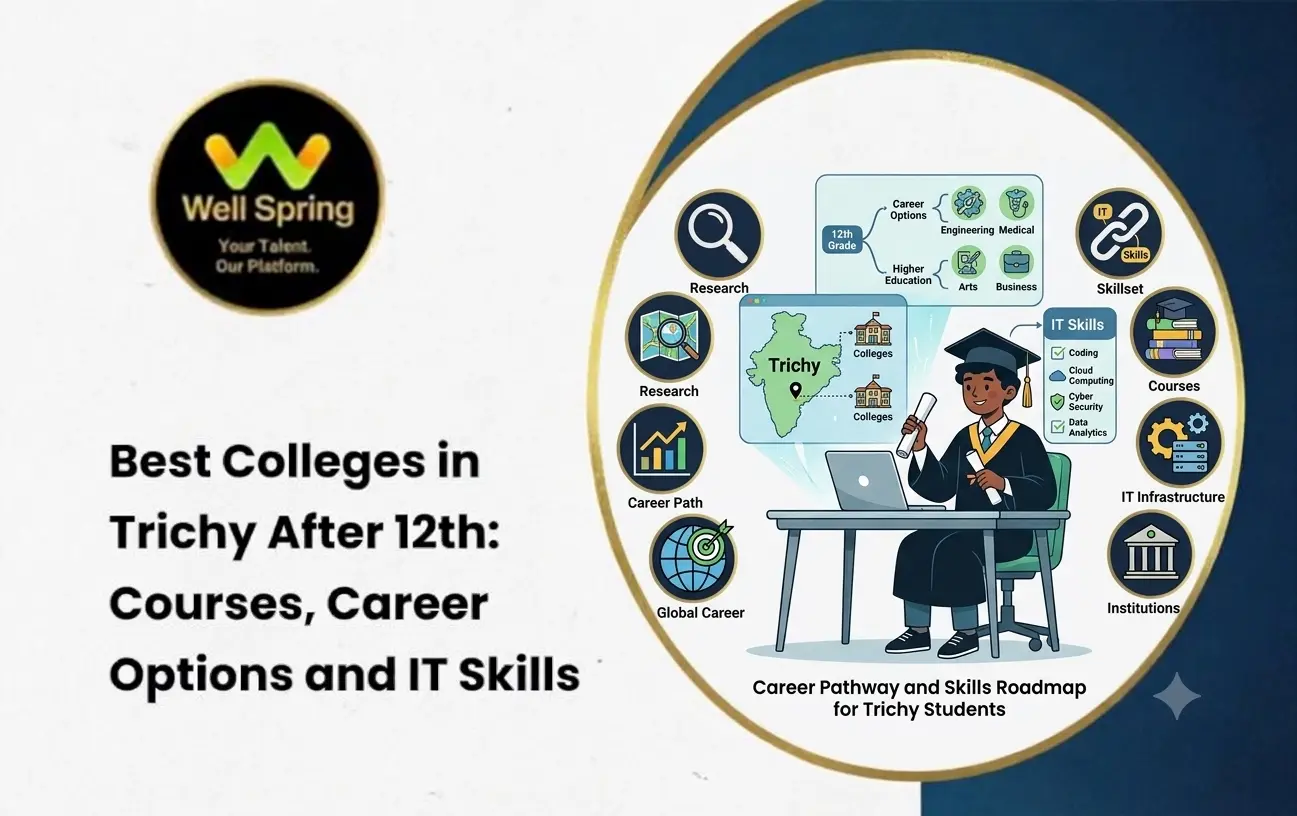

Choosing the right college after Class 12 is an important step in a student's academic and professional journey. It is an opportunity to explore different subjects, identify career interests and develop the knowledge needed for future opportunities.
Tiruchirappalli, popularly known as Trichy, is an established educational centre in Tamil Nadu. Students can explore universities, engineering colleges, arts and science colleges, medical institutions, law colleges, agricultural colleges, management institutions and polytechnic colleges in the city and surrounding areas.
However, choosing a college is only one part of career planning. Students should also consider the course they want to study, the skills they need to develop and the type of career they want to pursue after graduation.
For example, students interested in technology may consider computer science or information technology programmes. Commerce students may explore business, accounting and finance while developing additional digital skills. Arts and science students can also learn relevant technology skills based on their interests and career goals.
In this guide, we explore colleges in Trichy across different educational categories, the courses students can consider after Class 12, and the IT skills they can learn during or after college. We also explain how practical training, projects and internships can complement academic education.
1. What Should Students Consider After Completing Class 12?
Before choosing a college, students should understand their interests, academic qualifications and long-term goals. Different courses have different eligibility requirements, so it is important to research the available options carefully.
Here are some common educational pathways.
Science students: Depending on their subjects and eligibility, they may consider engineering, computer science, medicine, agriculture, biotechnology, mathematics, physics and other scientific programmes.
Commerce students: They may explore commerce, accounting, finance, economics, business administration, banking and related fields. They can also consider developing additional digital and analytical skills.
Arts and humanities students: They may consider languages, history, economics, social sciences, visual communication and other undergraduate programmes. Technology-related training can also be explored according to their interests and the requirements of individual courses.
Students interested in IT: Computer science, information technology, computer applications and engineering programmes may be suitable academic pathways. Students can also explore additional training in programming, web development, software testing and other technical areas.
Students interested in professional education: Medicine, law and other professional programmes have specific entrance examinations and eligibility conditions. Students should check the applicable admission rules before applying.
Students interested in practical technical education: Polytechnic diplomas and other technical programmes may offer alternative pathways, depending on their qualifications and career objectives.
Students should choose a course based on their interests and circumstances rather than following a particular pathway simply because their friends have chosen it.
2. Universities and Higher Education Institutions in Trichy
Trichy and its surrounding region have several higher education institutions offering programmes across different disciplines. Students should identify the exact institution, course and campus before applying.
Anna University and Its Affiliated Engineering Colleges
Anna University is an important part of Tamil Nadu's technical education system. Students interested in engineering should research the current university structure, affiliated colleges and available programmes.
When comparing engineering options, check the branch offered, curriculum, admission requirements, laboratory facilities and practical learning opportunities.
Bharathidasan University
Bharathidasan University is a major higher education institution in the Trichy region. Students can explore its current undergraduate, postgraduate and research programmes across different disciplines.
Review the available courses, subject requirements, admission notifications and affiliated-college information before selecting a programme.
National Institute of Technology Tiruchirappalli
National Institute of Technology Tiruchirappalli, commonly known as NIT Trichy, is a centrally funded technical institution.
Students interested in engineering and other technical disciplines can research its undergraduate programmes and admission requirements. For undergraduate engineering admission, applicants should review the applicable JEE Main requirements and seat-allocation procedures.
Indian Institute of Information Technology Tiruchirappalli
Indian Institute of Information Technology Tiruchirappalli, commonly called IIIT Tiruchirappalli, is relevant to students interested in information technology and computer science education.
Prospective students should review its current programmes, admission criteria, curriculum and opportunities for technical projects.
Tamil Nadu National Law University
Tamil Nadu National Law University is located in the Trichy region and is relevant to students interested in legal education.
Students should check the current integrated law programmes, entrance examination requirements and admission procedures for the relevant academic year.
Indian Institute of Management Tiruchirappalli
Indian Institute of Management Tiruchirappalli, or IIM Trichy, is primarily associated with management education.
Students completing Class 12 should understand that its flagship management programmes are generally intended for postgraduate study. Those interested in management can pursue a suitable undergraduate degree before exploring further management education.
Dhanalakshmi Srinivasan University, Samayapuram
Dhanalakshmi Srinivasan University in the Samayapuram area is another institution students can research when exploring higher education options.
Check the programmes currently offered at the relevant campus, admission requirements, fees and applicable recognition information.
PRIST University and Other Regional Institutions
Students researching PRIST University or other institutions associated with the wider Trichy region should confirm the exact campus, current location, programme availability and admission requirements.
Similarly, when researching SRM-branded educational institutions, identify the specific campus rather than assuming that all programmes offered by an institution or group are available at every location.
Tip: Always confirm current programme availability and recognition through official institutional or regulatory information before applying.
3. Medical Colleges in Trichy
Students interested in healthcare should explore medical education according to their academic background and career goals.
Medical education includes different pathways, such as medicine, nursing, pharmacy, physiotherapy and allied health sciences. Each programme has its own eligibility requirements and admission process.
The following institutions can be researched when exploring medical education in the Trichy region.
K.A.P. Viswanatham Government Medical College
K.A.P. Viswanatham Government Medical College is a government medical institution in Tiruchirappalli.
Students interested in MBBS should review the applicable NEET-UG requirements, counselling procedures, eligibility conditions and current admission notifications.
Chennai Medical College Hospital and Research Centre
Chennai Medical College Hospital and Research Centre, associated with the Irungalur area near Trichy, is another name students may encounter when researching medical education.
Confirm the institution's current official details, available programmes and applicable recognition before applying.
SRM Medical Education Options in the Wider Region
Students researching SRM medical education should identify the exact institution and campus. Similar institutional names may refer to different locations and programmes.
Check the current admission information and programme-specific requirements before making a decision.
Dhanalakshmi Srinivasan Medical Education Options
Students interested in medical education around the Samayapuram region can research the relevant Dhanalakshmi Srinivasan institution and its current programmes.
Before applying, verify the exact campus, course availability, admission route and applicable recognition.
Other Healthcare Courses After Class 12
Depending on their qualifications and interests, students may explore:
- Nursing
- Physiotherapy
- Pharmacy
- Medical laboratory technology
- Radiology and medical imaging
- Other allied health science programmes
The most suitable pathway depends on the student's eligibility and career objectives.
Although these courses are different from IT education, students in healthcare and other disciplines may also benefit from learning appropriate digital skills, such as spreadsheet applications, data handling and computer fundamentals.
4. Agricultural Colleges in Trichy
Agricultural education may suit students interested in farming, crop production, horticulture, agricultural engineering, irrigation, soil science and related industries.
Students can research the following institutions in the Trichy region.
Agricultural Engineering College and Research Institute, Kumulur
This institution can be researched by students interested in agricultural engineering.
The field combines engineering principles with agricultural applications, including areas such as machinery, irrigation and agricultural processing.
Anbil Dharmalingam Agricultural College and Research Institute
Students interested in agricultural science can explore the programmes offered by Anbil Dharmalingam Agricultural College and Research Institute.
Check the current courses, eligibility requirements, admission procedure and practical learning opportunities.
Horticultural College and Research Institute for Women
Students interested in horticulture can research the relevant horticultural education institution in the Trichy region.
Horticulture covers areas such as fruit production, vegetables, flowers and ornamental plants. Confirm the institution's current official name, location and programme availability before applying.
Is Agriculture a Good Option After Class 12?
Agriculture can be a suitable pathway for students interested in food production, agricultural research, horticulture and related businesses.
Students should compare agricultural science, agricultural engineering and horticulture programmes carefully because their subjects and career pathways differ.
Students interested in technology can also explore how digital tools, data analysis and software applications are used in modern agricultural systems.
5. Law Colleges in Trichy
Law is another educational pathway for students interested in legal systems, research, communication and structured reasoning.
Tamil Nadu National Law University
Tamil Nadu National Law University is an institution to research when considering integrated law programmes.
Students should check the current programme details, entrance examination, eligibility conditions and application deadlines.
Government Law College, Tiruchirappalli
Government Law College, Tiruchirappalli, is another institution students can investigate when comparing legal education options.
Check the available programmes, admission requirements and current institutional information before applying.
What Skills Are Useful for Law Students?
Law students can develop reading comprehension, writing, communication, research and analytical reasoning.
They may also benefit from appropriate digital skills, including document preparation, spreadsheet use and online research. The relevance of more advanced technical training depends on their individual career plans.
6. Business Schools and Management Education in Trichy
Students interested in business, entrepreneurship, marketing, finance and organisational management can research management education in the Trichy region.
Some institutions focus primarily on postgraduate management programmes, so students completing Class 12 should check whether an institution offers a suitable undergraduate programme.
CARE Business School
CARE Business School is an institution students can research when exploring management education in Trichy.
Check the current programmes, eligibility requirements, curriculum and practical learning opportunities.
Hallmark Business School
Hallmark Business School is another institution to investigate when comparing management education options.
Prospective students should confirm the programmes offered, fees, admission conditions and current institutional information.
Indian Institute of Management Tiruchirappalli
IIM Trichy is relevant to students planning to pursue management education, particularly at the postgraduate level.
Students completing Class 12 can research suitable undergraduate pathways before considering postgraduate management programmes.
Bharathidasan Institute of Management, Trichy
Bharathidasan Institute of Management, commonly known as BIM-Trichy, is another institution associated with management education.
Students should review its current programmes and admission requirements to determine whether they meet the relevant eligibility conditions.
St. Joseph's Institute of Management
Students researching St. Joseph's Institute of Management should confirm the exact institution, location, current programmes and admission requirements before applying.
How Can Business Students Improve Their Career Skills?
Business and commerce students can complement their academic studies with relevant practical skills, such as:
- Spreadsheet applications
- Business data analysis
- Presentation and communication
- Digital marketing
- Database fundamentals
- Basic programming, where relevant
- Business reporting and data visualisation
These skills may be useful in different business environments, depending on the student's chosen career.
7. Engineering Colleges in Trichy
Engineering is a popular educational pathway for students interested in technology, mathematics, design, electronics, computing and other technical disciplines.
Students should compare institutions based on the engineering branch, curriculum, admission requirements, facilities, fees and practical learning opportunities.
The following institutions can be included in a preliminary research list for Trichy and the surrounding region.
Jayaram College of Engineering and Technology
Research its current engineering programmes, branch availability, admission requirements and campus facilities.
CARE College of Engineering
Students can investigate the available engineering branches, laboratory facilities, curriculum and practical project opportunities.
Designed Environment Academy and Research Institute
Students interested in specialised design, architecture or related disciplines should verify the institution's exact official name, location, current programmes and applicable recognition.
Dhanalakshmi Srinivasan Institute of Technology
Students can research this institution when comparing engineering education options in the region.
Confirm the current branch list, admission requirements, applicable approvals and fee structure.
Anna University of Technology, Tiruchirappalli
Students researching the former Anna University of Technology, Tiruchirappalli, should verify the present institutional structure and affiliation arrangements.
Older educational listings may contain names that no longer reflect current administrative arrangements.
Mahalakshmi Engineering College
Students can investigate the institution's current engineering programmes, campus information and admission requirements.
M.A.M. College of Engineering
Research the available branches, laboratory facilities, fees and academic support before deciding whether the institution suits your goals.
M.I.E.T. Engineering College
Students can compare its current engineering programmes, curriculum, practical facilities and admission requirements with other institutions.
MAM College of Engineering and Technology
Research this institution separately from M.A.M. College of Engineering. Similar names do not necessarily refer to the same college.
Confirm the exact campus, programmes and current admission information.
Saranathan College of Engineering
Students interested in engineering education in Trichy can research the available branches, curriculum, project opportunities and fees.
Shivani Institute of Technology
Before including this institution in an application shortlist, confirm its current operational status, official details, available programmes and admission availability.
Shri Angalamman College of Engineering and Technology
Students can research the current engineering programmes, campus location, admission procedure and applicable approvals.
Trichy Engineering College
Confirm the exact institution, course availability, admission details and current campus information before applying.
K. Ramakrishnan College of Engineering
Students can investigate the available engineering branches, fees, practical facilities and opportunities for technical projects.
Government College of Engineering, Srirangam
Students should independently verify the exact official institution name, location, current status and admission availability before including this name in an application plan.
Indra Ganesan College of Engineering
Research the institution's current programme list, admission requirements, campus details and applicable affiliation or approval information.
Pavendar Bharathidasan College of Engineering and Technology
Students can investigate the available branches, eligibility requirements, facilities and current admission information.
Oxford Engineering College
Check the institution's current programme availability, campus details, fees and applicable approvals before applying.
Mookambigai College of Engineering
Students researching engineering education in the wider region should confirm the current location, available programmes and admission requirements.
How Should Students Choose an Engineering Branch?
The choice of engineering branch should reflect the student's interests and career goals.
Computer Science and Engineering: May suit students interested in programming, software development, computing and related technologies.
Electronics and Communication Engineering: Focuses on electronic systems, communication technologies and related applications.
Mechanical Engineering: Covers machines, manufacturing, mechanics and engineering design.
Civil Engineering: Focuses on construction, infrastructure, structures and related engineering applications.
Electrical and Electronics Engineering: Covers electrical systems, power and electronic technologies.
Students studying engineering can also explore additional technical training when it complements their degree. For example, a student interested in software development may learn programming or full-stack development, depending on their current knowledge and career objectives.
8. Arts and Science Colleges in Trichy
Arts and science colleges offer undergraduate education across humanities, languages, mathematics, commerce, computer science, natural sciences and other disciplines.
Students should compare the actual course and syllabus rather than choosing a college based only on its general reputation.
The following institutions can be researched when preparing a shortlist.
Bishop Heber College
Research the current undergraduate programmes, eligibility requirements, fees and admission procedures.
Nehru Memorial College, Puthanampatti
Students can explore its current arts and science programmes and compare the subjects offered with their interests.
Jamal Mohamed College
Check the current undergraduate programme list, subject requirements, admission schedule and fees.
National College, Trichy
Students can research its undergraduate programmes and compare the curriculum and practical learning opportunities.
Periyar E.V.R. College
Review the available courses, eligibility conditions and admission information before deciding whether a programme suits your goals.
St. Joseph's College, Tiruchirappalli
Students can investigate the current arts, science, commerce and other programmes available at the institution.
CARE College of Arts and Science
Check the current degree programmes, fees, eligibility requirements and campus facilities.
Srimad Andavan Arts and Science College
Students can review the available undergraduate courses and confirm the subject requirements for their preferred programme.
Holy Cross College, Tiruchirappalli
Research the current course list, admission conditions, fees and student support facilities.
Aiman College of Arts and Science for Women
Students can investigate the available programmes, eligibility requirements, facilities and admission procedures.
Cauvery College for Women
Check the current course offerings, subject requirements and admission details.
Urumu Dhanalakshmi College
Students can research the available programmes, campus details and admission conditions.
Government Arts College, Tiruchirappalli
Review the current undergraduate programmes, subject requirements and admission procedure.
Seethalakshmi Ramaswami College
Students can compare its current courses, eligibility requirements, facilities and fees with other institutions.
Shrimati Indira Gandhi College
Check the available programmes, admission requirements and campus information before applying.
M.I.E.T. Arts and Science College
Students can investigate the current course list, eligibility requirements, fees and facilities.
Christhu Raj College
Research the current undergraduate programmes, admission requirements and practical learning opportunities.
Which IT Skills Can Arts and Science Students Learn?
Students from arts and science backgrounds can explore technology skills according to their interests and existing knowledge.
For example:
- BSc Computer Science students may explore full-stack development, Python, Java or software testing.
- BSc Mathematics students may consider programming, data analytics or other relevant technical skills.
- BA graduates may explore web development, digital marketing or UI/UX design, depending on their interests.
- Commerce graduates may consider business data analysis, digital marketing, programming fundamentals or other relevant courses.
- Visual communication students may explore UI/UX design, graphic design and related digital skills.
These are examples rather than fixed pathways. Course eligibility, previous knowledge and individual career goals should guide the final choice.
9. Polytechnic Colleges in Trichy
Polytechnic education may suit students interested in practical technical learning. Diploma programmes can provide a pathway into technical fields, depending on the programme and the student's qualifications.
Seshasayee Institute of Technology, Trichy
Students can research the current diploma programmes, admission requirements, fees and practical training facilities.
Government Polytechnic College, Thuvakudi
Check the available diploma programmes, eligibility requirements and current admission information.
Government Polytechnic College, Srirangam
Students can investigate the current technical courses, facilities and admission procedures.
MIET Polytechnic College, Trichy
Research the current diploma programmes, practical learning arrangements, fees and eligibility requirements.
JJ Polytechnic College, Ammapettai, Trichy
Students should confirm the institution's exact official details, campus location, programme availability and admission conditions before applying.
Can Diploma Students Learn Additional IT Skills?
Students studying for a diploma may explore additional IT courses if those skills complement their qualifications and career plans.
For example, students interested in computing may learn programming fundamentals, while those interested in websites may explore web development.
Before choosing a course, consider the time required, existing academic responsibilities and whether the additional skills are relevant to the intended career.
10. IT Courses Students Can Learn After Class 12
After exploring college options, students can consider whether additional technical training would support their educational and career goals.
IT training is not limited to students pursuing a computer science degree. Depending on the course and prerequisites, students from commerce, arts, science and other backgrounds may also learn technology skills.
Here are some areas worth exploring.
Python Programming
Python is a programming language used in areas such as software development, automation and data analysis.
Beginners can start with variables, data types, conditions, loops, functions and basic problem-solving. As their knowledge improves, they can practise by building small applications.
Python may be suitable for students who want to explore programming before deciding on a more specialised technical pathway.
Java Programming
Java is used in various software development environments.
Students can learn programming fundamentals, object-oriented concepts, collections and basic application development. Those interested in software development can build small projects to practise their knowledge.
The suitability of a Java course depends on the student's previous programming experience and learning objectives.
Web Development
Web development involves building websites and web applications.
Students may start with HTML, CSS and JavaScript before exploring other technologies and frameworks.
This pathway can suit learners who enjoy creating websites, working with visual layouts and solving practical problems through code.
Full-Stack Development
Full-stack development covers both front-end and back-end aspects of web applications.
Depending on the programme, students may learn front-end technologies, server-side development, databases and application integration.
This course area may be suitable for learners who already understand some programming fundamentals or are prepared to begin with a structured beginner-friendly programme.
Software Testing
Software testing focuses on evaluating software to identify defects and check whether an application behaves as expected.
Students may learn testing concepts, test case preparation, defect reporting and manual testing. Some programmes also introduce automation testing.
It can be an option for learners interested in software quality, systematic problem-solving and application testing.
Data Analytics Fundamentals
Data analytics involves collecting, organising, interpreting and presenting data.
Students can begin with spreadsheets, data cleaning, basic statistics and visualisation. More advanced training may introduce SQL, Python or dedicated analytics tools.
Commerce students may find these skills particularly relevant when combined with their understanding of accounting, finance, sales or business operations.
Digital Marketing
Digital marketing covers online promotional activities such as search engine optimisation, content marketing, social media marketing and digital advertising.
Students interested in marketing, communication and business may explore this field.
Practical learning can include keyword research, content planning, website analysis and campaign evaluation.
UI/UX Design
UI/UX design focuses on the design and usability of digital products.
Students may explore user research, wireframes, interface design, prototypes and usability principles.
This pathway can interest learners who enjoy design, visual communication and understanding how people interact with websites and applications.
Before enrolling: Compare course content, prerequisites, practical work and duration. Choose a course that matches your current abilities and future goals.
11. IT Courses for Commerce Students
Commerce students often study subjects such as accounting, business, economics and finance. These subjects can provide useful context for learning certain technology and digital business skills.
Students do not necessarily need to change their degree to explore IT training. They can investigate additional courses that complement their existing education.
Python Programming for Beginners
Python can introduce commerce students to programming and basic automation.
For example, learners may practise processing simple datasets, performing calculations and organising information through small projects.
Data Analytics and Business Reporting
Data analytics can help students understand how to organise and interpret information.
Commerce students may explore spreadsheet analysis, data visualisation, SQL fundamentals and other suitable tools.
These skills may be relevant to business reporting, finance-related analysis and other data-oriented work, depending on the job requirements.
Web Development
Students interested in building websites can explore HTML, CSS, JavaScript and other web technologies.
A portfolio of small projects can help learners practise design, structure and basic programming.
Digital Marketing and SEO
Commerce students interested in marketing can explore search engine optimisation, content marketing, keyword research, website analytics and social media marketing.
This area combines business understanding with digital tools and online communication.
Software Testing
Students interested in a structured approach to problem-solving can investigate software testing fundamentals.
They can learn how to identify application issues, write test cases and report defects. Advanced testing programmes may require additional technical knowledge.
How Should Commerce Students Choose?
Commerce students should begin by identifying the kind of work they enjoy.
- Students interested in business data can explore analytics.
- Students interested in marketing can consider digital marketing and SEO.
- Students interested in building websites can explore web development.
- Students interested in programming can start with Python or another beginner-friendly language.
- Students interested in software quality can explore software testing.
The most suitable course depends on the student's interests, current knowledge and the requirements of their intended career.
12. IT Courses for Arts and Science Students
Students from arts and science backgrounds can also explore technology courses. The appropriate starting point depends on their previous experience and interests.
For Arts Graduates
Arts graduates may explore:
- Digital marketing
- UI/UX design
- Web development
- Graphic design
- Programming fundamentals
- Website content and SEO
Students should consider whether they prefer design, communication, marketing or programming before choosing a course.
For Science Graduates
Science graduates may explore:
- Python programming
- Java programming
- Web development
- Software testing
- Data analytics
- Full-stack development
Students with mathematical or analytical interests may enjoy programming or data-related learning, although each course has its own prerequisites.
For Visual Communication Students
Students interested in visual communication may consider UI/UX design, graphic design, website design and digital marketing.
Practical assignments can help them develop a portfolio that demonstrates their design and communication abilities.
For Mathematics Graduates
Students interested in logical problem-solving may explore programming, data analytics and related technical areas.
The best starting point depends on their familiarity with programming and their long-term career objectives.
13. IT Courses After Graduation
Graduation provides students with academic knowledge in a chosen discipline. Additional technical training can help some graduates explore new fields or develop skills relevant to their intended career.
The right course depends on the graduate's degree, existing technical knowledge and professional goals.
Full-Stack Development for Graduates
Graduates interested in web applications can explore full-stack development.
Training may cover front-end development, back-end programming, databases and practical application development.
Building projects helps learners practise the different parts of an application and understand how they work together.
Python Development
Python training may suit graduates who want to develop programming skills or explore software development and automation.
Beginners should start with fundamentals before moving to more advanced topics.
Java Development
Graduates interested in software development can explore Java and object-oriented programming.
Course content should match their current knowledge and the type of applications they want to learn to build.
Software Testing for Fresh Graduates
Software testing can be an option for graduates interested in software quality assurance.
A course may cover test planning, test cases, defect reporting and manual testing. Some programmes also include automation tools and programming fundamentals.
Data Analytics
Graduates from commerce, science, business and other disciplines may investigate data analytics if they enjoy working with information.
Depending on the course, topics may include spreadsheets, SQL, data visualisation and Python.
Cloud Computing and DevOps Fundamentals
Graduates with suitable technical foundations may explore cloud computing and DevOps.
These areas involve infrastructure, application deployment, automation and related technical processes. Some courses require prior knowledge of operating systems, networking, programming or development workflows.
UI/UX Design
Graduates interested in digital product design can explore user research, wireframing, prototyping and interface design.
Practical projects can help them demonstrate how they approach design problems and user needs.
Digital Marketing
Graduates interested in marketing, communication or business can explore SEO, content marketing, paid advertising and digital analytics.
They should look for practical exercises that help them understand how to plan and evaluate digital campaigns.
14. Can Non-IT Graduates Start Learning IT Skills?
Yes. Many technology skills can be learned by beginners, although the starting point and level of difficulty vary by subject.
A graduate with a degree in commerce, arts, business or another non-IT discipline can begin by identifying an area of interest.
For example, a commerce graduate may explore data analytics, while an arts graduate may prefer digital marketing or UI/UX design. Someone interested in programming can begin with fundamental concepts before progressing to more advanced development.
A practical learning plan can include the following steps:
- Identify a technology area that matches your interests.
- Check the prerequisites for the course.
- Learn the fundamental concepts.
- Practise through guided exercises.
- Complete projects that demonstrate your understanding.
- Prepare a portfolio where relevant.
- Explore internships or entry-level opportunities that match your skills.
Learning a new technical subject takes time and consistent practice. Completing a course does not automatically guarantee employment, but developing demonstrable skills can support career preparation.
15. How to Choose the Right IT Training Institute in Trichy
Students researching IT courses should compare training providers carefully before enrolling.
Check the Course Syllabus
Review the topics covered and make sure they match your learning goals.
A beginner should look for a structured introduction to the subject, while someone with previous experience may need more advanced content.
Look for Practical Training
Practical exercises help learners apply what they study.
For programming courses, this may involve writing code and building applications. For design courses, it may involve creating interfaces or prototypes. For digital marketing, it may involve keyword research, content planning and website analysis.
Ask About Project Work
Projects give students opportunities to demonstrate their understanding.
Before enrolling, ask what projects are included and whether learners receive guidance while completing them.
Understand the Course Duration and Fees
Compare course duration, class schedules, fees and any additional expenses.
Choose a programme that fits your time, budget and academic or professional responsibilities.
Check Trainer Support
Students should understand how trainers explain difficult concepts, answer questions and guide practical work.
A learning environment that encourages questions can help beginners build confidence.
Ask About Internship Opportunities
Relevant internships may provide opportunities to understand workplace practices and apply learned skills.
Students should check what internship opportunities are actually available and whether any conditions apply.
Choose a Course That Matches Your Goals
Do not select a course simply because it is popular. Consider your educational background, existing knowledge, interests and intended career path.
When comparing training options, choose an IT Training Institute in Trichy. that offers practical learning, relevant technical skills, and guidance aligned with your career goals.
16. Why Practical Projects Matter for Students and Graduates
Academic learning provides important theoretical knowledge. Practical projects can help students apply that knowledge to real tasks.
For example, a web development learner might build a portfolio website, while a Python learner might create a simple application. A student learning data analytics might organise and interpret a dataset.
Projects can help learners:
- Practise concepts independently.
- Understand how different skills work together.
- Identify gaps in their knowledge.
- Develop problem-solving abilities.
- Demonstrate their work to potential employers.
- Build a portfolio relevant to their interests.
The value of a project comes from the work and understanding behind it, not simply from having a project title or certificate.
Students should choose projects appropriate to their skill level and gradually take on more challenging tasks.
17. How Internships Can Help Students Prepare for Careers
Internships can provide opportunities to apply relevant skills in a professional or structured working environment.
For students and graduates interested in IT, an internship may offer exposure to project tasks, collaboration, documentation, feedback and workplace expectations.
Before applying, students should understand the internship's duration, responsibilities, eligibility requirements and learning opportunities.
It is also useful to maintain records of completed projects and the skills developed during the experience.
Students who are still pursuing a degree should balance additional training and internships with their academic responsibilities.
18. Common Mistakes to Avoid When Choosing a College or IT Course
Students can make more informed decisions by avoiding the following mistakes.
Choosing a college only because friends are joining: Your interests and career objectives may differ from theirs.
Selecting a course without checking the syllabus: Review the subjects and practical work before applying.
Ignoring eligibility requirements: Check academic qualifications and entrance examination conditions for college programmes.
Choosing an IT course only because it is popular: Select training that matches your interests and current abilities.
Relying only on placement claims: Evaluate course quality, project work and the evidence behind any published placement information.
Overlooking the total cost: Consider tuition, travel, accommodation, materials and other expenses.
Trusting outdated educational listings: Verify the institution's current name, status, programmes and admission details.
Collecting certificates without practising: Spend time applying your knowledge and building relevant projects.
Expecting immediate career results: Skill development requires consistent practice, and employment depends on many factors beyond course completion.
19. Admission Documents Students May Need
The documents required for college admission vary according to the institution and programme.
Students may be asked for:
- Class 10 certificate or marksheet
- Class 12 certificate or marksheet
- Transfer certificate, where required
- Community or category certificate, where applicable
- Entrance examination scorecard, where required
- Passport-sized photographs
- Identity documents specified by the institution
- Other documents mentioned in the official admission notification
Students should review the requirements for their specific course and keep copies of the necessary documents.
Admission documents for an IT training programme may be different from those required for a college degree. Confirm the requirements directly with the training provider.
Final Thoughts
Trichy offers a variety of educational pathways for students completing Class 12, including engineering, medicine, agriculture, law, management, arts, science and technical diploma programmes.
Choosing the right college is an important decision, but students can also consider how to develop skills that complement their education.
Commerce students may explore data analytics or digital marketing. Arts students may consider UI/UX design, web development or other suitable technology skills. Science students and engineering graduates may investigate programming, software testing, full-stack development or other technical areas according to their interests.
Practical exercises, projects and relevant internship opportunities can help learners apply their knowledge and prepare for future opportunities.
At Well Spring Talent Solutions, students and graduates can explore relevant IT training options based on their interests and learning goals. Before selecting a programme, review the course content, practical training opportunities and prerequisites to determine whether it suits your needs.
Explore the available options:
Take time to research your educational options, identify the skills you want to develop and choose a learning pathway that supports your long-term goals.