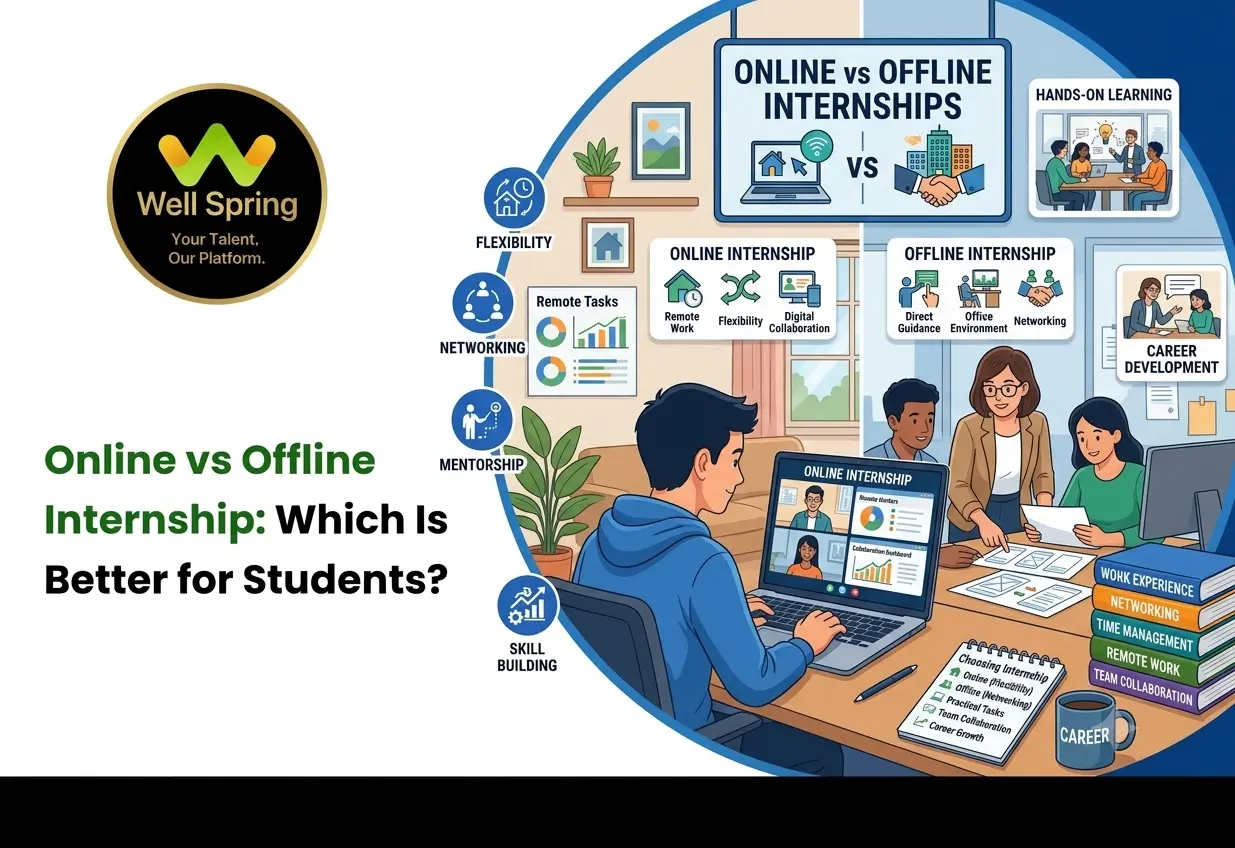

Choosing the right internship format can affect how students learn, communicate, work on projects, and prepare for professional environments. Today, students can gain experience through both online and offline internships.
An online internship for students allows learners to work remotely using digital communication and collaboration tools. An offline internship involves working from a physical workplace where students can interact directly with mentors, team members, and other professionals.
Both formats can provide useful learning experiences, but they differ in flexibility, communication, workplace exposure, networking, and day-to-day interaction.
What Is an Online Internship?
An online internship is an internship that students complete remotely rather than attending a physical workplace.
Students generally communicate with mentors and team members through video meetings, messaging platforms, email, project management systems, and other online tools. Tasks, assignments, meetings, and project updates can usually be handled through digital platforms.
Online internships can be useful for students who need greater flexibility or who want to gain professional experience while managing studies and other responsibilities.
Common Features of Online Internships
An online internship may include:
- Remote project work
- Online meetings with mentors
- Digital communication with team members
- Virtual project reviews
- Online task management
- Remote collaboration
- Digital documentation and reporting
- Flexible working arrangements depending on the organisation
The exact structure can vary depending on the company, role, project, and internship schedule.
What Is an Offline Internship?
An offline internship requires students to participate from a physical workplace or designated location.
Students work directly with mentors, employees, and other interns. They may attend scheduled working hours, participate in meetings, observe workplace processes, and complete practical tasks within the organisation.
An offline internship can give students more direct exposure to how teams communicate and operate in a professional environment.
Common Features of Offline Internships
An offline internship may include:
- Working from a physical office or workplace
- Direct interaction with mentors
- Face-to-face discussions
- In-person project collaboration
- Workplace observation
- Team meetings
- Direct feedback
- Exposure to professional routines
The experience can differ depending on the organisation and the nature of the internship.
Online vs Offline Internship: What Is the Difference?
The main difference between online and offline internships is the way students participate in the work environment.
| Factor | Online Internship | Offline Internship |
|---|---|---|
| Work location | Remote | Physical workplace |
| Communication | Mainly digital | Mainly face-to-face and digital |
| Flexibility | Often higher | Usually follows a fixed schedule |
| Mentorship | Virtual | Direct and in-person |
| Team interaction | Online collaboration | Direct team interaction |
| Workplace exposure | Limited to digital interaction | Direct workplace exposure |
| Travel | Usually not required | May require commuting |
| Networking | Mainly online | Direct professional interaction |
| Work environment | Remote setup | Physical workplace |
Neither format provides the same experience as the other. The better choice depends on what a student wants to learn and how they prefer to work.
Online Internship for Students: Benefits and Limitations
Online internships have become more accessible because many tasks can now be completed using digital tools.
Benefits of Online Internships
1. Greater flexibility
Students may have more flexibility when completing an online internship, depending on the organisation's working schedule.
This can make it easier to manage academic responsibilities alongside internship work.
2. No regular commute
Students do not usually need to travel to a workplace every day. This can save commuting time and make remote participation easier.
3. Experience with remote collaboration
Online internships can introduce students to digital communication, virtual meetings, file sharing, project management platforms, and other remote-working practices.
4. Comfortable learning environment
Some students may find it easier to concentrate and manage their work from a familiar environment.
5. Digital communication skills
Working remotely requires students to communicate clearly through email, messaging platforms, video meetings, and other digital channels.
Limitations of Online Internships
Online internships can also present challenges.
Students may have fewer opportunities for spontaneous conversations with colleagues. It can also be harder to ask quick questions or observe how a team works when most communication happens through digital platforms.
Remote students also need good time management, communication, and self-discipline to complete their responsibilities consistently.
Offline Internship for Students: Benefits and Limitations
Offline internships provide students with direct exposure to a physical professional environment.
Benefits of Offline Internships
1. Direct interaction with mentors
Students can communicate with mentors face-to-face and ask questions during their work.
2. Workplace exposure
Being present in a professional environment can help students understand workplace routines, team structures, communication styles, and professional expectations.
3. Easier team interaction
Students can participate directly in discussions and collaborative activities with other team members.
4. Immediate feedback
Face-to-face interaction can sometimes make it easier for mentors to explain tasks, review work, and provide feedback.
5. Networking opportunities
Working around professionals can create opportunities for students to build professional relationships through regular interaction.
Limitations of Offline Internships
Offline internships usually require students to travel to the workplace and follow the organisation's schedule.
Students may also have less flexibility compared with some remote internship arrangements.
For students who live far from the workplace, commuting time and travel expenses can also become practical considerations.
Online Internship vs Offline Internship: Which Format Fits Different Students?
The right format can depend on a student's situation, learning preferences, and goals.
Online internships may suit students who:
- Prefer remote learning and working
- Need greater flexibility
- Have academic responsibilities to manage
- Are comfortable using digital communication tools
- Want experience with remote collaboration
- Prefer not to commute regularly
Offline internships may suit students who:
- Prefer face-to-face interaction
- Want direct workplace exposure
- Learn better through in-person discussions
- Want regular interaction with mentors
- Want to experience a physical work environment
- Prefer working as part of an in-person team
These are general considerations rather than fixed rules. A student's experience can vary significantly depending on the internship role and organisation.
Learning and Mentorship: Online vs Offline
Mentorship is an important part of an internship because students often need guidance while working on unfamiliar tasks.
In an online internship, mentoring usually takes place through video calls, chat applications, email, shared documents, and project management platforms.
In an offline internship, students can communicate directly with mentors and may be able to receive guidance while working alongside them.
The quality of mentorship depends more on the organisation, mentor, project structure, and level of student involvement than simply on whether the internship is online or offline.
Project Experience in Online and Offline Internships
Project work can be part of both internship formats.
Online interns may collaborate through repositories, cloud platforms, communication tools, and project management systems.
Offline interns may work directly with team members while participating in project discussions and reviews at the workplace.
For students, the important consideration is not only where the internship takes place but also whether they receive meaningful responsibilities, practical tasks, feedback, and opportunities to apply what they have learned.
Networking Opportunities
Networking can happen through both online and offline internships, but the experience is different.
Online interns may build connections through virtual meetings, professional platforms, online communities, and remote collaboration.
Offline interns can develop relationships through direct conversations with mentors, colleagues, and other professionals.
Students interested in building professional connections should actively communicate, ask relevant questions, participate in discussions, and maintain professional relationships regardless of the internship format.
Skills Students Can Develop
Both online and offline internships can help students develop technical and professional skills.
Depending on the internship role, students may develop:
- Technical skills
- Communication skills
- Teamwork
- Problem-solving
- Time management
- Project coordination
- Professional communication
- Documentation skills
- Presentation skills
- Workplace discipline
The skills gained will depend on the actual responsibilities assigned during the internship.
How to Choose Between an Online and Offline Internship
Students can consider several factors before choosing an internship format.
1. Consider your learning style
Think about whether you learn more effectively through independent digital work or direct interaction with mentors and colleagues.
2. Check the internship structure
Look at the working hours, project responsibilities, mentoring process, meetings, and expected deliverables.
3. Consider your schedule
If you are studying at the same time, check whether the internship schedule can fit around your academic commitments.
4. Evaluate the project experience
Focus on what you will actually work on rather than choosing an internship only because it is online or offline.
5. Check the mentoring system
Find out how frequently mentors communicate with interns and how feedback is provided.
6. Consider location and travel
For an offline internship, consider commuting time and accessibility. For an online internship, consider whether you have a suitable environment and reliable internet connection.
7. Look at the overall learning opportunity
The internship should give you opportunities to practise skills, complete meaningful tasks, receive feedback, and understand how professional work is carried out.
Questions to Ask Before Starting an Internship
Before accepting an internship, students can ask:
- What will my responsibilities be?
- Will I work on a real project?
- Who will guide me during the internship?
- How will my work be reviewed?
- What are the working hours?
- How will communication take place?
- What tools will I use?
- Will I receive feedback?
- What skills will I be able to practise?
- How will my internship progress be evaluated?
Getting clear answers can help students understand what they can realistically expect from the experience.
Online or Offline Internship: Focus on the Learning Experience
The format of an internship is only one part of the overall experience.
A useful internship should provide opportunities to apply knowledge, work on relevant tasks, communicate with others, receive guidance, and understand professional expectations.
An online internship can provide experience with remote collaboration and digital communication, while an offline internship can provide direct workplace interaction and in-person exposure.
Students should therefore look beyond the format and evaluate the project, mentorship, responsibilities, schedule, and learning opportunities.
Final Thoughts
Online and offline internships offer different ways for students to gain practical experience.
An online internship for students can provide flexibility and experience with remote collaboration, while an offline internship can provide direct interaction and exposure to a physical workplace.
There is no single format that works for every student. The right choice depends on individual circumstances, learning preferences, schedule, project requirements, mentorship, and the type of professional experience a student wants to develop.
Instead of choosing an internship only because it is online or offline, students should look at what they will actually learn, practise, and contribute during the internship.