Blog Details
Home Blog Details

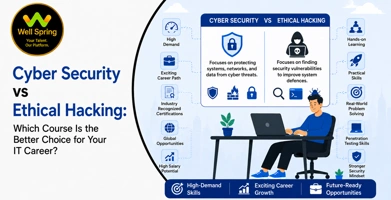
Choosing between Cyber Security vs Ethical Hacking is one of the biggest decisions for students and IT professionals planning a career in information technology. Although these two fields are closely related, they have different responsibilities, career paths, skill requirements, and job roles. Cyber Security focuses on protecting an organization's digital assets, networks, systems, and sensitive information from cyber threats, whereas Ethical Hacking focuses on identifying security vulnerabilities by legally testing systems before malicious hackers can exploit them.
This comprehensive guide compares Cyber Security vs Ethical Hacking, including career opportunities, salaries, required skills, certifications, industry demand, latest 2026 trends, and future scope. Whether you're planning to join a Cyber Security Course in Trichy or an Ethical Hacking Course in Trichy, this guide will help you make the right career decision.
If you're interested in defending organizations, securing networks, monitoring cyber threats, and building strong security systems, Cyber Security is the ideal career path. If you enjoy penetration testing, vulnerability assessments, solving complex technical challenges, and thinking like an attacker to improve security, Ethical Hacking is the better choice.
Both careers offer outstanding opportunities in 2026. However, Cyber Security provides broader career options across multiple security domains, while Ethical Hacking is a specialized field focused on offensive security and penetration testing.
As businesses rapidly adopt cloud computing, artificial intelligence, digital banking, online shopping, and connected devices, cyber threats have become more sophisticated than ever before. Every day, organizations face ransomware attacks, phishing scams, data breaches, malware infections, and identity theft attempts.
According to IBM's Cost of a Data Breach Report 2024, the global average cost of a data breach reached USD 4.88 million, the highest level ever recorded. Meanwhile, Cybersecurity Ventures predicts that global cybercrime damages could exceed USD 10.5 trillion annually, highlighting why organizations continue investing heavily in cybersecurity professionals.
The World Economic Forum also identifies cybersecurity as one of the most critical global business risks, with companies across every industry increasing investments in security technologies, compliance, and cyber resilience.
This growing demand has made Cyber Security vs Ethical Hacking one of the most searched career comparisons among students, graduates, and IT professionals.
Many aspiring professionals ask:
The answer depends on your interests, technical strengths, and preferred work environment.
If you enjoy protecting organizations, monitoring threats, implementing security policies, and preventing cyber attacks, Cyber Security may be the ideal career.
If you enjoy discovering vulnerabilities, performing penetration testing, exploiting weaknesses ethically, and solving security challenges, Ethical Hacking could be the perfect fit.
At Well Spring Talent Solutions, students receive practical, industry-oriented training through live security labs, simulated cyber attack scenarios, real-world projects, certification guidance, expert mentorship, interview preparation, and placement assistance. Whether enrolling in a Cyber Security Course in Trichy or an Ethical Hacking Course in Trichy, learners develop practical skills that match today's cybersecurity industry requirements.
Digital transformation has dramatically increased the attack surface for cybercriminals. Organizations now manage sensitive customer information, financial transactions, cloud applications, remote work environments, and IoT devices, making cybersecurity more important than ever.
Industries actively hiring cybersecurity professionals include:
Cybersecurity professionals help organizations:
As cyber attacks continue becoming more advanced, organizations are increasing investments in skilled cybersecurity professionals worldwide.
One of the biggest misconceptions among beginners is believing that reading cybersecurity concepts alone is enough to secure a job.
In reality, employers prefer candidates with practical experience.
Recruiters commonly evaluate:
Candidates who have worked on Capture The Flag (CTF) challenges, penetration testing labs, vulnerability assessments, and security projects often have a significant advantage over those who possess only theoretical knowledge.
This is why practical training environments and live security labs are essential for launching a successful cybersecurity career.
Cyber Security is the practice of protecting computers, networks, cloud environments, applications, and digital information from cyber threats, unauthorized access, malware, ransomware, phishing attacks, and other security risks.
Cyber Security combines technology, policies, processes, and people to ensure the confidentiality, integrity, and availability of digital assets.
Major cybersecurity domains include:
Cyber Security professionals continuously monitor systems, identify threats, investigate incidents, and strengthen organizational defenses.
A professional Cyber Security Course in Trichy equips students with practical knowledge required to protect modern IT infrastructure.
Students typically learn:
Students also work in simulated cyber labs that replicate real-world attack and defense scenarios.
Cyber Security professionals are required across almost every industry because every organization depends on secure digital systems.
Common employers include:
The increasing number of cyber threats makes Cyber Security one of the most future-proof IT careers available today.
Organizations today face an evolving threat landscape where attacks occur every minute.
Cyber Security professionals help businesses:
Because cybersecurity directly impacts business operations, customer confidence, and regulatory compliance, skilled professionals remain among the most valuable IT specialists.
According to the ISC² Cybersecurity Workforce Study, the global cybersecurity workforce gap remains in the millions, demonstrating the urgent need for qualified professionals across industries.
Ethical Hacking is the process of legally testing computer systems, applications, and networks to identify security vulnerabilities before cybercriminals can exploit them. Ethical Hackers, also known as White Hat Hackers, use the same tools and techniques as malicious hackers—but with the organization's permission—to strengthen security rather than cause harm.
Their primary objective is to simulate real-world cyberattacks, discover weaknesses, and recommend security improvements that protect sensitive information and business operations.
Ethical Hacking covers several specialized areas, including:
As cyberattacks become increasingly sophisticated, Ethical Hackers have become essential members of modern cybersecurity teams.
A professional Ethical Hacking Course in Trichy provides hands-on training in offensive security techniques and ethical penetration testing.
Students typically learn:
Students also participate in live hacking labs and Capture The Flag (CTF) challenges that simulate real-world attack scenarios.
Ethical Hackers are employed by organizations that proactively assess and improve their cybersecurity posture.
Common employers include:
Many Ethical Hackers also work as freelance penetration testers or independent security consultants.
Organizations no longer wait for cyberattacks to occur before improving security. Instead, they actively hire Ethical Hackers to identify vulnerabilities before attackers can exploit them.
Ethical Hackers help organizations:
As cyber threats continue evolving, Ethical Hackers remain an essential part of modern security teams.
Although both fields aim to protect organizations from cyber threats, they differ significantly in their responsibilities and day-to-day work.
|
Feature |
Cyber Security |
Ethical Hacking |
|
Primary Goal |
Protect systems and data |
Identify security vulnerabilities |
|
Security Approach |
Defensive |
Offensive |
|
Focus Area |
Prevention, monitoring & response |
Penetration testing & vulnerability discovery |
|
Daily Responsibilities |
Monitoring, securing, incident response |
Testing, exploiting and reporting vulnerabilities |
|
Career Scope |
Broad |
Specialized |
|
Work Environment |
SOC, IT Security Teams |
Penetration Testing Teams, Security Consulting |
|
Objective |
Prevent attacks |
Simulate attacks legally |
Simply put:
Both roles work together to improve organizational security.
Students often compare Cyber Security vs Ethical Hacking Career because both offer exciting opportunities in the IT industry.
Choose Cyber Security if you enjoy:
Choose Ethical Hacking if you enjoy:
Many professionals begin in Cyber Security and later specialize in Ethical Hacking, while others move in the opposite direction.
One of the most common questions students ask is Which is Better Cyber Security or Ethical Hacking?
There is no universal answer because both careers complement each other.
Choose Cyber Security if you prefer:
Choose Ethical Hacking if you prefer:
Professionals with expertise in both areas are among the most valuable cybersecurity specialists in today's job market.
Salary depends on technical expertise, certifications, experience, and specialization.
Generally:
|
Job Role |
Salary Growth Potential |
|
Cyber Security Analyst |
High |
|
Security Engineer |
Very High |
|
Security Consultant |
Very High |
|
Ethical Hacker |
Very High |
|
Penetration Tester |
Excellent |
|
Security Architect |
Excellent |
|
SOC Analyst |
High |
|
Incident Response Specialist |
Excellent |
According to various industry salary reports, professionals with advanced certifications, practical experience, and specialized security skills generally command significantly higher salaries than entry-level candidates.
Instead of focusing solely on job titles, employers evaluate candidates based on:
Professional Cyber Security experts typically develop expertise in:
Professional Ethical Hackers typically master:
1. Choosing Only Based on Salary
Many students assume one field pays significantly more than the other.
In reality, salary depends more on practical skills, certifications, and experience than the specific specialization.
2. Ignoring Networking Fundamentals
Networking is the foundation of both Cyber Security and Ethical Hacking.
Students should understand:
3. Learning Only Theory
Cybersecurity is a practical field.
Employers expect candidates to demonstrate hands-on experience through labs and security projects.
4. Avoiding Linux
Linux skills are essential because many enterprise servers, cloud platforms, and security tools operate on Linux.
5. Not Practicing in Legal Lab Environments
Students should always practice ethical hacking only in authorized environments such as virtual labs, Capture The Flag (CTF) platforms, and training environments.
Unauthorized hacking is illegal and unethical.
The cybersecurity landscape continues evolving rapidly.
Key trends include:
Professionals who continuously update their technical knowledge will remain highly competitive.
Students looking for an industry-oriented Cyber Security Course in Trichy or Ethical Hacking Course in Trichy receive practical training designed to match today's cybersecurity industry requirements.
Training includes:
Students graduate with practical experience that prepares them for real-world cybersecurity roles.
1. Build Strong Networking Knowledge
Networking concepts form the foundation of every cybersecurity specialization.
2. Practice Regularly
Work on legal cybersecurity labs, virtual machines, and Capture The Flag (CTF) platforms to develop practical skills.
3. Learn Programming Basics
Python, Bash, and PowerShell help automate security tasks and improve efficiency.
4. Earn Industry Certifications
Certifications such as CompTIA Security+, CEH, CySA+, and CISSP enhance credibility and career opportunities.
5. Stay Updated
Cyber threats evolve every day. Follow cybersecurity news, vulnerability databases, security blogs, and industry communities to remain current.
Which is better: Cyber Security or Ethical Hacking?
Both offer excellent career opportunities. Cyber Security focuses on defending systems, while Ethical Hacking focuses on identifying vulnerabilities through authorized testing.
Can an Ethical Hacker become a Cyber Security professional?
Yes. Many Ethical Hackers transition into broader Cyber Security roles because they already possess strong technical security knowledge.
Which career has better future scope?
Both careers have exceptional future demand. However, Cyber Security offers broader specialization opportunities, while Ethical Hacking provides expertise in offensive security.
Is Ethical Hacking legal?
Yes, when performed with proper authorization from the organization. Ethical Hackers operate within legal and professional guidelines to improve security.
Should beginners choose Cyber Security or Ethical Hacking?
Beginners generally benefit from learning Cyber Security fundamentals first before specializing in Ethical Hacking, as a strong understanding of defensive security provides a solid foundation.
The demand for cybersecurity professionals continues to grow across Trichy, Madurai, Thanjavur, Karur, Dindigul, Pudukkottai, Ariyalur, Perambalur, and other regions of Tamil Nadu. Organizations across banking, healthcare, IT services, manufacturing, government, and cloud computing are actively recruiting professionals with cybersecurity expertise.
At Well Spring Talent Solutions, students gain industry-oriented practical training through a Cyber Security Course in Trichy and an Ethical Hacking Course in Trichy, featuring live security labs, penetration testing practice, internships, expert mentorship, certification guidance, and placement assistance.
What is the difference between Cyber Security and Ethical Hacking?
Cyber Security focuses on protecting systems, networks, and data from cyber threats, while Ethical Hacking focuses on identifying vulnerabilities by legally testing systems before attackers can exploit them.
Which career has better job opportunities?
Both careers offer excellent opportunities. Cyber Security provides broader career paths across multiple domains, while Ethical Hacking is highly valued for penetration testing and offensive security roles.
Which course should beginners choose?
Beginners are generally advised to start with Cyber Security fundamentals before specializing in Ethical Hacking, as this builds a strong understanding of defensive security concepts.
Does Ethical Hacking require programming?
Basic programming knowledge, especially Python and scripting languages, is highly beneficial but not mandatory at the beginner level.
Is Cyber Security worth learning in 2026?
Yes. With cyber threats increasing every year and organizations investing heavily in digital security, Cyber Security remains one of the fastest-growing and most future-proof IT careers.
Choosing between Cyber Security vs Ethical Hacking depends on your interests and long-term career aspirations. If you enjoy protecting organizations, securing infrastructure, and managing cyber risks, Cyber Security offers a broad and rewarding career path. If you're passionate about penetration testing, uncovering vulnerabilities, and strengthening defenses through ethical attack simulations, Ethical Hacking provides an exciting specialization.
At Well Spring Talent Solutions, students receive practical, industry-oriented training through live labs, security projects, internships, expert mentorship, interview preparation, certification guidance, and placement assistance. Whether you choose a Cyber Security Course in Trichy or an Ethical Hacking Course in Trichy, you'll develop the hands-on skills needed to succeed in today's rapidly evolving cybersecurity industry.
Begin your cybersecurity journey today and become part of one of the world's fastest-growing and most essential technology domains.
21 Oct 2026
21 Oct 2026
20 Oct 2026

20 Oct 2026
19 Oct 2026
Both fields offer strong career opportunities. Cyber Security has broader roles such as Security Analyst, SOC Analyst, Security Engineer, and Security Consultant, while Ethical Hacking specializes in Penetration Testing, Vulnerability Assessment, and Red Team operations.
Yes. In fact, learning both is highly beneficial because Ethical Hacking is considered a specialized branch of Cyber Security. Professionals with expertise in both areas are highly sought after by employers.
Like many IT roles, Ethical Hacking can involve challenging projects and tight deadlines. However, it is also intellectually rewarding for professionals who enjoy solving complex security problems and continuous learning.
Yes. Certifications such as CompTIA Security+, Certified Ethical Hacker (CEH), CompTIA CySA+, CISSP, and cloud security certifications enhance credibility and improve job prospects when combined with practical experience.
Begin by learning networking, operating systems, and security fundamentals. Gain hands-on experience through cybersecurity labs and Capture The Flag (CTF) platforms, build a strong project portfolio, earn industry-recognized certifications, and enroll in an industry-oriented training program that provides live projects, internships, expert mentorship, and placement assistance.
We provide IT training, internships, and online learning for students in Trichy and across India.
We also welcome enquiries from students in these neighbourhoods, towns, and surrounding locations.
Can't attend classes in person? Explore online IT training opportunities with Well Spring Talent Solutions, designed to help learners develop practical technology skills from different locations across India.
Get internship updates, IT training news, placement opportunities, and career tips directly to your inbox.
Join our WhatsApp community for internship updates, IT courses, placement support, and latest job opportunities.
Join Now