Blog Details
Home Blog Details

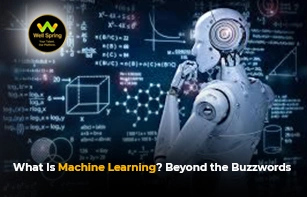
What is machine learning? Machine learning is a subset of artificial intelligence where algorithms identify patterns in historical data to make decisions or predictions without explicit programming.
Systems iteratively improve their accuracy by adjusting mathematical weights based on new inputs.
This powers everything from enterprise recommendation engines to autonomous vehicles.
Understanding artificial intelligence vs machine learning is the critical first step for technical leaders.
Artificial intelligence represents the broad concept of machines simulating human cognitive functions to solve complex problems.
Machine learning provides the actual mathematical engine, enabling systems to parse data and self-correct over time.
Without machine learning, modern artificial intelligence would simply not exist.
You cannot deploy reliable models in production without understanding the math powering them.
The mathematical foundations of machine learning for data science rely heavily on linear algebra, multivariate calculus, and probability theory.
Algorithms optimize performance by calculating gradients and iteratively minimizing a predefined loss function.
Mastering these concepts requires diving deep into foundational concepts in data optimization.
This foundational knowledge empowers developers to troubleshoot why a model fails rather than blindly swapping out Python libraries.
The debate between supervised vs unsupervised learning centers entirely on data structure and labeling.
The primary difference between supervised and unsupervised learning algorithms with examples is straightforward:
supervised models learn from labeled datasets (like tagging emails specifically as "spam"), while unsupervised models find hidden structures in unstructured data (like grouping similar customer purchasing behaviors without predefined categories).
Supervised Learning remains the most dominant and commercially viable approach in enterprise environments today.
To build effective predictive systems, engineers rely on a core machine learning algorithms list:
When traditional algorithms hit performance ceilings on unstructured data, Deep Learning takes over.
Advanced deep learning neural networks stack interconnected layers of artificial neurons to process high-dimensional data like images, audio, and video.
Each subsequent layer extracts increasingly abstract features from the raw input data.
Understanding how machine learning models are trained and optimized for production requires a massive shift from local script development to distributed computing.
Engineering teams must establish robust enterprise strategies for deploying and monitoring machine learning models to prevent model drift in live environments.
These automated frameworks continuously retrain Neural Networks on fresh production data to maintain peak accuracy.
Natural Language Processing (NLP) represents the most explosive growth sector in modern data science.
Early iterations relied heavily on basic Text Classification, Sentiment Analysis, and Semantic Analysis using strict Part-of-Speech (POS) Tagging.
Today, Large Language Models (LLMs) like GPT have completely replaced these legacy rule-based architectures.
The massive breakthrough arrived via the Transformer Architecture and its core Attention Mechanism, popularized by models like BERT.
Rather than reading text sequentially, these models process entire documents simultaneously to grasp deep context.
They use Tokenization to fracture text into manageable pieces, mapping them into dense Word Embeddings to capture nuanced meaning.
This generates Contextualized Word Representations, allowing the model to understand the word "bank" differently in a financial versus a geographical context.
These dense semantic networks now power highly accurate Neural Machine Translation (NMT) and automated Named Entity Recognition (NER) systems globally.
The true commercial return on investment comes from applied predictive modeling techniques.
Using Predictive Modeling, organizations parse massive historical datasets to forecast future behaviors accurately.
This proactive approach completely transforms how businesses handle customer churn, risk assessment, and supply chain disruptions.
The most impactful real-world applications of machine learning in predictive analytics directly influence revenue generation.
Modern businesses combine data warehousing with advanced statistical algorithms to automate dynamic pricing models and real-time inventory forecasting.
You can review the core principles of building robust predictive analytics pipelines to see exactly how industry leaders implement these strategies.
This comprehensive guide to machine learning for software engineers highlights the immense technical complexity involved in deploying real AI.
However, technical brilliance alone rarely translates to lasting business success.
Engineers must possess the communication skills required to explain algorithmic trade-offs to non-technical stakeholders.
We have seen firsthand why soft skills matter more than ever in the post-pandemic job market when scaling advanced data teams.
At Well Spring Talent Solutions, we specialize in identifying technical professionals who understand both matrix multiplication and human-centric business logic.
Whether you need to hire elite engineering talent through our specialized job placements or want to upskill your current staff with our customized talent programs, we are here to help.
Contact Well Spring Talent Solutions today to build a resilient data team that delivers measurable business ROI.

03 Jun 2026
03 Jun 2026

03 Jun 2026

03 Jun 2026

03 Jun 2026
Machine learning is a branch of Artificial Intelligence where systems learn from data to make predictions or decisions without explicit programming.
Traditional programming follows fixed rules, while ML models learn patterns from data and improve over time.
The three main types are supervised learning, unsupervised learning, and reinforcement learning.
It’s used in recommendations, fraud detection, voice assistants, and platforms like YouTube and Netflix.
Basic programming knowledge (like Python) is helpful, but many beginner-friendly tools make learning easier.
Get internship updates, IT training news, placement opportunities, and career tips directly to your inbox.
Join our WhatsApp community for internship updates, IT courses, placement support, and latest job opportunities.
Join Now