Blog Details
Home Blog Details
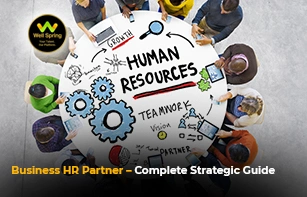
Summary: A Business HR Partner aligns human resources with business strategy to drive growth, performance, and culture. This guide explains roles, models, benefits, and implementation with updated insights. It helps organizations build scalable HR systems, improve employee engagement, and achieve measurable ROI through strategic HR collaboration.
A Business HR Partner acts as a strategic advisor who connects HR practices with business outcomes. Unlike traditional HR, this role focuses on growth, performance, and workforce alignment.
A HR business partner role and responsibilities include talent planning, workforce analytics, and leadership coaching. Moreover, companies use strategic HR business partner model to improve decision-making.
In simple terms, a business hr partner meaning in HR is someone who drives value through people strategies. Therefore, businesses treat HR as a core growth function rather than a support system.
Earlier, HR handled payroll, compliance, and hiring. However, modern businesses require agile HR strategies.
The shift towards a modern HR transformation strategy introduced HR as a business enabler. Consequently, organizations adopted the Ulrich HR model business partner concept to align HR with leadership goals.
Today, HR leaders focus on HR business partner vs HR manager differences, where partners influence strategy while managers execute operations. Hence, this evolution defines HR as a strategic pillar.
A business HR partner job description covers both strategic and operational contributions. They collaborate with leadership teams to improve workforce efficiency.
They drive HR business partner responsibilities in organizations like talent acquisition, employee engagement, and performance management. Additionally, they use data to support decisions.
Furthermore, HRBP roles in talent management and workforce planning ensure the right talent aligns with business goals. Therefore, organizations rely heavily on HR partners for sustainable growth.
A successful HR partner needs strong business and people skills. Communication and leadership are essential.
They must master skills needed for HR business partner success like analytics, stakeholder management, and strategic thinking. Additionally, HRBP competencies and leadership skills help them influence executives.
Moreover, digital literacy plays a key role. Understanding HR tech tools improves efficiency and insights. Hence, continuous learning remains critical in this evolving role.
The strategic HR business partner model focuses on aligning HR with business objectives. It integrates people strategies into company goals.
The Ulrich HR model business partner concept divides HR into shared services, centers of excellence, and HR business partners. This structure improves efficiency and scalability.
Therefore, companies adopting this model experience better decision-making and workforce alignment. As a result, HR becomes a proactive function rather than reactive.
Organizations gain multiple advantages by adopting HRBP strategies. They improve performance and employee satisfaction.
A strong benefits of HR business partner model in companies include better talent retention and leadership development. Moreover, it enhances strategic workforce planning and HR alignment.
Additionally, businesses achieve faster growth through data-driven decisions. Hence, HR becomes a revenue contributor rather than a cost center.
Traditional HR focuses on administrative tasks. In contrast, HR partners focus on strategy.
The HR business partner vs HR manager differences highlight this shift clearly. HR managers handle operations, while partners drive business outcomes.
Furthermore, HR partners work closely with leadership teams. Therefore, they influence decisions that impact growth and culture.
Companies must follow a structured approach to implement HRBP. First, they should align HR with business goals.
Next, define clear how to implement HR business partner model in companies strategies. Additionally, invest in training and tools.
Organizations like Wellspring Talent Solutions provide expert guidance in HR transformation. You can also explore internship programs to build HR capabilities or contact experts for consultation.
HR continues to evolve with technology and data-driven insights. Digital HR tools now play a major role.
The rise of future trends in HR business partnering 2026 includes AI-driven recruitment and predictive analytics. Additionally, companies focus on employee experience.
Moreover, remote work has reshaped HR strategies. Therefore, HR partners must adapt quickly to changing workforce dynamics.
Despite benefits, HR partners face several challenges. Balancing strategy and operations is complex.
Common challenges faced by HR business partners include resistance to change and lack of data. Additionally, aligning multiple stakeholders can be difficult.
However, proper training and leadership support can overcome these issues. Therefore, organizations must invest in HR capability building.
Many companies successfully implement HRBP models. They improve efficiency and employee engagement.
For example, global firms use HR business partner examples in organizations to align workforce strategies with business goals. Additionally, startups adopt agile HR models for scalability.
Hence, HRBP proves effective across industries. It supports growth, innovation, and organizational success.
A Business HR Partner transforms HR into a strategic powerhouse. It aligns people, processes, and performance with business goals.
Organizations that adopt HRBP models gain competitive advantage. Therefore, investing in HR transformation is no longer optional but essential.
03 Jun 2026
03 Jun 2026

03 Jun 2026

03 Jun 2026
03 Jun 2026
Strategic HR role aligning business goals.
Talent, strategy, workforce planning.
Strategy vs operations focus.
Improves growth and alignment.
Leadership, analytics, communication.
Get internship updates, IT training news, placement opportunities, and career tips directly to your inbox.
Join our WhatsApp community for internship updates, IT courses, placement support, and latest job opportunities.
Join Now