Blog Details
Home Blog Details

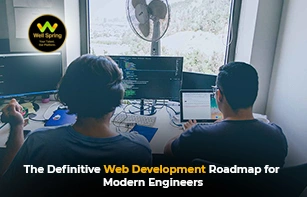
What is a web development roadmap?
A web development roadmap is a structured learning sequence guiding developers from foundational HTML and CSS through advanced frontend frameworks, backend infrastructure, and DevOps.
By following this Modern web technology learning trajectory, you progressively master the tools required to build scalable applications and secure engineering roles.
Transitioning from a coding novice to an employable engineer requires more than just memorizing syntax.
You need a clear, actionable web programming learning path that focuses on how modern technologies interact to solve real-world user problems.
This guide strips away the noise to show you exactly what to learn, why it matters, and how to combine these skills into a professional toolkit.
Laying the Groundwork: Core Web Fundamentals
Before writing complex application logic, you must understand how browsers interpret and display information.
Skip the bloated introductory courses and focus strictly on the foundational triad: HTML, CSS, and vanilla JavaScript.
Start by mastering semantic HTML to ensure your applications remain accessible to screen readers and search engines.
From there, implement Responsive Web Design using CSS Grid and Flexbox so your interfaces fluidly adapt to mobile, tablet, and desktop screens.
You must also understand the Hypertext Transfer Protocol (HTTP), as grasping how browsers request and receive data prevents major architectural headaches later.
The true turning point in this phase is understanding the Document Object Model (DOM).
Before adopting any external libraries, you must learn how vanilla JavaScript selects, modifies, and deletes DOM nodes natively.
The Mozilla Developer Network offers exceptional, comprehensive web development documentation to help you master these native browser APIs before moving forward.
Mastering the Visual Layer: The frontend development path
Once you understand browser fundamentals, you must navigate the complex frontend framework landscape.
A modern Front-end framework exists to manage state and synchronize it with the UI efficiently.
Your primary focus should be React, as its component-based architecture currently dominates the industry.
As you advance through this Frontend and backend developer progression guide, learn how React handles data flow through props and hooks.
You must also grasp Server-Side Rendering (SSR) through frameworks like Next.js, which dramatically improves initial page load times and search engine optimization.
Mastering this layer means understanding the severe trade-offs between client-side rendering and SSR.
You should only rely on external state management libraries like Redux when component drilling becomes unmanageable.
Building complex, dynamic interfaces forms the core of the modern web stack 2026, separating entry-level coders from capable frontend engineers.
Powering the Data: The backend developer roadmap
Applications require a robust server environment to process business logic, handle authentication, and store user data securely.
Your backend engineering stack dictates how efficiently your application scales under heavy user traffic.
If you already know JavaScript, adopting Node.js offers the fastest route into Back-end development.
Focus heavily on designing a clean, predictable RESTful API that allows your frontend to fetch and update data seamlessly.
This represents a critical milestone in your Web application architecture learning sequence, as poorly designed endpoints will cripple your application's performance.
Data persistence requires mastering at least one Database Management System (DBMS), such as PostgreSQL for relational data or MongoDB for flexible document storage. Simultaneously, you must prioritize Web Security by protecting your routes against SQL injection, cross-site scripting (XSS), and cross-site request forgery (CSRF).
Reviewing the top security risks and vulnerabilities published by OWASP ensures you build defensive coding habits early.
Architecting the System: A Complete full stack engineering guide
Connecting the client, server, and database transforms isolated skills into a unified full-stack development path.
Full-stack development requires you to deploy, monitor, and maintain the applications you build.
Modern engineering demands strict Version Control habits.
Relying on Git helps you track changes, branch features safely, and collaborate with other developers using modern version control workflows.
You must also understand modern web architecture patterns, like microservices and serverless functions, to choose the right hosting infrastructure for your project.
Finally, manual deployment is obsolete; you must automate your testing and hosting through Continuous Integration and Continuous Deployment (CI/CD).
Proper devops lifecycle integration ensures your code is automatically tested and pushed to production environments without human error.
Mastering these automated pipelines ultimately completes your Full-stack engineering career path.
Launching Your Career: The Professional web stack mastery blueprint
Technical proficiency alone rarely guarantees immediate employment.
Hiring managers want engineers who can communicate trade-offs, collaborate across departments, and adapt to existing legacy codebases.
At Well Spring Talent Solutions, we actively bridge the gap between technical mastery and professional placement.
Our specialized training programs provide structured mentorship to help you finalize your portfolio with production-ready projects.
We recognize that writing clean code is only half the battle; employers heavily weigh the internships during the interview process.
Once your technical foundation and communication skills align, you are ready to enter the market confidently.
Take the final step of your roadmap by exploring the open engineering positions we curate for top-tier candidates.
Stop getting stuck in tutorial purgatory and start building the real-world applications that modern tech companies actually need.

03 Jun 2026
03 Jun 2026

03 Jun 2026

03 Jun 2026

03 Jun 2026
Start with HTML, CSS, and JavaScript, then move to frameworks, backend development, databases, and deployment.
Begin with frontend basics, then expand into backend to become a full-stack developer.
Core tech includes HTML, CSS, JavaScript, React, Node.js, and databases like MongoDB.
It takes around 3–6 months for basics and 6–12 months to become job-ready with practice.
Yes, platforms like freeCodeCamp and Coursera offer free courses.
Get internship updates, IT training news, placement opportunities, and career tips directly to your inbox.
Join our WhatsApp community for internship updates, IT courses, placement support, and latest job opportunities.
Join Now