Blog Details
Home Blog Details
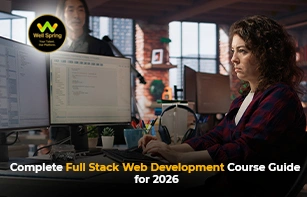
A full stack web development course trains you to build complete web applications from the ground up, managing both the user interface and server logic. The most effective programs cover Front-end Frameworks like React.js alongside Back-end Development environments like Node.js. By mastering the entire Software Development Life Cycle, you gain the ability to deploy scalable applications, design a robust RESTful API, and manage a Database Management System.
Single-discipline developers frequently hit advancement ceilings early in their careers. Understanding both client and server architectures makes you invaluable in the software engineering career path. You gain the necessary context to architect features end-to-end, debug complex cross-stack issues, and lead technical teams.
The modern tech industry relies heavily on versatile engineers who understand how AI coding assistants integrate into daily workflows. According to GitHub's 2025 Octoverse report, the platform now hosts over 180 million developers, with TypeScript and Python dominating as top languages due to massive AI integrations. Following a modern full stack developer roadmap ensures you utilize these AI tools to architect scalable systems rather than just writing basic boilerplate code.
For professionals transitioning from other industries, structured learning is critical to bypass tutorial fatigue. An online full stack developer bootcamp for career changers compresses years of traditional computer science theory into focused, project-based sprints. This targeted approach enables rapid portfolio building and significantly shortens the transition timeline into tech.
When evaluating a web application architecture course, the curriculum must reflect current production standards. Avoid programs that spend weeks teaching outdated libraries like jQuery. A high-quality full stack web development course syllabus for beginners 2026 will follow a strict, logical progression:
A specialized front-end and back-end development bootcamp must anchor its teaching in the unified JavaScript ecosystem. The State of JavaScript 2026 data confirms that React maintains a massive 91% usage share among frontend framework developers. Securing an advanced full stack web development certification with react and nodejs ensures you are learning the industry's most heavily adopted, enterprise-ready tools.
On the server side, Node.js utilizes an event-driven, non-blocking I/O model that makes it highly efficient for data-intensive applications. Your training should require you to build and consume a RESTful API, effectively passing JSON payloads back and forth between the client and server. Furthermore, understanding that nearly 29% of modern code is now AI-generated means your coursework must explicitly teach you how to audit and test these automated structures.
Data layer management is the dividing line that separates junior coders from capable mid-level software engineers. A comprehensive program will require you to design data schemas using both relational (SQL) and non-relational (NoSQL) database architecture.
SQL databases teach you strict ACID compliance, table joins, and structured data integrity. Conversely, NoSQL databases provide flexibility for unstructured data objects and rapid horizontal scaling. Knowing exactly when to apply each data model is a crucial architectural skill you must acquire.
Theoretical knowledge alone will not help you pass a rigorous technical whiteboard interview. You must select an affordable full stack development course with real world projects that forces you to deploy live, interactive applications. Hiring managers want to see complete GitHub repositories featuring authentication flows, payment integrations, and full database CRUD operations.
Your tech education should natively translate directly into tangible employment opportunities. The best full stack web development course with placement guarantee models actively bridge the gap between graduation and your first technical role. Partnering with a dedicated staffing authority like Well Spring Talent Solutions can drastically shorten your job hunt. By exploring their specialized programs, candidates receive targeted mentorship and curriculum alignment that meets exact employer specifications.
Context switching between entirely different languages such as Python for the backend and JavaScript for the frontend—severely slows down development velocity. The MERN stack (MongoDB, Express, React, Node) solves this bottleneck by standardizing JavaScript across the entire application ecosystem.
The 2025 Stack Overflow Developer Survey highlights that JavaScript remains the most used programming language for the 13th consecutive year, dominating 62% of the market. Earning a MERN stack certification definitively proves your competence in this unified, high-demand architecture. It demonstrates to prospective employers that you can seamlessly transition between UI state management and backend database querying without breaking your workflow.
The final transition from an ambitious student to an employed Full Stack Developer requires calculated strategy. Beyond writing clean code, you need hands-on experience in Agile project management, cloud infrastructure deployments, and rigorous software testing protocols.
If you are currently building out your professional portfolio, securing structured internships is a proven, reliable way to gain production-level experience and networking opportunities. Once your technical skills are sharp and your projects are live, browsing vetted jobs through Well Spring Talent Solutions ensures your resume bypasses the algorithm and reaches hiring managers who are actively looking for comprehensive engineering talent. A rigorous coding course provides the technical foundation, but applying that knowledge strategically is what ultimately dictates your career trajectory.

03 Jun 2026
03 Jun 2026
03 Jun 2026

03 Jun 2026
03 Jun 2026
It teaches both frontend (UI) and backend (server, database) development to build complete web applications.
Typically includes HTML, CSS, JavaScript, React, Node.js, Express, and databases like MongoDB.
Most courses take 4–8 months depending on depth and practice level.
Get internship updates, IT training news, placement opportunities, and career tips directly to your inbox.
Join our WhatsApp community for internship updates, IT courses, placement support, and latest job opportunities.
Join Now